
A passkey rollout is ready only when enrollment, recovery and application-session behavior preserve the intended assurance for each user cohort.
At a glance
Key findings
- Choose passkey custody and assurance properties before selecting enrollment and recovery workflows.
- NIST distinguishes adding another bound authenticator from account recovery, with recovery requirements tied to the account's assurance context.
- Session reauthentication bounds, authenticator invalidation and application offboarding remain separate controls.
- Accept each workforce cohort only after its supported enrollment, loss, replacement and notification paths have evidence.
Start with the access decision
A workforce passkey rollout needs a recovery design before broad enforcement. The organization must decide who may enroll a credential, where that credential can exist, how a user replaces it and what happens to application access after a loss or compromise. A successful passwordless sign-in answers only one of those questions. Treat enrollment, credential custody, recovery and session policy as separate acceptance gates, with evidence appropriate to each gate. [1][2][5]
Consider a hypothetical employee who signs in successfully with a passkey on a managed laptop and later loses that laptop while traveling. The rollout now depends on a different set of capabilities: another approved authenticator, an available recovery route, support staff authorized to use it and applications that apply the intended session controls. If the help desk must improvise a weaker route to restore access, the ordinary sign-in success did not establish the complete authentication design.
Begin with the access being protected. An ordinary workforce application, a privileged administrative interface and a service with a formal assurance requirement may need different authenticator policies. NIST's authenticator assurance levels describe authentication requirements, not product branding. A credential called a passkey is not automatically evidence that every requirement of a chosen AAL has been satisfied. Match the authenticator's properties and the verifier's behavior to the actual assurance decision. [1][4]
NIST SP 800-63B-4 was published as final guidance on July 31, 2025. Use that final version rather than treating the 2024 syncable-authenticator supplement as the current complete standard. The article uses NIST to make assurance and lifecycle boundaries explicit; it does not claim that every private enterprise is legally required to adopt every provision. An organization using the framework should preserve its normative distinctions and document how the selected implementation meets the applicable requirements. [1][3]
At AAL3, NIST requires a non-exportable private key and phishing resistance, and it excludes syncable authenticators because their private keys must be exportable for synchronization. That is a meaningful design boundary. It does not imply that a syncable passkey is unsuitable for every enterprise use case, nor that every hardware device automatically satisfies AAL3. The complete authenticator and verifier requirements still apply. [1][3][4]
Write the initial decision in operational terms: the applications and users in scope, the required authenticator properties, the permitted enrollment methods and the recovery evidence the organization can actually provide. This record should come before selecting pilot success metrics. Counting enrolled users without defining those conditions can reward a rollout that is easy to start but difficult to recover or govern.
Who controls the credential and its recovery
Passkeys can be device-bound or available through a synchronization provider. Those are custody and lifecycle choices, not merely different user-interface experiences. FIDO's enterprise guidance discusses deployment options across different organizational requirements. The review should identify who controls the device, the credential's availability on other devices and the account used to manage any synchronization service. A familiar consumer experience does not automatically establish the organization's desired control boundary. [5][6][7]
NIST describes a sync fabric as the mechanisms that store and distribute copies of authentication keys. Its guidance addresses protections around that fabric and the endpoints that receive keys. For an enterprise deployment, ask which sync account is used, how new devices become eligible and which recovery process restores access to that account. The passkey's availability after device loss may depend on those mechanisms even when the application itself never stores the private key. [3]
Separate form factor from exportability. A platform authenticator, a roaming security key and a syncable credential are not interchangeable categories. The organization needs to know the relevant properties of the actual implementation, not infer them from whether the user plugs in a device or touches a laptop sensor. FIDO's high-assurance guidance and NIST's authenticator requirements provide a basis for evaluating those properties. Record the evidence or policy used to accept an authenticator class. [4][7]
Credential ownership also affects offboarding. An organization may control the application account without controlling every device or synchronization account that has held its credential. Removing the account's accepted authenticator binding and closing application access are different actions from physically erasing every possible copy of a key. The rollout record should name the controls the organization possesses and the limits it cannot verify. NIST defines invalidation in terms of the binding between authenticator and subscriber account. [2]
For a device-bound design, consider replacement and alternate access before a device fails. A non-exportable credential may provide the desired assurance property while requiring another enrolled authenticator or an approved recovery process to restore access. That tradeoff should be explicit. Do not promise both non-exportability and effortless copying of the same credential without explaining which implementation actually supplies the recovery path. [1][2]
For a syncable design, examine shared dependencies. The same phone, email account or personal account may participate in both normal authentication and recovery of the synchronization service. A lost device can therefore expose a dependency that was invisible during ordinary enrollment. This is a proposed architecture review, not a claim that every sync provider uses the same recovery method. Use the provider's current contract for the selected implementation and retain the uncertainty where the organization lacks visibility.
Accessibility and working conditions belong in this decision. An approved authenticator should be usable by the intended workforce on its supported devices and applications, including the circumstances under which it will be replaced. FIDO's enterprise deployment guidance treats user populations and deployment requirements as design inputs. Test representative access methods and support needs rather than assuming one physical interaction or device model will fit every employee. [5][6]
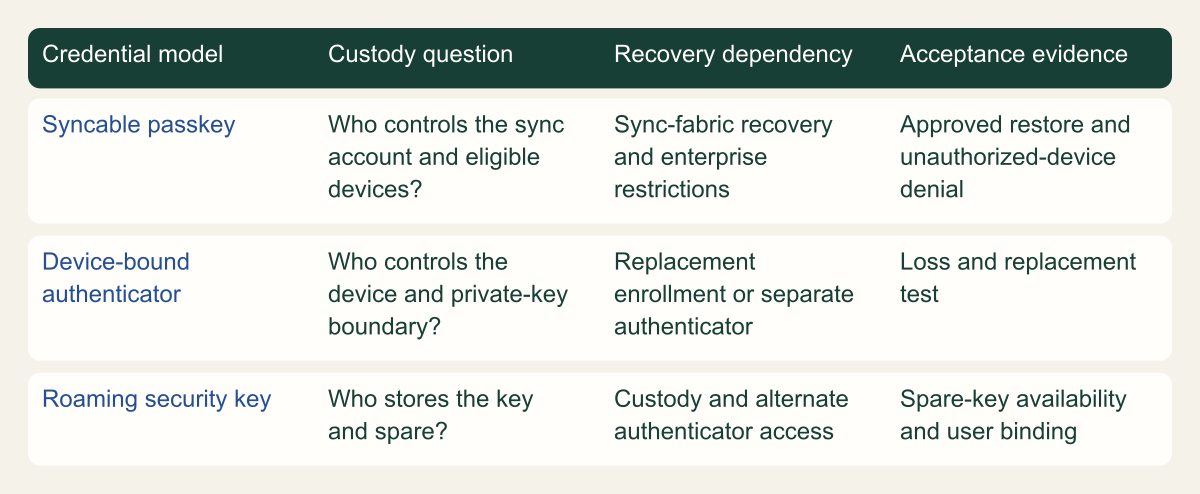
The ownership matrix distinguishes those questions without assigning invented security scores. It asks who controls the credential, which recovery dependency remains and what acceptance evidence is needed. The resulting policy may use different approved authenticator classes for different cohorts. That is more precise than choosing one product label for the entire organization and discovering later that its custody model does not match every access requirement.
Credential and recovery ownership by deployment pattern
Credential custody and recovery dependencies differ between syncable, device-bound and roaming authenticators.

Source. NIST syncable authenticators [3]; FIDO enterprise passkey introduction [5]; FIDO high-assurance enterprise authentication [7]. Sources checked August 28, 2026.
Method. Original conceptual model synthesized from the cited documentation. The relationships and proposed tests explain design choices; they are not measured results or a claim about a deployed environment.
Accessible table and figure data
| Credential model | Custody question | Recovery dependency | Acceptance evidence |
|---|---|---|---|
| Syncable passkey | Who controls the sync account and eligible devices? | Sync-fabric recovery and enterprise restrictions | Approved restore and unauthorized-device denial |
| Device-bound authenticator | Who controls the device and private-key boundary? | Replacement enrollment or separate authenticator | Loss and replacement test |
| Roaming security key | Who stores the key and spare? | Custody and alternate authenticator access | Spare-key availability and user binding |
| Credential model | Custody question | Recovery dependency | Acceptance evidence |
|---|---|---|---|
| Syncable passkey | Who controls the sync account and eligible devices? | Sync-fabric recovery and enterprise restrictions | Approved restore and unauthorized-device denial |
| Device-bound authenticator | Who controls the device and private-key boundary? | Replacement enrollment or separate authenticator | Loss and replacement test |
| Roaming security key | Who stores the key and spare? | Custody and alternate authenticator access | Spare-key availability and user binding |
Enrollment is the first security boundary
Authenticator binding establishes the association between a credential and a subscriber account. NIST requires maintaining a record of the authenticators bound to an account and their relevant characteristics. A deployment therefore needs more than a list of users who clicked an enrollment button. It needs an approved binding process and enough information to explain which account accepted which authenticator under which conditions. [2]
Distinguish initial enrollment from adding another authenticator to an existing account. NIST ties post-enrollment binding to an appropriate existing authentication level, with the applicable level determined by the account's available assurance and the assurance at which the new authenticator will be used. Do not reduce that rule to a generic assertion that any active browser session may enroll any credential. The authentication supporting the binding is part of the control. [2]
A workforce bootstrap mechanism should have explicit authority and scope. In Entra, Temporary Access Pass can support enrollment of authentication methods under the tenant's configured policies. Its lifetime and one-time-use behavior can be constrained. The organization must still decide who may issue it, what evidence is required before issuance and which enrollment steps the user is allowed to complete. A temporary pass is a product capability, not independent proof that an organization's recovery or assurance process is sound. [8]
Keep the bootstrap credential out of routine sign-in practice. A mechanism intended to establish or recover an approved authenticator should not become an undocumented permanent alternative whenever normal sign-in is inconvenient. Define its permitted use, delivery, expiry and audit record under the selected platform's contract. Test the intended transition from bootstrap access to the enrolled passkey, with an observer who can confirm that the final authenticator actually works.
Entra authentication-method policy and passkey enablement settings determine which methods and restrictions apply to the user population. Verify current platform and authenticator support before publishing a configuration procedure or enforcing a policy broadly. A pilot on one browser and device does not establish compatibility for every managed workstation or contractor environment. Keep the tested combination and policy scope with the enrollment evidence. [9]
Notifications are part of binding, not an optional afterthought. NIST requires an independent notification when a new authenticator is added. The purpose is to help the subscriber detect an unexpected binding. The design should identify the notification channel and the procedure for disputing an event, rather than relying on the same screen that completed enrollment. A successful credential registration and a delivered independent notification are separately observable outcomes. [2]
Test a mistaken binding as well as a correct one. The proposed acceptance exercise should establish how a user reports an unexpected authenticator and how the organization invalidates the affected binding through its authorized process. Do not perform this against a real employee's production account without permission. A controlled test identity can show whether the record, notification and correction path are understandable before thousands of users depend on them.
A lost device should trigger a designed path
Recovery begins by asking what the user still controls. If an approved bound authenticator remains available and can support the required action, adding a replacement can follow the ordinary additional-authenticator process. NIST distinguishes that situation from account recovery after the user loses the authenticators needed at the desired assurance level. The distinction matters because it changes the evidence required and prevents every device replacement from becoming a help-desk exception. [2]
NIST encourages maintaining at least two separate means of authentication to reduce the need for account recovery. The organization should evaluate whether those means are independently available in the failure scenarios it cares about. Two credentials on the same lost device may not provide the desired continuity. Likewise, a spare authenticator stored where the user cannot retrieve it may be useful for one scenario and ineffective for another. The local design should state the dependency, not just count credentials. [2]
When the user cannot satisfy the ordinary binding path, use the documented account-recovery procedure. NIST recognizes saved recovery codes, issued recovery codes, recovery contacts and repeated identity proofing, with requirements depending on the account's identity-proofing and authentication assurance context. It also allows application-specific methods based on documented risk analysis. That is not a general license to replace a missing authenticator with any convenient piece of personal information. [2]
For accounts whose maximum authentication level is AAL2, NIST specifies combinations such as recovery codes obtained through different methods, a recovery code plus an available bound single-factor authenticator, or repeated identity proofing where the account was identity-proofed. The provider's implemented recovery path should be compared with the relevant requirement rather than described simply as MFA recovery. Record which evidence is being accepted and which actor verifies it. [2]
AAL3 recovery needs careful interpretation too. NIST distinguishes accounts originally proofed at IAL1 or IAL2 from those proofed at IAL3; the latter have additional biometric comparison requirements in the specified recovery process. Do not infer one universal recovery procedure from the AAL3 label alone. The organization's initial identity-proofing process and the account's assurance context determine which provisions apply. After recovery, the replacement authenticator still needs to meet the authentication policy for its intended use. [2]
Saved codes and recovery contacts create their own custody requirements. A code must remain protected and available when normal authentication is lost. A recovery contact must be established and maintained through the supported process, not invented during an urgent call because someone claims to know the user. NIST's detailed requirements address how these methods are established and used. The article recommends mapping those requirements to the chosen provider rather than building a custom recovery service from a simplified checklist. [2]
The help desk needs a refusal and escalation path. If a caller cannot satisfy the approved evidence requirement, staff should know how to preserve the case, explain the next step and escalate without silently weakening the policy. A technically strong passkey rollout can still rely on an inconsistent support process if personnel are measured only on how quickly access is restored. Define the authorized decision and retained evidence, without inventing a universal waiting period for every organization.
A suspected compromise is different from an ordinary replacement. NIST calls for prompt suspension, invalidation or destruction of compromised authenticators under the applicable lifecycle process. The organization should identify how a user can report loss, theft or compromise and how the account owner responds. Do not delay handling a compromised binding merely because the replacement process is still being arranged, while also preserving the incident authority and evidence needed for the action. [2]
Recovery must generate a notification to the subscriber or designated recipient under NIST's requirements. Keep the notification path independent enough to help detect an unexpected recovery event, and provide a clear way to dispute it. If the only practical notification channel shares the failed or compromised dependency, record that limitation and review the provider's supported alternatives. A completed support ticket does not prove that the subscriber received the warning. [2]
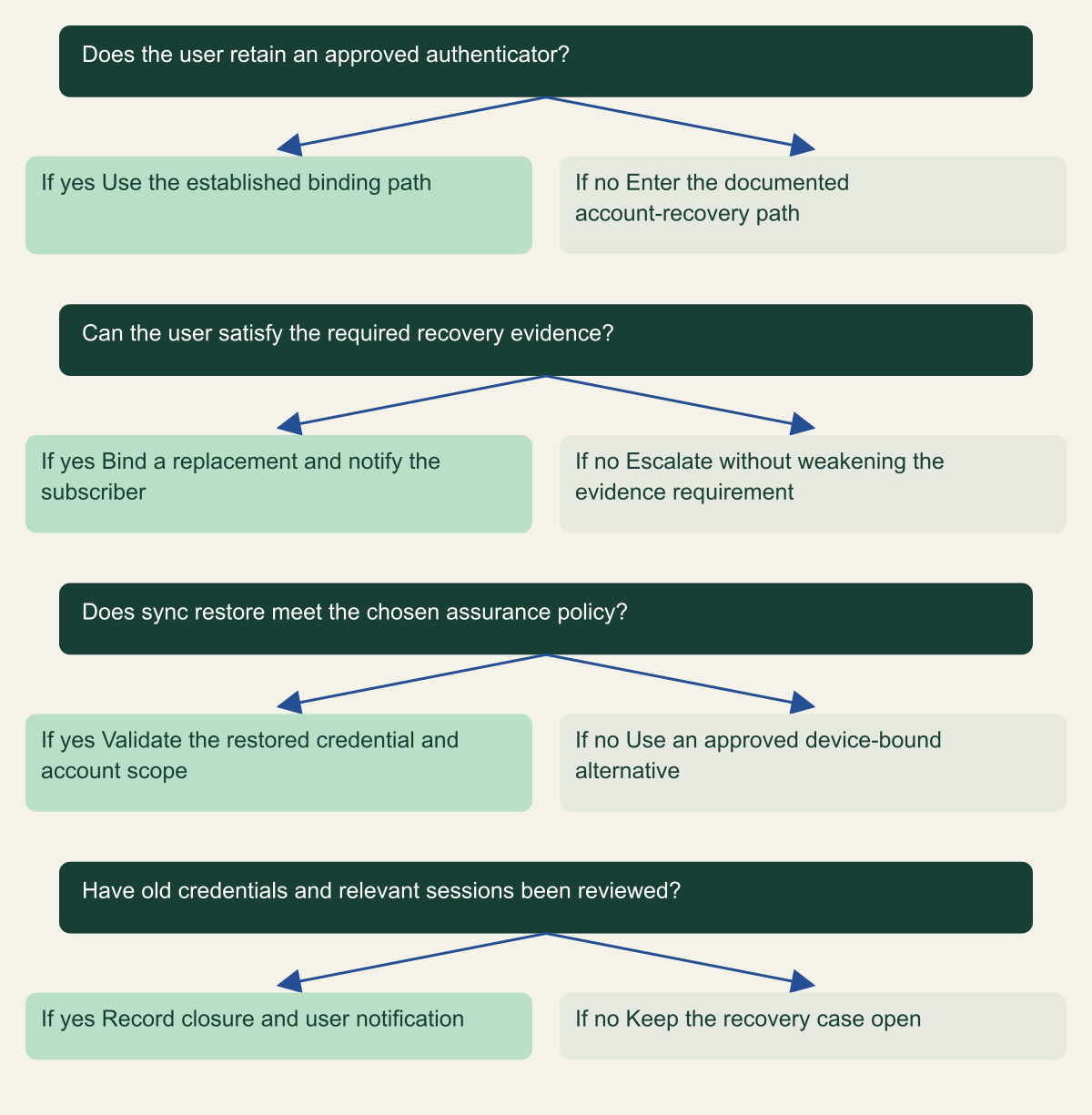
Finally, test the replacement authenticator and review the old binding and relevant sessions. Restoring a working sign-in is one outcome; handling the credential that was lost and the access established earlier are other outcomes. The recovery decision tree keeps those questions visible. It is an original conceptual framework using the cited requirements, not evidence that a particular organization's recovery method has been certified or exercised.
Replacement and account recovery take different paths
A replacement credential needs an approved evidence path, not an improvised weaker sign-in method.

Source. NIST authenticator event management [2]. Sources checked August 28, 2026.
Method. Original conceptual model synthesized from the cited documentation. The relationships and proposed tests explain design choices; they are not measured results or a claim about a deployed environment.
Accessible table and figure data
| Question | If yes | If no |
|---|---|---|
| Does the user retain an approved authenticator? | Use the established binding path | Enter the documented account-recovery path |
| Can the user satisfy the required recovery evidence? | Bind a replacement and notify the subscriber | Escalate without weakening the evidence requirement |
| Does sync restore meet the chosen assurance policy? | Validate the restored credential and account scope | Use an approved device-bound alternative |
| Have old credentials and relevant sessions been reviewed? | Record closure and user notification | Keep the recovery case open |
| Question | If yes | If no |
|---|---|---|
| Does the user retain an approved authenticator? | Use the established binding path | Enter the documented account-recovery path |
| Can the user satisfy the required recovery evidence? | Bind a replacement and notify the subscriber | Escalate without weakening the evidence requirement |
| Does sync restore meet the chosen assurance policy? | Validate the restored credential and account scope | Use an approved device-bound alternative |
| Have old credentials and relevant sessions been reviewed? | Record closure and user notification | Keep the recovery case open |
Passkeys do not set the application's session clock
A passkey is used for authentication, while the application or identity provider maintains the resulting session under its own supported controls. Replacing or invalidating an authenticator should not be described as automatically ending every application session created earlier. The rollout needs an explicit session policy and an application-side lifecycle procedure where required. This is why passkey acceptance and SCIM offboarding deserve separate evidence even when they affect the same user.
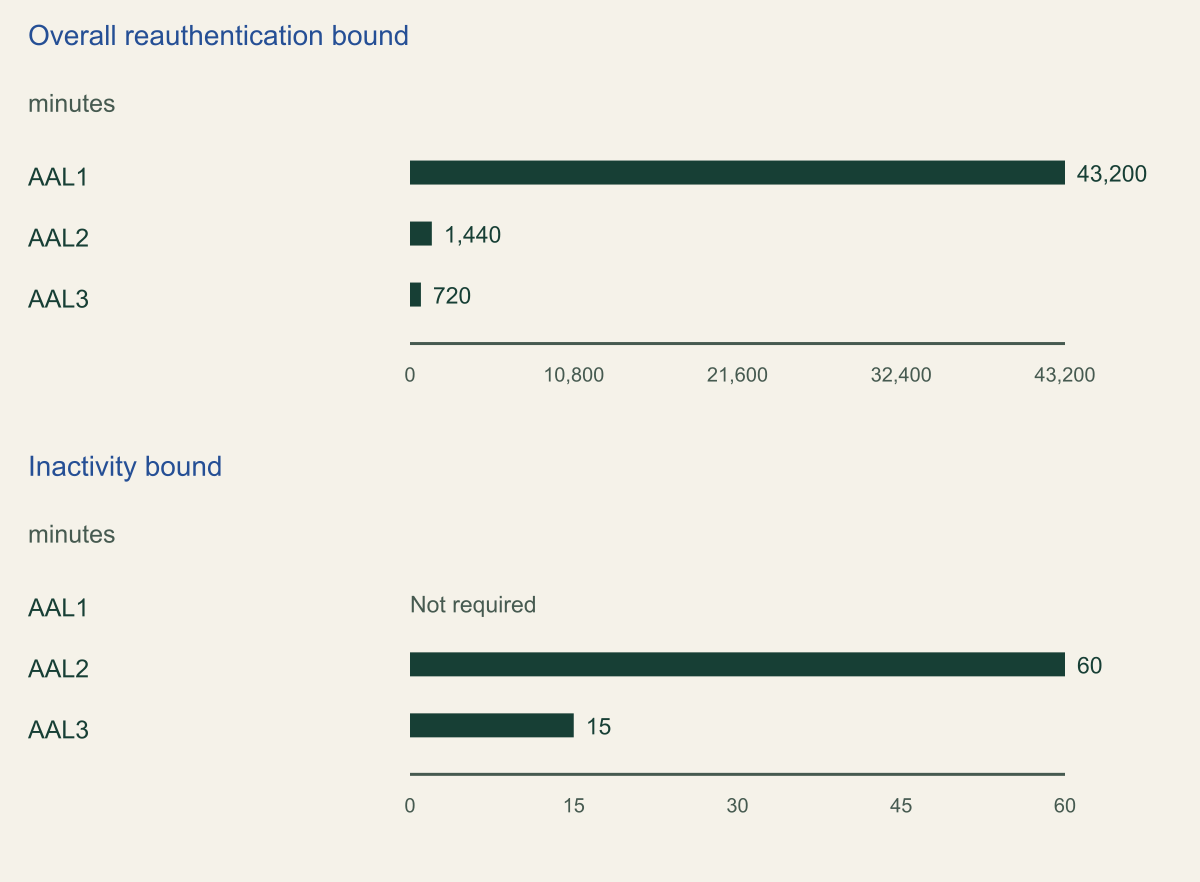
NIST SP 800-63B-4 distinguishes an overall reauthentication timeout from an inactivity timeout. The overall timeout limits the period following authentication or a previous reauthentication. The inactivity timeout addresses a session without subscriber activity. They answer different questions and should not be combined into one passkey expiry setting. The quantitative figure shows the published assurance-level bounds in a common unit while preserving their different normative force. [1]
At AAL1, NIST says the overall timeout should be no more than 30 days, while an inactivity timeout may be applied but is not required. At AAL2, the overall timeout should be no more than 24 hours and the inactivity timeout should be no more than one hour. These are the standard's recommendations within its assurance model, not measurements of how long an organization's users actually remain signed in. [1]
At AAL3, the overall timeout must be no more than 12 hours, while the inactivity timeout should be no more than 15 minutes. The distinction between SHALL and SHOULD is significant. Do not flatten all of the chart's values into mandatory limits or all into optional suggestions. The AAL1 inactivity entry is shown as Not required, not zero, because absence of a required timeout is not a measured zero-minute interval. [1]
The chart converts days and hours to minutes without estimating any values. Its source is the normative reauthentication sections of the final standard; the standard's summary table is non-normative. These data do not measure passkey adoption, phishing incidents or usability. They support a narrower implementation question: which session timeout and reauthentication behavior does the selected assurance policy require the verifier to implement?
Test application behavior under the actual policy. Observe how a fresh sign-in, an idle session, an overall timeout and a recovered account interact with the supported identity and application controls. Keep the observations scoped to the tested application rather than assuming that every relying party follows the same session implementation. A successful Entra sign-in does not prove that all downstream applications terminate or renew sessions identically.
Temporary Access Pass has its own expiry semantics as well. Its expiry is not a blanket instruction to invalidate every session established during its permitted use. Read Microsoft's current behavior for the selected workflow and test the transition into the intended authentication method. This prevents a bootstrap credential's lifetime from being mistaken for an application-session guarantee or a complete containment control after account recovery. [8]
Reauthentication bounds differ by assurance level
Session reauthentication has separate overall and inactivity bounds; a passkey's existence does not set either clock.

Source. NIST assurance levels [1]. Sources checked August 28, 2026. NIST SP 800-63B-4 reauthentication guidance, published July 31, 2025. Overall and inactivity intervals are shown in minutes. AAL3's overall bound uses SHALL; the other numeric bounds use SHOULD. AAL1 does not require an inactivity timeout. These are session-policy bounds, not passkey lifetimes.
Method. Original visualization of normative sections 2.1.3, 2.2.3 and 2.3.3, checked August 28, 2026. Days and hours were converted to minutes; no values were estimated or measured. The chart is not an adoption, breach-rate or user-experience dataset. Requirements apply when using the NIST assurance model; the article does not claim every private enterprise has a legal duty to use it. The short AAL3 inactivity bound must not be confused with a weaker authentication factor or reduced reauthentication requirements.
Accessible table and figure data
| Assurance level | Overall minutes | Inactivity minutes |
|---|---|---|
| AAL1 | 43200 | Not required |
| AAL2 | 1440 | 60 |
| AAL3 | 720 | 15 |
| Assurance level | Overall minutes | Inactivity minutes |
|---|---|---|
| AAL1 | 43200 | Not required |
| AAL2 | 1440 | 60 |
| AAL3 | 720 | 15 |
Pilot cohorts that expose different dependencies
Choose pilot cohorts by the differences that can change authentication and recovery, rather than an arbitrary enrollment percentage. Managed employees, contractors using permitted external devices, privileged administrators and users with accessibility requirements may expose different dependencies. These are planning categories, not claims that every organization must create the same groups. FIDO's enterprise guidance supports evaluating deployment choices against actual organizational and user requirements. [5][6][7]
For a managed-device cohort, record the supported operating system, browser, authenticator class and device-management assumptions. Test enrollment, normal sign-in and replacement through the same policy the organization intends to enforce. If a temporary exception is used during the pilot, record it rather than counting that user as evidence for the final configuration. An exception can help investigate a problem while still leaving the intended acceptance gate unresolved.
For a contractor or externally managed-device cohort, clarify who owns the device and any synchronization account. Determine what the organization can require, inspect and revoke through its supported identity controls. The goal is not to treat all external devices as equivalent. It is to avoid importing assumptions from a tightly managed employee environment into a population whose custody and support arrangements differ.
Privileged roles deserve separate recovery review. The ordinary workforce process may not provide the properties chosen for sensitive administration. Keep the tenant's emergency administrative access route distinct from routine user recovery, and do not make every locked-out employee eligible for an emergency administrator credential. The passkey cohort policy should identify when the user needs an approved higher-assurance authenticator and when a separate administrative recovery runbook owns the problem. [1][7]
Test users who depend on alternate interaction methods or devices. A rollout can satisfy a policy on one workstation while creating avoidable support barriers for another legitimate working arrangement. Document the supported alternative and verify that its enrollment and recovery evidence still meet the intended requirements. This is a practical acceptance recommendation, not an assertion that all authenticators offer identical accessibility features.
Include shared dependencies in the cohort record. A group may rely on the same help-desk schedule, device replacement process or synchronization provider. A successful test by one well-supported office user may not cover a remote user who loses a device outside that support window. State the available recovery service and the limitations instead of promising a restoration time unsupported by staffing or tested procedure.
Do not fabricate pilot statistics to make the plan look mature. Once authorized testing exists, the organization can record actual enrollment outcomes, failed recovery scenarios and support causes with a declared denominator and method. Before then, use a clear acceptance matrix and unfilled result fields. The information advantage comes from selecting the right failure scenarios, not from adding an illustrative success percentage that readers could mistake for evidence.
Acceptance evidence before broad enforcement
Build the acceptance record around the transitions the user must complete. For each supported cohort, record initial enrollment, ordinary sign-in, addition of another authenticator, loss or unavailability of the primary method, recovery where necessary and confirmation of the replacement. Include the policy and platform combination used. A credential inventory is necessary, but it does not prove those transitions work under the intended controls. [2][9]
Test the denied paths as well. An unapproved authenticator or unsupported device should receive the decision the policy intends. A recovery request without the required evidence should not silently succeed through a weaker route. An attempt to bind an unexpected authenticator should produce the appropriate rejection or independent notification. Use controlled test identities and approved scenarios; the article does not authorize experimenting with another employee's live account.
Check the bootstrap lifecycle separately from the completed passkey sign-in. For a Temporary Access Pass workflow, verify the configured lifetime and use restrictions, the authorized issuance process and the user's transition to an approved authenticator. Record any remaining session behavior as a separate observation. Microsoft's product guidance supplies the supported mechanism, while the organization's acceptance evidence establishes how its chosen configuration behaves. [8]
Capture enough information to diagnose failure without storing secrets. The record can identify the account class, authenticator type, policy, tested device and result, along with references to approved logs. It should not contain private keys, recovery codes or reusable bootstrap material. The same principle applies to screenshots: retain the evidence needed for the decision and avoid exposing sensitive account or credential details in broadly shared reports.
Treat partial success honestly. A user may enroll and sign in but be unable to recover after losing the only device. Another may complete recovery but fail to receive an independent notification. Those are different gaps with different owners. Do not average them into an overall successful pilot result unless the reporting method preserves the unresolved control. A release decision should state which required transitions remain unproven.
Define the conditions for pausing enforcement. If an approved cohort lacks a working recovery route or a required platform is unsupported, broad enforcement may create preventable lockout. The organization can hold that cohort, correct the supported configuration or choose another approved authenticator class. The decision should preserve the intended assurance requirement rather than silently disabling it to improve an enrollment count.
After correction, repeat the affected transition and retain the earlier result. A later successful attempt does not make the original failure irrelevant; it explains why the procedure or policy changed. This creates a useful operating record for future platform updates and support training. The acceptance gate is complete only when the evidence supports the actual cohort and policy moving into enforcement, not an easier substitute configuration.
Leave the organization with a maintained recovery contract
The maintained record should connect the authentication policy to credential custody, binding, recovery and session ownership. Name the teams that operate each part and the evidence they are expected to retain. A platform owner may control authentication-method policy while a service owner controls downstream sessions and a support team operates recovery. The user experiences one sign-in journey, but the organization needs those responsibilities separated to diagnose and correct failures.
Review the contract when the supported device set, synchronization provider, authentication policy or recovery mechanism changes. Also review it when organizational custody changes, such as a new support provider or a different process for issuing replacement devices. NIST treats authenticator maintenance, loss, compromise and invalidation as lifecycle events; the enterprise deployment should maintain corresponding operational records rather than treating enrollment as the end of the work. [2]
Keep the assurance decision visible in that review. A convenient new recovery feature may be appropriate for one cohort and insufficient for another. A more constrained authenticator may support a chosen assurance property while making replacement harder. FIDO's enterprise and high-assurance guidance helps frame those tradeoffs, but the organization must connect them to its own applications, user populations and available support processes. [5][7]
The next administrator should be able to answer a concrete question: when this user loses this authenticator, which approved evidence restores which access, and what happens to the earlier credential and sessions? If the answer depends on an undocumented exception or an unavailable personal account, the rollout still has a design gap. Keep that gap explicit until an accepted path exists.
Passkeys can be deployed with a clear and maintainable recovery contract when those questions are answered before broad enforcement. The useful result is an authentication system whose ordinary and exceptional paths can both be explained from current policy and evidence, with no need to improvise a weaker route at the moment a user needs help.
Method and provenance
Source-based technical analysis joining the primary documentation and standards cited above. Source contracts were reviewed on August 28, 2026. Original diagrams and decision records are editorial syntheses; quantitative figures, where present, preserve the source values and stated transformations.
NIST guidance has a stated scope; do not assert blanket legal applicability to every enterprise. Synced credentials improve portability but introduce sync-provider account and recovery dependencies. A phishing-resistant sign-in does not establish safe session handling or prevent every account-recovery attack. Feature support and passkey policies vary by platform and tenant.
AI assistance. AI assisted research, drafting and visual planning. The article does not claim personal deployment experience, a customer case study or tests performed in a production environment.
Published under the Cloud Security Desk organizational byline. Read the practitioner guide policy.
References
- NIST assurance levels National Institute of Standards and Technology. Published . Accessed .
- NIST authenticator event management National Institute of Standards and Technology. Published . Accessed .
- NIST syncable authenticators National Institute of Standards and Technology. Published . Accessed .
- NIST authenticator requirements National Institute of Standards and Technology. Published . Accessed .
- FIDO enterprise passkey introduction FIDO Alliance. Published . Accessed .
- FIDO replacing password-only authentication FIDO Alliance. Published . Accessed .
- FIDO high-assurance enterprise authentication FIDO Alliance. Published . Accessed .
- Entra Temporary Access Pass Microsoft. Accessed .
- Entra passkey enablement Microsoft. Accessed .