
SCIM offboarding should be measured from the application's loss of usable access, with provisioning status, target-account state and active application credentials treated as different evidence.
At a glance
Key findings
- SCIM resource state and application access are different offboarding boundaries.
- Measure actual source, provisioning, target and access-test events rather than treating a default synchronization interval as a revocation SLA.
- Application owners must handle sessions and credentials that the SCIM integration does not control.
Start with what counts as finished
SCIM offboarding is finished only when the application's agreed access paths have become unusable and the evidence supports that conclusion. A successful provisioning event is an intermediate observation. It can show that a directory change was sent or accepted, but it does not establish what happened to an existing application session, a locally issued API token or another credential outside the connector's scope. Define completion at the application before measuring the workflow. [1][2][5]
A hypothetical employee account illustrates the difference. An administrator removes the user's application assignment, the provisioning service sends a disable operation, and the target reports success. The user also has a browser session established earlier. Whether that session stops working depends on the application's behavior and the available revocation controls. The example does not claim a defect in a particular product. It shows why a connector status cannot substitute for an application-side access test.
Write a completion statement that names the relevant identities and access mechanisms. For one application, closure may require that new interactive sign-in is denied, existing sessions are terminated and user-generated API tokens are disabled. Another service may have a different credential model. The article's proposed framework requires the owner to identify those paths; it does not assume every application implements the same controls or can revoke them centrally. Microsoft's revocation guidance explicitly distinguishes identity-provider actions from application-managed access. [5]
Keep ordinary offboarding separate from urgent incident containment. A planned lifecycle change can follow an established provisioning process with monitoring and exceptions. A suspected compromise may require immediate application-specific action while synchronization continues. Both workflows need accurate evidence, but their authority, urgency and tolerated delay can differ. Do not turn a normal provisioning interval into an incident-response promise merely because the same account appears in both processes.
The useful measurement is therefore a set of events and outcomes, not one connector timestamp. Record the source action, provisioning attempt, target mutation and observed rejection of the access paths in scope. If an event is unavailable, mark it as unknown. If a test is not authorized or technically possible, state the alternative evidence and its limitation. That record is more useful than a precise-looking duration whose start and finish describe different things.
Read the application's SCIM contract
SCIM 2.0 separates an identity-resource schema from the HTTP protocol used to manage those resources. RFC 7643 defines the schema, while RFC 7644 describes operations such as creating, updating and deleting resources. These standards give clients and service providers a common way to exchange identity information. They do not provide a universal contract for every application session or credential that may be associated with the resulting user account. [1][2]
The active attribute is a particularly important boundary. RFC 7643 describes it as a boolean representing administrative status and leaves its definitive meaning to the service provider. An application commonly uses it to represent an enabled or disabled user, but an operator must still determine what disabled means for that application. Does it prevent a new login, invalidate an existing session, block an API token or affect only a subset of operations? The attribute name alone does not answer those questions. [1]
Read the target application's provisioning documentation alongside the connector configuration. Microsoft's SCIM endpoint guidance explains the expected endpoint behavior for Entra provisioning, including supported resource operations and attribute handling. The local integration still needs a mapping from the source lifecycle action to the operation actually sent and the target state it produces. Do not assume that removing an assignment, disabling a directory user and deleting a target resource all take the same path. [3][4]
Deletion also needs a defined meaning. RFC 7644 specifies the protocol's delete operation, but an offboarding plan must establish the target service's behavior, including any retention or application-specific cleanup requirements. Avoid equating a successful resource deletion response with proof that every credential or historical record was erased. The owner should document which effects are guaranteed by the application's contract and which require a separate operation. [2]
Account for identities that are related to the user without being identical to the SCIM-managed resource. A user may own an integration, a scheduled task or an application credential whose lifecycle is governed elsewhere. These are hypothetical categories to investigate, not claims about every SaaS product. The practical task is to ask the application owner which access-bearing objects survive the user-state change and who can manage them. A connector cannot close a path it neither represents nor controls.
Finally, preserve the distinction between a standards requirement and a local acceptance requirement. The organization may require all relevant interactive sessions to be rejected within an internally defined objective. That can be a reasonable operational target, but it is not a guarantee obtained simply by adopting SCIM. Trace the requirement to the application's controls and measured evidence, then record any gap between the desired outcome and the provider's supported behavior.
Record the events without inventing a revocation SLA
Choose the start event deliberately. An HR termination time, a directory disable, an assignment removal and a connector's first attempt are different timestamps. A duration measured from the provisioning attempt omits any delay before that attempt. A duration measured from an approved HR event may include upstream systems outside the connector's responsibility. State the event used and keep the other timestamps when they help locate delay. Otherwise, two apparently comparable offboarding measurements can describe different workflows.
Microsoft documents initial and incremental provisioning cycles, with synchronization behavior that depends on the application and provisioning service. [4] Its SCIM endpoint tutorial describes subsequent syncs occurring approximately every 40 minutes while the service is running. Access-revocation guidance describes a broader 20 to 40 minute provisioning context. These are scoped product descriptions, not an end-to-end guarantee that an application session will stop working within that period. They should inform the investigation, not become an invented service-level agreement. [3][5]
The next event is the target mutation. Provisioning logs can show the action, status and identity information associated with an attempted operation. The target's own audit or account record may provide further evidence that its state changed. Keep those observations connected through identifiers and timestamps, while recognizing that different systems may record events differently. A successful source-side entry and a target-side account state are related evidence, not interchangeable copies of the same event. [7]
The final event depends on the completion contract. If the requirement is that an existing browser session can no longer perform a protected operation, record the actual authorized test and rejection. If the requirement includes API credentials, test the relevant approved credential class or use documented revocation evidence that supports the same conclusion. Do not record the time of a provisioning success as the time of access loss when no application-side observation was made.
For a controlled measurement, keep the test frequency and coverage visible. If an access check succeeds at one observation and fails at the next, the exact transition occurred somewhere between them unless a reliable application event establishes it more precisely. Report that uncertainty rather than manufacturing a second-level finish time. This is a measurement recommendation, not a claim about the timing accuracy of any particular provisioning product.
The conceptual timeline in this section intentionally contains no elapsed durations. Its purpose is to show the sequence of evidence that a real test must collect. The article does not supply fabricated tenant results or estimate an organization's offboarding performance from published connector intervals. Once authorized observations exist, the owner can calculate durations using the declared start and finish events and retain the raw record needed to reproduce that calculation.
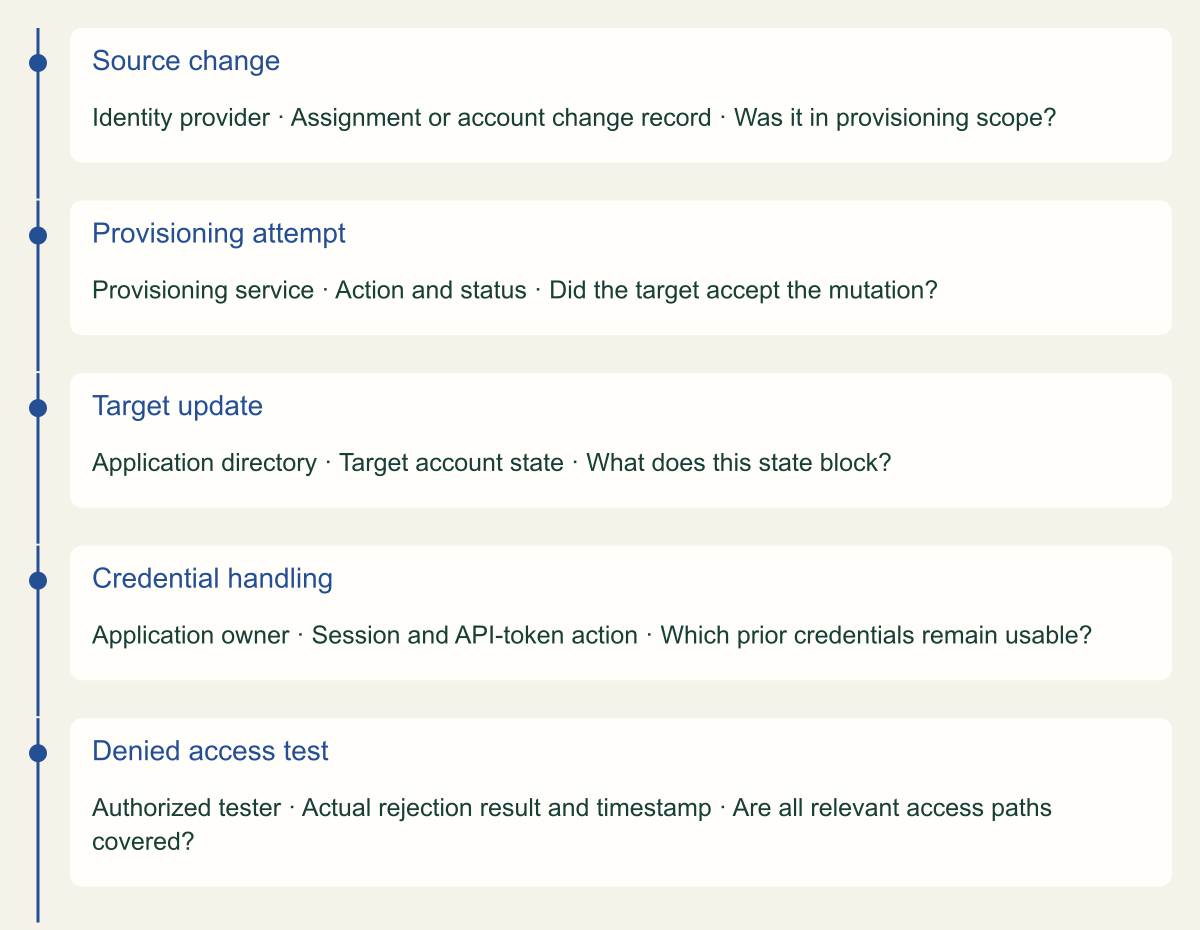
Offboarding has several completion events
The source change, target mutation and rejection of application access are different offboarding events.

Source. How Entra application provisioning works [4]; Revoke Entra user access [5]; Entra provisioning logs [7]. Sources checked August 28, 2026.
Method. Original conceptual model synthesized from the cited documentation. The relationships and proposed tests explain design choices; they are not measured results or a claim about a deployed environment.
Accessible table and figure data
| Event | Observer | Evidence | Open question |
|---|---|---|---|
| Source change | Identity provider | Assignment or account change record | Was it in provisioning scope? |
| Provisioning attempt | Provisioning service | Action and status | Did the target accept the mutation? |
| Target update | Application directory | Target account state | What does this state block? |
| Credential handling | Application owner | Session and API-token action | Which prior credentials remain usable? |
| Denied access test | Authorized tester | Actual rejection result and timestamp | Are all relevant access paths covered? |
| Event | Observer | Evidence | Open question |
|---|---|---|---|
| Source change | Identity provider | Assignment or account change record | Was it in provisioning scope? |
| Provisioning attempt | Provisioning service | Action and status | Did the target accept the mutation? |
| Target update | Application directory | Target account state | What does this state block? |
| Credential handling | Application owner | Session and API-token action | Which prior credentials remain usable? |
| Denied access test | Authorized tester | Actual rejection result and timestamp | Are all relevant access paths covered? |
A connector can be healthy while a user change fails
Look at the affected identity and operation, not only the connector's general status. A provisioning service can have a working connection while a particular user falls outside scope, encounters a mapping error or receives a target-side rejection. Microsoft's provisioning and log documentation provides the fields needed to investigate those operations. The offboarding record should include the actual user change and its result, so a healthy connector indicator cannot conceal a failed lifecycle action. [4][7]
Scoping deserves an explicit check. Entra supports provisioning scope and scoping filters that determine which users or groups are processed. A lifecycle change can therefore interact with assignment, filter conditions and connector behavior. Review the documented action taken when an identity leaves scope instead of assuming that every excluded identity is automatically handled in the way the offboarding policy intends. Scope is part of the integration contract, not merely an administrative filter applied after the fact. [8]
Quarantine changes the timing model further. Microsoft documents progressively reduced retry frequency when a provisioning job remains in quarantine, eventually reaching roughly daily attempts, and disabling a job after prolonged quarantine of more than four weeks. A normal-cycle assumption is inappropriate in that state. The relevant evidence is the job's current condition, the reason for quarantine and the authorized corrective action, followed by confirmation that the affected identity change was processed. [6]
Build an exception path before it is needed. Name the person who owns the target application, the person who can repair the connector and the authority required for manual access removal. The procedure should say what evidence is needed to close the user record while the automation is repaired. A manual application action can be a legitimate part of the workflow, but it should not disappear behind a later successful synchronization event.
Record retries without erasing earlier failures. An eventual success is useful, yet the previous errors may explain why an operational objective was missed or why another identity remains exposed. Preserve enough history to connect the original source action, failed attempts, corrective work and final application-side outcome. This is especially important when an incident response relies on the offboarding record to determine how long a particular path may have remained usable.
Avoid automatic closure based on an exception ticket's status alone. Closing a repair ticket proves that someone completed a workflow in the ticketing system. It does not necessarily prove that the target account, session and credential paths now satisfy the agreed contract. Require the appropriate outcome evidence or an explicitly accepted limitation, with an owner who understands what remains outside the connector's control.
Run an application-owned offboarding test
Use an authorized test identity with synthetic data and a defined scope. Establish the application access paths that the organization actually intends to close, such as a browser session and a permitted test API token. Do not use a departing employee's live session as a convenient fixture or copy production credentials into a test record. The application owner should approve the setup, the operations performed and the cleanup.
Before triggering offboarding, verify that each test path works as intended. Without that baseline, a later rejection may reflect a broken fixture rather than successful access removal. Record the identity, credential class and protected operation in non-secret terms. The test should be narrowly scoped enough that a mistaken action cannot alter unrelated business data. Any sample in the article is a proposed procedure, not evidence that the procedure has been executed.
Trigger the agreed source lifecycle action and observe provisioning separately. Capture the operation's status and investigate any error or scope-related behavior using the provisioning logs. Then inspect the target application's account state through its approved interface or audit record. This sequence lets the owner distinguish a delivery failure from an application behavior that does not meet the desired offboarding outcome. [3][7]
Test the previously established access paths according to the approved plan. A new sign-in denial is useful evidence, but it does not test an existing session. A rejected browser session does not test a locally issued API token. Keep separate result fields for each mechanism so one success does not stand in for all of them. Microsoft's revocation guidance is a starting point for identifying controls, while the target application's own behavior determines the final acceptance evidence. [5]
If an access path remains usable, stop calling the record complete and identify the responsible control. The application may provide a separate session termination or credential revocation operation, or the integration may not support the desired effect. Escalate through the defined owner rather than repeatedly sending the same SCIM mutation without a new hypothesis. Record whether the residual access is confirmed, suspected or untested; those states should not be collapsed into a single red or green label.
Repeat the relevant checks after corrective action and clean up the test identity and credentials. Retain the result, source contract and application version or configuration details needed to understand the test later. Re-test when the connector mapping, application session policy or credential mechanism changes. A previous successful test remains useful evidence for the configuration it exercised, but it does not automatically cover a new access path introduced afterward.
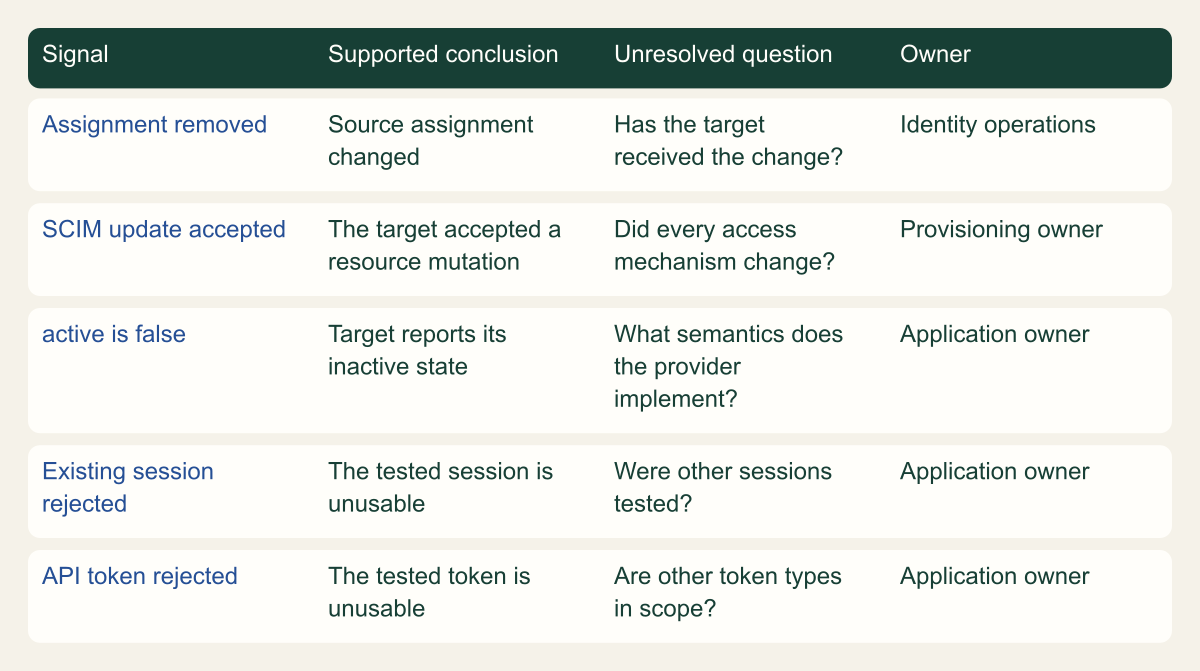
What each offboarding signal proves
Provisioning success proves less than an application-side test of the access path being closed.

Source. RFC 7643 SCIM core schema [1]; RFC 7644 SCIM protocol [2]; Revoke Entra user access [5]; Entra provisioning logs [7]. Sources checked August 28, 2026.
Method. Original conceptual model synthesized from the cited documentation. The relationships and proposed tests explain design choices; they are not measured results or a claim about a deployed environment.
Accessible table and figure data
| Signal | Supported conclusion | Unresolved question | Owner |
|---|---|---|---|
| Assignment removed | Source assignment changed | Has the target received the change? | Identity operations |
| SCIM update accepted | The target accepted a resource mutation | Did every access mechanism change? | Provisioning owner |
| active is false | Target reports its inactive state | What semantics does the provider implement? | Application owner |
| Existing session rejected | The tested session is unusable | Were other sessions tested? | Application owner |
| API token rejected | The tested token is unusable | Are other token types in scope? | Application owner |
| Signal | Supported conclusion | Unresolved question | Owner |
|---|---|---|---|
| Assignment removed | Source assignment changed | Has the target received the change? | Identity operations |
| SCIM update accepted | The target accepted a resource mutation | Did every access mechanism change? | Provisioning owner |
| active is false | Target reports its inactive state | What semantics does the provider implement? | Application owner |
| Existing session rejected | The tested session is unusable | Were other sessions tested? | Application owner |
| API token rejected | The tested token is unusable | Are other token types in scope? | Application owner |
Make the remaining access paths someone's responsibility
The handoff should identify the source lifecycle owner, provisioning owner and application owner, with explicit responsibility for paths outside SCIM. Keep a compact record of the account state, tested session behavior, API-token handling, unresolved exceptions and supporting evidence. This prevents a directory team from being assigned responsibility for a target control it cannot operate, while also preventing the application team from assuming that the connector solved everything.
An operational objective should name its start event, completion event and exceptions. If the organization measures elapsed offboarding time, use actual observations and preserve the measurement method. Published synchronization intervals can explain one stage, but they cannot replace the application's outcome. A precise number without a clear endpoint is less useful than an honest record showing which paths were closed and which still need action.
SCIM provides an effective common language for identity-resource changes. Its usefulness increases when the organization is equally precise about the application behavior around those changes. The closing question is whether the specific access path is unusable under the agreed contract, and whether the record proves it. That question turns a successful connector event into one part of an accountable offboarding process.
Method and provenance
Source-based technical analysis joining the primary documentation and standards cited above. Source contracts were reviewed on August 28, 2026. Original diagrams and decision records are editorial syntheses; quantitative figures, where present, preserve the source values and stated transformations.
An application may interpret active=false differently, and delete semantics do not universally erase session or API-token state. Normal synchronization, quarantine and failure retries have different timing. The correct test depends on the app's contracts, available logs and authorization to test residual access. Some application credentials cannot be revoked centrally through SCIM; the owner needs a separate documented procedure.
AI assistance. AI assisted research, drafting and visual planning. The article does not claim personal deployment experience, a customer case study or tests performed in a production environment.
Published under the Cloud Security Desk organizational byline. Read the practitioner guide policy.
References
- RFC 7643 SCIM core schema RFC Editor. Accessed .
- RFC 7644 SCIM protocol RFC Editor. Accessed .
- Develop a SCIM endpoint for Entra Microsoft. Accessed .
- How Entra application provisioning works Microsoft. Accessed .
- Revoke Entra user access Microsoft. Accessed .
- Provisioning quarantine Microsoft. Accessed .
- Entra provisioning logs Microsoft. Published . Accessed .
- Entra provisioning scoping filters Microsoft. Accessed .