An AWS containment procedure needs separate evidence for stopping new sessions and restricting credentials already issued. This guide compares role session revocation, federation shutdown and IAM Identity Center controls, then proposes verification and restoration records that account for shared roles and policy propagation.
At a glance
Key findings
- Preventing new federation and denying actions by existing role sessions are separate containment tasks. [2][5]
- A role-wide cutoff can affect legitimate users of the same role and does not by itself block sessions issued after that cutoff. [1]
- Retain a revocation control until its documented removal condition is met, and test restoration separately from containment.
Separate the two revocation questions
A responder disables a suspected account in the identity provider and sees the next sign-in fail. That is valuable evidence, but it answers only whether that authentication attempt succeeded. The incident may also involve a role session obtained earlier, a different role reached through federation or a credential copied to another process. The containment record must state which of these paths it covers.
AWS evaluates temporary credentials against applicable permissions when requests are made. Its documentation describes changing permissions to restrict existing sessions, while noting that changes can take time to propagate. Disabling the original authentication route should therefore not be treated as the complete mechanism for removing authority from already issued temporary credentials. [2]
Organize the runbook around two questions: can the identity obtain a new session, and can an older session still perform a relevant action? Give each question an owner, a control and an evidence requirement. If either answer remains unknown, record it as unknown rather than translating an identity-provider success message into an AWS-wide containment statement.
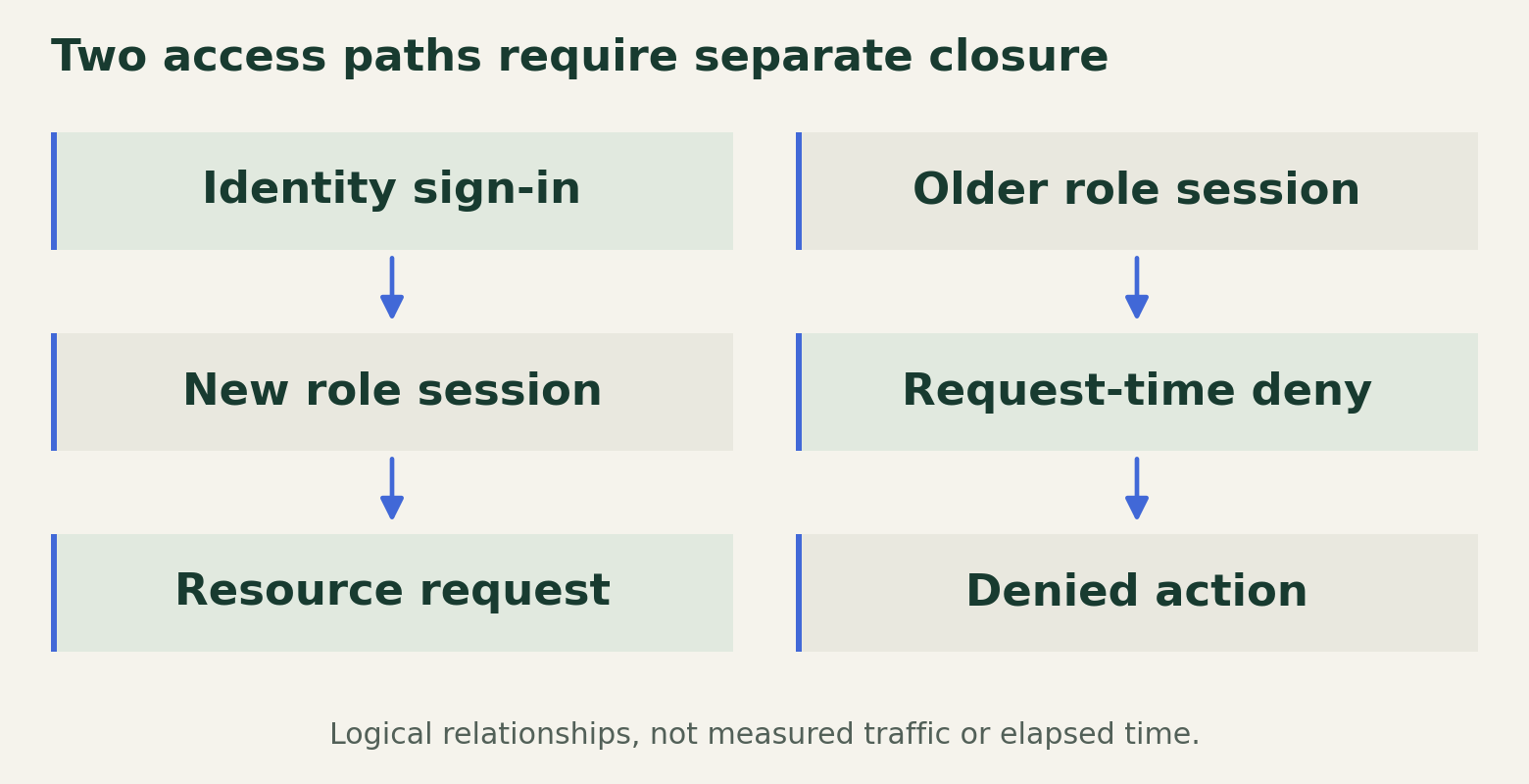
Two access paths require separate closure
Close new-session issuance and existing-session authority separately, then retain evidence for each result.

Source. Primary documentation [1] [2] [3] [4] [5]. Accessed August 28, 2026.
Method. Original two-path schematic synthesized from AWS revocation procedures. The paths distinguish new-session issuance from existing-session authorization; the table lists proposed evidence checks, not observed outcomes.
Accessible table and figure data
| Check | Evidence to retain | What it does not prove |
|---|---|---|
| New session attempt is rejected | Redacted authentication result and time | Existing credentials cannot act |
| Older test session action is denied | Role, action, target and denial time | Every unrelated role is contained |
| Identity Center access removed | Assignment and session records | Previously downloaded data is erased |
| Deny retained for documented interval | Approved removal criterion | A universal expiry for all credentials |
| Check | Evidence to retain | What it does not prove |
|---|---|---|
| New session attempt is rejected | Redacted authentication result and time | Existing credentials cannot act |
| Older test session action is denied | Role, action, target and denial time | Every unrelated role is contained |
| Identity Center access removed | Assignment and session records | Previously downloaded data is erased |
| Deny retained for documented interval | Approved removal criterion | A universal expiry for all credentials |
Identify the session family
Before choosing a deny, identify the account, role, federation path and affected resources. Distinguish an ordinary IAM role from an IAM Identity Center provisioned role. Record whether the role is shared by other people or automation and whether the investigation suggests movement into other roles. This inventory limits both false confidence and avoidable disruption.
The IAM role revocation action adds an inline policy named AWSRevokeOlderSessions, using aws:TokenIssueTime to deny sessions older than the cutoff. It affects the role's existing sessions, not just one person's credentials. Sessions issued later require separate attention. AWS also excludes service-linked roles from this revocation operation. [1]
A timestamp is consequently a boundary condition, not a universal incident end time. Preserve the cutoff, policy revision and role ARN. If a responder changes the cutoff again, retain the reason and previous value. Avoid editing a shared role during an investigation without identifying the business processes that could lose access and the person authorized to accept that disruption.
Choose the narrowest effective deny
AWS's federation guidance describes approaches for revoking sessions and using identity information to target affected users. Where correctly configured, source identity can support attribution through role chaining. Its availability and usefulness depend on the federation setup and policies; responders cannot assume every existing session carries the same identifying context. [5]
Choose a control using evidence already available, not an identifier the team wishes had been recorded. A narrow identity condition can be preferable to denying everyone on a shared role, but only if it actually matches the suspect sessions. A role-wide control may be justified when attribution is incomplete and the impact is approved. The runbook should make that decision explicit.
Write down the containment objective in terms of actions and resources. If the immediate concern is modification of a production secret, test that boundary with a safe equivalent in the approved test scope. A denial of an unrelated list operation cannot establish the same result. Also record which downstream roles, accounts or alternate credentials remain outside the chosen control.
Complete Identity Center revocation in order
IAM Identity Center publishes a separate user-access revocation procedure. It combines restriction of active permissions, removal of account assignments and portal sessions, and prevention of further sign-in through the relevant identity source. These steps address different parts of the access path; removing an assignment alone is not the complete procedure for previously issued role sessions. [3]
The associated deny-policy guidance uses a user identifier and requires the deny to remain for at least 12 hours in that documented procedure. [4] The IAM role documentation separately warns against directly modifying Identity Center provisioned roles for this purpose. [1] Treat the interval as a requirement of that workflow, not as a universal lifetime for every AWS credential.
Copy the current provider procedure into the incident change record by reference, then record completion evidence for each step. Name the identity source, the accounts involved and any propagation period still under observation. Set a deliberate review time for removing the temporary control. An automatic cleanup that runs before the approved condition can undo containment while the investigation is still active.
Prove old access fails and new access stays blocked
A planned exercise should establish a controlled session before revocation and preserve its issuance context securely. After the authorized change, use that session for a harmless action chosen to represent the intended boundary. Separately attempt the authorized authentication path again. Record the action, resource, role, result and observation time for both checks without saving credentials in the report.
One rejected request is a sample of behavior, not proof that every action in every account is denied. Define the acceptance set before running the exercise. It may include the relevant write action, a second affected account and a chained role if that path exists. Explicitly exclude systems that were not tested instead of presenting the exercise as complete organization coverage.
Distinguish an AWS authorization denial from a network timeout, expired test credential or application error. Each may stop the test action, but they support different conclusions about the revocation control. Where propagation is possible, use a bounded observation period approved by the incident lead and record any earlier successful request rather than keeping only the final denial.
Define restoration and residual exposure
Containment does not erase information already retrieved or reverse every action already performed. Review the resources accessible during the exposure window and preserve the investigation evidence independently of the revocation change. If another credential or trust relationship was created, include it as a separate access path with its own owner and closure evidence.
Restoration deserves its own approval. Confirm the identity is safe to re-enable, determine whether assignments should return unchanged and check that removing a temporary deny will not revive an access path the team still intends to block. Record the exact policy removal and an authorized fresh-session test. Do not silently equate successful restoration of one user's work with completion of the incident.
Keep the two containment results with the restoration decision: the new-session attempt and the existing-session resource check. Record when each observation occurred relative to the deny change, so a later reviewer can distinguish propagation from a newly created access path. If the same role is shared, name the unaffected workloads that were checked during restoration and any dependent process still awaiting its owner's confirmation. That makes safe recovery part of the runbook rather than an informal cleanup.
Method and provenance
Documentation review and original operational analysis using the cited primary sources, checked on August 28, 2026. The editorial date places the article in the retrospective series; publication and source review occurred in August 2026.
No account or credential was inspected or changed. Root credentials, service-linked roles, other derived access and previously copied data require separate handling. Policy propagation and service behavior prevent a universal instantaneous-containment claim. No empirical tests were performed for this article.
AI assistance. Researched, drafted and checked against cited sources with AI assistance. No independent human editorial review or original empirical testing is claimed.
Published under the Cloud Security Desk organizational byline. Read the series policy.
References
- Revoke IAM role temporary security credentials Amazon Web Services. Accessed .
- Disabling permissions for temporary security credentials Amazon Web Services. Accessed .
- Revoke active IAM role sessions created by permission sets Amazon Web Services. Accessed .
- Use a Deny policy to revoke active user permissions Amazon Web Services. Accessed .
- How to revoke federated users' active AWS sessions Amazon Web Services. Published . Accessed .