
A service-impact approach to incident classification aligned with NIST SP 800-61r3. The guide separates validation, type, priority and reporting obligations, then connects evidence confidence, command responsibilities and reassessment to an explicit decision record.
At a glance
Key findings
- NIST SP 800-61r3 separates triage and validation from incident categorization and prioritization. [1]
- Assess confidentiality, integrity and availability consequences while keeping evidence confidence distinct. [3]
- Severity is an owned, revisable response decision; provider labels and reporting obligations have separate scopes. [5][7][8]
The alert is not the service impact decision
An authored tabletop exercise begins with two fictional reports. One says an administrative principal changed a storage-access policy outside an approved change window; whether any data was read is unknown. The other says an isolated reporting job missed its scheduled run; whether a customer deadline is affected is unknown. Neither report supplies a complete service-impact decision.
The exercise is hypothetical, not a customer incident or an executed test. An identity event does not automatically outrank a batch failure. The first report raises an integrity and access question; the second raises a time-sensitive business question. Each needs an owner to connect evidence to consequences instead of inheriting the alerting product's severity label.
NIST SP 800-61 Revision 3 places triage, categorization and prioritization within an incident-management process. It recommends considering scope, likely impact, time criticality and available resources when deciding how quickly to respond. That supports a revisable decision grounded in context, not a universal severity number derived from one technical signal. [1]
A useful incident record separates what is observed, what consequences are plausible, how confident the team is and what action is justified now. It also names the person who can revise the decision as evidence changes. The initial label should organize work without becoming a substitute for the reasoning that produced it.
This guide proposes a qualitative operating model informed by NIST, FIRST and provider guidance. It does not invent a NIST severity scale, prescribe legal notification deadlines or report an incident exercise that was actually performed. An organization's service owners and designated response authority must adapt the model to their obligations and operating context.
Separate validation type priority and obligation
Validation asks whether the available report supports an incident. Classification describes the kind of incident. Prioritization decides the urgency and allocation of response effort. Reporting obligations determine who must be told under the applicable rules or contracts. These activities interact, but combining them into one severity field can conceal important differences.
NIST's current profile distinguishes RS.MA-02, which concerns triage and validation, from RS.MA-03, which concerns categorization and prioritization. Revision 3 was published in April 2025 and supersedes Revision 2. Its organization around CSF 2.0 should not be replaced with an older lifecycle diagram presented as the current publication's structure. [1][2]
A report can be credible enough to require investigation while its scope remains uncertain. The team should record which facts support validation and which questions remain open. A lack of complete attribution does not necessarily mean there is no incident, just as an alert generated with high confidence does not establish the total business consequence.
Incident type should remain descriptive. Account takeover, data exposure and service disruption can help route expertise and identify useful evidence. They do not automatically settle urgency. The same type can affect an isolated test environment or a critical shared dependency, and those contexts can justify different operating decisions.
Keep an incident’s overall priority separate from the urgency of an individual task. A narrowly scoped incident may contain an evidence source that will soon become unavailable, while a severe incident may include some work that can wait. The task owner needs the reason for the immediate action, not an assumption that every task inherits the same urgency. This distinction helps preserve time-sensitive evidence without misrepresenting the incident’s overall business impact.
A provider portal may also have its own incident object and workflow. Microsoft Defender's investigation guidance explains that product context, while Google Cloud describes its own data-incident response process. Those are useful sources for understanding the provider interface and responsibilities. They are not a universal definition of the customer's business impact or legal reporting duties. [7][8]
Assign reporting questions to the appropriate legal, privacy or contractual owner. Record when they were engaged and which facts they need, but do not wait for every reporting determination before authorizing necessary technical work. Conversely, do not assume that a technical severity label alone starts or satisfies every notification obligation.
Describe what the service could lose
Start with the business function, not the cloud resource count. A single shared identity or data dependency may affect several services, while many affected resources may support a limited internal function. The assessment should explain the consequence of losing confidentiality, integrity or availability at the relevant boundary.
NIST IR 8286D explicitly extends business impact analysis beyond interruption to confidentiality and integrity loss. It also addresses partial loss and degraded operation. That helps prevent an availability dashboard from becoming the entire impact assessment when the concern is unauthorized disclosure, altered data or a loss of trusted control. [3]
For the hypothetical administrative-identity event, ask what the identity could affect and what evidence supports that scope. Distinguish its nominal permissions from confirmed actions and from reasonable hypotheses about access still under investigation. The team may need precautionary action before every possibility is resolved, but it should not report all possible permissions as observed misuse.
For the batch-job event, identify what work failed, whether a deadline matters and which dependent function is affected. A technically isolated failure can still have a serious business consequence at a critical time. The purpose of the model is to expose that context, not to rank incident categories by intuition.
Avoid fabricated financial precision. If the organization has an approved impact model, use it with its assumptions. If it does not, describe the affected function, sensitivity, duration and plausible consequences qualitatively. Assign an owner to resolve material uncertainty rather than inserting an invented loss estimate to make the assessment look quantitative.
Shared cloud dependencies require explicit attention. Identity, keys, routing, data and management access can connect services that appear separate in a resource inventory. Map only the relationships supported by the environment's evidence, and distinguish an affected dependency from a confirmed outage in every service that uses it.
Keep confidence visible without hiding uncertainty
Confidence describes how strongly the evidence supports a statement. Impact describes the consequence if the relevant state is present or develops. Combining them into an unexplained numerical product can obscure both. A low-confidence possibility of severe harm may justify investigation or precaution even when it does not justify reporting that harm as confirmed.
Use distinct fields for observed facts, supported hypotheses and unknowns. Each important hypothesis should identify the evidence that could strengthen or weaken it. This gives the investigation a direction and prevents an early assumption from becoming an accepted fact merely because it has been copied into several updates.
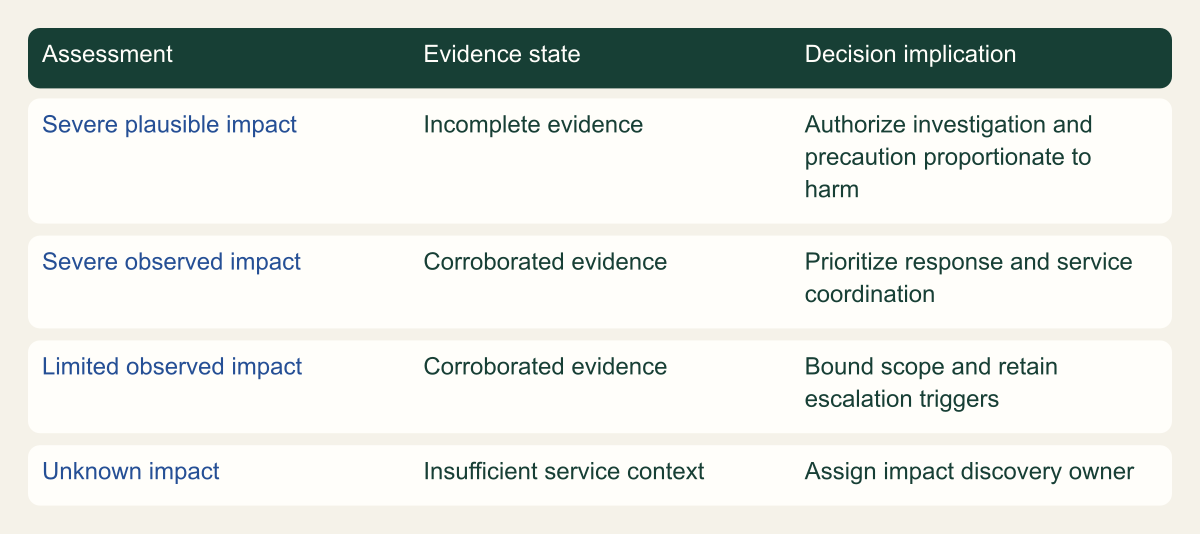
The qualitative matrix is an original decision aid, not a NIST classification scale. It separates severe observed impact, severe plausible impact, limited observed impact and unknown impact. Its purpose is to connect the evidence state to the next decision while preserving uncertainty. It does not assign a calculated risk score or a probability of compromise.
Missing telemetry deserves a precise description. If the team cannot observe a relevant activity because the source was not collected or the window expired, say so. That limitation differs from observing that the activity did not occur. The response decision may need to remain cautious, but the final incident account should not convert an evidence gap into a confirmed attacker action.
In the identity example, a sign-in record, an application grant and a resource operation can support different parts of the hypothesis. Correlating them may strengthen an explanation, while a mismatch may narrow it. The related Entra investigation guide shows why the authority granted to an application and the activity observed under that authority require separate evidence.
Make the reassessment condition concrete. New evidence of privileged changes, confirmation of a limited scope or restoration of an unavailable evidence source can all change the decision. A generic promise to review later is weaker than naming the observation or service event that should trigger another assessment.
Impact and confidence remain separate
The matrix records both a service consequence and how strongly the evidence supports it, without calculating a numeric risk score.

Source. Primary documentation [1] [3]. Reviewed August 28, 2026.
Method. Original conceptual synthesis reviewed August 28, 2026. Unit: qualitative states and relationships. Scope: Cloud incident severity classification. It is not measured performance, prevalence, risk or implementation proof. The matrix records both a service consequence and how strongly the evidence supports it, without calculating a numeric risk score.
Accessible table and figure data
| Assessment | Evidence state | Decision implication |
|---|---|---|
| Severe plausible impact | Incomplete evidence | Authorize investigation and precaution proportionate to harm |
| Severe observed impact | Corroborated evidence | Prioritize response and service coordination |
| Limited observed impact | Corroborated evidence | Bound scope and retain escalation triggers |
| Unknown impact | Insufficient service context | Assign impact discovery owner |
| Assessment | Evidence state | Decision implication |
|---|---|---|
| Severe plausible impact | Incomplete evidence | Authorize investigation and precaution proportionate to harm |
| Severe observed impact | Corroborated evidence | Prioritize response and service coordination |
| Limited observed impact | Corroborated evidence | Bound scope and retain escalation triggers |
| Unknown impact | Insufficient service context | Assign impact discovery owner |
A decision record for the tabletop
For the fictional policy-change report, the authored record below separates the observed change from the unconfirmed disclosure hypothesis. It assigns urgent investigation because the permission boundary may have changed, while explicitly leaving data access unconfirmed. This is a proposed local decision, not a NIST severity category or a claim that this action would be correct for every storage service.
The approved action is narrower than a declaration that all data was stolen. The response owner directs validation of the changed policy, preservation of available records and review of any reversible restriction with the service owner. The policy's effective permissions and the resource operations observed under them answer different questions. A missing access log must remain a visibility limit rather than proof that no access occurred.
The second fictional report follows a different reassessment path. If the reporting job only supports an internal dashboard and can be recovered before its accepted deadline, it can receive a lower response priority while its repair stays assigned. If the same job is the sole path to a time-sensitive customer obligation, that new fact can justify escalation. The technical failure is unchanged; the consequence model is better informed.
Neither case receives a numerical confidence multiplier. The useful output is a current decision, its evidence boundary and the observation that would change it. Recording an explicit trigger allows the next responder to revise the decision without treating a change of priority as a contradiction or quietly rewriting the original facts.
AUTHORED TABLETOP RECORD - NOT AN OBSERVED INCIDENT
Service: fictional order-history storage
Observed input: unapproved storage-access policy change
Plausible consequence: unauthorized reading or modification
Unconfirmed: whether any resource operation occurred
Current local decision: urgent validation and scoped containment review
Decision owner: designated incident commander
Required service input: impact of restricting the changed access path
Reassessment trigger: verified effective permissions or relevant access evidence
Reporting determination: assigned separately to the appropriate owner
Give the decision an owner and a clock
Someone must own the current priority decision and the allocation of response effort. That role should be distinguishable from the people collecting evidence and making technical changes. Otherwise, the team can become busy without anyone resolving conflicting actions, service consequences or the need for additional authority.
Google's incident-response guidance separates command, operations and communications responsibilities. FIRST's CSIRT Services Framework provides a broader view of incident-management services and their constituency context. These sources support clear responsibilities, but they do not require every organization to copy the same role names or staffing model. [5][6]
A clock in this context is an operating commitment, not an invented universal interval. Some conditions require immediate reassessment when a dependency changes or new evidence appears. Other work can follow an agreed update cadence. The response plan should define those expectations according to the service and incident, rather than importing arbitrary numbers from a generic template.
NIST distinguishes escalation of resources or response effort from elevation involving higher management. The current profile also calls for tracking and validating incident status so changes in strategy or resources can happen promptly. A priority label that never changes despite new information is not evidence that the original assessment was sound. [1]
Resource availability belongs in the operating decision without changing the underlying harm. If a team lacks expertise or capacity, it may need assistance or a different response sequence. That scarcity should not be disguised by lowering the stated impact. Record the constraint and the action taken to address it.
Define who can close or downgrade the incident as well as who can raise it. A quiet alert stream is not sufficient evidence that the relevant service state is understood. The decision owner should identify which observations support the change and which follow-up work remains assigned after active response ends.
A severity decision is revisited
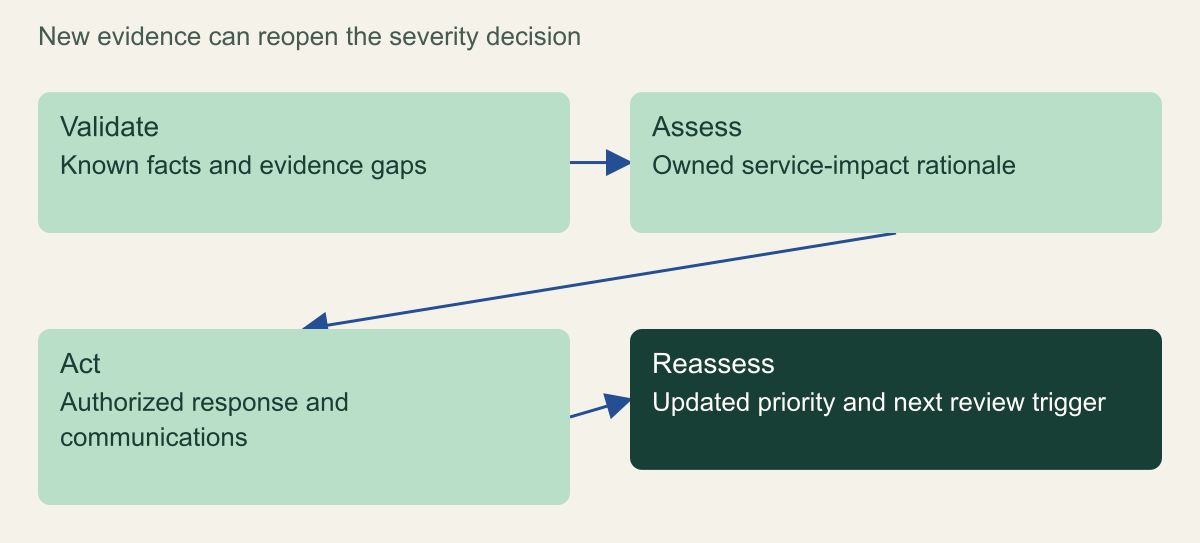
New evidence and service changes can revise the incident decision and resource allocation.

Source. Primary documentation [1] [5] [6]. Reviewed August 28, 2026.
Method. Original conceptual synthesis reviewed August 28, 2026. Unit: qualitative states and relationships. Scope: Cloud incident severity classification. It is not measured performance, prevalence, risk or implementation proof. New evidence and service changes can revise the incident decision and resource allocation.
Accessible table and figure data
| Step | Input | Recorded output |
|---|---|---|
| Validate | Report and supporting events | Known facts and gaps |
| Assess | Service scope and consequences | Owned priority rationale |
| Act | Approved response strategy | Actions and communications |
| Reassess | New evidence or changed impact | Updated priority and next trigger |
| Step | Input | Recorded output |
|---|---|---|
| Validate | Report and supporting events | Known facts and gaps |
| Assess | Service scope and consequences | Owned priority rationale |
| Act | Approved response strategy | Actions and communications |
| Reassess | New evidence or changed impact | Updated priority and next trigger |
Make containment and recovery decisions explicit
Containment can reduce exposure while disrupting a service or removing evidence. Recovery can restore function while changing the state an investigation needs to understand. The response team should describe these tradeoffs before an irreversible action where time permits, and record the rationale afterward when urgent action cannot wait.
NIST's current incident guidance recognizes the tension between rapid recovery and more thorough investigation. It also treats recovery initiation as a decision informed by incident characteristics and possible operational disruption. The guide does not support a universal instruction to collect every artifact before containment or to restore service before validating the incident state. [1]
The cloud forensic acquisition article explains one concrete boundary: stopping or changing an instance can remove volatile evidence that a disk snapshot does not preserve. The severity decision should identify whether that evidence opportunity is outweighed by the risk of continued execution and who has authority to accept that tradeoff.
Recovery planning has its own preparation requirements. NIST SP 800-184 addresses cybersecurity-event recovery, including planning and prioritization. Connect the incident strategy to a service recovery plan rather than assuming a successful infrastructure operation establishes safe business use. The appropriate acceptance conditions depend on the affected function and the incident. [4]
A recovered application may still need data reconciliation, credential changes or confirmation that the relevant authority is controlled. Define what must be true before users or dependent systems resume the critical operation. The existing restore-validation guide focuses on those service-level checks instead of treating a completed restore job as the endpoint.
Record the handoff between investigation and recovery. Which facts are established, which hypotheses remain open, which evidence has been preserved and which actions are still prohibited? That shared state helps prevent recovery work from silently invalidating an investigation assumption or an investigator from assuming a service remains contained after it has returned to use.
Exercise the model before a real incident
Use a tabletop to test ambiguous decisions rather than rehearsing only obvious cases. The administrative-identity and batch-job examples can reveal whether participants separate confidence from consequence and understand who can authorize action. The exercise should ask what evidence changes the decision, not merely whether everyone chooses the same label.
Include a missing-data condition and a shared dependency. Ask how the team records uncertainty when the relevant log is unavailable and how it evaluates service impact when one identity or key supports several workloads. These variations expose assumptions that a resource-level alert list may not reveal.
Evaluate the handoffs as well as the classifications. Can the incident owner obtain a service-impact assessment? Does the communications role know which statements are confirmed? Can the technical operator identify the authority for a disruptive action? A model that produces tidy labels but leaves these questions unanswered is not yet an effective operating procedure.
Retain disagreements from the exercise. A disagreement may expose an unclear business boundary, conflicting obligations or a missing decision owner. Resolve the underlying issue and update the procedure rather than forcing consensus around a label whose meaning remains ambiguous.
The resulting record should state what the exercise demonstrated and what was not tested. A tabletop can support a claim about decision clarity and coordination under its scenario. It does not measure production response time or prove that every necessary technical capability works. Those require appropriately scoped operational validation.
A useful severity model gives the team a current, explainable decision. It connects facts and uncertainty to service consequences, assigns authority and specifies when the assessment changes. The label remains helpful because the reasoning is visible, not because the organization has pretended that one alert score contains the whole incident.
Method and provenance
Primary documentation review and original operational analysis, checked August 28, 2026. Source versions, claim mappings and visual data are retained in the accompanying research dossier. This article was first published in the practitioner-guides collection on August 28, 2026.
No customer environment, incident evidence, production deployment or service performance was tested for this article. Hypothetical examples and conceptual diagrams are labeled. Organization-specific authorization, architecture and legal obligations require their own review.
AI assistance. Researched, drafted and checked against cited sources with AI assistance. No independent human editorial review or original empirical testing is claimed.
Published under the Cloud Security Desk organizational byline. Read the practitioner guide policy.
References
- NIST SP 800-61r3 Incident Response Recommendations National Institute of Standards and Technology. Accessed .
- Cybersecurity Framework | NIST National Institute of Standards and Technology. Accessed .
- NIST IR 8286D Using Business Impact Analysis National Institute of Standards and Technology. Accessed .
- SP 800-184, Guide for Cybersecurity Event Recovery | CSRC National Institute of Standards and Technology. Accessed .
- CSIRT Services Framework Version 2.1 FIRST. Accessed .
- Google SRE - Root Cause Analysis for Probing Incident Google. Accessed .
- Data incident response process | Security | Google Cloud Documentation Google. Accessed .