An application-focused recovery testing guide using NIST definitions, AWS Backup validation, and PostgreSQL recovery documentation. It separates resource restoration from service acceptance, objective setting, isolation, evidence, and cleanup.
At a glance
Key findings
- Infrastructure restoration and application acceptance are separate milestones, and both belong in recovery evidence.
- RPO and RTO are objectives; measured data loss and recovery duration must be reported against clearly defined start and finish points.
- Automated restore orchestration still needs application-specific validation, safe isolation, and evidence that cleanup completed.
Define the finish line before starting the clock
A database can finish restoring while the application remains unusable. Credentials may be missing, a dependent object store may represent a different point in time, or the restored software may reject the recovered schema. A recovery exercise that stops at resource creation can therefore report success before the service has crossed its most important acceptance boundary.
NIST's contingency-planning guidance distinguishes the recovery point objective, which concerns the point to which data must be recovered, from the recovery time objective, which concerns the permitted recovery duration. These definitions connect technical recovery to business impact. They are objectives, not measurements produced automatically by a backup service. [1]
Choose the finish line with the service owner. It might require a safe sign-in, a representative read, a controlled write, and verification that the resulting record is visible through the normal application path. Describe any reduced service level explicitly. Restoring read-only access can be a valuable milestone without being mislabeled as full recovery of a service that normally accepts transactions.
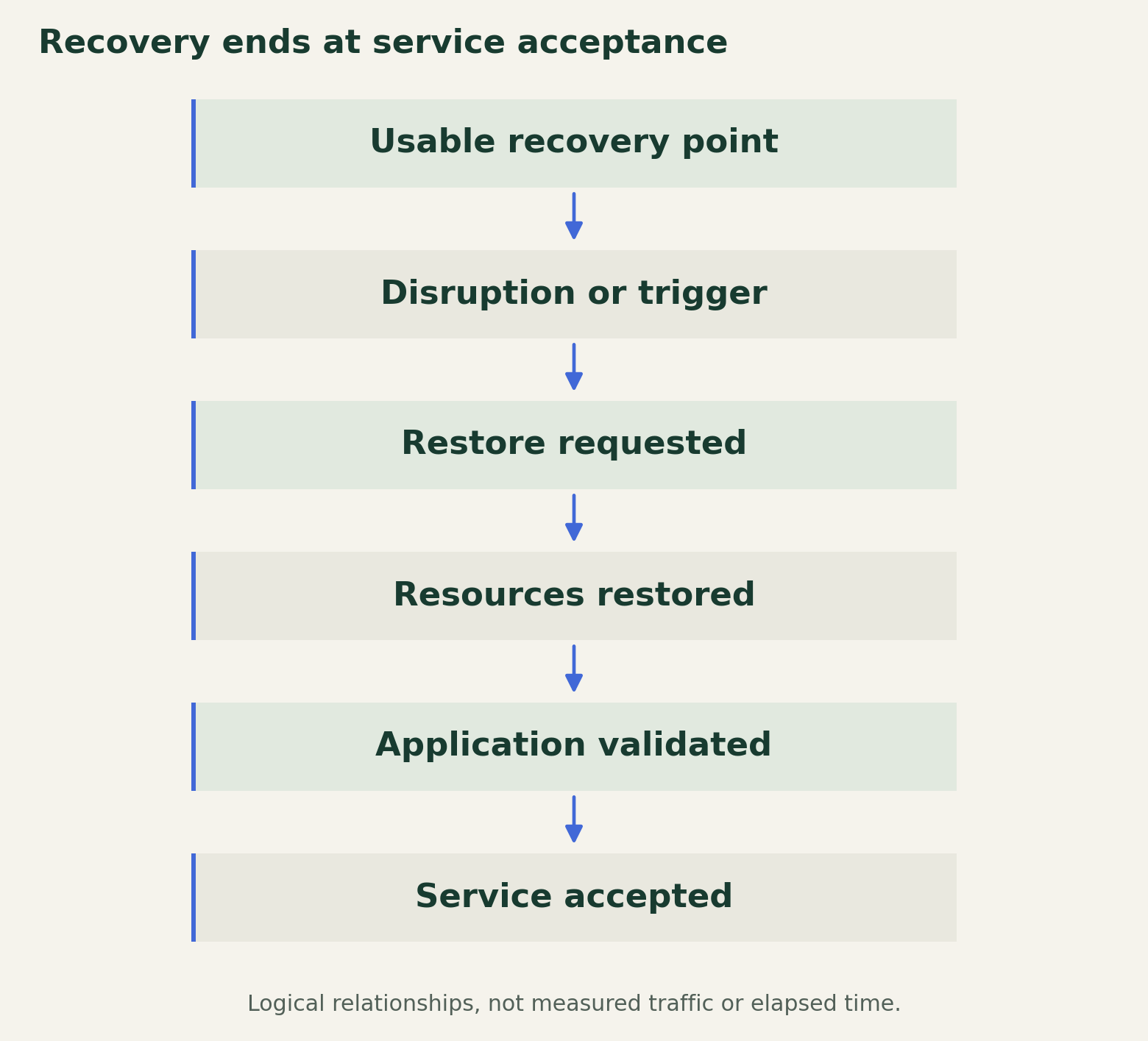
Recovery ends at service acceptance
Record restored resources and accepted application behavior as separate milestones.

Source. NIST contingency definitions, AWS Backup restore testing, and PostgreSQL recovery documentation [1]-[4].
Method. Original ordered milestone diagram with no time scale or measured durations. RPO and RTO remain objectives; actual data loss and recovery intervals require exercise evidence.
Accessible table and figure data
| Milestone | Evidence to retain | What it does not establish |
|---|---|---|
| Usable recovery point | Selected artifacts and recovered transaction marker | That every dependency is consistent |
| Disruption or exercise trigger | Agreed reference timestamp | That a restore began immediately |
| Restore requested | Job and operator record | That the resource is available |
| Resources restored | Service completion result | That the application works |
| Application validated | Versioned acceptance checks | That traffic has been accepted |
| Service accepted | Owner decision and operating scope | That cleanup has completed |
| Milestone | Evidence to retain | What it does not establish |
|---|---|---|
| Usable recovery point | Selected artifacts and recovered transaction marker | That every dependency is consistent |
| Disruption or exercise trigger | Agreed reference timestamp | That a restore began immediately |
| Restore requested | Job and operator record | That the resource is available |
| Resources restored | Service completion result | That the application works |
| Application validated | Versioned acceptance checks | That traffic has been accepted |
| Service accepted | Owner decision and operating scope | That cleanup has completed |
Choose a recoverable state across dependencies
Begin with the data needed to perform the accepted business operation. For a hypothetical document workflow, the database record, stored attachment, authorization configuration, and application version may all matter. List these dependencies and decide how the exercise will detect an inconsistent combination. The newest available copy of every component is not necessarily one coherent application state.
PostgreSQL's continuous-archiving guidance requires a base backup and a usable sequence of write-ahead log records for point-in-time recovery. A logical dump is not interchangeable with that physical recovery chain. The mechanism restores the database within its documented scope; it does not itself reconcile independent application services. [4]
Record the selected recovery point and the evidence that its required artifacts are available. If a missing log segment prevents reaching the intended point, preserve that result rather than quietly choosing an older point and keeping the original RPO claim. A fallback can be operationally sensible, but its data-loss implications must be visible to the people deciding whether to accept the recovered service.
Make validation an explicit job
AWS Backup restore testing can schedule restore exercises for supported resources and provides a validation workflow. Its documentation describes reacting to restore completion and supplying a validation result. The example validation function includes application-specific work left for the implementer, so copying a sample that returns success does not establish that an application was checked. [2][3]
Write the validator from the acceptance criteria outward. Check a small set of meaningful invariants: an expected fixture exists, its related records agree, required access controls apply, and a safe operation completes. A port-open check can diagnose reachability, but should not be the sole business acceptance test for a data service.
Keep failures informative. Distinguish a restore job failure from an unavailable validator, a permission error in the test harness, and a genuine application inconsistency. These outcomes require different repairs. Preserve the validation code version and its inputs with the run record so that a later successful run can be compared with the same checks rather than a weakened test.
Contain the restored environment
A restored application can contain real customer records, active integration settings, or scheduled jobs. Before starting it, decide how the test environment will prevent unintended messages, payments, data exports, or writes back to production. Isolation should cover application behavior as well as the location of the restored database.
Use controlled test identities and destinations for the operations that must be exercised. Where a production dependency cannot be called safely, replace it with an approved test endpoint and record that limit in the result. Do not call a partial test complete merely because the omitted dependency is inconvenient. Explain which behavior remains unverified and who owns a separate check.
AWS documents cleanup behavior as part of restore testing, including the validation window. [2] Add an independent cleanup receipt to the exercise: restored resources removed where intended, temporary credentials revoked, retained evidence protected, and unexpected resources investigated. A successful restore that leaves sensitive test resources exposed is not an acceptable operational outcome, even if the recovery measurements look good.
Record the full recovery timeline
Collect separate timestamps for the disruption or exercise trigger, recovery decision, restore request, resource availability, application validation, and service acceptance. Report the interval the organization actually committed to measure. If approval or investigation time is excluded, make that exclusion clear rather than presenting a narrower restore-job duration as total recovery time. Preserve time zones and correlation identifiers so application logs, operator actions, and service events can be placed on the same timeline without guessing their order.
Measure the recovered data point independently. Determine the latest relevant transaction or marker included in the accepted state and compare it with the incident reference point. The timestamp of the backup job alone may not answer that application question. Use an authorized synthetic marker when practical, and avoid exposing customer records in the exercise report.
Keep the timeline diagram free of invented durations. Its purpose is to show where time and data-loss evidence belong. Once real exercises exist, report their conditions, sample size, resource sizes, and any manual steps before comparing runs. A faster result on a smaller fixture is useful evidence about that fixture, not proof that the production service meets its objective under incident conditions.
Turn the result into a concrete change
The most useful recovery report ends with a decision and an owner. If validation failed because the application required an unavailable secret, fix the recovery dependency and rerun the same case. If the data point missed the objective, investigate backup selection, replication or archive continuity, and the acceptance criteria rather than simply increasing the frequency of a dashboard check.
Retain a compact receipt containing the recovery point, dependency manifest, application and validator versions, timeline, data-loss observation, acceptance result, and cleanup status. Mark simulated components and manual interventions. This gives the next operator enough information to reproduce the exercise without relying on the original author's memory.
Schedule another review when the service changes in a way that could alter recovery: a new datastore, larger working set, different encryption key, new migration strategy, or revised business objective. A recovery capability is demonstrated for a particular system and scenario. Keeping that scope explicit allows the organization to learn from successful exercises without turning yesterday's result into a permanent claim.
Method and provenance
Primary documentation review completed August 28, 2026, with an original acceptance checklist and recovery milestone model.
No restore, application validation, or timing experiment was executed. No recovery objective is claimed to have been met, and supported AWS resource types or customer-account configuration were not verified.
AI assistance. AI assistance was used to research sources, draft and structure the article, and prepare the visual specification. No human technical review is claimed.
Published under the Cloud Security Desk organizational byline. Read the series policy.
References
- Restore testing in AWS Backup AWS. Accessed .
- Restore testing validation AWS. Accessed .
- PostgreSQL 18 continuous archiving and point-in-time recovery PostgreSQL Global Development Group. Accessed .