
A Kubernetes maintenance guide separating eviction budgets from node failures and controller rollouts. It covers policy/v1 selectors, generation-aware status, unhealthy eviction, rounding and authorized exception handling.
At a glance
Key findings
Identify the operation that is waiting
When a Kubernetes drain stalls, first identify whether the operation is using the Eviction API and which workload budget it encounters. A PodDisruptionBudget, or PDB, limits certain voluntary disruptions. It is not a guarantee that Pods stay healthy, that replacements can be scheduled or that every kind of deletion is blocked.
Kubernetes distinguishes voluntary disruption from involuntary loss. A PDB can constrain an eviction request, while an unexpected node failure is not prevented by the budget. Unavailability still affects the workload's remaining budget. Controller-managed rolling updates are another distinct path and must be reviewed through their own rollout settings. [1]
Start the maintenance record with the requested operation, target node, affected workload and owner. Do not reduce the diagnosis to a message saying that Kubernetes will not drain. The exact request and response determine whether the next question concerns a budget, rate limiting, a controller, termination behavior or replacement capacity.
A hypothetical maintenance request may be blocked because a workload already has an unhealthy replica. Another may be waiting because a replacement cannot become ready. Those conditions can produce similar operational frustration but need different responses. Removing the budget in both cases would discard useful safety information without explaining the underlying workload state.
This guide proposes a read-only preflight and an owned decision process. No cluster was inspected and no Pod was evicted. Any actual drain, policy change or bypass must remain within the organization's maintenance authority and account for the application's data, quorum and availability requirements.
The useful end state is not merely a drained node. It is a workload whose maintenance behavior was understood, whose accepted disruption was authorized and whose useful service was verified afterward. Keep that application outcome separate from the infrastructure command's completion.
Match the budget to the workload
Check what the PDB actually selects before reading its availability numbers. In policy/v1, an empty selector object selects all Pods in the namespace, while a null selector selects none. That distinction makes a seemingly small manifest difference important. Use the API and cluster version actually deployed rather than assuming old examples have identical semantics. [2]
Match labels to the intended workload population. A selector should be reviewed against current Pods and their controlling resources, not only against a deployment manifest in a repository. A broad match can include unrelated workloads; an overly narrow match can leave intended replicas outside the budget. Preserve the selected population in the preflight evidence.
The API allows minAvailable or maxUnavailable, not both. For controllers and arbitrary workloads, the applicable scale and selector relationships also matter. A budget's name is not evidence that it corresponds to one cleanly defined application. Review the relevant specification and controller assumptions together. [2][3]
Look for overlapping budgets rather than treating every PDB as an independent extra layer of protection. The Eviction API documents a misconfiguration case in which multiple budgets cover a Pod and an eviction can return a server error. The operational response should be to resolve the ownership and selector conflict, not to retry indefinitely. [5]
For a hypothetical shared namespace, compare the desired workload set with the actual selected Pods before approving maintenance. If a recently added label caused another service to match, retain that discrepancy as a configuration defect. Correcting the selector requires its own review because it changes which workloads are protected.
A useful preflight table names the PDB, namespace, selector, selected Pods and controlling workload. Keep sensitive cluster details in the authorized change record. The public principle is simple: availability arithmetic is meaningful only after the selected population is understood.
Read status with its generation
The PDB status exposes fields including currentHealthy, desiredHealthy, expectedPods and disruptionsAllowed. Its observedGeneration links the calculated status to a specification generation. Check that relationship before treating a displayed allowance as current evidence for the budget being reviewed. [3]
A stale status is not permission to proceed. If the specification changed and the status has not caught up, record that the evaluation is pending. Likewise, a screenshot without the resource generation and capture time may be insufficient to explain why an operator believed an eviction was allowed later.
Read the fields together. The healthy count, desired healthy population and allowed disruptions describe different parts of the decision. A single large number in a dashboard can obscure whether it refers to expected replicas or currently available ones. Preserve the raw status and the workload context before deriving a maintenance conclusion.
Do not calculate a custom replacement allowance and silently substitute it for the API's state. The reader can use arithmetic to understand the configuration, but the maintenance procedure should respect the actual control behavior and its documented status. If observed values disagree with expectations, investigate the population, readiness and controller state.
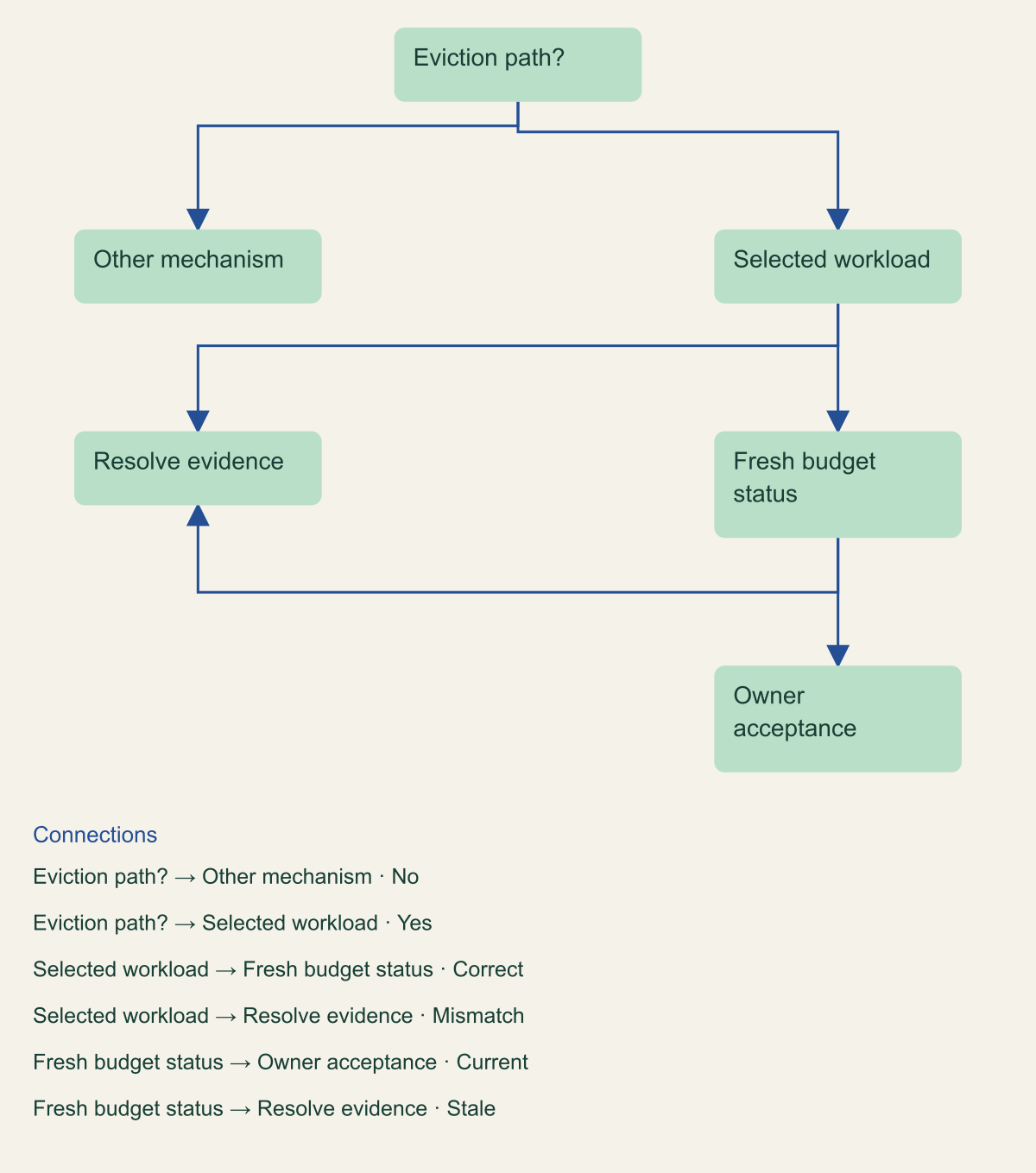
The decision tree intentionally includes a stop-for-evidence branch. Unknown selector scope or stale status is a reason to resolve the prerequisite, not a reason to assume the budget is unnecessarily strict. This keeps uncertainty from being converted into an implicit authorization for disruption.
Record who evaluated the status and when. A workload can change between preflight and execution, so the approved procedure should identify which conditions must be rechecked immediately before the authorized drain. A successful review earlier in the week does not establish that the same allowance still exists during maintenance.
Repeat the status review after a meaningful workload change during the maintenance window. A scaling event, readiness change or concurrent operation can alter the decision context even when the budget specification itself is unchanged. The execution receipt should preserve the relevant observation close to the action and distinguish it from the earlier planning snapshot. This is a recommended operational check, not a claim that the PDB reserves a future disruption allowance for the operator.
Resolve the preflight evidence before eviction
A stale or mismatched budget is a review gap, not permission to bypass it.

Source. Original preflight framework based on Kubernetes documentation. [1][2][3][5]
Method. Conceptual decision aid. Does not execute or authorize a drain.
Accessible table and figure data
| Question | If yes | If no |
|---|---|---|
| Eviction-based operation? | Review PDB | Review the actual mechanism |
| Correct selected population? | Read current status | Resolve selector |
| Status matches generation? | Assess allowance | Wait for valid evidence |
| Application prerequisites accepted? | Authorized drain | Owner decision |
| Question | If yes | If no |
|---|---|---|
| Eviction-based operation? | Review PDB | Review the actual mechanism |
| Correct selected population? | Read current status | Resolve selector |
| Status matches generation? | Assess allowance | Wait for valid evidence |
| Application prerequisites accepted? | Authorized drain | Owner decision |
Make readiness and unhealthy eviction explicit
PDB handling of unhealthy Pods deserves a deliberate review. The unhealthyPodEvictionPolicy field is stable from Kubernetes 1.31. Its default is IfHealthyBudget, while upstream guidance recommends AlwaysAllow for draining nodes with misbehaving Pods. Check the reader's cluster version and provider behavior before relying on that field. [2]
That recommendation does not eliminate application-specific consequences. An unhealthy Pod might still hold state, participate in a quorum or be needed for diagnosis. The workload owner should explain what eviction means for that application, including whether termination can worsen an already degraded condition. A policy that helps maintenance progress is not blanket permission to discard critical state.
Readiness is an input to the control, not proof of complete business correctness. A Pod can report ready while an external dependency prevents useful work, or remain unready because of a condition unrelated to whether its local state is recoverable. The maintenance decision needs both the Kubernetes signal and the service owner's acceptance criteria.
Consider a hypothetical workload with a Pod stuck in an unhealthy state during node maintenance. Ask whether the default policy is the reason eviction is blocked, what the proposed unhealthy-eviction behavior changes and how the remaining workload will be checked. Do not present changing the policy as a diagnosis of the readiness failure itself.
Preserve the old and proposed policy values and the rationale for any change. If the change is a temporary exception, record its expiration and restoration owner. If it is a lasting workload design choice, add it to the service's maintenance contract so the next operator does not rediscover the same decision under pressure.
A useful review separates three questions: is the Pod considered healthy by Kubernetes, is eviction permitted under the configured policy, and is the application's resulting state acceptable? Keeping those questions separate makes both a cautious pause and a justified continuation easier to explain.
Check where the replacement can run
A PDB does not create capacity or make a replacement ready. Before evicting a workload, review where a replacement can run and what it needs to start. This is an original preflight recommendation that complements the budget rather than changing its meaning.
Inspect placement constraints, available resources, volume attachment requirements and startup dependencies relevant to the workload. A replica count can look adequate while every viable replacement depends on the node or failure domain being maintained. Record the actual constraints rather than assuming that any free node is an eligible destination.
The review should include dependencies outside the Pod specification. An image registry, identity path or configuration service may be needed during startup even when the currently running replicas are stable. Maintenance can expose that difference by forcing a new instance through a path that existing instances have not used recently.
For a stateful workload, ask the application owner which conditions establish safe replacement. Storage becoming attached is not necessarily equivalent to a database becoming ready for useful traffic. Preserve the distinction between infrastructure progress and application acceptance, and link the service's established restore or recovery checks where appropriate.
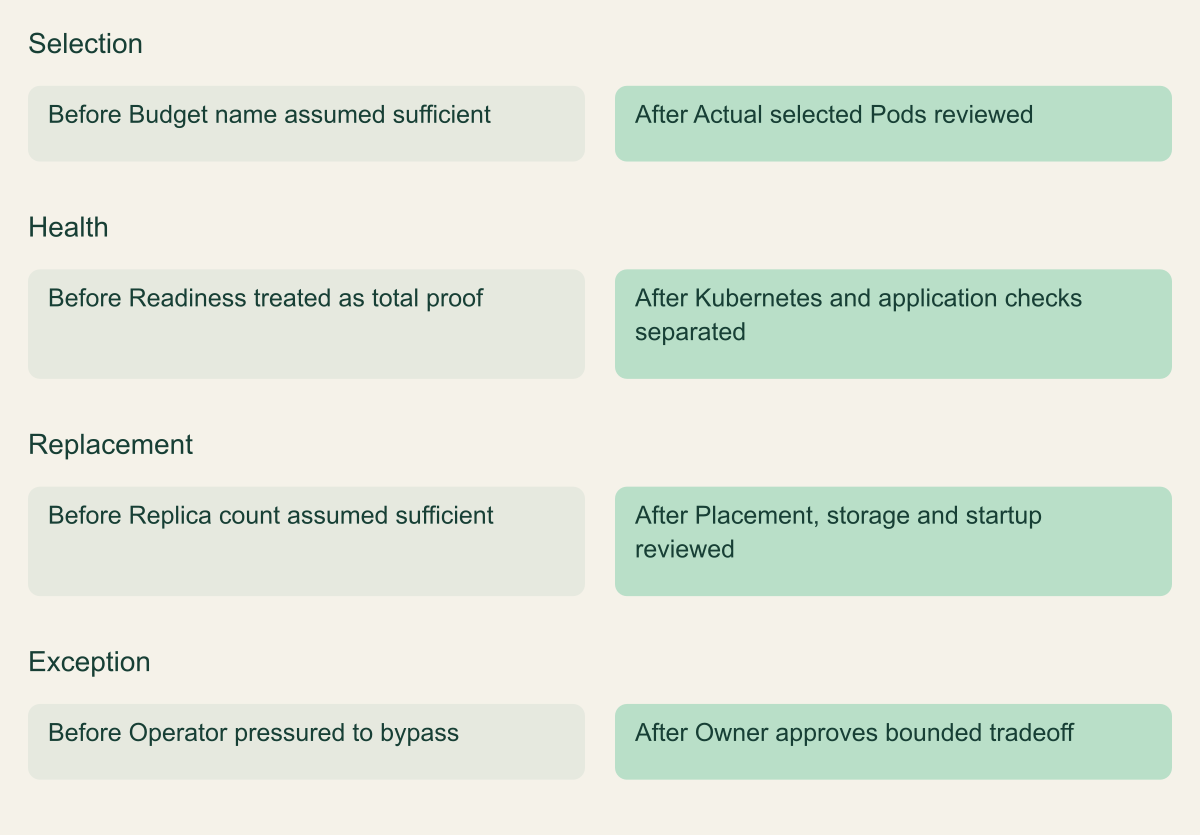
The before-and-after framework shows this change in review quality without claiming a measured downtime reduction. The after state makes selector scope, current budget, unhealthy handling and replacement readiness visible before a bounded drain. It does not promise that every maintenance problem can be predicted.
If replacement prerequisites cannot be established, escalate that concrete gap. An operator should not have to infer permission to continue from a general instruction to finish maintenance. Identify the decision owner, expected impact and evidence needed to proceed safely or reschedule the work.
Make replacement prerequisites visible
Budget allowance and a viable replacement are different checks.

Source. Original maintenance framework informed by Kubernetes documentation. [2][3][4][5]
Method. Conceptual comparison with no measured availability benefit.
Accessible table and figure data
| Boundary | Before | After |
|---|---|---|
| Selection | Budget name assumed sufficient | Actual selected Pods reviewed |
| Health | Readiness treated as total proof | Kubernetes and application checks separated |
| Replacement | Replica count assumed sufficient | Placement, storage and startup reviewed |
| Exception | Operator pressured to bypass | Owner approves bounded tradeoff |
| Boundary | Before | After |
|---|---|---|
| Selection | Budget name assumed sufficient | Actual selected Pods reviewed |
| Health | Readiness treated as total proof | Kubernetes and application checks separated |
| Replacement | Replica count assumed sufficient | Placement, storage and startup reviewed |
| Exception | Operator pressured to bypass | Owner approves bounded tradeoff |
Keep rollout policy separate
Deployment rolling-update controls use maxUnavailable and maxSurge in the controller's strategy, which is distinct from a PDB's eviction behavior. Kubernetes documents that percentage maxUnavailable values in a Deployment round down, while PDB percentage calculations round up. Identical-looking percentages therefore do not imply identical permitted disruption. [2][6]
A simple hypothetical arithmetic example makes the distinction visible. Thirty percent of three replicas is less than one. Rounding that quantity up versus down produces different integer allowances. This is only an explanation of the documented rounding rules, not a recommendation to use those settings or a prediction of application availability.
Review small replica counts especially carefully. A percentage that appears modest can produce a meaningful whole-Pod change. The service owner should understand the resulting integer behavior at the actual scale, including any scaling changes expected during maintenance. Avoid describing a percentage alone as conservative.
Keep the rollout and drain procedures separate in the operational record. A controller update can have its own scheduling, surge and readiness behavior, while an eviction-based maintenance action passes through a different control. Success in one procedure does not prove that the other has been tested.
If maintenance and a rollout might overlap, define ownership and coordination explicitly. The article does not claim a universal safe concurrency rule for all controllers. Instead, require the change plan to account for concurrent sources of unavailability and to preserve a clear explanation of which process changed the workload.
The practical review artifact is a paired description: the controller's rollout policy and the workload's eviction budget, each with its actual scope. This prevents a familiar maxUnavailable label from concealing two different mechanisms during an incident or maintenance handoff.
Treat drain bypass as an owned exception
Drain behavior has documented exclusions and caveats. Kubernetes explains DaemonSet handling and warns that Pods using nodeName or tolerations for unschedulability can still appear on a node intended for maintenance. Command completion therefore needs interpretation against the actual workload and scheduling behavior. [4]
An eviction response also needs its exact meaning. The API documents 429 responses for budget refusal or rate limiting, and a 500 response can indicate overlapping-budget misconfiguration. Do not treat every failed eviction as the same instruction to relax availability controls. Preserve the response and diagnose the supported alternatives. [5]
Direct deletion, forceful termination and eviction bypass are not neutral troubleshooting steps. They change the safety boundary under review. If an exception is necessary, the accountable owner should approve its expected impact, data implications and recovery plan. The operator should not inherit that authority merely because a drain has been waiting.
Before escalating, collect the evidence already available without disruption: selected Pods, budget generation and status, readiness, controller state and the exact API or drain response. This gives the decision owner a concrete problem instead of a vague request to force the node empty.
For a hypothetical urgent repair, the owner may decide that delaying maintenance is riskier than the accepted workload interruption. That can be a legitimate operational decision, but its receipt must describe the tradeoff and the expected recovery checks. It should not be reframed afterward as proof that the budget was irrelevant.
Do not normalize an exception by leaving the bypass in the standard runbook without review. After the event, determine whether the workload policy, capacity or procedure needs a durable correction. Preserve the original constraint as evidence of a design question, even when the immediate operation required a different authorized path.
Record the maintenance proof
A completed maintenance record should connect the approved preflight to what actually occurred. Include the selected workload, budget generation, relevant status, authorized action, observed evictions, replacement state and service acceptance result. The record should distinguish intended behavior from observed outcomes.
If the drain completed but an application check failed, the result is not an unqualified success. Likewise, an application that remained available does not prove that every intended control was respected. Report infrastructure completion and workload acceptance separately, with any exceptions assigned to an owner.
Retain failed or inconclusive checks. A missing status sample, an unexpected Pod placement or a replacement blocked by storage can explain why the next maintenance attempt needs different preparation. Erasing those details to leave a clean change ticket reduces the value of the exercise.
Finally, update the workload's maintenance contract when selectors, replica counts, readiness behavior, cluster versions or dependencies change. A PDB is useful when its relationship to the application is understood. The goal is a drain that can proceed under a known availability decision, not a budget that is always bypassed or a maintenance process that can never move forward.
Method and provenance
Source-led technical analysis of directly reviewed project and vendor documentation, with original decision frameworks and explicitly hypothetical examples. Sources were reviewed on September 2, 2026.
No customer environment, live configuration, workload measurement or production test was inspected. Product behavior and limits are bounded to the cited documentation and stated review date.
AI assistance. AI assisted research synthesis, drafting, diagram planning and deterministic editorial checks. No personal deployment experience, independent human review or live test is claimed.
Published under the Cloud Security Desk organizational byline. Read the practitioner guide policy.
References
- Disruptions Kubernetes. Accessed .
- Specify a disruption budget Kubernetes. Accessed .
- PodDisruptionBudget v1 API Kubernetes. Accessed .
- Safely drain a node Kubernetes. Accessed .
- API initiated eviction Kubernetes. Accessed .
- Deployments Kubernetes. Accessed .