A regional recovery review that explicitly applies AWS Availability Zone static-stability principles as an engineering inference. It covers prepared capacity, ARC control paths, data readiness, DNS observation, and failback dependencies.
At a glance
Key findings
- A recovery region is not ready if failover first requires provisioning capacity, discovering control endpoints, or repairing application dependencies.
- AWS ARC routing controls provide a documented data-plane mechanism, but application readiness and client behavior remain separate responsibilities.
- DNS TTL is a cache instruction, not a measured end-to-end failover duration or a guarantee that existing connections move.

Define what ready capacity must support
A recovery environment should have an explicit operating target. It may need to serve the full workload, a critical subset, or a deliberately reduced service. Specify that target before deciding whether the existing capacity is sufficient. A warm environment that can answer health checks may still be unable to handle the traffic or background work that arrives after a cutover.
Inventory dependencies with the application owner. Include data availability, secrets, certificates, runtime configuration, artifact access, service quotas, observability, and required downstream integrations. Identify which resources are already usable and which need a change during recovery. A standby application that reads configuration only from the affected region has a different failure boundary from its compute resources.
Keep capacity assumptions tied to evidence. A proposed exercise can use a controlled workload and record the accepted service level, latency, errors, and resource saturation. If production-scale testing is not authorized, preserve that limitation and use the available evidence to identify unanswered questions. Do not convert a successful low-volume request into a claim that the recovery region can carry peak demand.
Keep routing controls reachable during the failure
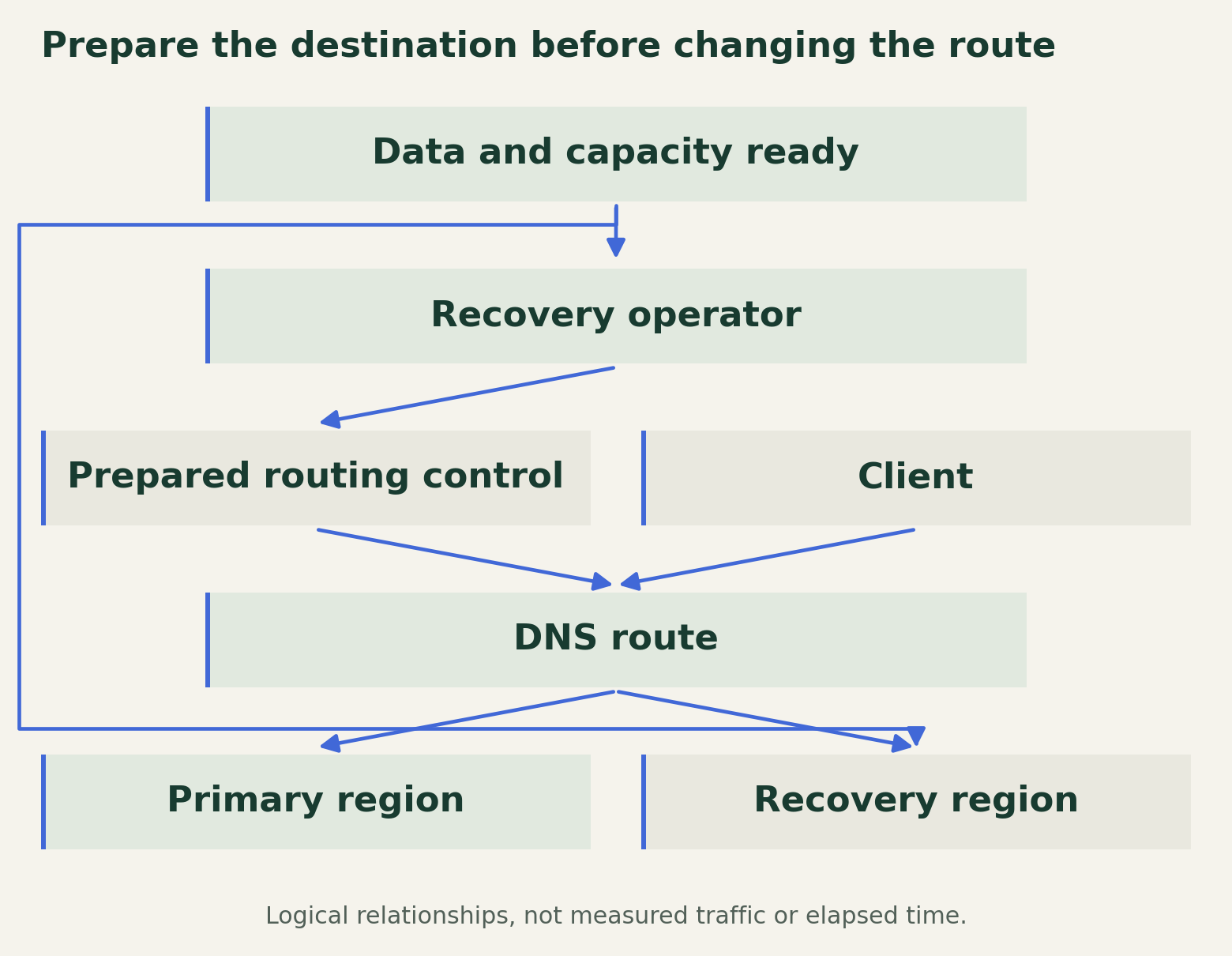
AWS ARC routing controls work with health checks used by Route 53 routing. AWS documents a redundant data plane and recommends retaining the cluster's regional endpoints and control identifiers, then using the data-plane API during recovery instead of depending on console discovery. These recommendations address the control path, not the application's readiness. [2][3]
The operational implication is to prepare the routing action before the incident. Store the required identifiers in an approved recovery record, validate the operator's permissions, and establish how the command reaches a working endpoint. Avoid a runbook whose only copy of those details lives in the application being recovered. Changes to routing-control configuration should trigger a review of the stored information.
Also define who is allowed to make the decision. A technically reachable API does not resolve conflicting operators, an ambiguous failure signal, or uncertainty about the receiving region. Record prerequisites for moving traffic and a way to observe the resulting control state. Keep the decision process short enough to use under pressure while preserving the checks that prevent an unsafe cutover.
Separate routing readiness from data readiness
Routing can move requests toward an environment that is not ready to accept writes. Before authorizing a cutover, establish which copy of the data is authoritative, how recent it is, and what prevents incompatible writers from operating at the same time. Those questions belong to the datastore and application design, not to the DNS routing control.
Use a dependency register to connect each acceptance criterion to an owner and a signal. For example, an application may require a verified recovery point, a designated writer, usable credentials, and a safe response from a critical downstream service. Label these as proposed criteria until the relevant environment has been exercised. A green regional health endpoint should not silently replace them.
Plan the return path as carefully as the initial move. After the original region recovers, data may have changed in the recovery region. Simply reversing the routing decision can expose stale state or conflicting authority. Define the reconciliation and acceptance process before calling failback routine, and preserve the ability to keep serving from the recovery environment while those checks are completed.
Measure when clients observe the change
Route 53 documents TTL as controlling how long DNS resolvers may cache a record. A routing change therefore does not imply that every client immediately requests a new answer. [4] Treat the configured TTL as an input to the behavior under review, not as a complete measurement of service recovery.
The acceptance exercise should observe representative client paths. Record when the routing control changes, when new DNS answers are observed, when requests reach the receiving environment, and when the service passes its agreed checks. Existing connections and application retry behavior need separate observation because a DNS answer alone does not describe an already established session.
Report the test conditions honestly. Resolver choice, client location, connection reuse, workload shape, and the exact failure scenario can affect what the exercise demonstrates. A single synthetic probe is useful for a narrow observation, but it should not become a universal cutover time. Preserve failed and delayed paths so the next run can test whether the identified dependency was actually repaired.
Maintain the ready state between exercises
Readiness can drift even when no one changes the recovery runbook. Application releases introduce new dependencies, certificates expire, secrets rotate, and resource requirements grow. Include recovery configuration in ordinary change review so the standby environment does not become an older, incomplete description of production.
Keep a compact evidence package for each exercise: application versions, dependency states, capacity target, routing identifiers, operator role, data acceptance, client observations, and the final operating decision. Separate observed timings from objectives and assumptions. This record makes disagreements about readiness easier to resolve because the discussion can focus on a concrete missing condition.
A region is prepared when the organization can identify the existing resources that will carry the accepted workload and the surviving control path that will direct traffic to them. Any remaining creation step is an explicit recovery dependency. That is the practical value of static stability in this review: fewer critical capabilities must be invented while the primary service is already unavailable.
Method and provenance
Primary documentation review completed August 28, 2026, with an original regional dependency register and proposed client-observation plan.
No regional deployment, traffic cutover, capacity test, or DNS timing experiment was performed. Applying static stability beyond the cited Availability Zone setting is explicitly an editorial inference.
AI assistance. AI assistance was used to research sources, draft and structure the article, and prepare the visual specification. No human technical review is claimed.
Published under the Cloud Security Desk organizational byline. Read the series policy.
References
- Static stability using Availability Zones AWS Builders' Library. Accessed .
- Routing control in Amazon Application Recovery Controller AWS. Accessed .
- Best practices for routing control in Amazon ARC AWS. Accessed .
- Values for simple records in Route 53, including TTL AWS. Accessed .