
A public TLS lifecycle guide grounded in the CA/Browser Forum validity schedule and current ACME, ARI and issuer documentation. It distinguishes issuance limits from vendor profiles and follows authorization, deployment, served-endpoint checks and recovery responsibilities.
At a glance
Key findings
- Public TLS maximum validity depends on issuance date; the current schedule reaches 47 days for issuance on or after March 15, 2029. [1]
- ACME, ARI, issuer profiles and deployment integrations have distinct roles and support requirements. [3][4][5][8]
- Close renewal on an observed served certificate, not only successful issuance or an updated file.
Renewed is not the same as served
A certificate can be renewed successfully while an endpoint continues serving an older one. Issuance, installation, process reload and client verification are separate events. As public TLS certificate validity limits shorten, a renewal process needs evidence across that whole path, not only a successful request to the certificate authority.
Consider a hypothetical service with a managed edge certificate and a separately operated origin. The edge renews on schedule, but the origin's deployment job fails. An inventory that records only the newest certificate in the account can look healthy while a different endpoint still has an approaching expiration. This example illustrates an operational boundary; it is not a reported outage or a test performed for this article.
The public TLS schedule also needs a precise scope. CA/Browser Forum requirements govern publicly trusted TLS subscriber certificates. They do not set the lifetime of every private certificate, SSH certificate or application authentication credential. A team reviewing Entra application certificate rotation is working with a different authority and lifecycle, even if both tasks involve certificate files. [1]
A useful renewal design has an owner for each transition: authorization, issuance, delivery, deployment and verification of the certificate actually served. It should also identify what happens if a transition fails and how the service remains usable while the problem is resolved. Automation reduces manual steps only when those dependencies are supported and observable.
The standards and product details below were checked on August 28, 2026. No customer certificate inventory or renewal job was inspected. The schedule chart is a transcription of normative limits, and the lifecycle example is conceptual.
Read the issuance schedule precisely
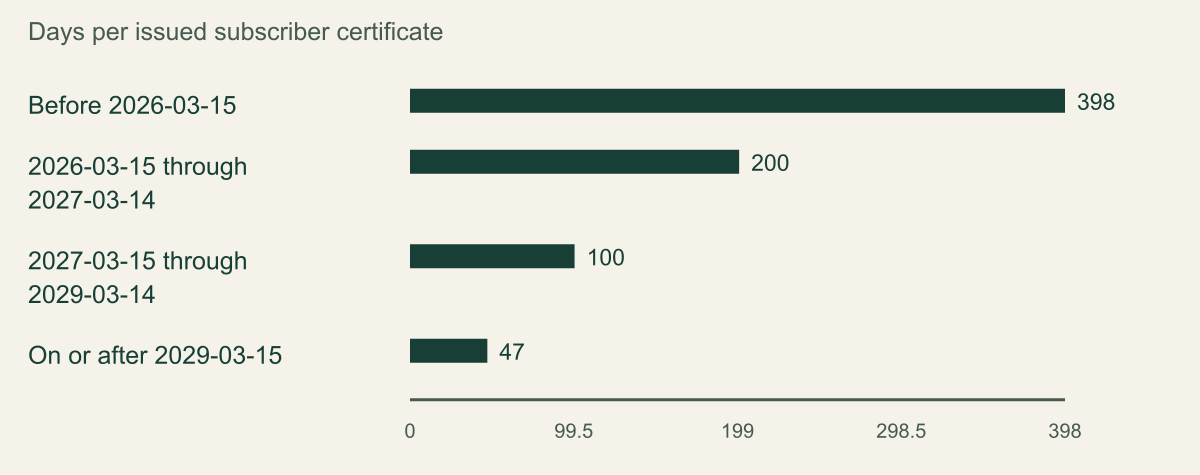
Section 6.3.2 of the CA/Browser Forum TLS Baseline Requirements defines maximum validity according to when a subscriber certificate is issued. Before March 15, 2026, the maximum is 398 days. From March 15, 2026 until March 15, 2027, it is 200 days. From March 15, 2027 until March 15, 2029, it is 100 days. On or after March 15, 2029, it is 47 days. [1]
Those are the MUST NOT maximums shown in the chart. The same section gives shorter SHOULD NOT values of 397, 199, 99 and 46 days and explains the calculation of a day. The chart should not be read as an instruction to issue every certificate for the largest permitted interval. It shows a normative ceiling, not a recommended operating target. [1]
The issuance boundary matters. An already issued certificate does not have its encoded expiration rewritten when the next schedule period begins. Conversely, a new issuance must meet the rules applicable to that issuance. Treating the change as a universal day on which all existing certificates suddenly expire would misstate the requirement.
Domain and IP validation-data reuse has a separate schedule. Do not substitute that period for certificate validity or combine both into one unlabeled chart. A renewal workflow must satisfy the applicable authorization and validation requirements, but those requirements answer a different question from how long the issued certificate remains valid. The ballot provides adoption context; the current requirements are the operative reference. [1][2]
Issuer profiles can be shorter than the normative maximum. Let's Encrypt's February 24, 2026 announcement describes its own planned changes to certificate lifetimes and rate limits. Those details matter to users of that CA, but its selected profile is not the universal CA/Browser Forum maximum. Keep the issuer policy and the baseline requirement separate in planning records. [5]
Use absolute dates in the inventory and review schedule. Phrases such as next spring or the new limit become ambiguous when copied into a long-lived procedure. Record the source checked, the applicable issuance window and the date on which the team intends to recheck the policy.
Public TLS maximum certificate validity
CA/Browser Forum TLS Baseline Requirements section 6.3.2, reviewed August 28, 2026. Maximum validity depends on issuance date. This schedule covers publicly trusted TLS subscriber certificates, not private PKI or application credentials.

Source. Primary source [1]. Reviewed August 28, 2026. CA/Browser Forum TLS Baseline Requirements section 6.3.2, reviewed August 28, 2026. Maximum validity depends on issuance date. This schedule covers publicly trusted TLS subscriber certificates, not private PKI or application credentials.
Method. CA/Browser Forum public TLS certificate requirements reviewed August 28, 2026. Unit: days of maximum certificate validity. The four values are the MUST NOT maximums of 398, 200, 100 and 47 days for their respective issuance-date windows. No calculation or interpolation was used. The separate SHOULD NOT recommendations are 397, 199, 99 and 46 days. These rules concern covered public TLS certificates and do not make previously issued certificates expire immediately when a new window begins. They do not measure renewal or deployment reliability.
Accessible table and figure data
| Certificate issue window | Maximum validity days |
|---|---|
| Before 2026-03-15 | 398 |
| 2026-03-15 through 2027-03-14 | 200 |
| 2027-03-15 through 2029-03-14 | 100 |
| On or after 2029-03-15 | 47 |
| Certificate issue window | Maximum validity days |
|---|---|
| Before 2026-03-15 | 398 |
| 2026-03-15 through 2027-03-14 | 200 |
| 2027-03-15 through 2029-03-14 | 100 |
| On or after 2029-03-15 | 47 |
Inventory the renewal responsibilities
Begin with endpoints and names, not a directory of certificate files. Identify the hostnames users or systems reach, the places TLS terminates and the owners responsible for each path. A service can have a public edge, a load balancer, an origin and an administrative endpoint with different renewal arrangements.
For each termination point, record the issuer, certificate manager or client, validation method, key custody and deployment integration. Distinguish the place where a certificate is issued from the place where it is installed. If those are managed by different systems or teams, make the handoff explicit rather than assuming a successful issuance triggers a successful deployment everywhere.
AWS ACM's managed-renewal guidance documents eligibility and service-specific behavior. Use that source to determine which certificates and integrations receive the documented automation. Do not generalize managed renewal into a claim that ACM automatically updates every independently operated application or origin using a certificate. The deployment responsibility depends on the integration. [8]
Identify how the running process receives changed material. Some integrations handle this under a managed service contract; other applications require an installation or reload step. The relevant proof is that the intended endpoint now serves the expected certificate, not merely that a secret store or file path contains a newer object.
An unknown owner is an operational finding. Assign someone to resolve the renewal and deployment path before an expiration forces an emergency decision. The same applies to undocumented names and endpoints that appear only in monitoring or old configuration. An incomplete inventory can undermine an otherwise well-designed renewal client.
Keep sensitive details out of public documentation. A general lifecycle record can explain roles and controls without exposing private key locations, unrestricted DNS tokens or internal management endpoints. The controlled operational inventory needs enough detail for authorized recovery, but the public article does not need those secrets.
Automate authorization without broadening it unnecessarily
ACME standardizes interactions used for automated certificate management, including account and authorization workflows. It does not eliminate the need to establish authority over the requested identifiers. The client, validation method and CA must support the selected process, and the organization must preserve the credentials and access that process requires. [3]
Choose a challenge method based on the service's actual constraints. Let's Encrypt documents HTTP-01, DNS-01 and other supported approaches, with different requirements and limitations. The method that is convenient for a public web endpoint may not fit a wildcard request or a different network arrangement. Use the issuer's current documentation rather than assuming one challenge works for every name. [6]
DNS-01 introduces a particularly important authority boundary because automation needs to arrange the required DNS records. Review what the credential can change and whether its scope can be limited to the validation purpose. A renewal job should not receive broad zone administration merely because that is the easiest token to create.
Separate the automation's routine authority from the authority needed to repair it. A client may legitimately update validation records while an administrator controls its configuration or account recovery. Record both paths so a failed credential rotation does not leave the team unable to renew or tempted to distribute an unrestricted credential during an incident.
Test the authorization path under approved conditions before relying on it. The test should establish that the selected client can complete the supported validation and that failures are visible to an owner. It should also identify external dependencies, such as DNS access or network reachability, whose loss would prevent issuance.
Keep the source of each authorization assumption visible. A CA's challenge documentation explains its supported mechanism. A DNS provider's permissions explain what a token can modify. The application's deployment process explains how the resulting certificate is used. None of those documents alone describes the complete lifecycle.
Use renewal information with explicit client support
RFC 9773 defines the ACME Renewal Information extension, commonly called ARI. It lets the server provide a suggested renewal window. That information can help a supporting client schedule renewal, but the extension's existence does not establish that a particular client, account or certificate workflow uses it correctly. [4]
Treat ARI as one input to the operational schedule. Confirm the client version and CA behavior, observe how the client uses the suggested window and determine what happens if renewal information is unavailable. A schedule that exists only in a design document is not evidence that the installed client will act before the service loses a usable certificate.
Rate-limit treatment is also issuer-specific. Let's Encrypt publishes current rules, including the conditions under which renewal behavior receives particular treatment. Consult those rules directly when planning retries or a large certificate change. Do not infer a universal exemption for every renewal from a headline about ARI or from another CA's policy. [7]
Avoid converting a shorter lifetime into a fixed manual calendar task without reviewing the client lifecycle. The point of supported automation is to make authorization, scheduling and renewal repeatable. A manual reminder can be a supplementary control, but it does not prove the deployed client is healthy or that the certificate reaches every endpoint.
A failed renewal should produce an actionable record: the affected name, the current certificate, the failed stage and the responsible owner. Distinguish a scheduling failure from an authorization failure or an issuance rejection. Those problems can require different repairs, and an undifferentiated renewal failed message may delay the useful response.
The plan should retain room for future policy changes without pretending to predict them. Record the current baseline, issuer profile and client support, then define a review trigger when any of those changes. The article's dated references establish what was checked, not a guarantee that the same rules will remain in effect indefinitely.
Verify deployment at the endpoint
The renewal sequence should end at an independent client observation. After issuance and installation, verify that the intended endpoint serves the expected certificate and chain for the requested name. This is a different check from finding a new certificate in the management system or seeing an installation job return successfully.
Choose the observation path deliberately. A check through a public edge may validate that edge while saying little about a separately terminated origin connection. A direct origin check may omit the path users actually take. Record which hostname, route and termination point the verification covers so the result is not generalized to unrelated endpoints.
The hypothetical edge-and-origin service makes the distinction concrete. The edge renewal can be complete while origin deployment remains open. The lifecycle record should show two states and two owners if that is how the service operates. An overall green status should not obscure the unresolved origin simply because the edge is the most visible certificate.
Where a running process loads certificate material, verify the load boundary. An updated file or secret can coexist with a process that still uses previously loaded material. The related secret-rotation guide covers that broader pattern. For TLS, the served certificate supplies a direct observation of what the endpoint is presenting at the time of the check.
Keep deployment evidence reproducible without exposing keys. The record can identify the certificate by suitable public attributes, the endpoint observed, the time and the verification result. Private key material is not needed in a routine evidence screenshot or a general incident ticket. The receipt should explain the result without creating another disclosure path.
A successful observation is time-bounded. It proves what the checked endpoint served under that path and configuration, not that every replica or future deployment will remain correct. If several independently managed endpoints need verification, the inventory should identify them rather than allowing one successful request to stand in for the whole estate.
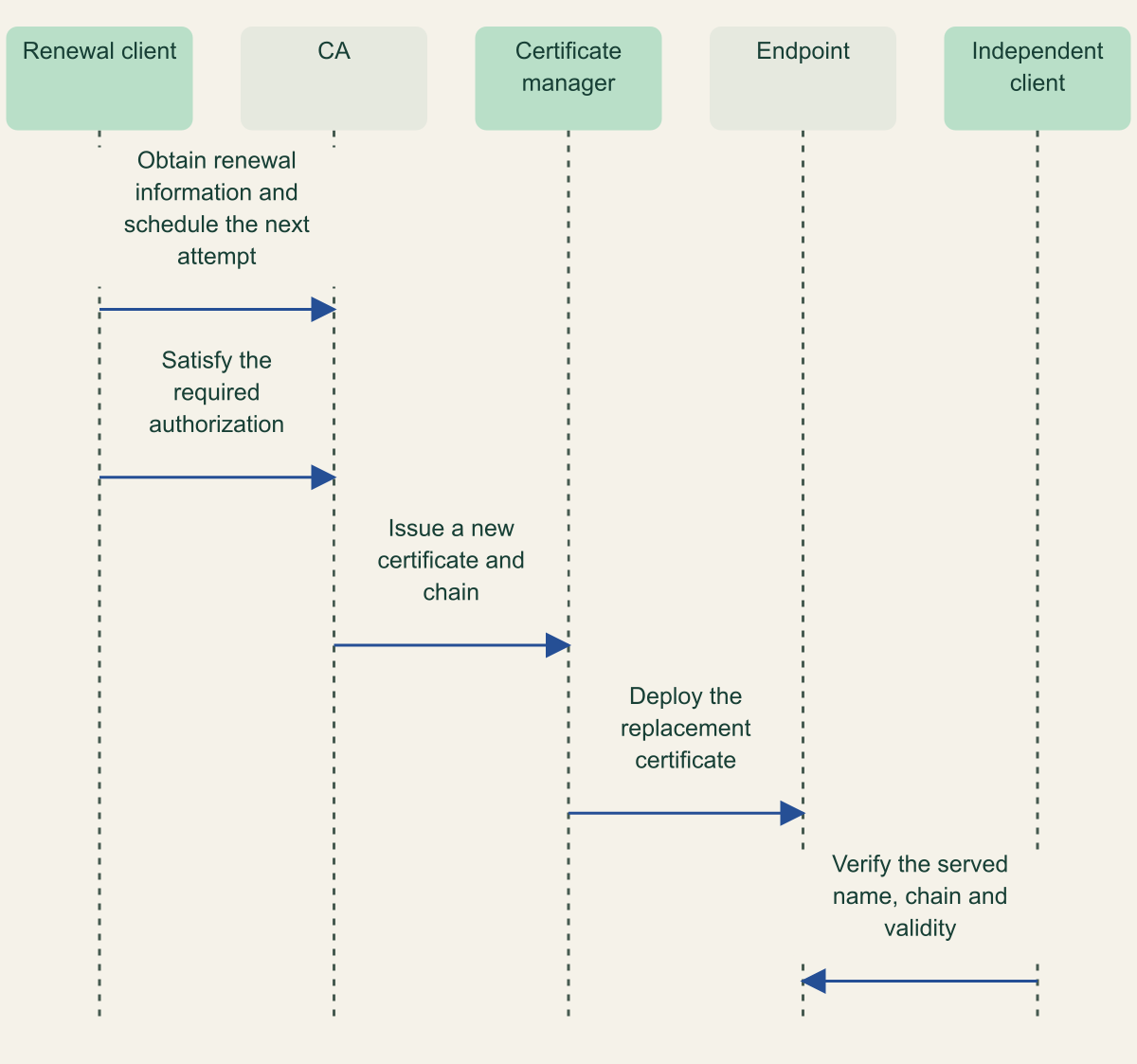
A renewal reaches the endpoint through several steps
Issuance and deployment have separate acknowledgments, and the final check observes the certificate served to a client.

Source. Primary documentation [3] [4] [8]. Reviewed August 28, 2026.
Method. Original conceptual synthesis reviewed August 28, 2026. Unit: qualitative states and relationships. Scope: Shorter TLS certificate validity and renewal lifecycle. It is not measured performance, prevalence, risk or implementation proof. Issuance and deployment have separate acknowledgments, and the final check observes the certificate served to a client.
Accessible table and figure data
| Step | Actors | Evidence |
|---|---|---|
| Schedule | Client and CA renewal information | Planned renewal window |
| Authorize | Client, validation service and CA | Authorization result |
| Issue | CA and certificate manager | New certificate and chain |
| Deploy | Certificate manager and endpoint | Installation or integration receipt |
| Verify | Independent client and endpoint | Served name, chain and validity |
| Step | Actors | Evidence |
|---|---|---|
| Schedule | Client and CA renewal information | Planned renewal window |
| Authorize | Client, validation service and CA | Authorization result |
| Issue | CA and certificate manager | New certificate and chain |
| Deploy | Certificate manager and endpoint | Installation or integration receipt |
| Verify | Independent client and endpoint | Served name, chain and validity |
Prepare for failed renewal and failed deployment
Plan for failures at each stage. Authorization may be unavailable, a client credential may stop working, issuance may be rejected or deployment may fail after a certificate is obtained. The recovery action should match the failed boundary. Repeatedly requesting new certificates does not repair an application that is unable to load the certificate it already has.
Maintain an approved path to the required account, DNS and key-management controls. Access should be limited and auditable, yet usable by designated operators during a service incident. A recovery process that depends on an unavailable identity path needs to be addressed before it becomes an emergency.
Rollback also needs a meaningful definition. Restoring a previous configuration can be useful if it returns the service to a valid and authorized state. Rolling back to an expired certificate is not recovery merely because the deployment tool accepts the old file. Check the actual served result and validity after any corrective action.
Identify how alert ownership changes across teams. A CA or certificate manager may report issuance trouble, while application monitoring detects that an endpoint still serves old material. Route each signal to someone who can act at that boundary, and preserve a common record so the teams do not diagnose the same problem independently.
Exercises should remain within authorized and supported environments. Test failure visibility, access and recovery steps without deliberately breaking a production certificate path to create article evidence. This article has not executed such an exercise and makes no claim about the reader's current readiness.
Make the next review part of the lifecycle
The closure record should identify the issued certificate, the deployment transition and the endpoint verification that supports success. Retain any exclusions, such as an endpoint outside the checked path or a client whose support remains unconfirmed. That record is more specific than a single renewed flag and makes later investigation easier.
Review the process after a CA policy change, client upgrade, DNS permission change or new TLS termination point. Each can alter a prerequisite without changing the application team’s visible certificate inventory. Keep the next review date and source references attached to the lifecycle documentation.
The shorter validity schedule creates a concrete reason to examine automation, but the useful operating principle lasts beyond the schedule. A certificate must be authorized, issued, deployed and served correctly. Assign those transitions, verify them at their actual boundaries and keep a recovery path for the step that fails.
Method and provenance
Primary documentation review and original operational analysis, checked August 28, 2026. Source versions, claim mappings and visual data are retained in the accompanying research dossier. This article was first published in the practitioner-guides collection on August 28, 2026.
No customer environment, incident evidence, production deployment or service performance was tested for this article. Hypothetical examples and conceptual diagrams are labeled. Chart values retain their stated source scope and must not be interpreted as organizational risk or measured implementation success. Organization-specific authorization, architecture and legal obligations require their own review.
AI assistance. Researched, drafted and checked against cited sources with AI assistance. No independent human editorial review or original empirical testing is claimed.
Published under the Cloud Security Desk organizational byline. Read the practitioner guide policy.
References
- Latest Baseline Requirements | CA/Browser Forum CA/Browser Forum. Accessed .
- Ballot SC081v3: Introduce Schedule of Reducing Validity and Data Reuse Periods | CA/Browser Forum CA/Browser Forum. Accessed .
- RFC 8555 Automated Certificate Management Environment RFC Editor. Accessed .
- RFC 9773: ACME Renewal Information (ARI) Extension RFC Editor. Accessed .
- Shorter Certificate Lifetimes and Rate Limits - Let's Encrypt Let's Encrypt. Accessed .
- Challenge Types - Let's Encrypt Let's Encrypt. Accessed .
- Rate Limits - Let's Encrypt Let's Encrypt. Accessed .
- Managed certificate renewal in AWS Certificate Manager - AWS Certificate Manager Amazon Web Services. Accessed .