
A DNS recovery analysis spanning authoritative health routing, positive and negative caches, stale answers, Java runtime behavior and persistent connections. It explains how to observe each boundary without turning a low TTL or one successful lookup into an end-to-end recovery claim.
At a glance
Key findings
- Authoritative routing, resolver caching, application caching and existing connections are separate failover boundaries. [1][2][6][8]
- Negative caching and serve-stale behavior require their own interpretation; TTL expiry is not a universal client migration guarantee. [3][4]
- Record the exact observation path and application outcome instead of treating one DNS lookup as complete recovery.
Changing the answer does not move every client
An authoritative DNS change controls the answer a nameserver is prepared to return. It does not instantly replace every answer already cached by a recursive resolver, change every application's address cache or move a connection that is already established. A low TTL can influence one part of that process without defining the complete recovery time.
Imagine three clients in a hypothetical failover exercise. One performs a fresh lookup after the authoritative change. Another retains a previously resolved address. A third continues using an existing connection and does not need another lookup yet. The clients can therefore occupy different states even while the authoritative service consistently returns the new destination.
The practical task is to observe those boundaries separately. Record health detection, authoritative selection, recursive answers, application resolution and the peer actually used by the application. A successful result at one boundary is useful evidence, but it should not be described as proof that every client has completed failover.
Foundational DNS specifications describe resolution and caching, including the TTL field associated with resource records. Later standards address negative caching and serving stale data. Provider and runtime documentation add implementation-specific behavior. These sources explain why one numerical TTL is an incomplete service-recovery claim. [1][2][3][4]
This guide concerns DNS and client convergence. The related regional failover guide addresses prepared infrastructure and control-plane dependencies. No live failover experiment was performed for this article, and the timeline uses qualitative event order rather than invented elapsed times.
Separate health detection from authoritative routing
Health-based DNS routing begins with a decision about the destination's health. The provider then applies its configured routing behavior when answering queries. The interval between an application problem and a changed authoritative answer can include health observation and policy decisions before a resolver's cache behavior becomes relevant.
Route 53's failover documentation describes authoritative responses based on configured health behavior. That explains which answer the service selects under the relevant policy; it does not establish when every recursive resolver or application will request that answer. Keep the provider decision and client migration as separate observations. [6]
Review what the health signal actually represents. A check against a simple endpoint may establish that the endpoint responds while leaving a critical business dependency untested. Conversely, a check can fail because of its own path or configuration. The routing policy should be connected to the intended service condition rather than an unexplained healthy flag.
Record the change at the authoritative boundary. Identify the name, record type, routing configuration and answer returned from the relevant authoritative service. A configuration update request and an observed answer are different events. The latter gives a clearer basis for investigating what downstream resolvers and clients may subsequently receive.
Provider-specific record behavior matters. Route 53 and Cloudflare document TTL and record-type considerations that should be reviewed for the actual setup. Do not transfer a default or recommendation from an ordinary record to an alias, proxied record or another provider without checking its rules. [5][7]
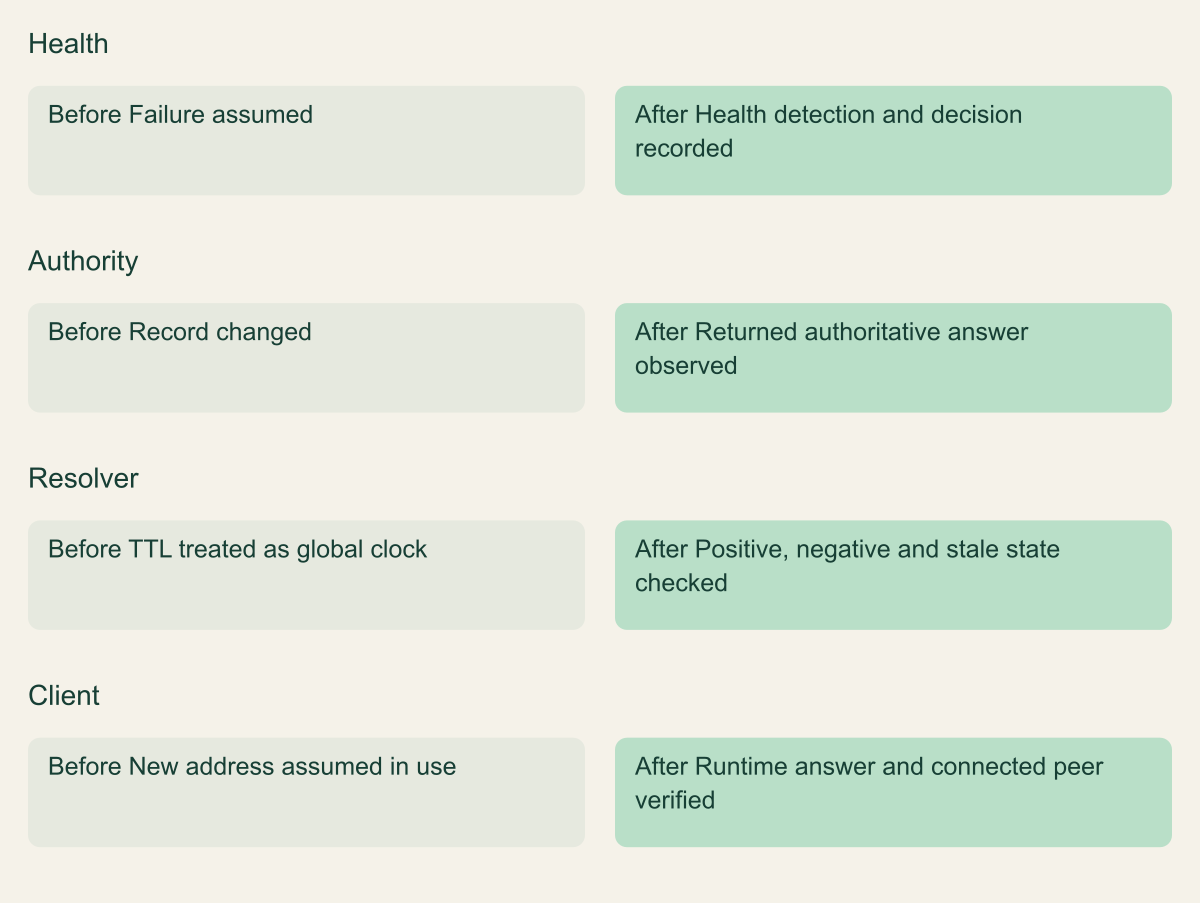
The before-and-after comparison replaces the idea of a single failover clock with an observation record. It does not say that every boundary is equally slow or that DNS is necessarily the cause of an outage. Its purpose is to make the claim testable: which state changed, where was it observed and which downstream state remains unresolved?
Replace a single failover clock with observed boundaries
The proposed recovery record observes each boundary rather than assuming the authoritative TTL is the whole failover time.

Source. Primary documentation [6] [1] [3] [4] [8]. Reviewed August 28, 2026.
Method. Original conceptual synthesis reviewed August 28, 2026. Unit: qualitative states and relationships. Scope: DNS failover TTL and cache boundaries. It is not measured performance, prevalence, risk or implementation proof. The proposed recovery record observes each boundary rather than assuming the authoritative TTL is the whole failover time.
Accessible table and figure data
| Boundary | Before | After |
|---|---|---|
| Health | Failure assumed | Health detection and decision recorded |
| Authority | Record changed | Returned authoritative answer observed |
| Resolver | TTL treated as global clock | Positive, negative and stale state checked |
| Client | New address assumed in use | Runtime answer and connected peer verified |
| Boundary | Before | After |
|---|---|---|
| Health | Failure assumed | Health detection and decision recorded |
| Authority | Record changed | Returned authoritative answer observed |
| Resolver | TTL treated as global clock | Positive, negative and stale state checked |
| Client | New address assumed in use | Runtime answer and connected peer verified |
Read positive and negative cache behavior separately
A positive answer supplies data that a resolver can cache under DNS rules. The resource record's TTL affects ordinary reuse of that cached data. If a resolver already has an answer, an operator's later change at the authoritative service does not ordinarily reach into that resolver and replace its stored copy immediately. [1][2]
This is why lowering a TTL after an incident begins should not be treated as retroactive cache invalidation. An answer obtained earlier may still be governed by the state the resolver retained. A planned change can prepare an appropriate TTL in advance, but the actual convergence claim still needs to account for the resolvers and clients involved.
Negative caching is a different state. RFC 2308 describes caching of negative answers, including cases where a name does not exist or the requested data is absent. A name introduced during recovery may therefore encounter a previously cached negative result rather than a cached old destination. The operator needs to identify which answer is being retained. [3]
Read the negative response itself. A nonexistent-name response and a response indicating that the requested record data is absent are different cases under RFC 2308. A name can exist without the particular record type a client requested. Preserve the response code and relevant answer context rather than translating every empty result into hostname missing. That distinction can change whether the next investigation concerns the name, the record type or a retained negative answer. [3]
Distinguish those cases in the evidence. A resolver returning an old address, a resolver returning a negative answer and a resolver unable to answer are not interchangeable symptoms. Each suggests different next questions about the prior response, caching policy, authoritative data and network path. A generic DNS failed label can conceal the useful distinction.
Avoid making the application retry the wrong operation without understanding the state. Repeating an identical lookup through the same cache may return the same retained answer. The diagnostic goal is to identify the boundary, not merely to produce more requests and hope that one happens to show the desired result.
Record the resolver used by a test. A lookup through one public recursive service and a lookup through the application's configured resolver may produce different evidence. Neither result should be generalized to all clients. The test record should state its vantage point and the reason that vantage point matters to the service.
The intended record type also belongs in the observation. An application can use more than one address family or perform different lookups along its connection path. A successful answer for one type does not automatically establish that the application selects it or that every relevant lookup now returns usable data.
Account for stale answers during resolver trouble
TTL expiry does not describe every possible resolver behavior. RFC 8767 specifies a way to serve stale DNS data under defined conditions, helping maintain resolution when fresh authoritative information is unavailable. That creates an availability-versus-freshness tradeoff that an operator should understand before treating an expired TTL as proof that an old answer cannot appear. [4]
Do not assume every resolver implements the same stale-answer policy. The standard describes the mechanism and recommendations; the effective behavior depends on the deployed resolver and its configuration. A particular observation should be explained with the relevant implementation evidence rather than a universal assertion about all DNS caches.
Stale data can be useful when the alternative is no answer. During a destination change, however, continued use of an older answer may conflict with the operator's desired convergence. The right interpretation depends on the failure scenario. A resolver preserving availability under authoritative trouble is not necessarily behaving like a broken ordinary TTL cache.
Separate authoritative availability from destination availability. A resolver may be unable to refresh an answer even while an old destination remains usable, or it may retain an answer whose destination no longer serves the application. The DNS result and the service transaction are different observations and should remain separate in the recovery record.
When investigating stale behavior, retain the answer, its context and the resolver path used by the client. Do not infer a complete resolver configuration from one returned TTL value. The next step may require provider documentation or an operator of the resolver to explain the effective policy.
This boundary also changes the interpretation of a test. An exercise in which the authoritative service remains available can demonstrate a different path from an event that impairs authoritative reachability. State which condition was tested. A single successful planned change does not prove how the same clients will behave when fresh resolution itself is disrupted.
Inspect the application's own boundary
An application can add another cache after recursive resolution. Oracle's Java SE 25 InetAddress documentation describes address caching and associated security properties, including separate treatment of successful and unsuccessful lookups. That is one concrete runtime example, not a description of every language or every deployed Java configuration. [8]
Inspect the effective runtime policy rather than assuming a DNS record's TTL is the only value involved. The configuration that ships with a runtime, the security properties applied by an operator and application behavior can affect the result. A review should identify the actual runtime version and configuration used by the service being tested.
Connection reuse is separate again. Once a client has established a connection to a peer, the next application request may use that connection without performing another DNS lookup. A new authoritative answer therefore does not, by itself, establish that the next request will reach a new address. Examine the client's connection lifecycle as well as its resolver behavior.
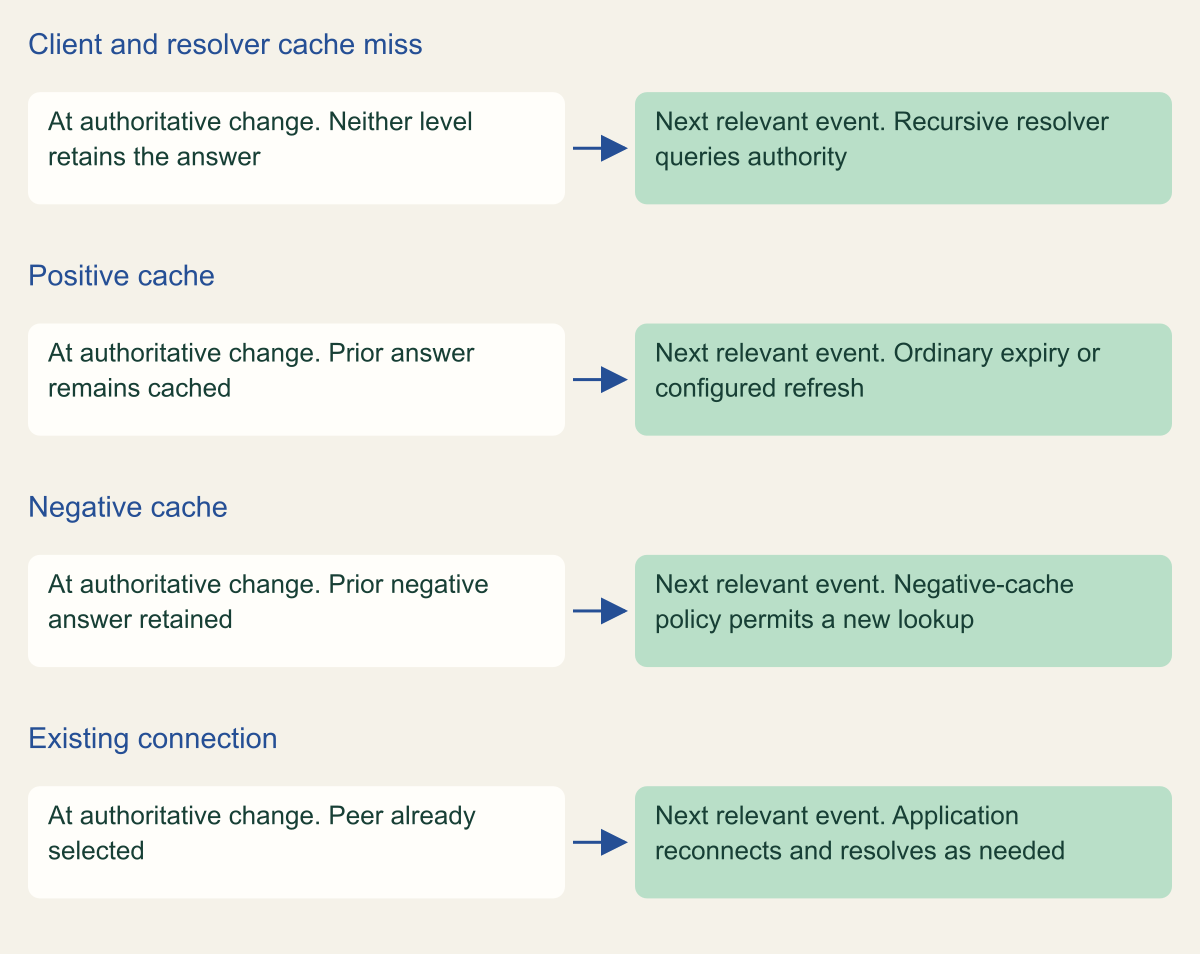
The qualitative timeline shows these states without assigning durations. Its first lane assumes that neither the client nor the recursive resolver retains the answer, so the resolver queries the authority. A client-side cache miss alone is insufficient: the recursive resolver can still answer from its own cache. Retained positive answers, retained negative answers and existing connections have different next relevant events. Equal-length segments would imply timing evidence the article does not have. [1][3][4]
Client libraries and intermediaries can add complexity. An application may resolve through a local component or connect through a proxy that performs its own selection. The operating question is where the address decision is made and where it is retained. Trace that path rather than assuming that a shell lookup from the same machine reproduces the application's behavior.
TLS also remains a separate acceptance condition. Reaching the new destination is not useful if that destination serves the wrong certificate for the intended name or cannot complete the application exchange. The certificate-renewal guide explains served-endpoint verification. A DNS recovery observation should not silently stand in for those higher-layer checks.
Avoid prescribing a universal cache-disabling setting. Reducing caching can change query load and dependency behavior, and the appropriate policy depends on the service's needs. The useful recommendation is to make the runtime policy explicit and test its effect on the stated recovery objective.
Clients can occupy different states after a DNS change
Each lane describes a different client state and its next relevant event, with no invented elapsed-time scale or universal convergence promise.

Source. Primary documentation [1] [3] [4] [8]. Reviewed August 28, 2026.
Method. Original conceptual synthesis reviewed August 28, 2026. Unit: qualitative states and relationships. Scope: DNS failover TTL and cache boundaries. It is not measured performance, prevalence, risk or implementation proof. Each lane describes a different client state and its next relevant event, with no invented elapsed-time scale or universal convergence promise.
Accessible table and figure data
| Client state | At authoritative change | Next relevant event |
|---|---|---|
| Client and resolver cache miss | Neither level retains the answer | Recursive resolver queries authority |
| Positive cache | Prior answer remains cached | Ordinary expiry or configured refresh |
| Negative cache | Prior negative answer retained | Negative-cache policy permits a new lookup |
| Existing connection | Peer already selected | Application reconnects and resolves as needed |
| Client state | At authoritative change | Next relevant event |
|---|---|---|
| Client and resolver cache miss | Neither level retains the answer | Recursive resolver queries authority |
| Positive cache | Prior answer remains cached | Ordinary expiry or configured refresh |
| Negative cache | Prior negative answer retained | Negative-cache policy permits a new lookup |
| Existing connection | Peer already selected | Application reconnects and resolves as needed |
Observe each boundary during an authorized exercise
Define the recovery question before choosing diagnostic commands. Does the team need to verify that the authoritative answer changed, that a particular resolver refreshed its answer or that the application's critical transaction now reaches a healthy destination? Those are different tests, and each should have an expected result and an observation point.
For the authoritative check, record the name, type, relevant policy and returned answer. For the recursive check, identify the resolver and the state it returns. For the application check, identify the runtime configuration and the actual peer used. Keep timestamps for these observations without pretending that differences between unrelated tools are automatically a measured causal sequence.
Use vantage points that reflect the service's users and dependencies. An external client, an internal workload and a private endpoint may follow different resolution paths. The goal is not to maximize the number of screenshots; it is to identify the paths that matter and explain which ones were examined.
Private networking can make this especially important. The existing Azure Storage endpoint guide distinguishes DNS, routing and authorization checks. A successful private answer does not prove that the application used the private route, and a usable route does not establish data permission. The same discipline helps keep a failover claim within its actual evidence.
Preserve unresolved observations. If one client continues using the old peer, record its resolver and connection state before assuming that the authoritative service failed. If a fresh lookup succeeds but the application transaction fails, investigate the application path. A mixed result should not be rounded into a universal propagation success.
Do not force production disruption to create evidence for an article. An authorized exercise should use an approved environment, change plan and recovery path. This guide supplies the observation model but reports no executed test, measured convergence interval or production result.
The exercise record should also capture which caches and connections existed before the change. A test that starts every client fresh can miss behavior experienced by long-running processes. Including relevant preexisting states makes the exercise more informative without requiring a claim that every possible client configuration has been reproduced.
Write the recovery claim with its limits
A precise claim names the boundary and the checked population. For example, an exercise can establish that selected authoritative and recursive paths returned a new answer under a stated configuration. A separate application check can establish that a particular client completed the critical transaction through the intended destination. Neither statement needs to promise universal convergence.
Keep desired recovery objectives separate from observed results. The business may require a service to recover within a particular interval, but a low TTL is only one architectural input. The objective also depends on health detection, destination readiness, client behavior and application acceptance. The recovery-objective guide provides the broader planning framework.
Review the claim after material changes. A runtime upgrade, new connection pool, different resolver, DNS provider change or altered record type can change the path the exercise covered. Retain the tested versions and assumptions so the earlier result remains interpretable rather than becoming a timeless statement about the service.
Where the organization cannot observe a client population directly, say so. It may be possible to test representative paths or collect service-side evidence, but those choices introduce their own limits. Do not convert lack of visibility into a claim that no client remains affected.
The operational advantage is a more useful diagnosis. Instead of saying DNS has not propagated, the team can identify an authoritative decision, a cached answer, a stale-response policy or an existing connection that still needs attention. That specificity connects the next action to the actual boundary and prevents a single TTL from carrying a promise it cannot support.
Method and provenance
Primary documentation review and original operational analysis, checked August 28, 2026. Source versions, claim mappings and visual data are retained in the accompanying research dossier. This article was first published in the practitioner-guides collection on August 28, 2026.
No customer environment, incident evidence, production deployment or service performance was tested for this article. Hypothetical examples and conceptual diagrams are labeled. Organization-specific authorization, architecture and legal obligations require their own review.
AI assistance. Researched, drafted and checked against cited sources with AI assistance. No independent human editorial review or original empirical testing is claimed.
Published under the Cloud Security Desk organizational byline. Read the practitioner guide policy.
References
- RFC 1034 Domain Names Concepts and Facilities RFC Editor. Accessed .
- RFC 1035 Domain Names Implementation and Specification RFC Editor. Accessed .
- RFC 2308 Negative Caching of DNS Queries RFC Editor. Accessed .
- RFC 8767: Serving Stale Data to Improve DNS Resiliency RFC Editor. Accessed .
- Amazon Route 53 FAQs - Amazon Web Services Amazon Web Services. Accessed .
- Configuring DNS failover - Amazon Route 53 Amazon Web Services. Accessed .
- Time to Live (TTL) · Cloudflare DNS docs Cloudflare. Accessed .
- InetAddress (Java SE 25 & JDK 25) Oracle. Accessed .