
A planning framework for recovery commitments grounded in NIST and cloud-provider guidance. It distinguishes RTO, RPO and tolerated business interruption, addresses cross-component data consistency and operating authority, and connects architecture choices to acceptance evidence and unresolved gaps.
At a glance
Key findings
- Recovery objectives need a named business function, an explicit interruption clock, an acceptable recovered data point and an owner who can accept the result. [1][2][3]
- A running database or prepared region does not by itself establish that the service can complete its agreed user journey safely.
- Architecture choices and exercise results should remain separate records, with unresolved dependency and data-consistency gaps kept visible. [7][8]
Recovery begins with a service promise
A recovery objective should describe the service the organization needs back, not just the infrastructure it wants running. Consider an entirely hypothetical order service. Customers submit orders, a payment provider returns an authorization reference, and the application records the accepted work. A restored database that opens successfully is useful progress. It does not yet establish whether an acknowledged order exists, whether its payment state agrees, or whether accepting another order is safe.
The proposed acceptance boundary for this example is deliberately concrete: an authorized customer can inspect previously accepted work, the service can identify unresolved payment relationships, and new orders resume only through an approved write path. Analytics and optional recommendations may remain unavailable if the service owner has accepted that reduced scope. These are authored planning choices, not a description of a tested system or a recommendation for every business.
That boundary changes the architecture discussion. A team can now ask which data, identities, keys, dependencies and decisions are required to deliver the agreed function. It can identify where a recovery design falls short before translating a provider's architecture diagram into a customer commitment. The discussion also becomes easier to challenge: a stakeholder can point to an omitted business operation instead of disagreeing with an unexplained recovery tier.
This guide defines that planning record using NIST terminology and cloud-provider guidance reviewed on August 28, 2026. It reports no production exercise, customer outage, measured recovery time or financial-loss estimate. The diagrams are conceptual. The existing restore-validation guide addresses how to examine a recovered application; the task here is to define what that examination must establish and whether the proposed design can plausibly deliver it.
Name the loss the business cannot tolerate
Begin with the business function and the consequences of losing it. A list of critical databases is not yet a business impact analysis. Ask who cannot complete which activity, what information may be wrong or missing, and whether the consequence changes as interruption continues. NIST IR 8286D treats business impact analysis as relevant to confidentiality and integrity as well as availability. Recovery planning should therefore account for a service that is reachable but cannot be trusted. [4]
For the hypothetical order service, distinguish several conditions. Customers may be unable to submit new orders. Operators may be unable to determine whether an existing order was accepted. A payment authorization may exist without a corresponding recoverable order record. These conditions require different decisions. Returning an error during an interruption and silently losing acknowledged work should not be merged into one generic statement that the application was down.
Time sensitivity also needs an owner. An internal report that can be delayed is different from a business action whose value disappears after a deadline. The planning team should obtain that distinction from the responsible business function rather than assigning it from an infrastructure label. Where contractual or legal requirements matter, the appropriate specialists must interpret them. This article supplies no universal deadline or legal conclusion.
Define the minimum acceptable service explicitly. In this example, access to accepted-order status might be useful before new ordering resumes, but only if that view meets an agreed freshness and integrity requirement. An apparently helpful read-only screen can still mislead a customer if it presents incomplete history as final. Partial operation needs its own acceptance wording, communication and path to full service; it should not become an unannounced reduction in the promise.
Record what the assessment does not establish. If the business has no defensible estimate of financial loss, preserve the known operational consequences and the missing analysis. Do not manufacture a smooth cost-per-minute curve to make the architecture decision look quantitative. The consequence may depend on timing, backlog, affected customers or whether an irreversible action occurred. Those uncertainties are useful requirements for further investigation, not an excuse to attach arbitrary precision.
The resulting statement should be readable by both a service owner and a recovery engineer. It identifies the function, affected population, unacceptable loss and permitted reduced operation. That statement becomes the reason for the recovery objectives. Without it, a demanding target can be impossible to justify, while a convenient target can overlook the very consequence the recovery investment was intended to prevent.
Write the two objectives without hiding their clocks
Recovery time objective and recovery point objective answer different questions. NIST's RTO definition concerns how long system components can remain in recovery before adversely affecting the mission or business process. RPO identifies the point in time to which data must be recovered after an outage. An RPO is not the amount of time a restore command may run, and an RTO does not describe the age of the recovered records. [2][3]
NIST SP 800-34 Revision 1 also distinguishes maximum tolerable downtime, the tolerated total interruption to a business process. Its discussion allows for work beyond restoring the technical resource, such as reprocessing, so the resource RTO normally needs to fit within that wider allowance. The publication's RPO discussion concerns acceptable data loss and is separate from that interruption calculation. These definitions come from a federal contingency-planning guide updated in November 2010; they do not impose one numerical target on every cloud application. [1]
A local objective must make the clock operational. Name the event that starts the service-interruption measurement and the acceptance condition that ends it. If the organization separately tracks detection, incident declaration and restoration activity, retain those timestamps as different observations. Starting a reported outage clock only when an operator declares recovery can conceal earlier user impact. Where the actual start is uncertain, record the uncertainty instead of presenting a convenient timestamp as established fact.
For the authored order-service example, recovery complete cannot mean only that the database process accepts connections. It means the agreed customer journey and required integrity checks meet their acceptance criteria. The precise duration target is intentionally left for the service owner to approve. A planning record with an unapproved duration is incomplete, but it is more honest than inserting an illustrative number that later becomes an accidental commitment.
Describe the data objective with equal care. Identify the records covered, the event against which the acceptable recovery point is assessed, and how the recovered state will be demonstrated. A schedule saying backups run regularly does not identify the newest usable recovery point. Nor does a replication setting prove that every acknowledged business action can be reconstructed under the selected failure scenario. The data claim requires its own evidence and assumptions.
Avoid the phrase restore everything quickly. A usable objective states the business function, interruption start, accepted end state, approved time allowance and data boundary. It also identifies who approves exceptions and which failure scenarios the design covers. The objectives can then be challenged independently: the service might return within its time allowance while missing required data, or preserve data while taking too long to resume the agreed function.
Draw the dependency boundary
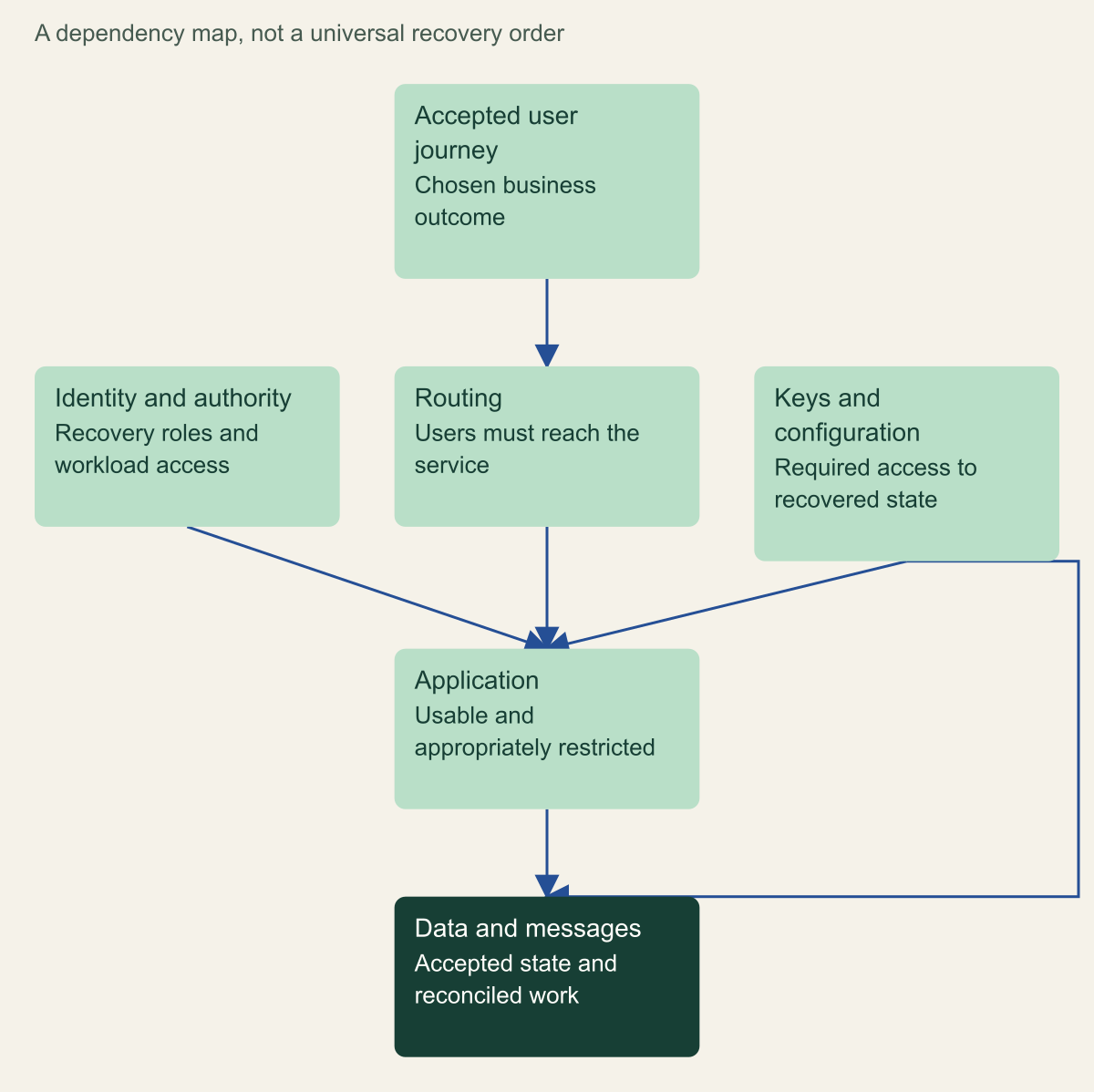
Trace the accepted user journey into the components it needs. For the hypothetical service, a customer must reach the intended application, authenticate where required, inspect the relevant order state and receive an accurate response. The application needs configuration, authorized data access and a usable relationship with the payment provider. Recovery operators need a separate path to make the changes that return those capabilities. None of these dependencies is represented fully by the database's availability alone.
The architecture diagram separates these relationships without prescribing one universal recovery order. A key may enable access to data; configuration may identify the correct endpoint; routing may direct a customer to the recovered application. Some preparatory work can proceed independently, while other actions require a preceding state to be ready. A dependency graph is therefore a better planning input than a flat list whose component recovery times are simply added together.
For each relationship, identify what must be available at recovery time and how that availability is established. If the application needs an encrypted configuration artifact, the artifact and the authorized decryption path are separate requirements. If it needs an image or deployment package, identify the usable artifact and the means to obtain it. The proposed worksheet should describe these dependencies at the level needed to explain failure, not reproduce an entire asset inventory.
External dependencies deserve explicit treatment. The recovery team may not control the payment provider, customer identity service or network intermediary. Record the assumed behavior, available evidence and fallback decision for each relevant dependency. A vendor's general availability statement does not automatically establish that the particular operation, account or integration required by the service will work during the chosen scenario. The local objective must not quietly borrow an unverified guarantee.
Routing introduces another boundary. The DNS guide explains why an authoritative change, a resolver refresh and an application connection are different observations. A recovery plan that stops when a record is edited has not yet shown that the relevant clients reach the accepted service. Describe which client paths the exercise will examine and where visibility remains limited. This keeps a routing action from being mistaken for an end-to-end result.
Use the graph to find circular assumptions. A recovery role might depend on an identity path whose repair requires that same role. An application deployment might need a registry reached only through the environment being rebuilt. These are proposed review questions, not claims that such defects exist in a particular organization. The practical value is to surface the circularity while the team can still change the design or prepare a controlled alternative.
Keep the diagram tied to the business boundary. Optional analytics can remain outside the first accepted service if the owner approves that scope; an essential order lookup cannot. Google Cloud's planning guidance connects recovery strategy to dependencies and testing. The diagram here applies that principle as a local planning tool, not a provider-certified design or evidence that any dependency has already been recovered. [7]
The service boundary includes its recovery dependencies
An application cannot meet its recovery objective until the dependencies required for its accepted business function are usable.

Source. Primary documentation [1] [7] [8]. Reviewed August 28, 2026.
Method. Original conceptual synthesis reviewed August 28, 2026. Unit: qualitative states and relationships. Scope: Cloud recovery objective design. It is not measured performance, prevalence, risk or implementation proof. An application cannot meet its recovery objective until the dependencies required for its accepted business function are usable.
Accessible table and figure data
| Dependency | Service need | Acceptance question |
|---|---|---|
| Identity and authority | Operators and workloads authenticate | Can approved recovery roles act |
| Keys and configuration | Recovered state can be interpreted | Are required secrets and keys available |
| Data and messages | Accepted work is consistent | Can committed work be reconciled |
| Routing and application | Users reach a safe service | Can the chosen user journey complete |
| Dependency | Service need | Acceptance question |
|---|---|---|
| Identity and authority | Operators and workloads authenticate | Can approved recovery roles act |
| Keys and configuration | Recovered state can be interpreted | Are required secrets and keys available |
| Data and messages | Accepted work is consistent | Can committed work be reconciled |
| Routing and application | Users reach a safe service | Can the chosen user journey complete |
Choose which data must agree
The order-service example contains more than one form of state. There is the order record, the payment authorization reference, any message requesting downstream work and the customer's observation that the request succeeded. A recovery design needs an account of how those states relate. Picking the most recent recoverable copy of each component independently does not, by itself, demonstrate a consistent business outcome.
Define the acceptance rule before choosing a replay or reconciliation action. For this authored example, an acknowledged order must be traceable to the intended payment relationship, and unresolved cases must remain distinguishable from completed work. That is a proposed business invariant. The implementation may require a different rule, but it must say what the organization considers correct when components recover to different points. A general promise of current data does not answer that question.
Separate data freshness from data correctness. A newer copy can contain an unwanted or corrupted change. A geographically separate replica may preserve availability while also carrying a destructive application action. AWS's recovery guidance distinguishes replication from point-in-time protection against corruption or deletion. The planning implication is to identify which failure the recovery point must survive, rather than treating every available copy as equivalent evidence. [5]
For the hypothetical payment boundary, the recovered database alone may not establish whether an external effect occurred. The plan should identify an authorized reconciliation source and a safe way to resolve ambiguous cases before repeating an irreversible operation. This is not a recommendation to replay all historical messages. It is a requirement to define how the service distinguishes missing work, completed work and work whose outcome cannot yet be established.
Keep retention and recovery objectives separate as well. Retaining a record for a long period does not prove that it is complete, readable, consistent with related records or available within the recovery window. The planning record should identify the evidence required for the chosen data point and who can interpret it. Where a component cannot provide that evidence, the gap belongs in the architecture decision instead of disappearing behind the word backup.
Data boundaries can differ by function if the business accepts the difference. Delayed analytics may be tolerable while missing accepted orders are not. Document those distinct requirements rather than extending the most demanding rule to every dataset or weakening the critical rule to match the easiest component. AWS's database recovery guidance similarly distinguishes application criticality when selecting recovery approaches. The decision remains local to the actual workload and its consequences. [6]
Compare architectures against the objective
Cloud recovery patterns describe different amounts of preparation, retained state and ready capacity. AWS presents backup and restore, pilot light, warm standby and multi-site active-active approaches. Its guidance distinguishes a reduced running standby from a pilot-light environment that needs additional activation, and discusses the cost and operating implications of the alternatives. These labels organize a comparison; they do not establish that a particular deployment meets its objective. [5]
Evaluate the work left for the moment of recovery. A design that rebuilds resources must account for obtaining configuration, accessing artifacts, establishing permissions and completing the required deployment. The order-service worksheet should name those tasks and their dependencies. Calling them automated is not enough: the team must identify what invokes the automation, which services it needs and what happens when a required input is unavailable.
A design that keeps a smaller environment running raises a different question: which accepted work can it support before capacity changes? For the hypothetical service, read-only order inspection and new order submission may have different resource requirements. The owner should decide whether either reduced function counts as recovery, rather than allowing a small successful health check to stand in for the full promised workload.
A design that operates in more than one location still requires an explicit data and authority model. The planning review must ask which location can accept writes, how conflicting or uncertain state is handled and what prevents unsafe operation during a partial failure. The label active-active does not answer those implementation questions. Its value must be assessed against the chosen failure scenarios and the service's consistency requirements.
AWS's database guidance offers qualitative cost comparisons and indicative recovery ranges for full-stack options. Those ranges are useful context for examining tradeoffs, but they are not measurements from this hypothetical application. This article therefore does not draw a benchmark chart from them or assign a universal recovery duration to each pattern. A numerical commitment needs a workload-specific design and evidence that addresses its actual dependencies. [6]
Compare operating work as well as infrastructure spending. The proposed local review should include maintaining configuration agreement, practicing transitions, investigating replication failures, managing credentials and returning to the preferred operating arrangement. These are cost categories to investigate, not quantified estimates. A design can reduce the work needed during an outage while increasing the ongoing work needed to keep that preparation valid.
The existing static-stability guide examines prepared regional capacity in more detail. Here, the relevant question is whether that preparation removes a dependency that would otherwise threaten the approved objective. The same investment can be essential for one service and unnecessary for another. The architecture decision should explain the relationship to the business requirement rather than recommending the most elaborate pattern by default.
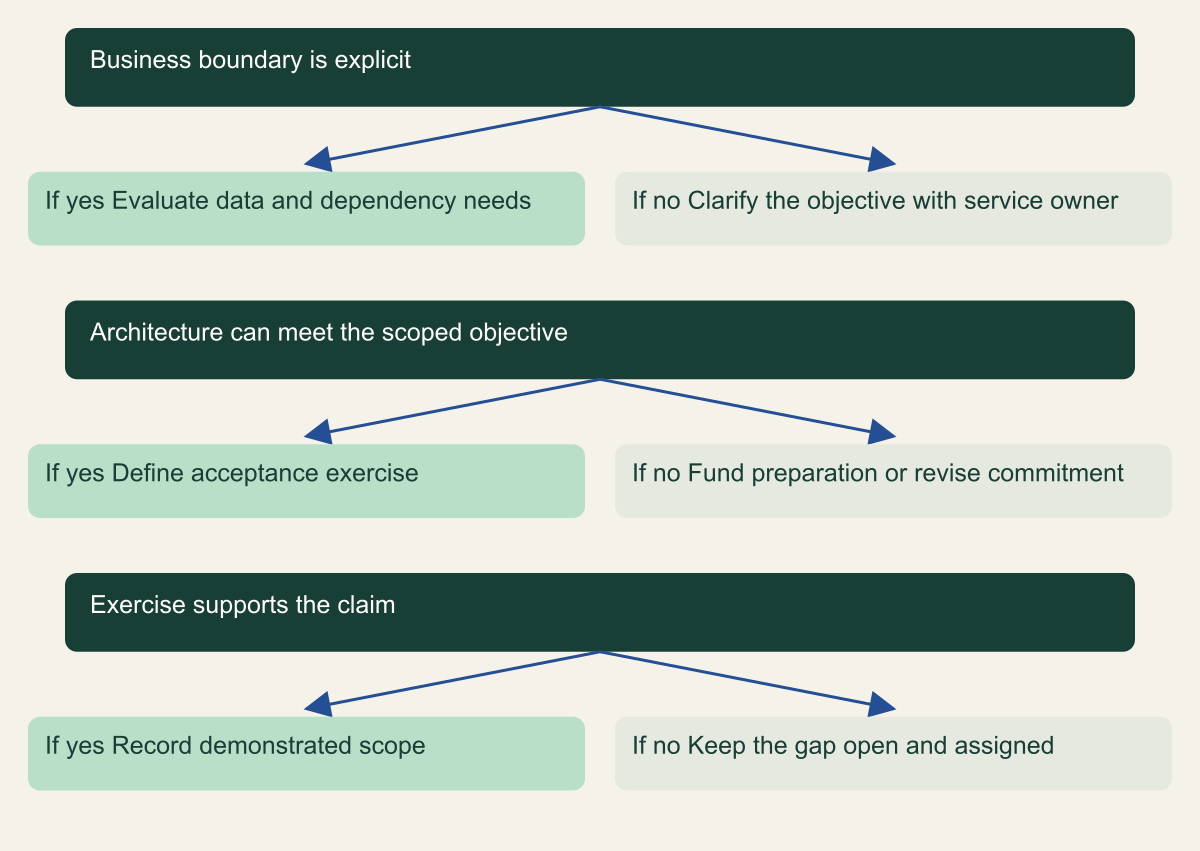
Azure's disaster-recovery guidance treats the plan as specific to the workload and its recovery requirements. The decision tree reflects that discipline: clarify the objective, evaluate a feasible design, and define an exercise that can support the claim. If a branch remains unresolved, keep it unresolved. An attractive architecture diagram is not an acceptable substitute for the missing decision or an unperformed test. [8]
Choose a feasible recovery commitment
The architecture decision follows the stated service and data objective, with an explicit path for infeasibility.

Source. Primary documentation [5] [7] [8]. Reviewed August 28, 2026.
Method. Original conceptual synthesis reviewed August 28, 2026. Unit: qualitative states and relationships. Scope: Cloud recovery objective design. It is not measured performance, prevalence, risk or implementation proof. The architecture decision follows the stated service and data objective, with an explicit path for infeasibility.
Accessible table and figure data
| Question | If yes | If no |
|---|---|---|
| Business boundary is explicit | Evaluate data and dependency needs | Clarify the objective with service owner |
| Architecture can meet the scoped objective | Define acceptance exercise | Fund preparation or revise commitment |
| Exercise supports the claim | Record demonstrated scope | Keep the gap open and assigned |
| Question | If yes | If no |
|---|---|---|
| Business boundary is explicit | Evaluate data and dependency needs | Clarify the objective with service owner |
| Architecture can meet the scoped objective | Define acceptance exercise | Fund preparation or revise commitment |
| Exercise supports the claim | Record demonstrated scope | Keep the gap open and assigned |
Treat operating authority as a dependency
Recovery changes can have significant consequences, so the plan needs both authority and restraint. Identify who may declare the recovery procedure, change the accepted write location, use emergency access and approve the return to normal operation. These responsibilities may belong to different people. The proposed record should make the handoffs visible so that a technical capability is not mistaken for permission to exercise it.
For the hypothetical order service, the ability to start a database does not necessarily include authority to resume payment-related writes. The person assessing data consistency may need to inform a separate service owner who accepts the business consequence. Describe that decision path before an incident. If the expected approver is unavailable, the plan needs an approved alternate or an explicit escalation, not an assumption that any available administrator can decide.
Access dependencies should be examined under the same scenario as the application. A normal sign-in path may rely on systems affected by the interruption. An emergency path should be scoped, protected, observable and validated through an authorized process. The Entra emergency-access guide provides a concrete treatment of that identity boundary. Its existence does not mean that every recovery system should share one unrestricted emergency account.
Keys are equally consequential. The backup-key guide explains why encrypted data and authorized key access must be considered together. For this planning record, identify which recovered state requires which decryption capability, where the approved authority resides and how access is reviewed. Do not copy sensitive credentials or key material into an editorial worksheet, recovery diagram or general-purpose incident ticket to make the dependency look complete.
Preserve a distinction between prepared authority and a completed action. A tested emergency sign-in can support an access claim in its tested scope. It does not establish that every subsequent recovery operation is permitted, safe or successful. The same reasoning applies to automation identities: their configuration should be connected to the particular recovery actions and resources they are expected to use, with failures left visible.
Finally, include the means to coordinate. The plan should say where approved instructions and decision records can be reached if the normal application environment is unavailable. This is an authored operational requirement to examine, not a claim that a particular collaboration platform will survive every outage. A technically recoverable service can still face an avoidable decision delay if the responsible people cannot find the current plan or determine who is authorized to act.
Define the acceptance evidence before the exercise
An exercise is most informative when the expected result is written before the team begins. Identify the scenario, affected dependencies, starting state, allowed actions and acceptance boundary. For the hypothetical order service, that includes the selected records, unresolved payment relationships, permitted customer functions and conditions for safe writes. It should also identify which assertions the exercise cannot test, such as an external dependency deliberately left untouched.
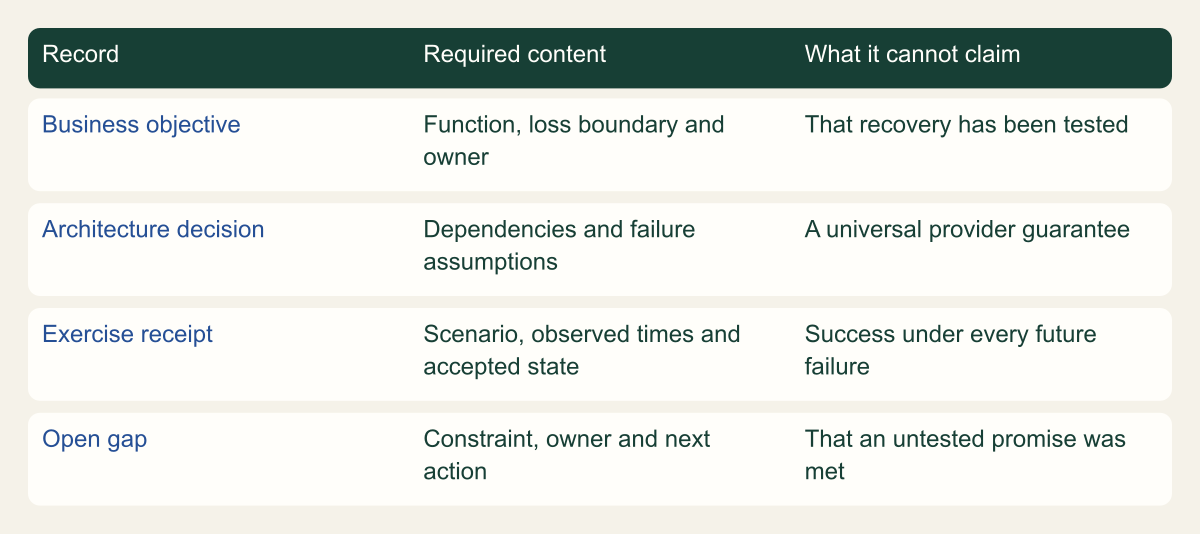
Separate the target from the observation. The objective records what the organization requires. The exercise receipt records what happened in the authorized test, under a stated configuration and scope. If the observed result misses the objective, keep both values and explain the gap. Changing the target retrospectively to match a successful-looking test removes the very comparison that makes the exercise useful.
Collect evidence at the boundary that supports the claim. A resource startup event supports a resource observation. A successful application transaction supports a particular user-journey observation. A reconciliation result supports a statement about the examined records. The proposed evidence matrix keeps these claims distinct so the final report does not treat one convenient screenshot or one healthy status indicator as proof of the whole service.
The restore-validation guide supplies the detailed examination of a recovered application. Use the objective record to select the relevant checks rather than repeating a generic test list. If the service owner permits reduced operation, test that reduced operation and its limits explicitly. If new writes remain prohibited until consistency is established, the acceptance evidence should show the decision that permits them, not merely that the interface was reachable.
Record how the test differs from the intended failure scenario. An exercise with intact identity, available artifacts and prepared operators may be useful, yet it does not demonstrate behavior when those dependencies fail too. Such limits do not make the exercise worthless. They define the result's scope and identify the next uncertainty that requires an additional test or a design change. Google Cloud's guidance emphasizes testing and refining the plan. [7]
Keep unsuccessful steps and manual interventions in the receipt. A missing permission repaired during the exercise, an undocumented command or an unavailable dependency is evidence about the design. The team can correct the issue and repeat the relevant check, but the corrected result should identify what changed. NIST's contingency-planning process includes testing, training, exercises and ongoing maintenance; a plan is not finished merely because a document has been approved. [1]
An objective and a result are different records
The planning record states the desired outcome; the exercise record states what was actually demonstrated.

Source. Primary documentation [1] [7]. Reviewed August 28, 2026.
Method. Original conceptual synthesis reviewed August 28, 2026. Unit: qualitative states and relationships. Scope: Cloud recovery objective design. It is not measured performance, prevalence, risk or implementation proof. The planning record states the desired outcome; the exercise record states what was actually demonstrated.
Accessible table and figure data
| Record | Required content | What it cannot claim |
|---|---|---|
| Business objective | Function, loss boundary and owner | That recovery has been tested |
| Architecture decision | Dependencies and failure assumptions | A universal provider guarantee |
| Exercise receipt | Scenario, observed times and accepted state | Success under every future failure |
| Open gap | Constraint, owner and next action | That an untested promise was met |
| Record | Required content | What it cannot claim |
|---|---|---|
| Business objective | Function, loss boundary and owner | That recovery has been tested |
| Architecture decision | Dependencies and failure assumptions | A universal provider guarantee |
| Exercise receipt | Scenario, observed times and accepted state | Success under every future failure |
| Open gap | Constraint, owner and next action | That an untested promise was met |
Fund the gap or change the promise
A recovery gap is a decision to resolve, not a wording problem to hide. If the required service cannot return within the approved objective under the selected scenario, describe the limiting dependency and the available alternatives. The organization might prepare more capacity, improve access independence, change the data design, reduce the initially accepted function or approve a longer interruption. Each option changes a different part of the promise.
Keep the tradeoff attached to its owner. An engineering team can explain what preparation a design needs and what remains unverified. The service owner can assess which business consequence is acceptable. Funding and risk authority determine which action proceeds. A technically convenient objective should not silently replace the business requirement, and an aspirational requirement should not be reported as demonstrated capability before the supporting work is complete.
The authored order-service record can now be read as a coherent commitment. It names accepted-order inspection and controlled resumption of ordering; identifies the interruption clock and approved duration; specifies the recoverable order and payment relationships; lists essential routing, identity, key and external-service assumptions; and assigns acceptance authority. Optional analytics are outside the initial boundary only by explicit agreement. Any missing duration approval, unavailable dependency or untested consistency claim remains an open item.
A useful review asks what would invalidate that record. A new payment integration, changed identity path, different data store, altered customer promise or new deployment mechanism can change the recovery assumptions. Review the affected relationship and evidence when the system changes. The record does not need to be rewritten indiscriminately, but the team must be able to identify which previous conclusions depended on the changed component.
Finish with four separate artifacts: the approved objective, the architecture decision, the exercise receipt and the assigned gaps. They answer what is required, how the design is intended to meet it, what has been demonstrated and what still needs work. Keeping them connected gives a cloud recovery commitment a defensible meaning. It also makes the next investment clearer: address the dependency or data boundary that prevents the service promise from being supported, then verify the resulting change.
Method and provenance
Primary documentation review and original operational analysis, checked August 28, 2026. Source versions, claim mappings and visual data are retained in the accompanying research dossier. This article was first published in the practitioner-guides collection on August 28, 2026.
No customer environment, incident evidence, production deployment or service performance was tested for this article. Hypothetical examples and conceptual diagrams are labeled. Organization-specific authorization, architecture and legal obligations require their own review.
AI assistance. Researched, drafted and checked against cited sources with AI assistance. No independent human editorial review or original empirical testing is claimed.
Published under the Cloud Security Desk organizational byline. Read the practitioner guide policy.
References
- NIST SP 800-34r1 Contingency Planning Guide National Institute of Standards and Technology. Accessed .
- Recovery Time Objective - Glossary | CSRC National Institute of Standards and Technology. Accessed .
- Recovery Point Objective - Glossary | CSRC National Institute of Standards and Technology. Accessed .
- NIST IR 8286D Using Business Impact Analysis National Institute of Standards and Technology. Accessed .
- Disaster recovery options in the cloud - Disaster Recovery of Workloads on AWS: Recovery in the Cloud Amazon Web Services. Accessed .
- Defining your disaster recovery strategy - AWS Prescriptive Guidance Amazon Web Services. Accessed .