
Kubernetes tenant isolation is an architecture decision about shared authority, kernels and failure domains; namespaces, sandboxed runtimes, virtual control planes and separate clusters solve different parts of that decision.
At a glance
Key findings
- Tenant authority determines the isolation problem before any namespace, runtime or cluster choice is made.
- Control-plane separation and data-plane isolation address different boundaries and can be combined.
- gVisor and Kata have distinct execution models and limits; no universal security or performance ranking is supported.
- Accept the architecture through scoped denied-path tests, resource checks and explicit ownership of shared dependencies.
Begin with what a tenant is allowed to control
Choosing Kubernetes tenant isolation begins with the authority a tenant receives and the infrastructure failures it must not share. A namespace, a virtual control plane, a sandboxed runtime and a separate cluster address different boundaries. They are not interchangeable products on a single security scale. Define who controls workload code, pod specifications, service accounts and cluster administration before deciding which combination is appropriate. Kubernetes' multi-tenancy guidance separates control-plane and data-plane isolation for this reason. [1]
Compare two hypothetical tenants. An internal development team deploys approved application templates through a platform workflow and cannot create privileged workloads. A hosted build customer submits untrusted code and may need a much broader execution environment. Both can be described as tenants, but their authority and threat assumptions differ. A design accepted for the first does not automatically answer the second's shared-kernel, scheduling or administrative-control questions.
Write an authority inventory for the tenant. Include the ability to create or modify workloads, select service accounts, attach storage, request host access, choose runtime classes and interact with cluster-scoped resources. Also identify what the tenant can do indirectly through controllers or platform APIs. A restricted human role can still trigger a powerful automation path if that path accepts unsafe tenant-controlled inputs.
Review Kubernetes permissions as operations, not role names. RBAC distinguishes namespaced and cluster-level grants, and some permissions enable sensitive actions or escalation paths. A role described informally as developer may still be able to create workloads using identities or data that the platform did not intend to expose. Use the actual Role, ClusterRole and binding relationships when defining tenant authority, and retain the implementation-specific policy review. [9]
Define the consequence the architecture is meant to prevent. Cross-tenant API access, host-kernel exposure, resource contention, shared administrative failure and cloud-identity misuse are different problems. A control can help with one while leaving another unchanged. The article's decision framework therefore uses explicit questions and shared dependencies rather than invented isolation scores or a claim that every option is universally stronger than another.
Keep the review separate from a configuration tutorial. Existing admission and egress guides explain implementation checks for those controls. This pillar owns the architectural choice: what is shared, which tenant actions are permitted, which additional boundaries are required and how the organization will test the assumptions. The final decision should be specific enough that a later change in tenant authority triggers a meaningful review.
Separate the control plane from the data plane
The control plane governs Kubernetes API state and the operations that act on it. The data plane runs workloads and supplies their execution environment. Kubernetes multi-tenancy documentation treats isolation in these areas separately. A tenant-specific API view does not automatically provide a separate kernel, and a sandboxed workload does not automatically receive an independent Kubernetes administration boundary. Identify both sides in the architecture record. [1]
Namespaces scope many Kubernetes resources, but not every object belongs to a namespace. Nodes and persistent volumes are examples of cluster-scoped resources. A tenant design that assumes every resource is contained by a namespace can therefore miss shared control objects and administrative authority. Review which APIs and controllers operate across the namespace boundary, not only the namespaced objects visible in an application's manifest. [8]
A virtual control plane can provide a tenant-specific control-plane abstraction and a degree of API separation. The underlying worker environment can still be shared. The relevant questions are which objects and controllers belong to the tenant's control plane, which operations are synchronized or delegated to the host environment, and who administers that underlying environment. Treat the implementation's data-plane sharing as an explicit dependency. [1]
A separate cluster changes the Kubernetes control-plane boundary and usually changes worker allocation, but it does not necessarily separate cloud accounts, networks, registries or administrative identities. The architecture needs to show those dependencies outside the cluster box. Otherwise, a diagram can imply independence while the same organization-wide credential or shared service remains capable of affecting every tenant environment.
Workload placement is another distinct choice. Dedicated node pools can reduce some forms of co-location while leaving a shared API and administrative domain. Sandboxed runtimes can add an execution boundary on nodes that remain part of a shared cluster. These choices can be combined. Do not frame the decision as if choosing a namespace excludes runtime isolation or as if a virtual control plane requires every workload to share the same kernel behavior. [1][2]
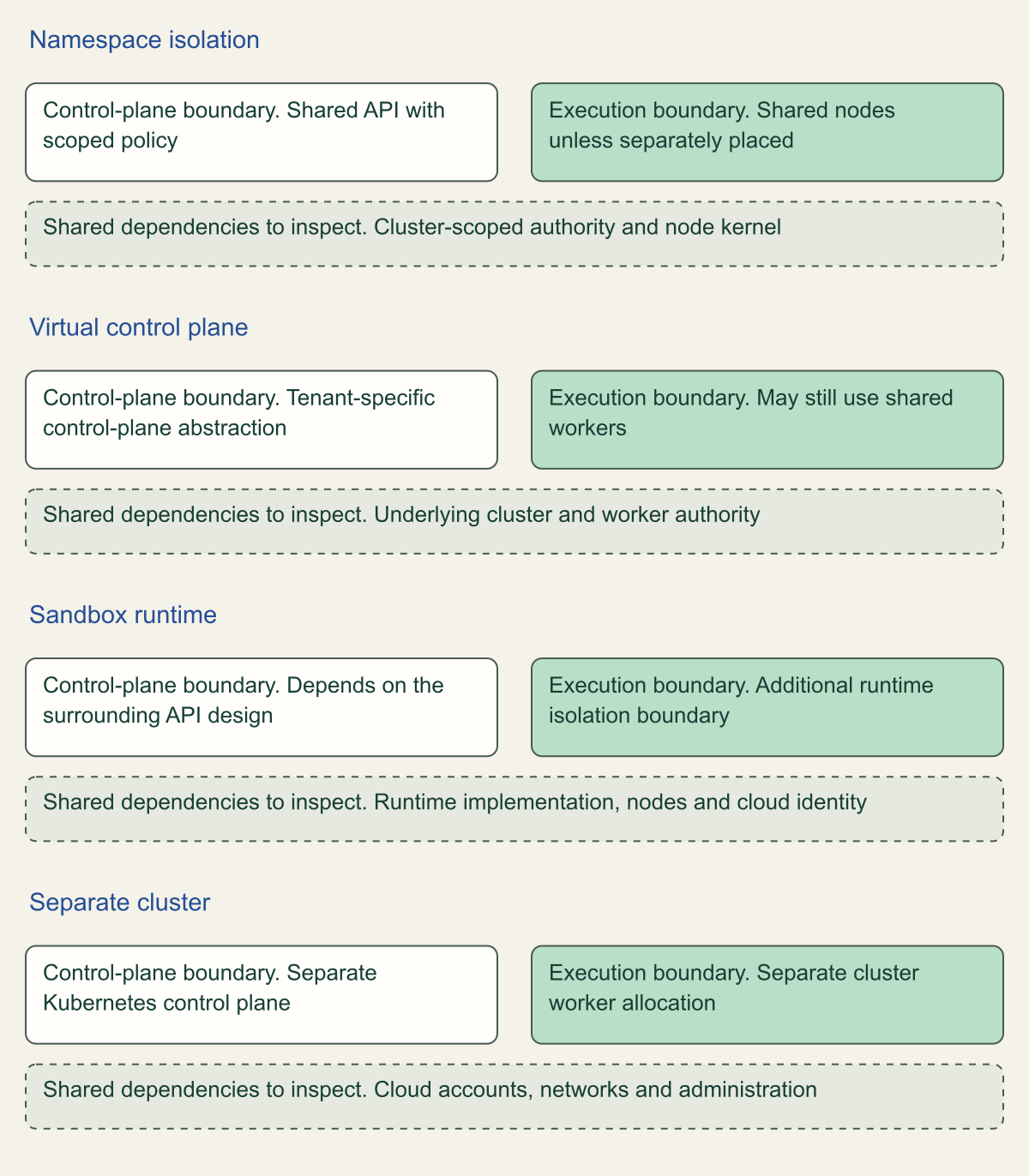
The architecture figure deliberately shows what remains shared for each option. It is an original conceptual comparison, not a certification of a particular implementation. Its purpose is to make an omitted boundary visible: a tenant can have separate API state while sharing workers, or separate workers while relying on the same control-plane administrator. The correct combination follows the threat model and operating requirements.
Assign an owner to each shared boundary. The platform team may own the host cluster, a tenant may own its virtual control plane and another team may own cloud IAM or node images. The isolation decision must say who can change those components and how a change reaches tenants. Ownership that is unclear during normal operation is likely to be even harder to resolve during a cross-tenant incident.
Four places a Kubernetes tenant can share a boundary
Namespace, API, runtime and cluster separation leave different infrastructure dependencies shared.

Source. Kubernetes multi-tenancy [1]; Kubernetes RuntimeClass [2]; gVisor security model [5]; Kata Containers architecture overview [6]. Sources checked August 28, 2026.
Method. Original conceptual model synthesized from the cited documentation. The relationships and proposed tests explain design choices; they are not measured results or a claim about a deployed environment.
Accessible table and figure data
| Architecture option | Control-plane boundary | Execution boundary | Shared dependencies to inspect |
|---|---|---|---|
| Namespace isolation | Shared API with scoped policy | Shared nodes unless separately placed | Cluster-scoped authority and node kernel |
| Virtual control plane | Tenant-specific control-plane abstraction | May still use shared workers | Underlying cluster and worker authority |
| Sandbox runtime | Depends on the surrounding API design | Additional runtime isolation boundary | Runtime implementation, nodes and cloud identity |
| Separate cluster | Separate Kubernetes control plane | Separate cluster worker allocation | Cloud accounts, networks and administration |
| Architecture option | Control-plane boundary | Execution boundary | Shared dependencies to inspect |
|---|---|---|---|
| Namespace isolation | Shared API with scoped policy | Shared nodes unless separately placed | Cluster-scoped authority and node kernel |
| Virtual control plane | Tenant-specific control-plane abstraction | May still use shared workers | Underlying cluster and worker authority |
| Sandbox runtime | Depends on the surrounding API design | Additional runtime isolation boundary | Runtime implementation, nodes and cloud identity |
| Separate cluster | Separate Kubernetes control plane | Separate cluster worker allocation | Cloud accounts, networks and administration |
What namespace controls can and cannot promise
Namespace isolation is a policy arrangement around shared infrastructure. It can be appropriate for a defined tenant population when the relevant API permissions, workload privileges, network access and resource controls are constrained. The namespace itself is not an independent kernel or a universal security boundary. Kubernetes' guidance emphasizes the controls needed around namespace-based multi-tenancy, so an architecture review should inspect those controls rather than treating the namespace name as the conclusion. [1][8]
Start with API access. Review whether tenant identities can read or mutate another namespace's resources and whether a cluster-level binding expands their authority. Also inspect the service accounts available to workloads and the permissions of controllers acting on tenant input. RBAC provides the mechanisms for those grants, but the effective access decision depends on how the organization combines them. A namespaced Role does not cancel a broader ClusterRoleBinding elsewhere. [9]
Workload creation can carry indirect authority. A tenant that can submit arbitrary pod specifications may be able to request identities, mounts, host interfaces or privileged behavior that changes the intended boundary. The exact result depends on admission, RBAC and runtime configuration. Define which pod-level capabilities the tenant is allowed to request and verify the enforcement path. Do not rely on a friendly deployment template if the same tenant can bypass it through a direct API call. [1][7][9]
Admission controls help constrain those requests, but they need an architecture-level purpose. Specify which workload properties are forbidden and which exceptions are approved. Keep exception ownership explicit, especially when an operational workload requires broader host access. The detailed Pod Security Admission rollout belongs in the existing implementation guide; this review should establish why its selected policy matches the tenant's authority and what other controls remain necessary.
Network isolation is similarly separate. A namespace boundary does not by itself define every permitted workload connection. The tenant design needs an egress and ingress policy consistent with the application's dependencies, along with tests at the actual enforcement point. Link the architecture decision to the existing NetworkPolicy test procedure rather than assuming that a policy object proves every intended network path is denied. [1]
Resource controls add another layer but do not replace access controls. ResourceQuota can limit aggregate namespace consumption and object counts, while LimitRange constrains individual objects. Those mechanisms can help organize shared capacity and prevent particular classes of overconsumption. They do not establish that a tenant cannot read another tenant's data or exercise an unreviewed cloud identity. Keep the resource and authority decisions separate. [3][4]
For the hypothetical cooperative internal team, the review might accept namespace-based policy with constrained workload templates, enforced admission and network controls, reviewed identities and accountable platform administration. That is a conditional design decision, not a universal recommendation for all internal tenants. If the team later gains arbitrary runtime or cluster-level authority, the original assumptions need to be revisited even though the workloads remain in the same namespace.
Document the exceptions that remain shared. Cluster-wide operators, observability components, storage integrations and node management can affect more than one namespace. The platform owner should identify those components and the authority they hold. A namespace design is more defensible when shared administration is acknowledged and governed than when the architecture claims a separation that the operational tooling does not actually provide.
Choose a runtime against a stated threat model
A sandboxed runtime adds an execution boundary, but its mechanism and limits matter. gVisor uses a userspace application kernel to mediate application interactions rather than exposing the same direct host-kernel interface as an ordinary container runtime. Kata Containers uses virtual machines as part of its container execution architecture. These are different approaches with different compatibility and operational considerations. Evaluate the documented threat model of the implementation the platform can actually support. [5][6]
Kubernetes RuntimeClass selects a configured runtime handler and can declare scheduling requirements and pod overhead. The resource does not install or validate the runtime by itself. The handler needs to exist on the relevant nodes, and the workload must be placed where it is supported. A manifest containing a runtimeClassName is therefore a requested configuration, not proof that a production workload ran inside the intended isolation boundary. [2]
Control who can choose the runtime and placement. If a tenant is required to use a sandbox but can select an unrestricted runtime class or move the workload to another node pool, the architecture has an enforcement gap. Review the admission and scheduling policy that constrains those choices. The desired boundary should survive the tenant's permitted API actions, not depend on the tenant voluntarily leaving a field unchanged.
Check compatibility with the workload's actual requirements. System calls, filesystem behavior, device access and observability integrations can differ across runtime mechanisms. Use the runtime project's documentation and representative application tests instead of assuming that a container image will behave identically under every handler. A compatibility exception that restores broad host access may remove the boundary that motivated the runtime choice. Record that tradeoff explicitly. [5][6][7]
gVisor's security model also states limits, including that it does not generally protect against hardware side-channel attacks. Do not translate an additional syscall or kernel boundary into a claim that every co-resident threat is addressed. If the tenant's requirements include a threat outside the runtime's model, evaluate another boundary or an additional control. The correct comparison is against the stated threat, not a product label that sounds more isolated. [5]
Kata's VM-backed approach changes the execution boundary but still requires management of the virtualization stack, host environment and shared services. A VM boundary does not remove the need to govern Kubernetes API access or cloud identities. Review how the selected deployment allocates virtual machines, handles storage and networking, and exposes operational diagnostics. The article does not assume a universal one-VM-per-tenant arrangement for every Kata configuration. [6]
Linux kernel security mechanisms remain relevant within the broader design. Kubernetes documents controls such as seccomp and mandatory access controls, along with their scope and interaction with container configuration. These mechanisms can constrain workload behavior, but they should not be presented as interchangeable with a separate VM or virtual control plane. State which layer supplies which restriction and test the configuration used by the workload. [7]
Account for runtime overhead through supported scheduling and resource mechanisms. RuntimeClass can describe pod overhead, which affects how the platform reasons about the workload's resource requirements. Use values appropriate to the actual runtime and configuration rather than copying a documentation example as a benchmark. The article provides no comparative performance dataset and does not rank gVisor and Kata by invented latency or memory figures. [2]
A runtime decision should finish with a bounded acceptance statement: the selected workload runs under the intended handler, the required application behavior works, forbidden runtime or placement choices are denied, and the documented residual threats are accepted or covered elsewhere. That statement is more useful than calling the runtime secure without identifying the tenant actions and failure conditions it was chosen to contain.
When the boundary needs separate clusters
Separate clusters deserve evaluation when the required administrative or failure boundary cannot be maintained inside the proposed shared environment. A tenant may need authority over cluster-scoped objects, a different upgrade schedule or a control-plane configuration that conflicts with other tenants. Those requirements can make a separate cluster operationally clearer than a growing set of exceptions inside one shared cluster. Kubernetes' multi-tenancy guidance presents multiple isolation approaches rather than one universal answer. [1]
Hostile or independently administered tenants also change the assumptions. If the platform cannot constrain the authority a tenant exercises over workload execution or cluster administration, namespace policy alone may not match the threat model. A sandbox can address part of the execution risk, while the administrative boundary still needs review. Do not infer that one additional runtime layer makes unrestricted cluster-level authority safe to share.
Consider the hypothetical hosted build service. Customers supply untrusted code, but the platform controls how jobs are submitted and which runtime executes them. The design should evaluate sandbox compatibility, worker allocation, job identities, artifact access and control-plane permissions separately. If a customer instead receives administrative control over a cluster environment, the architecture needs a different account of shared authority. These are conditional scenarios, not a claim that all build services require one particular topology.
Separate clusters can simplify some boundaries while increasing operating work. The organization must manage provisioning, upgrades, policy consistency, observability and recovery across the chosen fleet. That tradeoff is qualitative here; no cost or staffing benchmark is supplied. Evaluate the actual platform's automation and service requirements rather than claiming that a larger cluster count is inherently more expensive or that a shared cluster is always easier to operate.
Inspect dependencies outside Kubernetes. Cloud accounts, IAM roles, encryption keys, network paths, DNS and artifact registries can remain shared across otherwise separate clusters. An administrator or service with authority over those components may still affect several tenants. The isolation decision should identify which shared dependencies are acceptable and which require another boundary, with owners who can maintain that separation.
Recovery requirements can also influence the choice. A shared control-plane failure or a cluster-wide change can affect several tenants at once. Separate clusters may change that failure domain, but they can still rely on the same recovery credentials or external control services. Connect the architecture decision to the organization's explicit recovery objectives and dependency tests rather than assuming that separate clusters automatically recover independently.
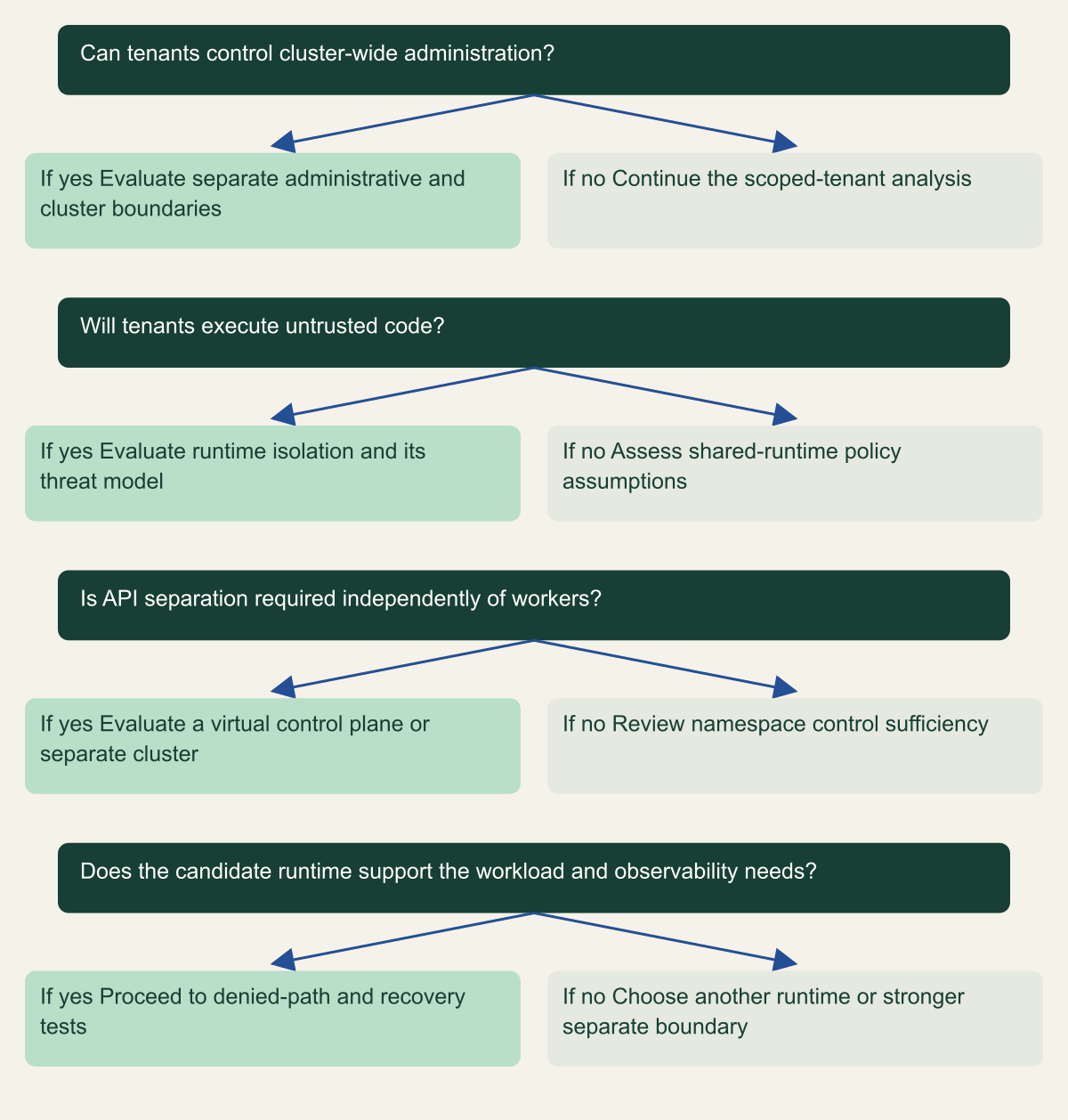
The decision tree uses these questions to select an evaluation path, not to issue a guaranteed approval. If the tenant needs a boundary the current platform cannot enforce, the next action may be a separate cluster, a different runtime design or a narrower tenant contract. The important result is that the chosen architecture matches the authority actually granted, with no hidden dependence on cooperative behavior that the tenant is not required to maintain.
Choose isolation from tenant authority and tolerated sharing
Tenant authority and tolerated sharing determine which isolation options deserve evaluation.

Source. Kubernetes multi-tenancy [1]; gVisor security model [5]; Kata Containers architecture overview [6]; Kubernetes RBAC [9]. Sources checked August 28, 2026.
Method. Original conceptual model synthesized from the cited documentation. The relationships and proposed tests explain design choices; they are not measured results or a claim about a deployed environment.
Accessible table and figure data
| Question | If yes | If no |
|---|---|---|
| Can tenants control cluster-wide administration? | Evaluate separate administrative and cluster boundaries | Continue the scoped-tenant analysis |
| Will tenants execute untrusted code? | Evaluate runtime isolation and its threat model | Assess shared-runtime policy assumptions |
| Is API separation required independently of workers? | Evaluate a virtual control plane or separate cluster | Review namespace control sufficiency |
| Does the candidate runtime support the workload and observability needs? | Proceed to denied-path and recovery tests | Choose another runtime or stronger separate boundary |
| Question | If yes | If no |
|---|---|---|
| Can tenants control cluster-wide administration? | Evaluate separate administrative and cluster boundaries | Continue the scoped-tenant analysis |
| Will tenants execute untrusted code? | Evaluate runtime isolation and its threat model | Assess shared-runtime policy assumptions |
| Is API separation required independently of workers? | Evaluate a virtual control plane or separate cluster | Review namespace control sufficiency |
| Does the candidate runtime support the workload and observability needs? | Proceed to denied-path and recovery tests | Choose another runtime or stronger separate boundary |
Resource limits are another layer of shared responsibility
ResourceQuota controls aggregate consumption and object counts within a namespace under the documented Kubernetes rules. LimitRange applies constraints and defaults to individual resources. Use them together where the tenant contract requires both aggregate and per-object limits. They solve different problems: a sensible per-container limit does not necessarily bound the number of objects a tenant can create, while an aggregate quota does not describe every application's resource configuration. [3][4]
Admission and runtime behavior need to be distinguished. A quota can reject creation or updates that exceed its defined constraints, but it is not a complete guarantee against every form of shared-infrastructure contention. Control-plane work, node behavior, networking and storage dependencies may require other policies or capacity decisions. State which resources are actually governed by the quota and which remain outside the selected configuration. [3]
Runtime overhead belongs in capacity planning. If the chosen RuntimeClass declares overhead, review how that affects scheduling and the resource accounting used by the platform. A tenant quota based only on the application's nominal requests may not describe the complete runtime cost. Use the supported overhead mechanism and observed workload requirements; do not create an illustrative numerical overhead table that readers could mistake for measurements from gVisor, Kata or the target cluster. [2]
Set ownership for requests, limits and defaults. The tenant may know the application's normal behavior, while the platform owner knows the shared node and control-plane constraints. A default that silently changes workload behavior can be difficult to diagnose if neither team owns it. Record which values are tenant-supplied, which are imposed by the platform and how exceptions are reviewed, using the actual LimitRange and quota configuration as evidence. [3][4]
Use controlled resource-pressure tests where they are necessary to validate the contract. Choose a bounded fixture and an authorized environment, and identify what the test is meant to establish. It may verify quota rejection, scheduling behavior or an application's handling of a limit. It should not be presented as a comprehensive denial-of-service assessment or a production performance benchmark unless the method and evidence support that claim.
Finally, keep availability and confidentiality separate. A tenant can remain within its quota while possessing an overly broad service account, and a correctly scoped identity can still encounter resource pressure. The architecture needs both authority controls and a workable resource contract. Combining them in one green status obscures which part failed when a tenant's workload affects another service.
Turn architecture assumptions into denied-path tests
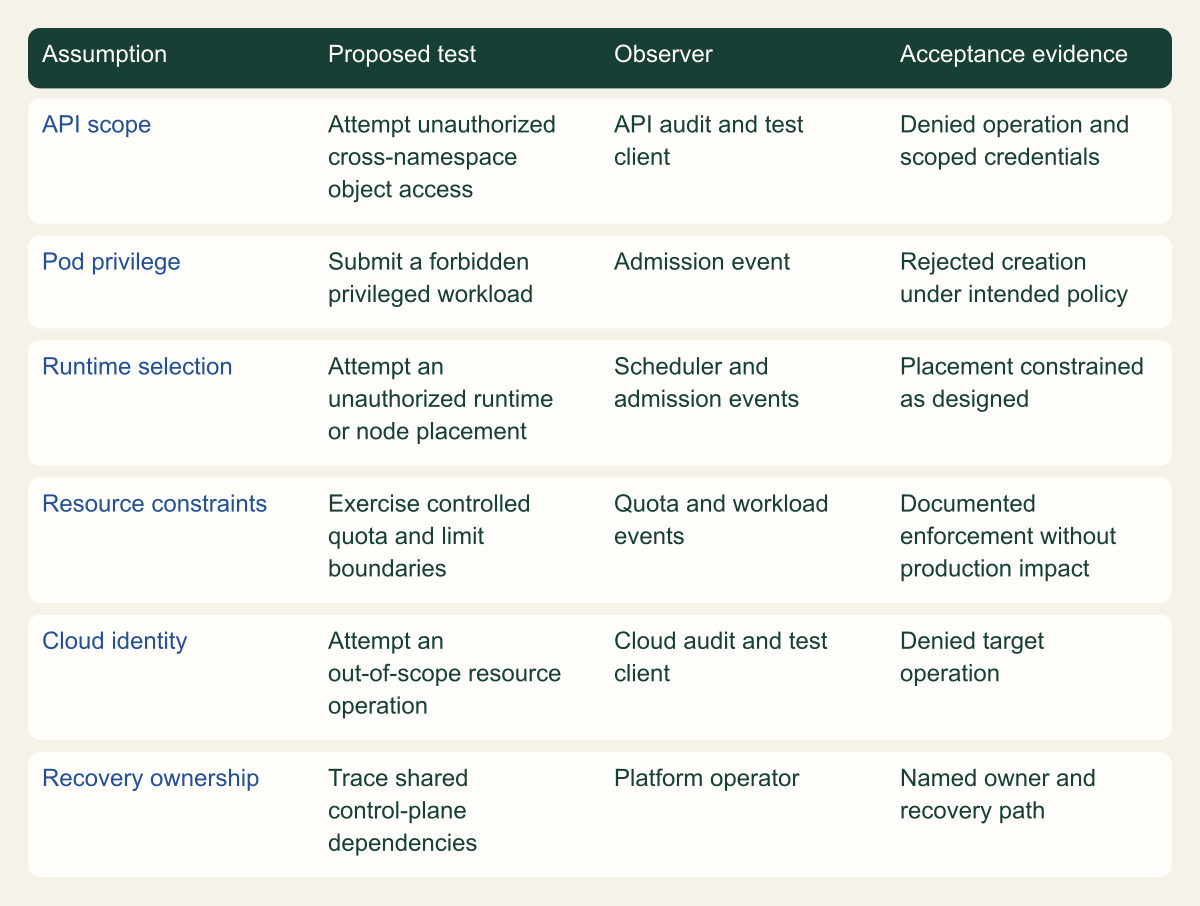
Build the acceptance matrix from the authority inventory. Each important assumption should have a proposed test, an observer and an outcome that can be recorded. The matrix in this section uses nonnumeric rows because it describes a method, not measured results. It does not claim that any real cluster has passed the tests. Execute the chosen cases only in an authorized environment with appropriate recovery and cleanup.
Test API scope with the tenant's actual credentials. Confirm permitted operations in the intended namespace and rejection of controlled attempts outside that scope. Include the relevant service-account and controller paths, not only the human user's role. A successful denial through one credential does not establish that another credential available to the workload has the same restriction. Keep the principal and operation with the evidence. [9]
Test the workload properties the tenant is forbidden to request. A controlled admission attempt can check whether the chosen policy rejects a privileged configuration or another disallowed host-level capability. The exact fixture should follow the existing admission guide and the target Kubernetes version. Record the enforcing policy and result, rather than treating the presence of an admission configuration as proof of rejection. [1][7]
Test runtime selection and placement. Where sandbox execution is required, verify that the workload runs under the intended handler and that unauthorized runtime or node choices are rejected. Keep a distinction between the pod's requested runtimeClassName, the scheduling decision and the observed execution environment. A manifest value alone is not enough to establish that the intended runtime boundary was used. [2]
Test resource controls at their documented enforcement points. Use permitted fixtures to observe quota and LimitRange behavior without creating uncontrolled pressure on production infrastructure. Record which aggregate or per-object condition was exercised and how the workload responded. Do not generalize a successful quota rejection into a claim that the tenant cannot affect shared capacity through any other resource or API path. [3][4]
Test cloud identity and external dependencies separately. A workload may be isolated at the Kubernetes API while still carrying an identity that can access another tenant's cloud resource. Perform narrowly scoped permitted and denied resource operations under an approved test plan, and connect the results to the workload's identity configuration. Kubernetes namespace membership should not be used as a substitute for reviewing the external resource grant.
Review operational escape paths. Platform maintenance, debugging and exception workflows can introduce authority not present in the ordinary tenant deployment. Identify who may use those paths, what approval is required and how the resulting access is observed. This is a governance and architecture check, not an instruction to disable necessary operations. The goal is to keep exceptional authority explicit instead of letting it silently become part of every tenant's effective permissions.
Include a recovery exercise that follows the chosen failure boundaries. If tenants share a host cluster or administrative service, record how its unavailability affects them and which team restores it. If clusters are separate, test the dependencies that remain shared outside Kubernetes. The recovery objective should reflect the architecture actually operated, not the number of boxes drawn in the cluster diagram.
When a test fails, update the assumption or the control before calling the architecture accepted. A denied API request does not compensate for an unrestricted runtime choice, and a successful sandbox launch does not compensate for an overly broad cloud identity. Preserve the failed result and the corrective decision. This makes later reviews more useful because they can see which boundary changed and why the selected design was considered acceptable.
Evidence that tests each isolation assumption
Architecture assumptions become reviewable when each has a denied-path test and an evidence owner.

Source. Kubernetes multi-tenancy [1]; Kubernetes RuntimeClass [2]; Kubernetes ResourceQuota [3]; Kubernetes RBAC [9]. Sources checked August 28, 2026.
Method. Original conceptual model synthesized from the cited documentation. The relationships and proposed tests explain design choices; they are not measured results or a claim about a deployed environment.
Accessible table and figure data
| Assumption | Proposed test | Observer | Acceptance evidence |
|---|---|---|---|
| API scope | Attempt unauthorized cross-namespace object access | API audit and test client | Denied operation and scoped credentials |
| Pod privilege | Submit a forbidden privileged workload | Admission event | Rejected creation under intended policy |
| Runtime selection | Attempt an unauthorized runtime or node placement | Scheduler and admission events | Placement constrained as designed |
| Resource constraints | Exercise controlled quota and limit boundaries | Quota and workload events | Documented enforcement without production impact |
| Cloud identity | Attempt an out-of-scope resource operation | Cloud audit and test client | Denied target operation |
| Recovery ownership | Trace shared control-plane dependencies | Platform operator | Named owner and recovery path |
| Assumption | Proposed test | Observer | Acceptance evidence |
|---|---|---|---|
| API scope | Attempt unauthorized cross-namespace object access | API audit and test client | Denied operation and scoped credentials |
| Pod privilege | Submit a forbidden privileged workload | Admission event | Rejected creation under intended policy |
| Runtime selection | Attempt an unauthorized runtime or node placement | Scheduler and admission events | Placement constrained as designed |
| Resource constraints | Exercise controlled quota and limit boundaries | Quota and workload events | Documented enforcement without production impact |
| Cloud identity | Attempt an out-of-scope resource operation | Cloud audit and test client | Denied target operation |
| Recovery ownership | Trace shared control-plane dependencies | Platform operator | Named owner and recovery path |
Write the isolation decision so it can be revisited
The final decision record should name the tenant's authority, the selected control-plane and execution boundaries, resource policies and shared cloud dependencies. Include the runtime and Kubernetes versions used in acceptance tests, the relevant policy references and the owners of exceptions. This gives a future platform engineer enough context to determine whether a requested capability still fits the approved design.
State the residual risks in the terms used by the source threat models. If a runtime does not generally address hardware side channels, retain that limitation. If a virtual control plane shares workers, keep that sharing visible. If separate clusters rely on one cloud administrative identity, name that dependency. A precise limitation is more useful than a broad assurance statement that ignores how the system is operated. [1][5][6]
Review the decision when tenant authority changes. Granting access to a new runtime class, controller, cluster-scoped API or external cloud identity can alter the boundary even when the workload remains in the same namespace. An application change that needs broader host capabilities also deserves review. The original decision should identify these triggers so the platform does not accumulate exceptions without reconsidering the threat model.
Keep performance and compatibility evidence separate from security assumptions. A representative workload test can establish whether the selected runtime supports required behavior and acceptable operating characteristics. It does not prove every isolation property. Conversely, a runtime with a suitable threat model may still be inappropriate for an application it cannot support reliably. The decision needs both kinds of evidence without turning either into a universal ranking.
A defensible Kubernetes tenant design is one whose sharing is intentional and whose authority boundaries survive the tenant actions it permits. Namespaces, virtual control planes, sandboxed runtimes and separate clusters can each contribute to that design. The architecture becomes useful when the organization can explain what each boundary protects, what remains shared and which observations support the choice.
Method and provenance
Source-based technical analysis joining the primary documentation and standards cited above. Source contracts were reviewed on August 28, 2026. Original diagrams and decision records are editorial syntheses; quantitative figures, where present, preserve the source values and stated transformations.
No authoritative cross-runtime performance dataset was adopted; all benchmark and cost comparisons are out of scope. gVisor's documented threat model excludes general hardware side-channel protection. A separate cluster can still share cloud accounts, IAM, networks or node-management authority and therefore does not automatically establish full organizational separation. Virtual control planes can offer API separation while retaining shared worker-node risks. Operational complexity, compatibility and observability differ across runtimes and providers; test actual workload needs.
AI assistance. AI assisted research, drafting and visual planning. The article does not claim personal deployment experience, a customer case study or tests performed in a production environment.
Published under the Cloud Security Desk organizational byline. Read the practitioner guide policy.
References
- Kubernetes multi-tenancy Kubernetes. Accessed .
- Kubernetes RuntimeClass Kubernetes. Accessed .
- Kubernetes ResourceQuota Kubernetes. Accessed .
- Kubernetes LimitRange Kubernetes. Accessed .
- gVisor security model gVisor Project. Accessed .
- Kata Containers architecture overview Kata Containers. Accessed .
- Kubernetes Linux kernel security constraints Kubernetes. Accessed .
- Kubernetes namespaces Kubernetes. Accessed .
- Kubernetes RBAC Kubernetes. Accessed .