
A substantial PostgreSQL 18 PITR guide separating backup consistency from later target recovery. It covers manifests, archive continuity, verification limits, incremental ancestry, target actions, isolation and reproducible acceptance records.
At a glance
Key findings
- A valid base backup and its consistency WAL do not prove that a later PITR target is reachable. [1][3][7]
- Physical recovery needs the correct history and compatible environment, with configuration preserved separately. [1][6][8]
- Backup verification, target recovery and application acceptance are distinct results. [3][4]
Define the target before the restore
Reproducible PostgreSQL point-in-time recovery requires a compatible physical base backup, the necessary continuous WAL, the correct timeline history and an explicit recovery target. A backup command reporting success is only one input. Define the state you intend to recover and the evidence that will establish it before starting a restore.
PostgreSQL distinguishes SQL dumps, filesystem backups and continuous archiving as different backup approaches. This guide concerns the physical continuous-archive path, not importing a logical dump or using a managed database provider's restore interface. Keep that distinction explicit when collecting artifacts and choosing tools. [10]
Physical recovery concerns a PostgreSQL cluster, meaning the database system's data directory and associated databases, not merely one application's named database. The base-backup documentation describes a whole-cluster physical backup. An application owner asking for one table or database may need a different extraction or reconciliation plan after isolated recovery. [2]
Define the recovery question in business terms first. Which last acceptable transaction or state should remain, and which harmful or unintended change should not? The timestamp when an alert fired may be later than the actual data change. Preserve the evidence that links the desired target to application state instead of selecting a convenient time without justification.
A hypothetical incident involves an unintended data modification discovered after subsequent legitimate work. Recovery to an earlier point may remove both the harmful change and some valid later work. That is a business reconciliation decision, not a defect in WAL replay. The recovery owner should know which consequences require separate handling before clients are allowed to write.
The technical scope here is PostgreSQL 18, with 18.6 listed as the supported current minor release when sources were reviewed on September 2, 2026. PostgreSQL 19 remained a development version at that review. Match the actual environment and current supported guidance rather than treating this dated statement as permanent. [8]
No backup, database, archive or restore was inspected or executed for this article. The procedure is a source-led engineering framework with explicitly hypothetical examples. It provides no measured recovery-time objective, recovery-point achievement or restore-speed benchmark.
Bind the backup to a compatible environment
Create an artifact inventory that identifies the source cluster, major version, backup format, tablespaces, configuration and relevant extensions or libraries. The restore environment must be compatible with the physical data and its dependencies. A major-version upgrade is a separate operation, not something accomplished by opening an old physical backup with a newer server. [8]
PostgreSQL backup manifests include a system identifier in the current manifest format and describe the backed-up files and required WAL ranges. Use that identity as part of the relationship check between artifacts. A directory name chosen by an operator is not sufficient evidence that a backup belongs to the intended cluster. [6]
The pg_controldata utility can display cluster-wide control information, including catalog and WAL/checkpoint context, when the operator has the required data-directory access. It is a read-oriented diagnostic aid, not a substitute for backup verification or application acceptance. Preserve the tool version and the artifact examined if its output supports the inventory. [11]
Configuration needs separate attention. PostgreSQL's continuous-archiving documentation explains that WAL does not replay ordinary edits to files such as postgresql.conf, pg_hba.conf and pg_ident.conf. Preserve the configuration needed for the intended recovery environment rather than assuming a database replay restores every operational setting. [1]
Record tablespace relationships and destination mapping before copying data. A restore that places files in an unintended location can threaten existing material or fail because required paths are unavailable. The approved plan should identify fresh destination paths, ownership and capacity, with no broad deletion or overwrite step against an unresolved directory.
Extensions, authentication and external integration settings belong in the compatibility review even when they are not the immediate cause of the incident. Ask which components are needed merely to start the isolated database and which are needed for the application's later acceptance. Do not enable production-facing integrations automatically just because their old configuration was preserved.
The inventory should distinguish observed facts from assumptions. If the source version is known but an extension package or historical configuration is missing, record that gap and its owner. A restore plan should not call itself reproducible while relying on an undocumented machine state that only one administrator remembers.
Prove the archive is a chain
A continuous-archive restore needs the WAL required from the base backup through the chosen target, not simply the newest segment visible in storage. PostgreSQL's recovery documentation describes the required continuous sequence and the relationship to the base backup. Treat the archive as a chain with identity and continuity requirements. [1]
Archiving success also needs the documented meaning. The archive command must report success only when the WAL is safely archived, and failure can cause WAL to accumulate. A filled filesystem can become an availability problem. The review should examine the actual archiving procedure and monitoring rather than equating an existing archive directory with a complete recovery capability. [1]
The pg_stat_archiver view provides counts and timestamps, but its documented caveats matter. A recent last_archived_wal value does not prove that every older file is present, and some failure conditions are not reflected in the ordinary failure counter. Use the statistics as operational signals, not as a complete archive-integrity certificate. [9]
Replication retention is another boundary. PostgreSQL's replication configuration documents sending-server capacity and settings that govern retained WAL for replication slots. Slot retention is not the same as a durable, independently usable archive, and a slot's state does not prove that the recovery target's archive chain is complete. [12]
For a hypothetical review, begin with the selected backup's requirements and trace forward to the intended target on the correct history branch. Record which artifacts are present, where they came from and what verifies their identity. Do not start from the latest filename and infer that everything before it must have been retained.
Preserve original archive objects while checking the chain. A verification process should not overwrite a conflicting filename or silently replace a suspect segment with a similarly named file from another cluster. If an object cannot be validated, keep the discrepancy visible and resolve its provenance before using it in a recovery attempt.
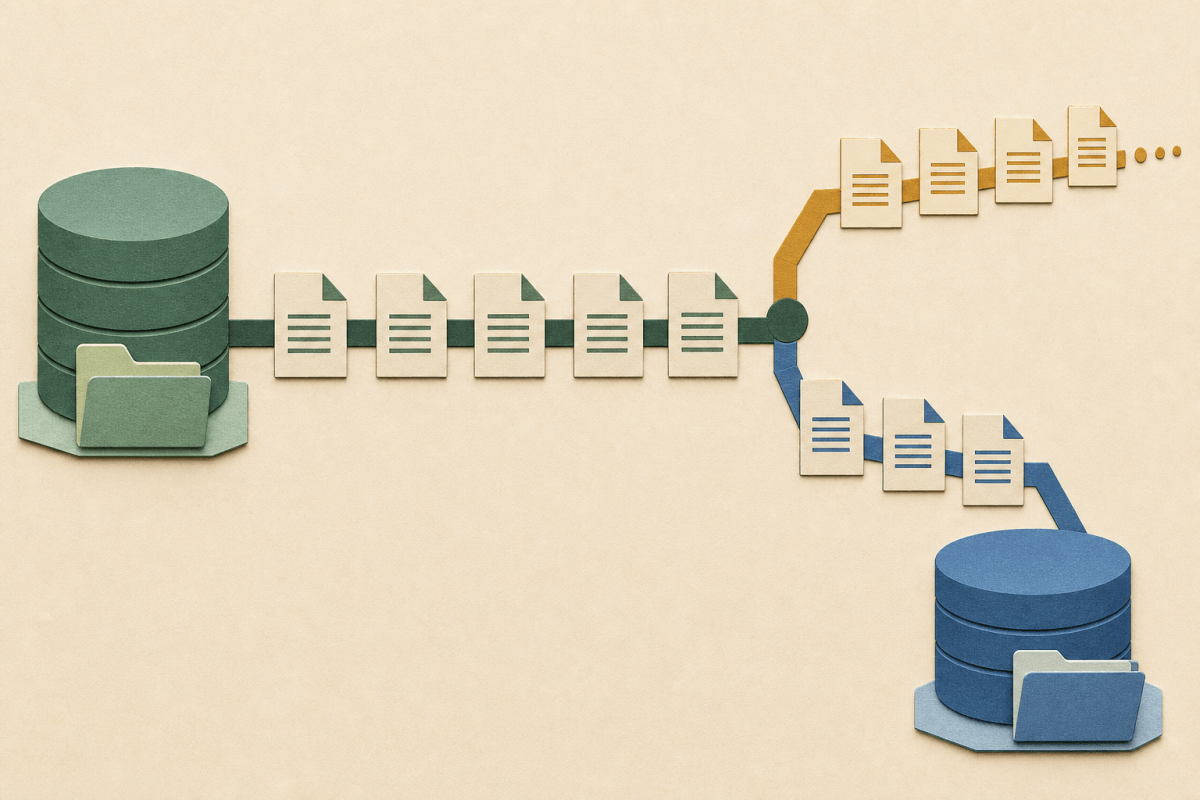
The illustration shows a complete shared WAL chain and a selected recovery branch without inventing a recovery percentage. One missing required artifact can block the selected target even when many other backup files exist. The useful question is whether this chain supports this target, not what fraction of an archive appears populated.
Recovery follows one complete history branch
The starting backup and required WAL must support the selected timeline before the recovered database is accepted.

Source. Original illustration informed by PostgreSQL continuous-archive, verification and manifest documentation. [1][3][5][7]
Method. Conceptual illustration with an equivalent table. No completeness percentage or restore duration is represented.
Accessible table and figure data
| Illustrated element | Recovery meaning | Evidence to check |
|---|---|---|
| Physical base | Starting cluster state | Usable compatible backup and its manifest |
| Shared WAL chain | History required for replay | All required segments are retrievable |
| Selected recovery branch | Chosen history and target | Explicit timeline ancestry and recovery target |
| Alternative history branch | A different continuation | Do not substitute a branch merely because it is newer |
| Recovered working database | Candidate recovered state | Database and application acceptance remain necessary |
| Illustrated element | Recovery meaning | Evidence to check |
|---|---|---|
| Physical base | Starting cluster state | Usable compatible backup and its manifest |
| Shared WAL chain | History required for replay | All required segments are retrievable |
| Selected recovery branch | Chosen history and target | Explicit timeline ancestry and recovery target |
| Alternative history branch | A different continuation | Do not substitute a branch merely because it is newer |
| Recovered working database | Candidate recovered state | Database and application acceptance remain necessary |
Separate consistency WAL from target WAL
A base backup has a consistency requirement before it can become a usable recovered cluster. Its manifest's WAL ranges describe required replay, including an End-LSN associated with the earliest permitted endpoint for that backup. That endpoint is not automatically the later application recovery target the incident requires. [6][7]
PostgreSQL also requires a point-in-time target to be after the end of the selected base backup. If the desired state precedes that boundary, choose an appropriate earlier backup rather than trying to force a newer backup backward. Recovery replays forward from a usable base; it is not an arbitrary undo operation. [1]
Keep two evidence questions in the worksheet. Can the backup reach its required consistent state? Can the available archive continue from there to the selected target on the intended timeline? A positive answer to the first is necessary but does not settle the second.
This distinction explains a common overclaim about verification. pg_verifybackup can check the backup and its required WAL, but that does not automatically validate every later segment needed for a future PITR target. The tool's successful result must be described according to its actual scope. [3]
In a hypothetical rehearsal, an old verification receipt may still be relevant to the base files while the target has moved later. The rehearsal needs a fresh chain review for the additional archive interval. Reusing the old receipt is reasonable only if its meaning remains unchanged; extending its conclusion to new material is not.
Record the chosen backup endpoint and recovery target separately, with their source evidence. If the target is expressed as time, retain its timezone and the reasoning that connects it to the application event. If it is expressed as an LSN or named point, retain the corresponding identity and history context.
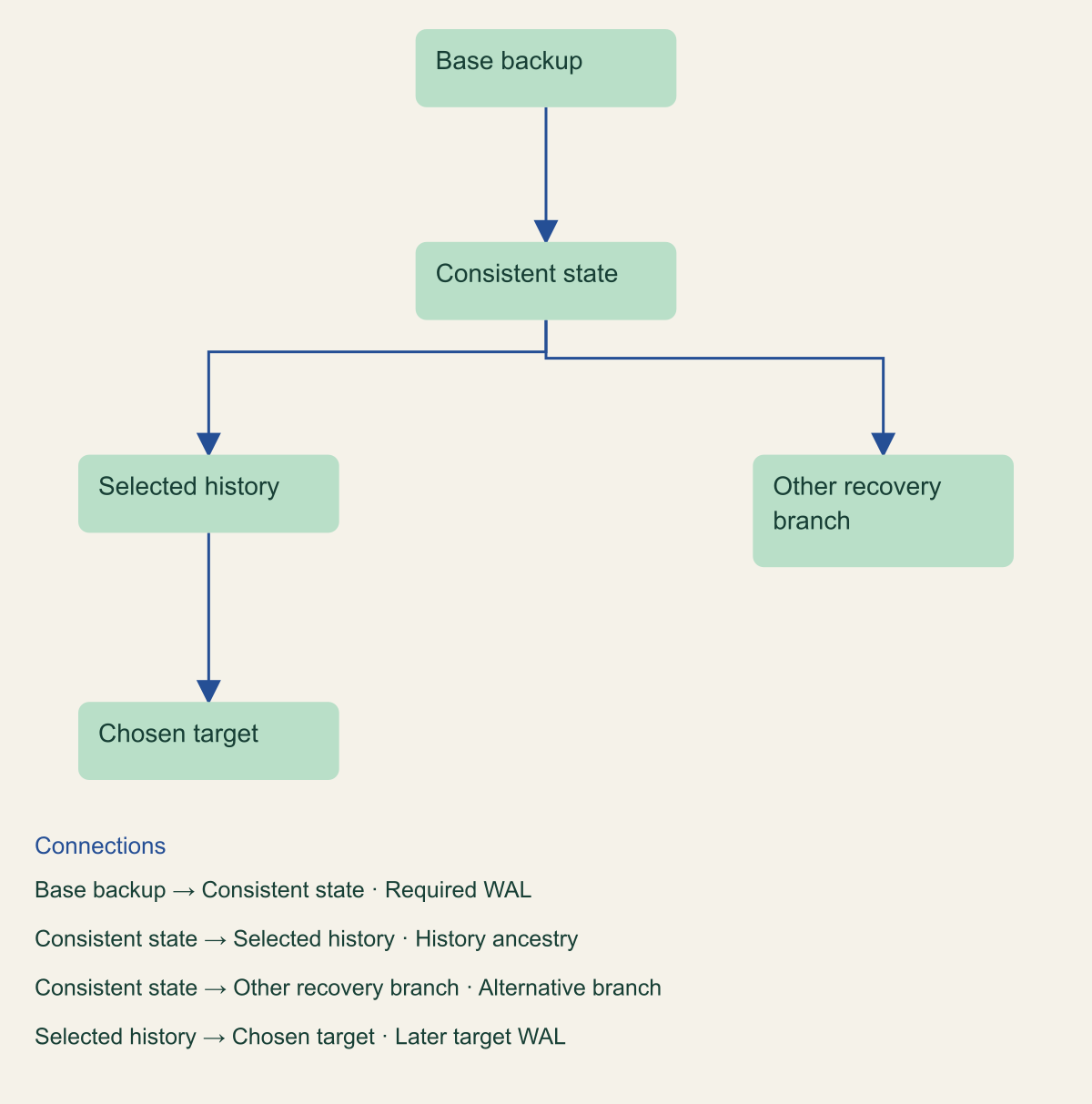
The dependency graph distinguishes shared ancestry from alternate recovery branches. Its layout is conceptual, not a time scale. The relationship matters because files that are individually plausible can still belong to a history that does not lead to the selected application state.
Consistency and the selected target are different endpoints
Follow the intended history branch beyond the base backup's minimum consistent state.

Source. Original ancestry model based on PostgreSQL recovery and manifest definitions. [1][4][7]
Method. Conceptual topology only, not numeric time or LSN spacing.
Accessible table and figure data
| Point | Meaning | Review |
|---|---|---|
| Base backup | Physical starting material | Identity and integrity |
| Consistency endpoint | Minimum required replay | Manifest WAL range |
| Selected branch | Intended recovery history | Timeline ancestry |
| Application target | Requested useful state | Required later WAL and acceptance |
| Point | Meaning | Review |
|---|---|---|
| Base backup | Physical starting material | Identity and integrity |
| Consistency endpoint | Minimum required replay | Manifest WAL range |
| Selected branch | Intended recovery history | Timeline ancestry |
| Application target | Requested useful state | Required later WAL and acceptance |
Verify the backup without overstating the check
pg_verifybackup checks backup contents against the manifest and performs documented WAL verification for the backup's required range. PostgreSQL explicitly warns that verification is not a substitute for a test restore. A successful check supports the artifact claims it examined, not every future startup or application behavior. [3]
Format and version conditions matter. The current tool supports checks for plain and tar backups, but WAL parsing is not available for tar-format verification in the same way; the documented no-parse-WAL option changes what is checked. Preserve such options in the receipt instead of reporting a generic verification passed. [3]
Protect the manifest's provenance. Checksums can detect inconsistency relative to a manifest, but a manifest that is modified together with the data is not an independent guarantee of authenticity. The base-backup documentation discusses the need to protect against malicious modification. Keep the trusted source and transfer history of both manifest and backup material explicit. [2]
A verification failure should remain a concrete artifact problem. Identify the file, range or check that failed and retain the original result. Do not disable the failing check merely to obtain a successful exit status and then report the backup as fully verified. A narrower check may be appropriate for a documented reason, but its conclusion must remain narrower.
Separate tool compatibility from data validity. Use tools appropriate to the major version and the documented WAL format requirements, and record their versions. A failed check caused by an incompatible verifier does not establish corruption; equally, choosing a tool that does less checking does not establish that the suspect material is sound.
A useful verification receipt contains the input artifact identifiers, manifest reference, tool version, options, result and exact limitations. Store it with the recovery inventory so the next operator does not have to infer which backup or copy was checked from a terminal screenshot.
The next gate is an isolated restore that can test startup and the selected state. That gate should use protected originals and a writable working copy, with the network and application boundaries prepared in advance. Verification reduces uncertainty, but it does not eliminate the need to observe the system that the application will actually use.
Keep incremental ancestors recoverable
Native incremental backups add ancestry requirements to the physical recovery plan. pg_combinebackup takes the full backup and required incremental ancestors in order before the target incremental backup. The relationship check is not the same as verifying every input's integrity. Preserve and verify the required chain rather than retaining only the newest incremental artifact. [5]
This capability is not unique to PostgreSQL 18; the guide uses the version-18 tools and documentation without claiming that the feature was introduced there. The operational question is whether the reader's actual version, backup method and retained ancestors support the selected recovery path.
Document the dependency set when an incremental backup is created. Identify the full base, each required ancestor and the target artifact, together with their manifests and storage locations. Retention decisions should follow that dependency set. Deleting an apparently old ancestor can make a newer retained backup unusable for the intended combination.
pg_combinebackup offers linking options, but hard links can make later changes affect original inputs. Its documentation also describes restrictions involving changes in checksum state. For a preservation-sensitive recovery, use a deliberately separated output and review those options rather than choosing the fastest-looking method without understanding its consequences. [5]
The default recommendation here is to protect originals and work on separate copies, not to present a universal storage-layout recipe. The available filesystem, storage budget and approved recovery tooling may differ. What must remain true is that a failed rehearsal cannot silently modify the only retained ancestor.
A hypothetical recovery inventory that lists only the latest incremental filename is incomplete. Add the ancestor order, verification status and the resulting combined output identity. If one ancestor is unavailable, state which target path is blocked and which alternative full backup may still be evaluated.
Combining the backup is another intermediate result, not service recovery. The output still needs the appropriate verification, target WAL, timeline selection and isolated restore. Keep that sequence explicit so a successful combination command does not become an unsupported statement that point-in-time recovery is ready.
Choose a target and history branch
Choose one recovery-target mechanism deliberately: immediate consistency, time, transaction ID, LSN or a named restore point, according to the documented settings. PostgreSQL permits only one of the target parameters in the relevant configuration. Preserve the selected mechanism and value rather than leaving several competing targets in a copied configuration. [4]
For time-based recovery, use an explicit timezone offset and decide whether the target boundary is inclusive. Transaction IDs should not be treated as a simple numeric ordering of commit time. These details affect the selected state and deserve review before replay begins, not after a surprising result. [4]
A target must be justified by application evidence. The time a user reported corruption may not be the time the harmful transaction committed. A named restore point can be useful when deliberately established before a planned change, but it cannot be invented retroactively as evidence for an earlier unknown state.
Timeline selection is equally important. The default latest behavior may follow a history branch that is not the one intended for this recovery. Preserve timeline history and choose the branch that leads to the target, especially when previous recovery attempts or promotions created alternate histories. [1][4]
The conceptual ancestry diagram shows a common parent and different descendants. It does not imply that a higher-looking branch is better or more recent in the application sense. The review needs the actual timeline identifiers and history relationship, not a visual preference for the newest filename.
For a hypothetical investigation, document both the chosen target and the rejected alternatives. Explain why the selected boundary preserves required good work and excludes the identified harmful change, and identify any legitimate later work that must be reconciled. This makes the recovery a reviewable decision rather than a timestamp selected under pressure.
Have the application and database owners agree on acceptance before execution. If they disagree about which state is acceptable, replaying more quickly will not resolve the decision. Preserve the unresolved choice and the evidence needed to make it, rather than allowing tool defaults to choose the business outcome implicitly.
Restore into an isolated working copy
Prepare an isolated recovery environment with fresh, explicit destinations and protected original artifacts. Verify ownership, permissions, capacity, tablespace mapping and required configuration before making the working copy writable. Do not use broad deletion commands or overwrite an existing data directory whose role has not been resolved.
Isolation should address application and external effects, not only the database listener. Review scheduled jobs, integrations, monitoring agents and credentials that might connect the recovered system to production. An old configuration can be operationally useful while still being unsafe to activate unchanged in a rehearsal.
Use the documented restore procedure appropriate to the backup format and environment. The base-backup options that generate standby configuration serve a different purpose from an archive-recovery setup. In particular, the -R option creates standby-related configuration; it should not be assumed to prepare the intended isolated PITR workflow. [2]
The restore command must retrieve the correct archived file into the requested destination with the documented success and failure behavior. Preserve filename and cluster provenance checks in the approved implementation. Do not build a permissive fetcher that silently substitutes a similarly named segment when the expected one is missing.
Before starting, review the plan as a series of gates: protected originals available, compatible environment prepared, required base and ancestors verified, target chain identified, history selected and client access restricted. A failed gate should stop the procedure with a concrete next action instead of encouraging improvisation against the only copy.
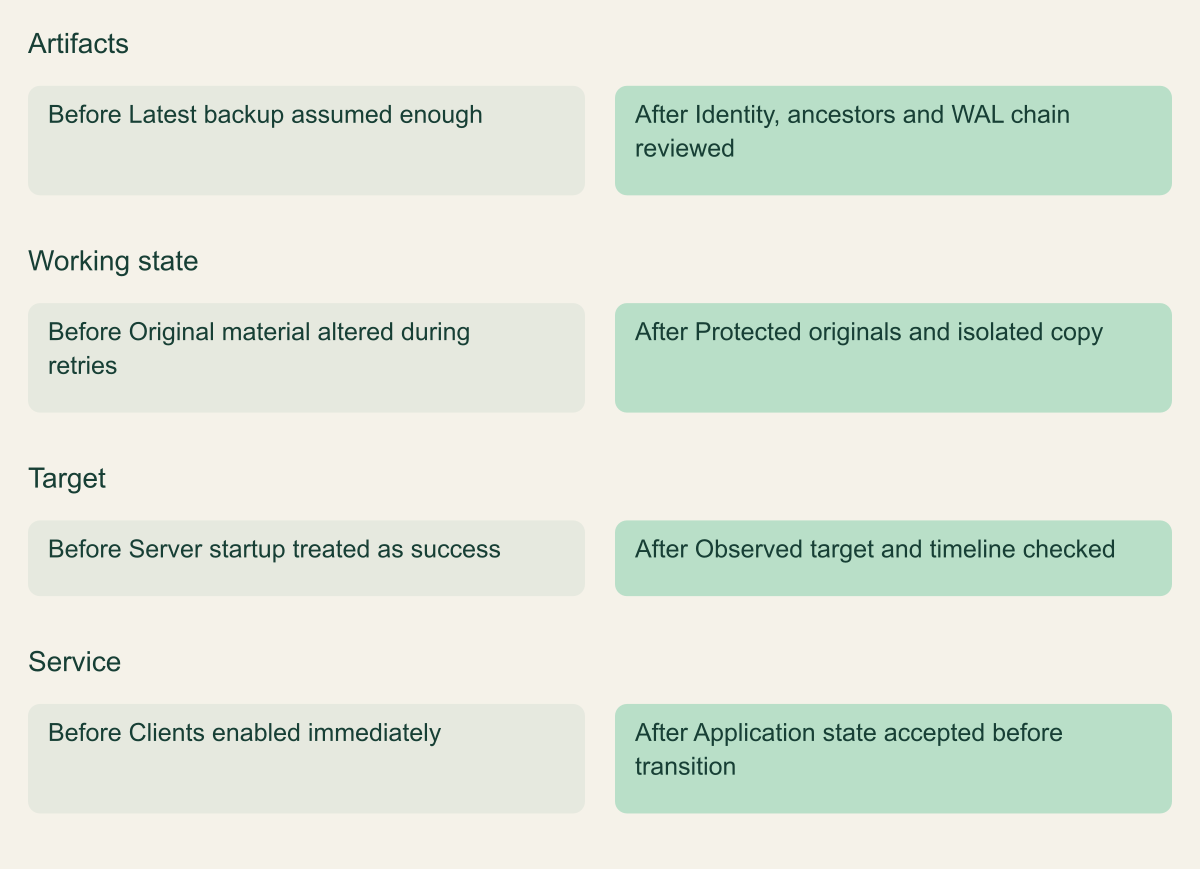
The before-and-after visual describes this separation. The after state moves from protected originals to an isolated working copy, then to target inspection and authorized application acceptance. It does not claim that every step is automated or that isolation alone proves the recovered data is correct.
If the attempt fails, preserve logs and the working-copy state needed for diagnosis while leaving originals unchanged. A later retry should have a documented reason and input relationship. Do not repeatedly alter the same untracked directory until something starts and then call the result reproducible.
Preserve originals while proving the recovered state
Successful backup creation is an input, not final recovery acceptance.

Source. Original recovery framework informed by PostgreSQL documentation. [1][3][4][5]
Method. Conceptual comparison without measured RTO, RPO or performance improvement.
Accessible table and figure data
| Boundary | Before | After |
|---|---|---|
| Artifacts | Latest backup assumed enough | Identity, ancestors and WAL chain reviewed |
| Working state | Original material altered during retries | Protected originals and isolated copy |
| Target | Server startup treated as success | Observed target and timeline checked |
| Service | Clients enabled immediately | Application state accepted before transition |
| Boundary | Before | After |
|---|---|---|
| Artifacts | Latest backup assumed enough | Identity, ancestors and WAL chain reviewed |
| Working state | Original material altered during retries | Protected originals and isolated copy |
| Target | Server startup treated as success | Observed target and timeline checked |
| Service | Clients enabled immediately | Application state accepted before transition |
Pause before accepting production work
Archive recovery uses recovery.signal, while standby configuration has a different role. The selected recovery action also matters: pause, promote and shutdown have distinct behavior. A target that is not reached causes recovery to fail rather than quietly proving the desired state. Read the actual server outcome and logs. [4]
Pause is a useful inspection boundary, but its behavior depends on hot-standby settings; without hot standby it can behave as shutdown. The shutdown action leaves conditions that require deliberate handling before another start. Do not assume that choosing pause always produces an immediately queryable inspection environment. [4][12]
Separate database startup from permission to accept application writes. A server process running or a connection succeeding is not a complete recovery result. The plan should identify who can inspect the recovered state, which operations are permitted during that inspection and who authorizes the transition to ordinary clients.
Keep the observed stop point in the receipt. Compare it with the intended target and history rather than relying only on the configuration file. If the system stopped for an error or unavailable WAL, that is not the same as reaching the selected recovery boundary. Preserve the difference even when both outcomes leave the server unavailable to users.
A hypothetical recovery may reach a technically consistent state but fail an application invariant. The correct result is an unacceptable recovered state requiring another decision, not a successful restore waiting for a cosmetic check. The owner may choose another target or investigate missing context, with originals preserved.
Promotion should be an explicit authorized transition. Once the recovered environment begins accepting new writes, its history and reconciliation obligations change. Do not make that transition merely to see whether the application opens, especially when the target-state decision is still unresolved.
If the procedure uses a shutdown target action, record the next startup procedure and configuration changes required by the documented behavior. A future operator should not discover an intentional repeated shutdown and mistake it for a new unexplained outage. Recovery controls belong in the handoff as well as in the server configuration.
Validate the state the business needs
Database consistency and business correctness are separate acceptance questions. The restore may reconstruct a valid PostgreSQL state while the application still needs reconciliation with queues, caches, files or external systems. WAL replay does not establish that those independent systems were restored to the same business moment.
Define concrete invariants before connecting ordinary clients. Identify expected good records, excluded harmful changes, key relationships and the application operations needed to demonstrate useful behavior. These are recommended acceptance categories; the actual checks must be supplied by the application owner and the incident evidence.
A hypothetical order-processing system can illustrate the problem without invented data. A database target may precede an unintended update while an external notification or payment side effect already occurred. Restoring the database alone does not undo that external action. The recovery decision needs a reconciliation owner and a safe plan for resuming work.
Test read and write behavior separately where the approved environment permits it. A successful read can establish visibility of a target state, while a write can create new side effects and history. Use harmless, authorized checks with explicit cleanup or reconciliation, and do not treat a broad smoke test as evidence that every critical workflow is correct.
Keep tool verification in its proper role during acceptance. PostgreSQL's warning that backup verification is not a substitute for a test restore applies here as well: an artifact check cannot demonstrate application-specific invariants. The application-restore guide provides a complementary acceptance framework rather than replacing the physical-chain checks in this article. [3]
Record the observed result of each check and the scope it supports. If some external dependency cannot be tested, preserve that limitation and the decision owner. An overall recovery status should not erase partial results or imply that untested integrations were proven healthy.
Only after the accepted state and access transition are approved should the service resume its intended workload. Preserve the relationship between the isolated recovered copy and the eventual serving environment. A later investigation should be able to identify which state was accepted and what changed between inspection and production use.
Retain a replayable recovery record
The recovery receipt should connect every important artifact and decision. Include cluster identity, versions, backup format, manifests, ancestor order, WAL and timeline references, target configuration, tool options, observed stop point and application acceptance. Use controlled references to sensitive locations rather than exposing credentials or full internal paths in a broad incident summary.
Separate planned values from observed results. The configuration can say which target was requested; the logs and inspection say what actually occurred. A verification receipt can say which files were checked; the restore result says whether the selected chain was usable. These relationships are the core of reproducibility.
Retain failures as part of the record. A missing segment, incompatible environment, incorrect timeline or failed invariant explains why an attempt did not meet the objective. Preserve the correction and its relationship to the next attempt rather than presenting only the final successful-looking command output.
Use the next rehearsal to reproduce the prerequisites, not merely the final command sequence. Another authorized operator should be able to find the protected artifacts, establish compatibility, select the intended history and understand the acceptance criteria. Hidden dependencies on one administrator's workstation or memory should become explicit gaps.
Review retention with the dependency graph in view. An older full backup or incremental ancestor may still support a newer target path. A history file or configuration artifact can matter even when it is small and easy to overlook. Deletion decisions should account for the recovery paths they remove.
The final conclusion should state the actual recovery capability demonstrated and its limits. This article demonstrates none in a live environment. Its contribution is the chain of questions that a real rehearsal must answer: which base, which WAL, which history, which target and which accepted application state. Keeping those questions connected makes point-in-time recovery reproducible rather than merely hopeful.
Method and provenance
Source-led technical analysis of directly reviewed project and vendor documentation, with original decision frameworks and explicitly hypothetical examples. Sources were reviewed on September 2, 2026.
No database, backup, archive or restore was inspected or executed. Technical behavior is scoped to PostgreSQL 18 documentation reviewed September 2, 2026; managed-service workflows and major upgrades are outside scope.
AI assistance. AI assisted research synthesis, drafting, diagram planning and deterministic editorial checks. No personal deployment experience, independent human review or live test is claimed.
Published under the Cloud Security Desk organizational byline. Read the practitioner guide policy.
References
- PostgreSQL 18 continuous archiving and point in time recovery PostgreSQL Global Development Group. Accessed .
- PostgreSQL 18 pg_basebackup PostgreSQL Global Development Group. Accessed .
- PostgreSQL 18 pg_verifybackup PostgreSQL Global Development Group. Accessed .
- PostgreSQL 18 WAL recovery configuration PostgreSQL Global Development Group. Accessed .
- PostgreSQL 18 pg_combinebackup PostgreSQL Global Development Group. Accessed .
- PostgreSQL backup manifest top level object PostgreSQL Global Development Group. Accessed .
- PostgreSQL backup manifest WAL range object PostgreSQL Global Development Group. Accessed .
- PostgreSQL versioning policy PostgreSQL Global Development Group. Accessed .
- PostgreSQL 18 cumulative statistics PostgreSQL Global Development Group. Accessed .
- PostgreSQL 18 backup and restore PostgreSQL Global Development Group. Accessed .
- PostgreSQL 18 pg_controldata PostgreSQL Global Development Group. Accessed .
- PostgreSQL 18 replication configuration PostgreSQL Global Development Group. Accessed .