A state-aware rollback guide using AWS, Kubernetes, and GitLab documentation. A hypothetical column transition explains mixed writers, compatibility stages, backfill invariants, delayed removal, and tests against the same migrated database.
At a glance
Key findings
- An application rollout can be reversed while its database changes remain in place, so rollback safety must include persisted state.
- Additive schema changes, compatibility code, verified backfills, and delayed removal create a reviewable rollback window.
- A completed migration job does not prove business-data correctness or that an older application can read the resulting state.
Identify what the rollback command actually reverses
An application rollback is comforting only if the older application can still operate on the state it will find. A deployment tool may restore the previous image while leaving a renamed column, changed record format, or new values untouched. The first rollback question is therefore which parts of the system the command reverses and which parts it leaves behind.
Kubernetes documents Deployment rollback as restoring a previous Pod template. That scope does not include undoing a database migration. AWS's rollback-safety guidance likewise emphasizes compatibility between software versions and the data or protocols they share during a deployment. [1][2] Together these sources point to a practical review boundary: code and persisted state need separate evidence.
Inventory every writer and reader affected by the change. Include workers, scheduled jobs, administrative tools, and delayed messages as well as the main web application. During a gradual rollout, more than one version may be active. A migration can be compatible with the newly deployed server while breaking a background process that still expects the previous representation.
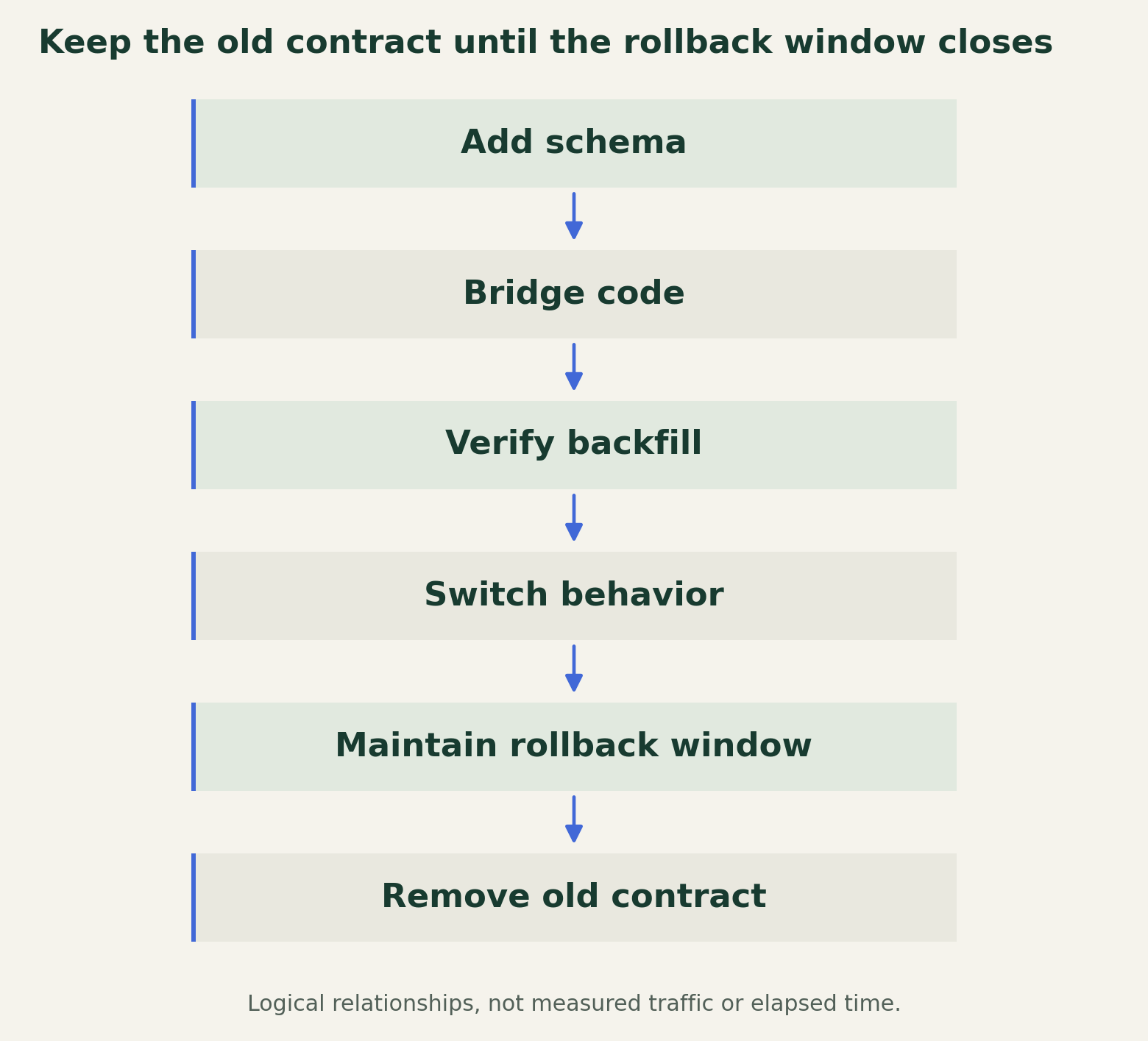
Keep the old contract until the rollback window closes
Removing the old representation is a separate step after compatibility and data correctness have been verified.

Source. AWS rollback-safety guidance, Kubernetes Deployment scope, and GitLab migration practices [1]-[4].
Method. Original staged migration model using a hypothetical column transition. Stages describe acceptance requirements, not a tested migration or a universal framework-specific procedure.
Accessible table and figure data
| Stage | Data contract | Required evidence before advancing |
|---|---|---|
| Add | Old representation remains available | Old application still reads and writes correctly |
| Bridge | Explicit authority and compatibility writes | Mixed-version writer behavior is understood |
| Backfill | New representation populated safely | Restart safety and business invariants pass |
| Switch | New behavior with old contract preserved | Prior application works against newly written data |
| Maintain window | Designated rollback version remains supported | Delayed readers and writers remain covered |
| Remove | Old representation retired | Window closed and replacement recovery path approved |
| Stage | Data contract | Required evidence before advancing |
|---|---|---|
| Add | Old representation remains available | Old application still reads and writes correctly |
| Bridge | Explicit authority and compatibility writes | Mixed-version writer behavior is understood |
| Backfill | New representation populated safely | Restart safety and business invariants pass |
| Switch | New behavior with old contract preserved | Prior application works against newly written data |
| Maintain window | Designated rollback version remains supported | Delayed readers and writers remain covered |
| Remove | Old representation retired | Window closed and replacement recovery path approved |
Design a compatibility window before changing data
Consider a hypothetical application replacing a display_name column with preferred_name. Dropping the old column as soon as the new code is available would remove the data shape an older release needs. A safer plan begins by adding the new representation while preserving the old one, then defines how both stay consistent during the transition.
Specify the source of truth at each stage. A bridge release might continue reading the old column while writing both columns. That alone does not solve mixed-version behavior: an older writer may still update only the old column. The plan must either account for those writes through an explicit synchronization mechanism or retire those writers before declaring the new representation complete.
Write the rollback contract in terms of the oldest application version still supported. Identify which schema and value formats it can read, which writes it can perform, and how new writes remain visible after rollback. This is a compatibility requirement, not merely a request to preserve a database backup. Restoring a backup can discard later business activity and has a different operational purpose.
Backfill with progress and invariants
A large data transformation deserves its own execution plan. GitLab's guidance uses batched background migrations for data work and distinguishes them from schema changes. It also requires attention to idempotence and completion. [4] The broader lesson is to make long-running work observable and resumable instead of hiding it inside an application startup step.
Define a bounded batch, a progress marker, and the condition under which a record is eligible to change. Protect concurrent updates from being overwritten by a stale backfill read. The appropriate mechanism depends on the database and application, but the acceptance requirement is clear: rerunning an interrupted batch must not corrupt a record or undo a newer valid write.
Verify business invariants in addition to row counts. For the hypothetical name change, confirm that the accepted value is preserved and that records modified during the migration remain consistent. Sample checks can be useful diagnostics, but a release decision should state what they cover and what remains unchecked. A job marked complete indicates that its workflow ended, not that every application's interpretation of the data is correct.
Switch behavior before removing structure
Once the new representation is populated and verified, switch reads or other application behavior in a controlled release. Keep the older representation usable for the agreed rollback window if the prior application remains a supported recovery option. That may require continued dual writes or another explicit compatibility mechanism, with a defined owner and retirement condition.
GitLab's zero-downtime migration guidance illustrates why removal needs staging: application code can retain assumptions about database columns, including cached schema information. Its process separates ignoring a column from dropping it in a later release. [3] Treat the example as framework-specific evidence for the underlying compatibility problem, not as a universal release schedule for every stack.
Make the destructive step a separate approval. Before removing the old column or representation, confirm that old readers and writers are gone, delayed work is covered, the rollback window has closed, and the recovery strategy after removal is understood. Re-adding an empty column is not equivalent to recovering the values that were deleted. A syntactically reversible migration can still destroy information the application needs.
Exercise both directions on realistic fixtures
A useful compatibility test starts with the old application and schema, introduces the additive change, runs the bridge version, and performs representative reads and writes. It then switches to the new behavior and rolls the application back while preserving the migrated database. This directly tests the state an operator would encounter after reversing only the code deployment.
Include records created before the migration, records updated during it, and values newly written by the candidate release. Test background workers and API clients that consume the same data. For a format change, include a value the old reader might reject rather than only the simplest shared case. Keep the fixture synthetic and the migration isolated from production data.
Also test interruption and retry of the backfill. Capture progress, restart the job, and verify that the same business invariants still hold. Measure operational effects in an authorized representative environment when necessary, including lock waits and application errors, but do not infer production duration from a tiny fixture. Correctness and acceptable workload impact are separate release conditions.
Ship a release record that includes data state
The release record should say more than which image is deployed. Include the schema stage, active reader and writer versions, backfill status, accepted invariants, oldest supported rollback version, and the condition that ends the rollback window. This gives an incident operator the information needed to decide whether a code rollback remains safe.
Keep irreversible steps visible in the change plan. If the team chooses to remove compatibility earlier for cost or complexity reasons, record that tradeoff and the replacement recovery path. Do not leave a familiar rollback command in the runbook without warning that the database now requires a newer application. The operator should not discover the boundary while responding to an outage.
A reliable rollback strategy preserves an agreed relationship between code and state for a defined period. Additive changes, explicit ownership of writes, verified backfills, and delayed removal make that relationship reviewable. The final question is concrete: after this release has written real data, can the designated previous version still perform the accepted operations against that same database?
Method and provenance
Primary documentation review completed August 28, 2026, with an original hypothetical column migration, compatibility stages, and proposed rollback tests.
No database migration, deployment rollback, load test, or data transformation was executed. The example requires adaptation to the application's transaction model, framework, and supported database versions.
AI assistance. AI assistance was used to research sources, draft and structure the article, and prepare the visual specification. No human technical review is claimed.
Published under the Cloud Security Desk organizational byline. Read the series policy.
References
- Ensuring rollback safety during deployments AWS Builders' Library. Accessed .
- Kubernetes Deployments and rolling back a Deployment Kubernetes. Accessed .
- Avoiding downtime in migrations GitLab. Accessed .
- Batched background migrations GitLab. Accessed .