
An acquisition-focused cloud forensics guide using AWS and NIST sources. It explains volatile-state loss, EBS snapshot limits, containment tradeoffs, controlled evidence environments and collection receipts without claiming complete capture or legal admissibility.
At a glance
Key findings
- A disk snapshot does not include application or operating-system data still cached in memory. [4]
- Containment and evidence acquisition can conflict; record the authorized decision and its expected evidence loss. [8]
- Preserve source identity, copy lineage and unavailable artifacts separately from later conclusions.
A snapshot leaves some of the incident behind
A disk snapshot can preserve the files that reached a volume while missing the process, connection and in-memory state that explains how those files were used. That distinction should shape the first response decision. Before stopping a suspected compromised instance, identify the evidence that could disappear, the harm that continued execution could cause and who has authority to choose between them.
Consider a hypothetical response exercise. An authorized team sees an unexpected process on a virtual machine, a connection to an unfamiliar destination and a recently changed application file. The instance also has an encrypted data volume. Stopping it may interrupt harmful activity, but it can also remove the opportunity to examine live memory. Copying its disk alone cannot settle every question raised by those observations.
AWS explicitly states that an EBS snapshot does not include data cached by an application or operating system. Its normal snapshot guidance discusses pausing writes and other steps for consistency. Those are useful storage facts, but they do not automatically determine the right forensic action. A step that improves a backup's consistency may destroy evidence an investigation needed to preserve. [4]
The practical response is an acquisition plan with several evidence streams. Treat live execution, persisted storage and provider records separately. For each stream, record what is available, how it can be collected, what collection changes and what will remain unknown. A snapshot then becomes a well-described artifact within the investigation instead of a misleading substitute for the entire machine.
This guide concerns authorized incident preparation and collection decisions. It does not prescribe covert access, guarantee legal admissibility or claim that any customer system was examined. The example is fictional. An organization's incident lead, legal advisers and designated evidence custodians must establish the authority and handling requirements for its actual environment.
Classify artifacts by what can disappear
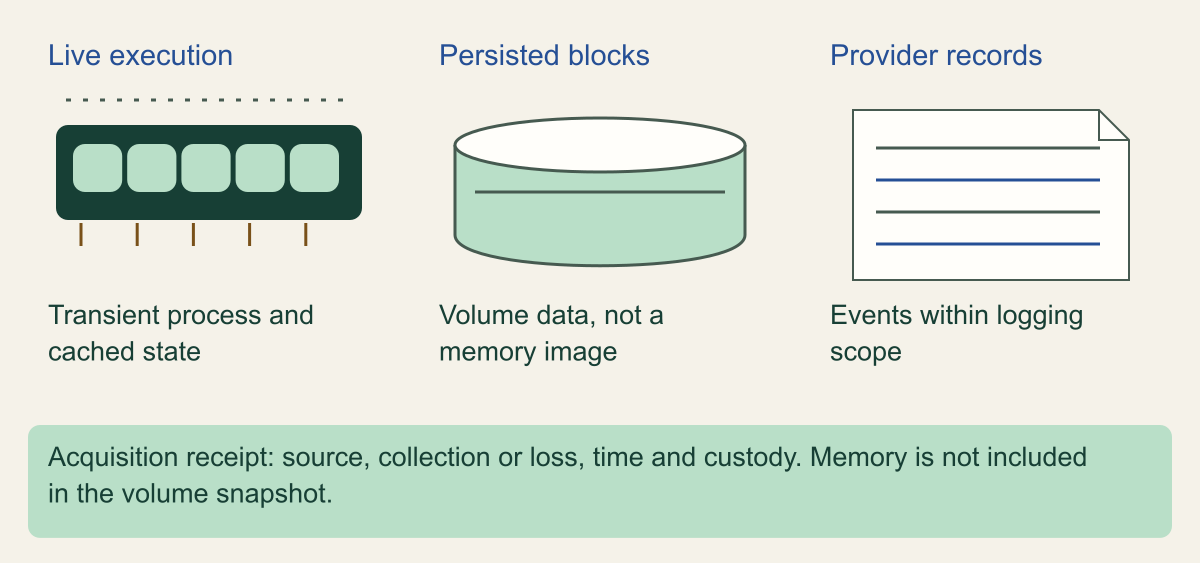
Start with persistence, not the name of a collection tool. Live execution can include memory contents, processes and active connection context. Persisted storage can contain application files, logs and other blocks written to a volume. Provider records may describe administrative operations independently of the guest system. These categories can support different conclusions even when their timestamps appear close together.
AWS's forensic collection guidance discusses disk acquisition alongside other relevant artifacts, including memory and instance context. NIST's foundational forensic guidance also treats collection as part of a broader examination and analysis process. Neither supports the shortcut that possession of one disk image establishes complete knowledge of an incident. [2][6]
Create an artifact list with an availability state. A source can be available now, obtainable through a separate authorized workflow, unavailable in the service model or already lost. Keep those states distinct. A managed service may not expose guest memory to its customer at all. That is a service boundary to document, not a reason to claim there was no relevant activity in memory.
Time needs similar care. An event timestamp says when a source reports an event. An acquisition timestamp says when the responder collected an artifact. A copy timestamp records another operation. Conflating them can make an old artifact look newly created or an acquisition delay look like an attacker action. Preserve the original field and describe any normalization used for analysis.
The illustration separates these evidence layers rather than placing them on a fictional completeness scale. There is no justified percentage that says a snapshot contains most of an incident. Its usefulness depends on the question. A persistent configuration change may be visible on disk; a short-lived process may require another source; an account-level action may be clearer in provider records.
Before collection begins, connect each intended conclusion to a possible source. If the team wants to know whether a privileged role changed a storage policy, a guest disk may be peripheral. If it needs to understand a process's runtime state, an account audit event may be insufficient. This question-to-source mapping keeps acquisition focused while leaving uncertainty visible.
Evidence persists on different layers
Memory, disk and provider records preserve different parts of an incident.

Source. Primary documentation [4] [2] [6]. Reviewed August 28, 2026.
Method. Original conceptual synthesis reviewed August 28, 2026. Unit: qualitative states and relationships. Scope: Cloud forensic volatile evidence acquisition. It is not measured performance, prevalence, risk or implementation proof. Memory, disk and provider records preserve different parts of an incident.
Accessible table and figure data
| Layer | Potential evidence | Limit |
|---|---|---|
| Live execution | Memory and active context | Can disappear on shutdown |
| Volume snapshot | Persisted block data | Excludes cached memory state |
| Provider record | Independent service events | Depends on logging scope and retention |
| Acquisition receipt | Source and copy provenance | Does not prove complete collection |
| Layer | Potential evidence | Limit |
|---|---|---|
| Live execution | Memory and active context | Can disappear on shutdown |
| Volume snapshot | Persisted block data | Excludes cached memory state |
| Provider record | Independent service events | Depends on logging scope and retention |
| Acquisition receipt | Source and copy provenance | Does not prove complete collection |
Choose containment with the evidence loss visible
The response lead should decide whether delaying containment creates unacceptable harm. That decision might involve ongoing access to sensitive data, effects on other workloads or loss of a critical service. Evidence preservation matters, but it does not override every other responsibility. Record why an action was chosen and which evidence opportunities it was expected to remove.
Current NIST incident-response guidance explicitly recognizes tradeoffs between quickly recovering and conducting a more thorough investigation or observing attacker behavior. It recommends prioritizing response with scope, likely impact, time criticality and available resources in view. The decision is therefore contextual; a fixed rule to always collect first or always stop first is too broad. [8]
Containment also needs an observable definition. AWS warns that restricting security groups can block new traffic while existing tracked connections remain. A configuration change is not sufficient proof that every connection ended. Review the documented behavior of the chosen containment method, then verify its intended effect through the evidence available to the authorized team. [7]
In the hypothetical exercise, the lead might authorize immediate isolation because the connection presents a credible risk to another system. The receipt should state that preserving uninterrupted live state was a lower priority than containing that risk. Alternatively, a supported collection could be authorized before a disruptive action if the remaining exposure is acceptable. Neither branch should be depicted as universally correct.
Avoid giving the acquisition operator an implicit mandate to decide the whole incident strategy. Their technical assessment should inform the decision: which artifacts are volatile, how long a supported procedure may take, what privileges it requires and how it could alter the system. The accountable response lead combines that assessment with service and business consequences.
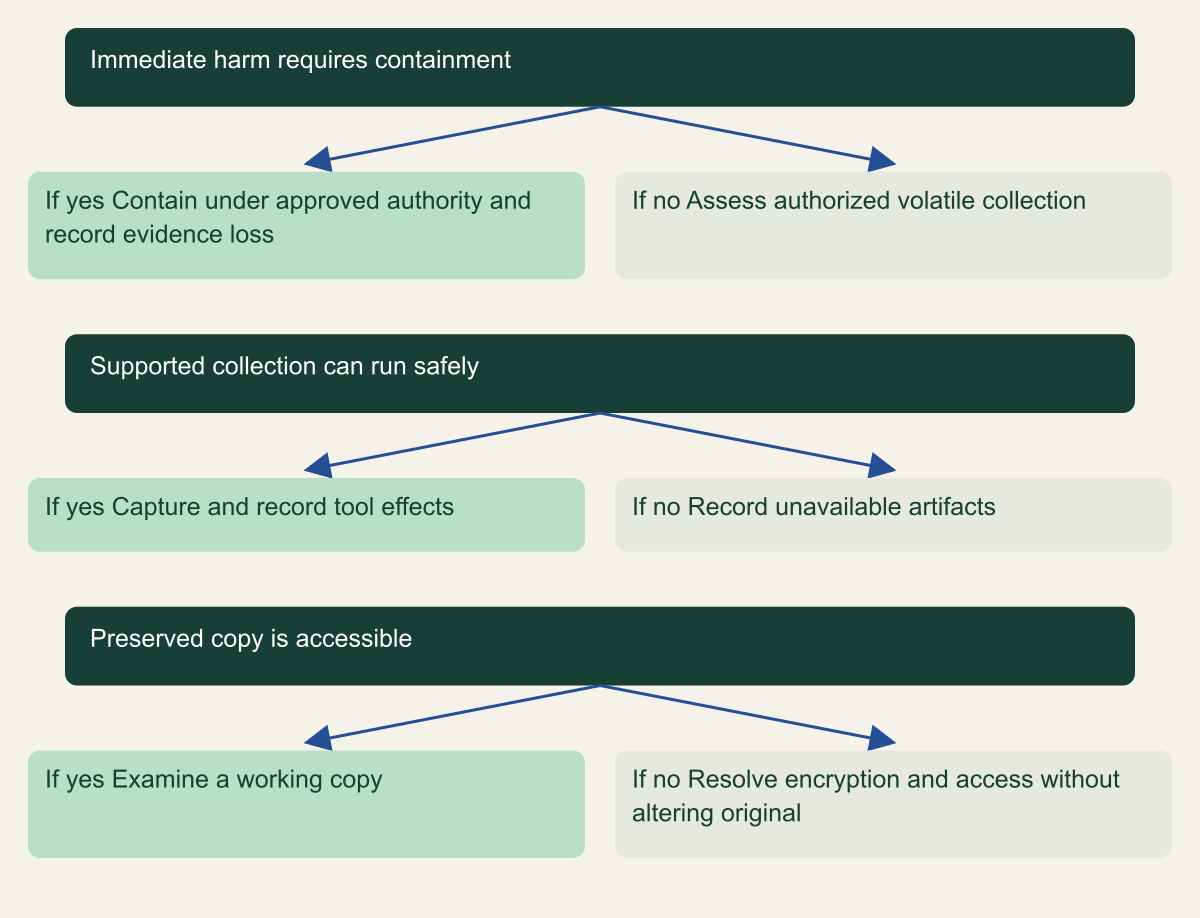
The decision tree deliberately retains unresolved branches. If collection is unsupported, unsafe or unauthorized, the correct record is an unavailable artifact and its reason. It is not an improvised procedure represented as approved evidence handling. A response can be defensible while acknowledging that some evidence could not be preserved.
An explicit containment and acquisition decision
The response lead records the tradeoff before taking an action that can destroy volatile state.

Source. Primary documentation [8] [1] [7]. Reviewed August 28, 2026.
Method. Original conceptual synthesis reviewed August 28, 2026. Unit: qualitative states and relationships. Scope: Cloud forensic volatile evidence acquisition. It is not measured performance, prevalence, risk or implementation proof. The response lead records the tradeoff before taking an action that can destroy volatile state.
Accessible table and figure data
| Question | If yes | If no |
|---|---|---|
| Immediate harm requires containment | Contain under approved authority and record evidence loss | Assess authorized volatile collection |
| Supported collection can run safely | Capture and record tool effects | Record unavailable artifacts |
| Preserved copy is accessible | Examine a working copy | Resolve encryption and access without altering original |
| Question | If yes | If no |
|---|---|---|
| Immediate harm requires containment | Contain under approved authority and record evidence loss | Assess authorized volatile collection |
| Supported collection can run safely | Capture and record tool effects | Record unavailable artifacts |
| Preserved copy is accessible | Examine a working copy | Resolve encryption and access without altering original |
Acquire disk evidence without implying memory completeness
Describe the storage artifact precisely. Identify the source instance, each relevant volume and the relationship between them. An application may distribute state across several volumes or use storage with a different lifecycle. A snapshot of one selected volume does not establish that every application component or temporary location was captured.
For ordinary EBS snapshots, AWS's cached-data warning establishes a clear limit. Data still in memory is outside that artifact. Consistency steps may reduce uncertainty about persisted application state, but their effect on live evidence must remain part of the response decision. Do not rewrite a storage-consistency recommendation as a universal forensic sequence. [4]
Copying a snapshot introduces another boundary. AWS documents copy behavior and encryption considerations, including cross-account scenarios. The investigation plan must establish which authorized identities can access the original, copy it and use the relevant encryption keys. A copy that exists but cannot be read by the approved examination role may not support the planned analysis. [5]
Keep the original and the examination copy distinguishable in the record. Identify which object was collected, which was copied and which was attached or otherwise made available for analysis. If several volumes form a related set, preserve that association. A later reviewer should not have to infer it from filenames or the order in which screenshots were taken.
A failed copy or missing permission should remain a collection exception. Do not silently substitute a different disk or a later snapshot and call it the same evidence. A later artifact may still be useful, but its timing and source must be explicit. Explain whether the substitution affects the incident claim or simply narrows the available examination window.
This is also where recovery and investigation can diverge. A team restoring service may prefer a known-good state, while an investigation may need to preserve the suspected state. Those goals can coexist through separately controlled copies and procedures. They should not compete through undocumented edits to the only artifact the team retained.
Keep the acquisition environment separate
AWS's forensic-environment guidance describes separating preservation and investigation activities with controlled environments and access. The purpose is to make the evidence destination and the examination workflow deliberate. A responder should know where an artifact goes, who can change it and which role is intended to work with a copy. [1]
For a cloud team, the design review should follow authority in both directions. Can the acquisition role obtain the intended source material? Can it write only to the approved destination? Can an examination role read a working copy without changing the preserved original? These questions are more useful than a broad claim that a separate account automatically makes evidence safe.
AWS's artifact-collection framework provides a concrete reference for moving forensic artifacts into S3 under controlled permissions. Use that documentation to understand the service-specific interactions, then adapt the trust relationships to the organization's account and encryption design. Do not copy a policy into production without reviewing the resources and principals it authorizes. [3]
The destination is itself sensitive. Memory and disk artifacts can contain credentials, personal information, proprietary code or data unrelated to the suspected incident. Limit access to the investigation purpose, define retention and review any transfer across organizational or geographic boundaries. A public incident report should not expose private object locations or the contents of the artifacts.
Operational access should be prepared before an emergency. If a forensic account exists but nobody can assume its collection role during an identity outage, the diagram has not established a usable capability. Exercise the authorized access path and preserve the result. Preparation should identify missing permissions without leaving broad emergency access permanently available to unrelated operators.
Finally, separate the tool's capabilities from the environment's trust. A supported collection tool may still be executed with the wrong source selection or an overly broad destination credential. Conversely, a well-restricted destination does not make an unsupported acquisition complete. Both the collection procedure and its surrounding authority need review.
Write the receipt as the collection happens
An acquisition receipt should make the artifact understandable after the immediate responders have moved on. Record the incident identifier, source resource, acquisition start and completion, tool and version, operator role, destination, copy lineage and known failures. Include enough context to reproduce the interpretation without placing private credentials or sensitive payloads into the general incident tracker.
The distinction between a tool version and a tool name matters. Different releases or options can collect different material. A record that says only memory captured leaves later reviewers guessing about the method and its effects. If the tool modifies the system during collection, preserve that limitation rather than presenting the artifact as an untouched view from outside the host.
Where a supported workflow produces hashes, retain them with their meaning and the artifact they describe. A matching hash can support a statement about unchanged bytes across a particular comparison. It does not establish that the original acquisition was complete, that every timestamp was correct or that the system was uncompromised when collection began. Those are separate claims.
Provider evidence can have its own verification procedure. For example, retained CloudTrail files may be checked using their associated integrity material. That task should link to the acquisition receipt without replacing it. A successful log-integrity result does not prove that guest memory was collected or that the trail included every event relevant to the investigation.
Write exceptions at the time they occur. If an encrypted copy cannot be opened, a volume is missing or an attempted collection fails, identify the affected source and the next owner. An overall status can summarize progress, but it should not erase partial results. Later investigators need to know which conclusions rest on observed material and which depend on an unresolved gap.
Use the receipt to distinguish observations from interpretations. The presence of a file is an observation about the artifact. A claim about who created it or why it exists may require other evidence. Keeping those levels separate makes the final explanation more precise and reduces the chance that an early hypothesis becomes an unsupported fact through repetition.
Prepare the gaps before the next incident
A useful readiness exercise begins with the collection questions, not a promise to capture everything. Choose an authorized test instance and a documented scenario. Confirm the source selection, available acquisition methods, destination permissions, encryption access and examination path. Record exactly what the exercise demonstrates and what remains outside its scope.
Use the exercise to discover service boundaries. Some workloads have no customer-accessible guest operating system. Others depend on temporary storage, multiple volumes or provider logs with separate configuration and retention. The collection plan should identify alternative evidence sources where direct access is unavailable, while acknowledging that those sources may answer a narrower question.
Test the organizational handoff as well. The responder, incident lead, service owner and evidence custodian need a shared understanding of who can authorize disruption, who collects material and who approves examination access. A technically successful collection can still fail its purpose if the team cannot find its receipt or determine whether the artifact may be used.
Review the plan after changes to the operating system, acquisition tool, encryption design or account structure. A procedure that worked against one test configuration is evidence about that configuration. It should not be carried forward as a timeless capability after its prerequisites change. Keep the supported versions and last verified scope adjacent to the procedure.
The immediate objective is a collection decision that can be explained later. Preserve what the approved response requires, identify what the chosen action can destroy and record the limits of each artifact. A well-described snapshot, a clearly unavailable memory capture and an honest decision receipt are more useful than an unqualified statement that the instance was fully preserved.
Method and provenance
Primary documentation review and original operational analysis, checked August 28, 2026. Source versions, claim mappings and visual data are retained in the accompanying research dossier. This article was first published in the practitioner-guides collection on August 28, 2026.
No customer environment, incident evidence, production deployment or service performance was tested for this article. Hypothetical examples and conceptual diagrams are labeled. Organization-specific authorization, architecture and legal obligations require their own review.
AI assistance. Researched, drafted and checked against cited sources with AI assistance. No independent human editorial review or original empirical testing is claimed.
Published under the Cloud Security Desk organizational byline. Read the practitioner guide policy.
References
- Forensic investigation environment strategies in the AWS Cloud | AWS Security Blog Amazon Web Services. Accessed .
- How to automate forensic disk collection in AWS | AWS Security Blog Amazon Web Services. Accessed .
- A framework for securely collecting forensic artifacts into S3 buckets | AWS Security Blog Amazon Web Services. Accessed .
- Create Amazon EBS snapshots - Amazon EBS Amazon Web Services. Accessed .
- Copy an Amazon EBS snapshot - Amazon EBS Amazon Web Services. Accessed .
- SP 800-86, Guide to Integrating Forensic Techniques into Incident Response | CSRC National Institute of Standards and Technology. Accessed .
- Contain - AWS Security Incident Response User Guide Amazon Web Services. Accessed .
- NIST SP 800-61r3 Incident Response Recommendations National Institute of Standards and Technology. Accessed .