CloudTrail digest validation supports a specific integrity claim about delivered log files. This guide separates enabling digests from running validation, describes a reproducible validation receipt, and explains why missing intervals, retention controls and collection completeness require separate conclusions.
At a glance
Key findings
- Enabling log file integrity validation creates the material needed for later verification; it does not run the verification for the investigator. [1][4]
- A successful file-integrity result does not prove that all relevant event categories were collected.
- Record requested, validated and unresolved intervals separately, and preserve the exceptions rather than summarizing them as a single pass.
State the claim the evidence must support
An incident timeline assembled from CloudTrail records can answer several different questions. Which operations were recorded? Have the retained files changed? Were all relevant operations selected for collection? Who controlled the identity in each record? These questions overlap in an investigation, but they do not share a single proof.
CloudTrail log file integrity validation uses cryptographic material to detect changes to delivered log files. AWS describes SHA-256 hashes and digitally signed digest files, with digests delivered hourly when the feature is enabled. This supports checking file integrity; it does not establish that the trail collected every event the investigator might want. [1]
Write the intended integrity claim before processing the evidence. Identify the trail, account context, region, period and files under examination. Keep the question of event coverage in a separate record. A strong integrity result over a partial collection is still a result about that partial collection, and the final report should make the distinction easy to see.
Understand the digest chain
A digest contains references to log files and their hashes, together with information connecting it to a previous digest. AWS's digest-structure documentation describes the fields used to verify those relationships. The chain provides context for validating file and digest continuity; it is not simply a checksum copied next to one exported event. [2]
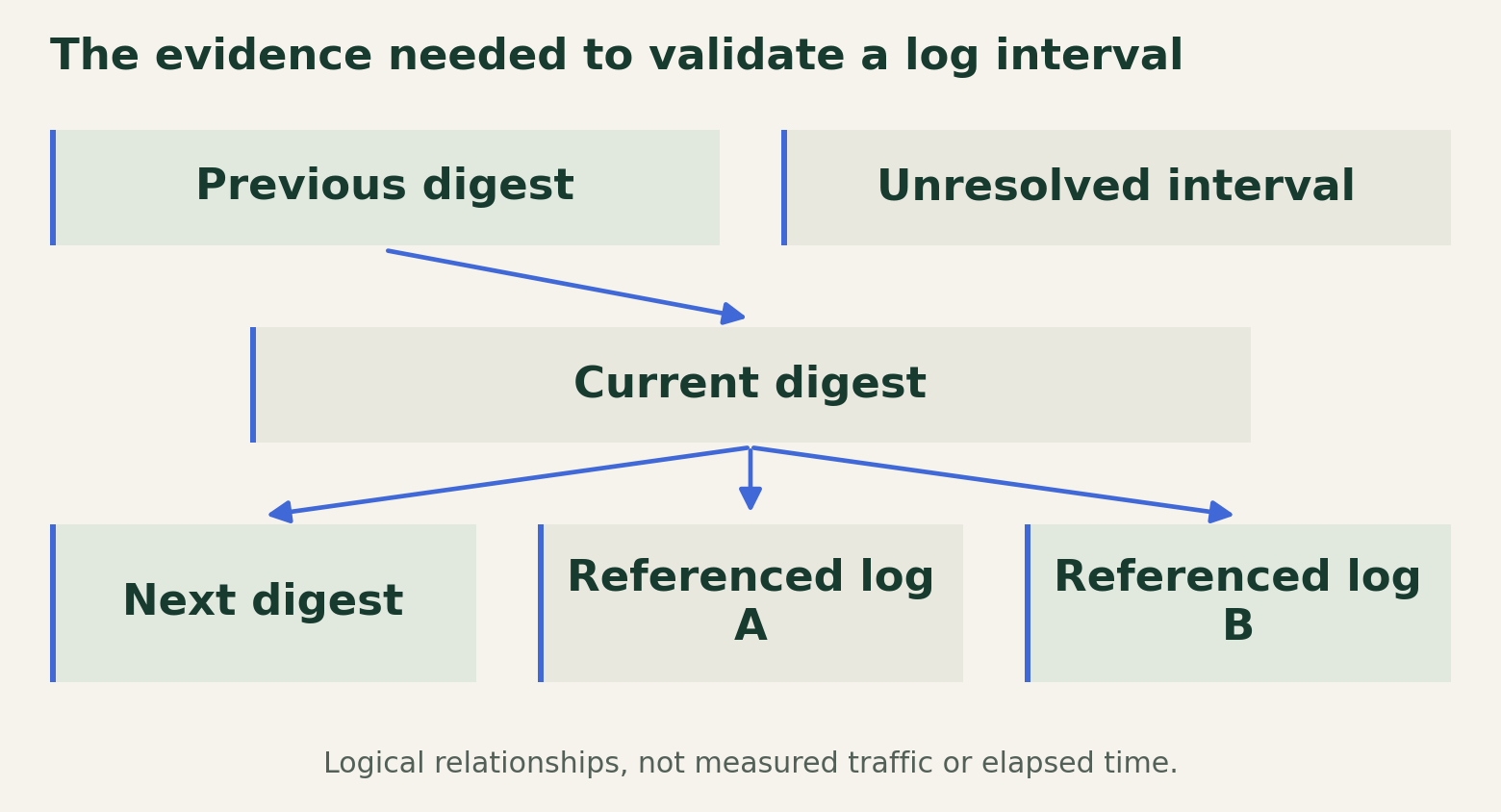
The schematic shows symbolic files and links, not a real investigation. A log file is associated with the digest that references it, and consecutive digests supply a chain across time. A missing segment is left visible. It should not be redrawn as a continuous line merely because the surrounding files can be opened or parsed successfully.
For evidence handling, preserve the original objects and associated metadata alongside any working copy. Analysts may need a normalized table for searching, but that derivative table serves a different purpose from the files used in integrity verification. Record how the working table was produced so that a later investigator can trace a row back to its source.
The evidence needed to validate a log interval
Validate the files and the requested interval explicitly; keep collection completeness and retention as separate claims.

Source. Primary documentation [1] [2] [3] [4] [5]. Accessed August 28, 2026.
Method. Original digest-chain schematic based on AWS documentation. File labels and links are symbolic. The unresolved interval is not represented as validated continuity, and no hashes or test results are invented.
Accessible table and figure data
| Receipt field | Purpose | Limit |
|---|---|---|
| Trail and region | Identify the source | Not a complete account inventory |
| Requested interval | Bound the question | May exceed validated coverage |
| Validated interval | State successful coverage | Does not prove all relevant events were selected |
| Missing or invalid files | Preserve exceptions | Requires investigation of cause |
| Original location and metadata | Support reproducibility | Copied parsed rows are insufficient |
| Receipt field | Purpose | Limit |
|---|---|---|
| Trail and region | Identify the source | Not a complete account inventory |
| Requested interval | Bound the question | May exceed validated coverage |
| Validated interval | State successful coverage | Does not prove all relevant events were selected |
| Missing or invalid files | Preserve exceptions | Requires investigation of cause |
| Original location and metadata | Support reproducibility | Copied parsed rows are insufficient |
Preserve the validation inputs
AWS's CLI validation procedure uses the digest and log files for the requested trail and interval. It validates files referenced by digests and expects the required objects at their documented locations. The command aws cloudtrail validate-logs is therefore a verification operation over specific inputs, not a general declaration that an account's audit history is trustworthy. [3]
Before running an authorized verification, record the requested interval, object location, tool version and permissions available to the operator. Check whether the evidence includes the relevant digest objects as well as the log files. A copied collection of parsed JSON events may be useful for searching while still lacking the inputs needed to reproduce the integrity result.
Keep credentials and private bucket identifiers out of a public report. Within the controlled evidence record, preserve enough location and version context to reproduce the operation. If files are copied for analysis, document the copy separately and avoid silently substituting it for the original validation input. The source location and the analyst's workspace are not the same evidence object.
Record a validation result explicitly
Enabling integrity validation starts delivery of digest material. [4] AWS explicitly distinguishes that configuration from the act of validating the logs. [1] A screenshot of the feature setting does not establish that anyone checked the incident interval. The result needs the actual verification output and a statement of the period it covered.
Use a receipt with separate fields for requested interval, successfully validated interval and exceptions. Include missing or invalid files, errors and any period that could not be evaluated. Preserve the underlying output rather than keeping only a manually entered “passed” label. A summary should help an investigator find the exceptions, not require them to discover exceptions hidden beneath the summary. Name the operator who ran the verification and the reviewer who accepted any unresolved interval. These roles explain who can answer later questions about the result.
Review partial success carefully. If the command validates some files but not others, describe the validated subset and the unresolved portion independently. Do not let a later presentation round a mixed outcome into a complete integrity claim. The person accepting the evidence should understand whether the unresolved portion overlaps the events on which the incident conclusion depends.
Investigate gaps without assuming tampering
AWS documents circumstances that affect digest continuity, including disabling validation and periods when logging is stopped. Digests are not retroactively supplied for a period when the feature was disabled. [6] Delivery problems and separate backfill chains also require attention when interpreting continuity. [3] A gap is an investigation question, not automatic proof of malicious deletion.
Build competing explanations from the available evidence: an intentional configuration change, a delivery issue, unavailable objects or an integrity failure. Identify the record needed to distinguish each explanation. Retain configuration history and relevant service-status evidence with their own provenance rather than treating the file-validation output as an explanation of every gap.
Ask whether the gap affects the incident claim. A missing interval outside the investigated activity and a missing file containing a decisive action are not equivalent limitations. Both belong in the receipt, but the report should explain their different consequences. This keeps the integrity discussion tied to the actual timeline rather than turning it into an unrelated checklist.
Keep retention separate from integrity
S3 Object Lock applies retention protection to individual object versions under its documented modes. [5] Retaining a protected version does not replace CloudTrail digest verification. The storage decision and the verification decision need separate owners and evidence, so a change to one cannot silently stand in for approval of the other.
An evidence plan should therefore name both the retention control and the verification procedure. Identify who may alter the storage policy, who may read the evidence and who records validation outcomes. An immutable file that was never checked and a checked file that was later lost create different operational failures; neither should be hidden behind the label “protected logs.”
When the timeline is delivered, attach the validation receipt and the coverage limitations to the conclusions that rely on them. A reader should be able to identify the source files, see the verified interval and understand why any gap was accepted or remained unresolved. That is a more durable integrity claim than the existence of a setting that happened to be enabled when someone opened the console.
Method and provenance
Documentation review and original operational analysis using the cited primary sources, checked on August 28, 2026. The editorial date places the article in the retrospective series; publication and source review occurred in August 2026.
No customer logs were validated. File integrity does not prove collection completeness, detection quality or human attribution. This article makes no legal-admissibility or compliance determination, and storage-lock changes need separate authorization. No empirical tests were performed for this article.
AI assistance. Researched, drafted and checked against cited sources with AI assistance. No independent human editorial review or original empirical testing is claimed.
Published under the Cloud Security Desk organizational byline. Read the series policy.
References
- Validating CloudTrail log file integrity Amazon Web Services. Accessed .
- CloudTrail digest file structure Amazon Web Services. Accessed .
- Validating CloudTrail log file integrity with the AWS CLI Amazon Web Services. Accessed .
- Enabling log file integrity validation for CloudTrail Amazon Web Services. Accessed .
- Using S3 Object Lock Amazon Web Services. Accessed .
- CreateTrail API and EnableLogFileValidation behavior Amazon Web Services. Accessed .