
An Entra Conditional Access rollout guide for device-code authentication. It explains cross-device authorization, identifies evidence for approved use, separates report-only evaluation from enforcement and makes protocol tracking, exceptions and user guidance part of acceptance.
At a glance
Key findings
- A legitimate authentication page does not identify the separate client that requested the device code.
- Report-only outcomes estimate policy impact but do not establish successful enforcement.
- Protocol tracking can apply an authentication-flow restriction to later requests from the same originating session.
The legitimate page does not identify the requesting device
Restrict device-code authentication by identifying the clients that genuinely need it, evaluating the intended policy against sign-in evidence and then testing enforced access for both approved and unapproved cases. Include later requests from protocol-tracked sessions in the test. A policy that appears to block the first device-code sign-in is not fully understood until its effect on the supported client lifecycle is known. [2][4]
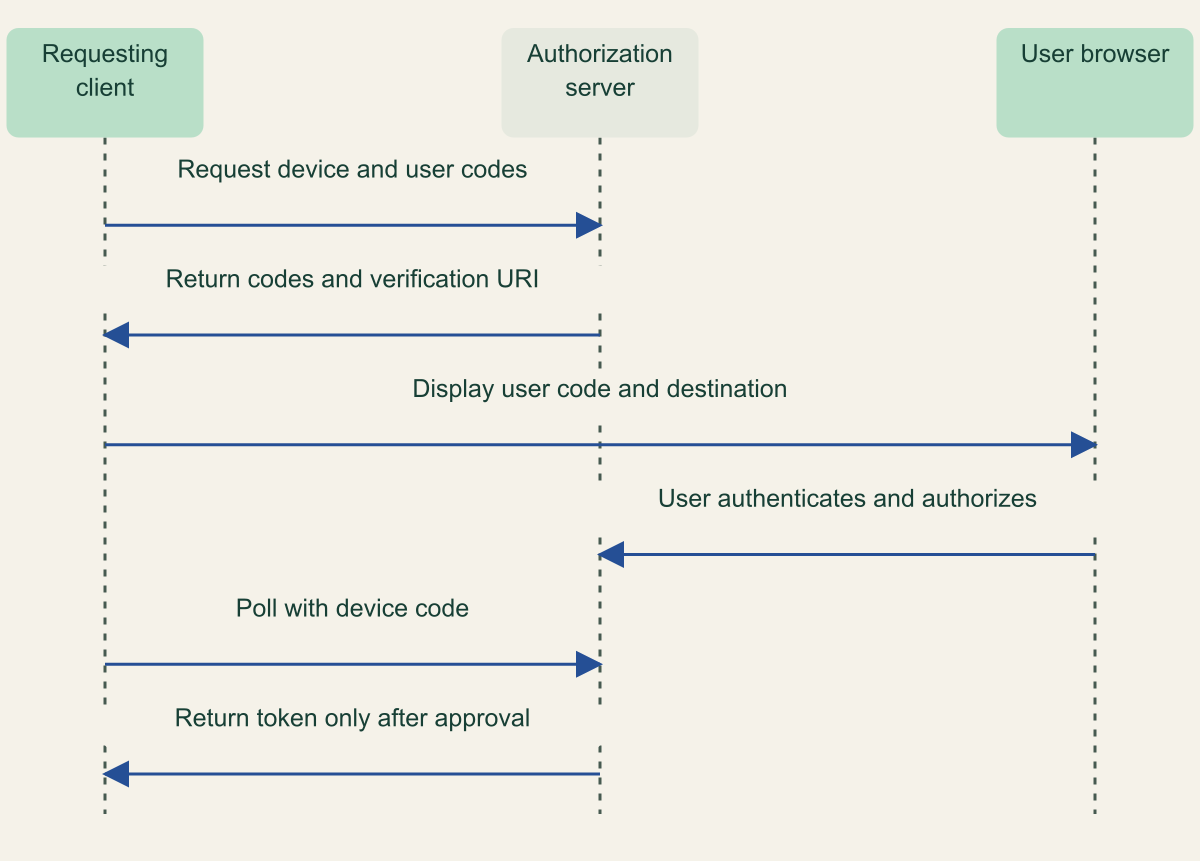
The OAuth device authorization grant separates the client requesting access from the browser where the user authenticates. The client obtains a device code and a user code, directs the user to a verification location and polls for completion. The user can perform authentication on another device. This is useful for input-constrained clients, but it means the browser's legitimate identity page is not itself proof that the original requesting client is the one the user intended to authorize. [1]
Microsoft's protocol documentation describes a default fifteen-minute window for the user to complete the device authorization request. That is the default expires_in value for this stage, not a universal access-token or session lifetime. The client needs to handle polling and completion under the actual protocol response rather than assuming that a successful browser authentication instantly resolves every request. [3]
RFC 8628 distinguishes the user code from the device code and defines polling behavior. When an interval is not supplied, the client waits at least five seconds between polling requests; a slow_down response increases the interval by five seconds for subsequent requests. These are protocol timing rules, not measurements of how quickly an attack succeeds or a tenant policy takes effect. Do not turn them into a security-effectiveness chart. [1]
In April 2026, Microsoft reported a campaign using device-code phishing to induce users to approve an attacker's requesting session through the legitimate authentication process. The report provides evidence of that observed mechanism, not an incidence estimate for every organization. The security lesson is the separation of user authentication from the user's understanding of the client being authorized. A genuine page and successful MFA can coexist with an unintended authorization. [5]
Phishing-resistant authentication remains valuable, but it does not answer every question about consent to a cross-device operation. A user can authenticate strongly while approving a code associated with an unintended client. Keep the authentication method and the authorization context distinct. The tenant can then address device-code exposure with a flow-specific policy instead of assuming that a stronger browser authentication method removes the need to govern this flow.
The requester and approving browser are different actors
The client that polls for a token is separate from the browser where the user authenticates and approves the code. Conceptual sequence, not a measured result.

Source. IETF, OAuth device authorization grant, Cross-device authorization, code lifetime, polling and phishing considerations. [1]; Microsoft, Microsoft device authorization protocol, Device request, user authentication and token polling [3].
Method. Original conceptual sequence synthesizing the cited documentation. It represents design relationships, not observed test results. Reviewed 2026-09-02.
Accessible table and figure data
| From | To | Message |
|---|---|---|
| Requesting client | Authorization server | Request device and user codes |
| Authorization server | Requesting client | Return codes and verification URI |
| Requesting client | User browser | Display user code and destination |
| User browser | Authorization server | User authenticates and authorizes |
| Requesting client | Authorization server | Poll with device code |
| Authorization server | Requesting client | Return token only after approval |
| From | To | Message |
|---|---|---|
| Requesting client | Authorization server | Request device and user codes |
| Authorization server | Requesting client | Return codes and verification URI |
| Requesting client | User browser | Display user code and destination |
| User browser | Authorization server | User authenticates and authorizes |
| Requesting client | Authorization server | Poll with device code |
| Authorization server | Requesting client | Return token only after approval |
Find who uses the flow before blocking it
Start with the sign-in evidence available for the tenant. Microsoft's Conditional Access documentation identifies authentication protocol filtering as useful for finding device-code activity and describes an original transfer method field for protocol-tracked sessions. Use those properties to distinguish the immediate request from a session that originated through the flow earlier. A report grouped only by application name can miss that relationship. [2]
Inventory the user or workload population, application identifiers, target resources, client ownership and business purpose. A familiar display name is not sufficient evidence that a particular flow is approved. The application owner should explain why the client uses device code and whether the supported scenario actually requires it. Keep that explanation tied to the identifier and resource scope used by the policy and investigation tools.
Microsoft's security-operations guidance recommends investigating device-code usage that does not fit an expected input-constrained-device scenario. That is a useful triage prompt, not proof that every unexpected event is malicious. A client can be misconfigured or a team can be using an undocumented workflow. Determine the cause before assigning the event a threat conclusion, and preserve the distinction between unexplained use and confirmed abuse. [6]
Look beyond the most active users. An infrequently used administration client or device-registration workflow can be important even if it contributes few events during the observation period. The inventory should combine telemetry with accountable owner confirmation. A quiet week cannot prove that a quarterly operational procedure does not depend on the flow, and a claimed dependency should be supported by an actual supported client scenario.
Use the observation period honestly. Record the dates, tenant scope and known logging limitations. Do not infer organization-wide prevalence from a small sample or treat missing data as no usage. The goal is a defensible policy rollout population, not an invented attack-rate metric. Additional observation may be needed when the known business cycle includes clients that have not appeared in the current evidence.
The OAuth security best current practice supports modern authorization-code protections such as PKCE. Where a full-featured client uses device code only as a convenient workaround for a broken interactive integration, ask the application owner to review the supported alternative. That does not mean replacing every device flow indiscriminately. It means selecting a flow appropriate to the client rather than letting an accidental implementation shortcut define the tenant's permanent exception list. [8]
Keep investigation artifacts proportionate. Relevant identifiers and policy outcomes can support correlation, but exporting complete token material or unnecessary user detail creates another exposure. The inventory should retain enough evidence to justify the decision and allow authorized follow-up. It should not become an unrestricted catalogue of authentication activity simply because the policy project needs a usage summary.
Write a bounded exception policy
Microsoft documents an authentication-flows condition in Conditional Access that can restrict device code flow. Its blocking guidance starts with the intended user and resource scope, selects the device-code condition and uses a block grant control. The documented rollout begins in report-only mode before moving to enforcement after impact review. Use this supported policy mechanism rather than assuming that a warning to users can enforce an organization-wide restriction. [2][4]
The scope is the actual access decision, not merely the client name in an informal allowlist. Identify the users and resources to which the block applies and the cases excluded. The policy design should be understandable to the owners of those resources. A narrowly approved operational dependency should not become an exception for every resource a privileged user might access through another device-code client.
Emergency access needs deliberate treatment. Microsoft's policy instructions describe excluding emergency or break-glass accounts and auditing the exclusion list. Coordinate those exclusions with the organization's existing emergency-access design. Do not create a new unreviewed privileged account simply to make the rollout easier, and do not assume that an excluded account has no other policy or monitoring responsibilities. [4]
For each other exception, require a client owner, supported use case, necessary population, relevant resources and a review trigger. These are proposed governance fields. An exception can be justified where a required input-constrained client has no appropriate supported alternative, but the justification should be specific enough to revisit when the product changes. A broad group called device-code users without an owner or purpose is difficult to defend later.
Report-only mode evaluates a policy without enforcing its controls. Microsoft documents the distinction between outcomes such as would-block conditions and user action that would have been required. Interpret those results as impact evidence. They cannot demonstrate that an approved device reconnects successfully after an actual block or that an unapproved request is stopped in the enforced configuration. [7]
Avoid treating a report-only failure as a request to exempt the user automatically. The failure may be the intended security outcome. Review it against the inventory and business requirement, then decide whether the application needs migration, a bounded exception or continued blocking. Otherwise, the rollout can gradually exempt exactly the unknown usage it was intended to bring under control.
Test the session after the first sign-in
Entra protocol tracking applies authentication-flow information to the session so restrictions can continue to reflect its originating method. Microsoft's documentation explains that later requests can be affected even if the immediate request appears to use a different flow. A troubleshooting process that looks only at the current protocol can therefore misidentify an intended policy block as an unrelated authentication failure. [2]
Use original transfer method evidence when reviewing these cases. Correlate it with the policy result, target resource and supported client behavior. The field helps explain why the policy applies; it does not establish that the user acted maliciously. Keep the causal question about session origin separate from the incident question about whether the client or approval was authorized. [2]
The test plan should follow an approved client through initial authentication, subsequent resource access, reconnect and any supported sign-out or device lifecycle operation relevant to the business use. A successful first login is not enough if later operations are blocked in a way the owner did not anticipate. Conversely, a later block may be exactly the intended policy result rather than something to remediate by weakening the policy.
Microsoft specifically notes that protocol-tracked blocks are expected when the policy is enabled and that changing a policy to disabled or report-only can require obtaining a fresh token before the device works again. This is an important operational distinction. Do not promise that toggling a setting restores every existing client session immediately, or that a previously acquired token can be treated as evidence of the new policy state. [2]
Device Registration Service behavior also has documented interaction with authentication-flow policy. Review the current Microsoft guidance for the actual device scenario rather than applying a generic application exception without understanding its resource effect. The supported operation and policy scope should be written together in the acceptance record. A device registration or sign-out path can matter even when ordinary application requests appear healthy. [2]
If a client fails after enforcement, capture the relevant policy outcome before changing scope. Determine whether the failure is an intended tracked-session restriction, an unrecorded approved dependency or a genuinely incorrect configuration. The next action differs in each case. Broadly exempting an application because a user reports a broken device can erase the boundary without resolving which session behavior caused the problem.
Give users and responders a precise rule
User guidance should connect the code to an action the user initiated on a known client. A useful rule is to complete a device-code authorization only when the user is actively signing into the intended device or application and understands the request. Telling users only to check that the browser shows Microsoft's legitimate domain is incomplete for this flow, because the genuine page can be part of an unintended authorization. [1][5]
Avoid describing the mechanism as an automatic MFA bypass. The observed campaign can involve the user completing the expected authentication process while authorizing the wrong requesting session. Other controls can still affect the result. Accurate language helps responders look for the client, resource and session context instead of assuming that successful MFA proves the access was intended or that every device-code event defeats MFA. [5]
Investigation should connect the originating device-code request, the resulting sign-in or session evidence and the resources accessed under that authority. Microsoft's report offers detection ideas tied to its observations, while the general security-operations guidance helps identify unusual application flows. Treat those as starting points to validate against the tenant's available telemetry, not a universal detection rule with a guaranteed false-positive rate. [5][6]
If abuse is suspected, follow the authorized identity-incident process for containment, session handling and application investigation. Blocking future device-code requests does not by itself describe everything that should happen to existing grants, tokens or resource access. The relevant follow-up depends on the affected identity and application. Preserve the distinction between changing a preventive policy and completing incident containment.
Partner access adds another coordination point. A resource tenant may accept authentication claims from another organization while still restricting the flows or resources that can be used. Do not weaken a resource policy merely because the home-tenant authentication succeeded. The partner owner and identity team should agree which client path is approved and which tenant's evidence establishes each part of that path.
Approve evidence from both sides of the policy
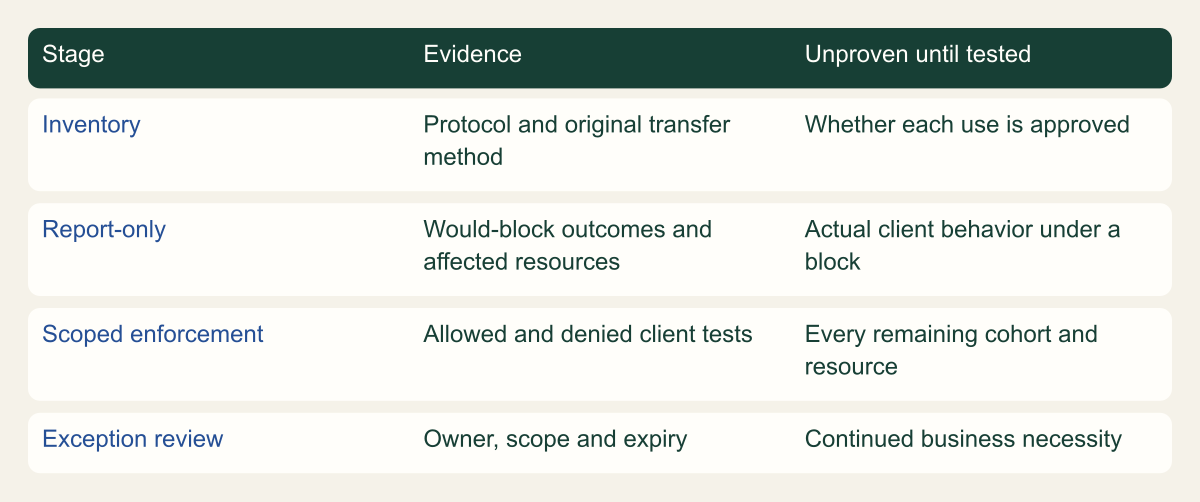
Acceptance needs evidence from an enforced configuration. Demonstrate that an unapproved device-code path is denied and that each approved client scenario still works within its explicitly permitted scope. Include a later request from a protocol-tracked session where that behavior matters. The figure separates inventory, report-only evaluation, enforcement and exception review because each contributes a different kind of evidence. [2][4][7]
Record the policy version, user or group scope, resource scope, exclusions and test identities used. Keep the expected result beside the observed result for each case. A test performed by an excluded administrator does not establish the experience of an ordinary user, and a test against a different resource does not establish the effect on the application whose availability the owner approved.
Document unresolved clients individually. A rollout can be intentionally staged, but the record should say which dependencies remain on the earlier policy and who owns the next decision. Do not turn unknown impact into a claim that the flow has been safely disabled organization-wide. The article supplies this acceptance model without claiming that a live tenant policy or client was tested during preparation.
Review exceptions when clients, resources or partner arrangements change. A supported alternative can remove the original need for a device-code exception, while a new client release can change the tracked-session behavior that was previously tested. The policy should follow the maintained business requirement, not simply accumulate every exclusion that once resolved a support ticket.
The finished control is more than a block toggle. It connects a precise cross-device authorization risk to an inventory of legitimate use, an enforced scope and a tested session lifecycle. When those elements are explicit, the organization can restrict an unnecessary flow without confusing a legitimate authentication page, a report-only result or a successful first sign-in with proof that the whole access path is understood.
Evaluation and enforcement produce different evidence
Inventory, report-only evaluation, scoped enforcement and exception review produce different kinds of evidence. Conceptual matrix, not a measured result.

Source. Microsoft, Conditional Access authentication flows, Device-code and authentication-transfer restrictions plus registration exceptions. [2]; Microsoft, Block authentication flows with Conditional Access, Report-only rollout and narrowly documented exceptions [4]; Microsoft, Conditional Access report-only mode, Policy evaluation without enforcement and interpretation of results [7].
Method. Original conceptual matrix synthesizing the cited documentation. It represents design relationships, not observed test results. Reviewed 2026-09-02.
Accessible table and figure data
| Stage | Evidence | Unproven until tested |
|---|---|---|
| Inventory | Protocol and original transfer method | Whether each use is approved |
| Report-only | Would-block outcomes and affected resources | Actual client behavior under a block |
| Scoped enforcement | Allowed and denied client tests | Every remaining cohort and resource |
| Exception review | Owner, scope and expiry | Continued business necessity |
| Stage | Evidence | Unproven until tested |
|---|---|---|
| Inventory | Protocol and original transfer method | Whether each use is approved |
| Report-only | Would-block outcomes and affected resources | Actual client behavior under a block |
| Scoped enforcement | Allowed and denied client tests | Every remaining cohort and resource |
| Exception review | Owner, scope and expiry | Continued business necessity |
Method and provenance
Primary documentation and standards were reviewed on September 2, 2026. The guide combines source-supported behavior with explicitly framed implementation recommendations and hypothetical examples.
No customer deployment, production environment or live cloud configuration was tested. Product behavior is limited to the cited documentation and stated scope; actual versions, policies and application behavior require verification.
AI assistance. AI-assisted research synthesis, drafting and consistency checks. No human review or firsthand deployment experience is claimed.
Published under the Cloud Security Desk organizational byline. Read the practitioner guide policy.
References
- OAuth device authorization grant IETF. Accessed .
- Conditional Access authentication flows Microsoft. Accessed .
- Microsoft device authorization protocol Microsoft. Accessed .
- Block authentication flows with Conditional Access Microsoft. Accessed .
- Microsoft device-code phishing observations Microsoft. Accessed .
- Entra security operations for applications Microsoft. Accessed .
- Conditional Access report-only mode Microsoft. Accessed .
- OAuth security best current practice IETF. Accessed .