
A trust review of the OpenTelemetry Collector path from sender to destination. It covers identity-bound tenant routing, processor changes, sensitive configuration, component stability and failure-path checks while separating provenance from transport confidentiality and successful delivery.
At a glance
Key findings
- Authenticate a sender and constrain its route before treating client-supplied tenant attributes as authority. [2][4][5]
- Processors and exporters can change the meaning or destination of evidence, so their configuration belongs in the trust review. [6][7][8]
- A successful export is not proof of truthful fields, complete collection or tested tenant isolation.
A delivered record may still have the wrong provenance
The collector accepted the connection and exported the record. That observation says something about delivery, but it does not establish who was entitled to assert every field or whether the record reached the correct tenant. A telemetry path used for security evidence needs an explicit trust contract from sender identity through processing to destination.
Consider a hypothetical shared gateway with two authorized senders. One supplies a resource attribute naming the other tenant. The design question is whether routing accepts that client-supplied value or constrains it through an operator-controlled mapping from authenticated identity. This is an authored threat model, not a claim that every OpenTelemetry Collector deployment has that behavior.
OpenTelemetry's security guidance addresses configuration, hosting and data protection as parts of the Collector's security posture. The Collector is not merely a transparent pipe: its components can receive, transform, filter, buffer and export telemetry. Those responsibilities create boundaries that matter when a later investigation relies on the resulting records. [1][2][3]
Keep provenance separate from confidentiality and availability. Encrypted transport can protect a connection without making the sender's assertions truthful. Successful delivery can coexist with incorrect tenant routing. A retained record can be available for analysis while lacking the transformation context needed to understand its fields.
The practical objective is a reviewable evidence contract. Name the allowed sender, accepted signals, assigned tenant, transformations, destination and failure behavior. Then test the boundaries that support those claims. This article supplies a conceptual review model and reports no executed Collector deployment or customer telemetry inspection.
Map the components that can change the record
The Collector architecture separates receivers, processors and exporters within configured pipelines. A receiver accepts telemetry, a processor can change or filter it, and an exporter sends it onward. Components must be present in the distribution and connected through the service configuration to participate in the intended path. [4][7]
Trace one record through that path. Identify where transport terminates, where identity is established, where attributes can be changed and where routing selects a destination. Include any upstream proxy or agent that performs part of those functions. A diagram that begins after an important transformation may omit the boundary on which the later trust claim depends.
Record original meaning as well as field names. An attribute can describe the emitting process, the resource represented by an event or a value asserted by the application. Normalizing those fields can be useful, but it can also obscure their source if the transformation is undocumented. A familiar label does not establish that every sender used it with the same meaning.
The gateway pattern centralizes collection and processing for multiple clients. That can simplify operations while concentrating authority over many streams. Review the gateway as a shared dependency: which senders it accepts, whose configuration controls it and which destinations it can reach. Its convenience does not remove the need to separate tenant or environment boundaries. [5]
Buffering introduces another location where sensitive records may reside. The security review should determine whether telemetry is held in memory or persisted under the selected components and settings, and who can access that state. Do not assume that exporting data to a protected backend makes every intermediate copy equally protected.
Keep collection scope separate from this trust review. A correctly secured Collector can still receive an incomplete set of provider events. Conversely, a complete source stream can be changed or misrouted after collection. The existing log-coverage articles address which events are available; this guide addresses the path that handles them.
Bind identity before trusting tenant attributes
Begin with peer authentication. Determine which client identities can connect to each receiver and how the Collector or its trusted front end verifies them. Then determine the authority associated with that identity. Authentication alone does not decide which tenant, environment or destination the client is permitted to name.
OpenTelemetry's configuration guidance describes security and authentication considerations for the Collector path. Apply those capabilities according to the chosen receiver, extension and deployment. A configuration snippet naming TLS or an authentication extension is not proof that the deployed endpoint enforces the intended policy. The effective listener and trust material must be checked. [2][4]
In the hypothetical gateway, an operator-controlled identity-to-route mapping can prevent a sender from choosing another tenant merely by changing a payload attribute. That is a proposed architecture requirement, not a built-in guarantee inferred from the presence of an OTLP receiver. Its implementation must be validated using the actual distribution and routing components.
Check the granularity of the identity itself. If two senders use the same authentication credential, that credential alone cannot distinguish their tenant authority. A design that needs separate tenant decisions must obtain the distinction through an appropriate trusted boundary, such as distinct identities or an explicitly trusted intermediary. Separate destination names do not repair an upstream identity model that cannot tell the authorized senders apart.
Distinguish authenticated metadata from application assertions. A client certificate can identify a peer under the configured trust policy, while a resource attribute remains data supplied by that peer. If the peer is compromised or buggy, its attributes can be wrong. The downstream evidence record should not erase that distinction by marking the entire payload trusted.
Review what happens when identity is absent, ambiguous or no longer authorized. The design might reject the connection, quarantine an unsupported stream or route it to a separately controlled diagnostic destination. Whatever policy is chosen, it should not silently place unknown data into a tenant's ordinary evidence store with the same status as authorized records.
Test negative cases deliberately in an isolated, approved environment. A wrong-tenant attribute, an unauthorized sender and an allowed sender on the wrong path should each have a defined outcome. A successful happy-path export cannot establish those boundaries because it never challenges the assumptions they are meant to enforce.
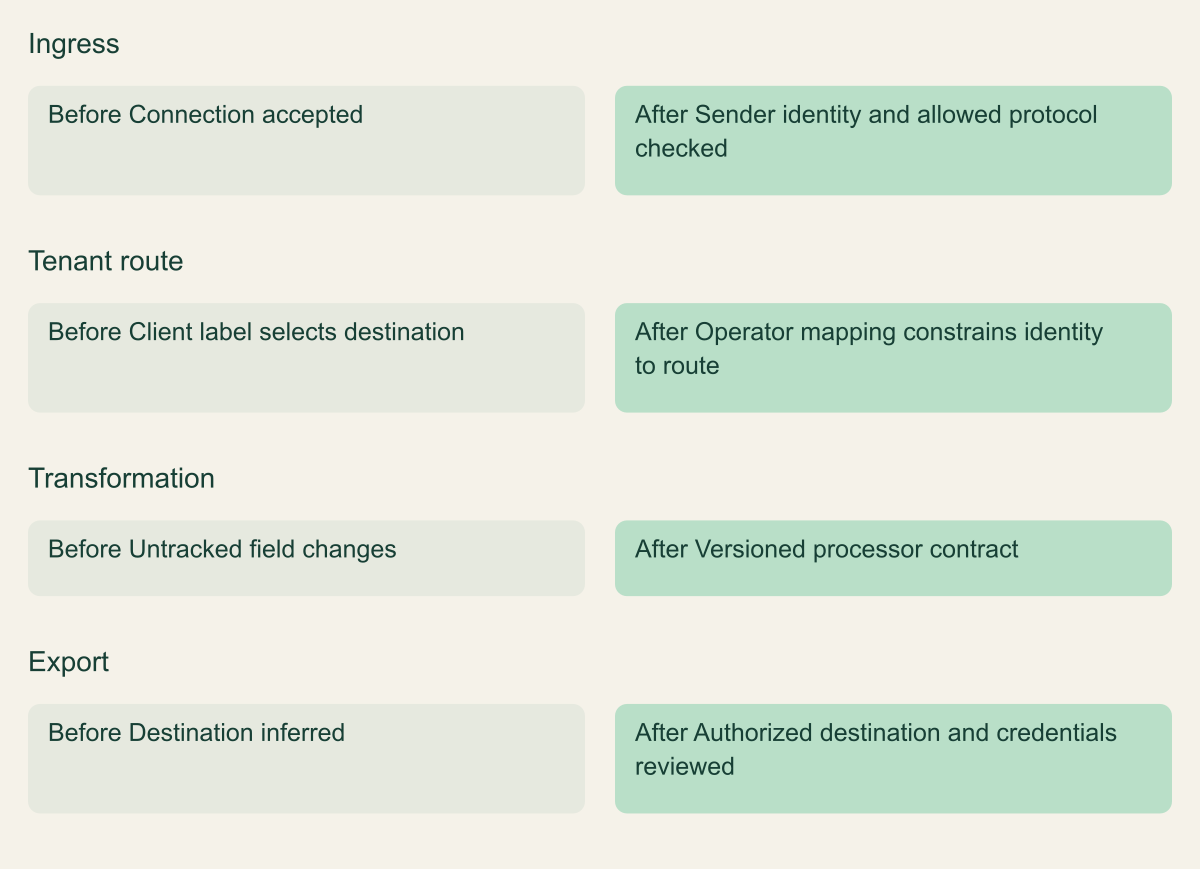
The before-and-after comparison shows the intended authority change. It replaces a route chosen solely from client labels with an explicit identity and route contract. It does not claim that a generic diagram supplies a complete configuration or that tenant isolation has been tested in an environment the article has not accessed.
Make the tenant route an explicit boundary
The proposed design separates the authenticated sender from attributes that sender can supply.

Source. Primary documentation [2] [5] [6]. Reviewed August 28, 2026.
Method. Original conceptual synthesis reviewed August 28, 2026. Unit: qualitative states and relationships. Scope: OpenTelemetry Collector security evidence boundary. It is not measured performance, prevalence, risk or implementation proof. The proposed design separates the authenticated sender from attributes that sender can supply.
Accessible table and figure data
| Boundary | Before | After |
|---|---|---|
| Ingress | Connection accepted | Sender identity and allowed protocol checked |
| Tenant route | Client label selects destination | Operator mapping constrains identity to route |
| Transformation | Untracked field changes | Versioned processor contract |
| Export | Destination inferred | Authorized destination and credentials reviewed |
| Boundary | Before | After |
|---|---|---|
| Ingress | Connection accepted | Sender identity and allowed protocol checked |
| Tenant route | Client label selects destination | Operator mapping constrains identity to route |
| Transformation | Untracked field changes | Versioned processor contract |
| Export | Destination inferred | Authorized destination and credentials reviewed |
Treat transformations as evidence decisions
A transformation can improve usability while changing what a record supports. Filtering can remove events, redaction can remove fields and enrichment can add context. Each decision should be tied to a purpose and an owner. A downstream analyst needs to know which information was originally present, which was changed and which conclusions the resulting record can still support.
The current contrib redaction-processor documentation describes its allow and block behavior and distinguishes component stability by signal. At the August 28, 2026 review, its README labels logs and metrics alpha and traces beta. That is a reason to verify the selected component and version, not to describe every redaction configuration as equally stable or production-ready. [8]
Minimize sensitive content deliberately. A field useful for debugging can contain credentials, personal data or confidential application material. Removing it may reduce exposure but also remove investigative context. Define the accepted tradeoff and any separately controlled evidence path rather than allowing routine telemetry to become an unreviewed repository of sensitive payloads.
The prompt-logging guide provides one domain-specific example of that decision. The Collector review should generalize the boundary without assuming every signal contains prompts. Identify the sensitive fields in the actual schema and test the intended transformation against authorized fixtures, including representations the rule might miss.
Preserve transformation provenance. Record the processor configuration, version and scope associated with a stream. If the configuration changes, later queries may be comparing records produced under different field rules. A data set can remain syntactically consistent while its interpretation changes, so a schema label alone may not explain the difference.
Avoid silently filling unknown identity fields with a reassuring default. An enrichment can be useful when it is derived from a trusted source and its meaning is documented. If it merely guesses missing context, the result should not be presented as an observed fact. Keep unknown states visible where they affect the evidence claim.
Also review failure behavior. A processor error, resource limit or unsupported value can affect whether a record is delivered, changed or dropped. The exact behavior is component-specific. The evidence contract should identify what the chosen implementation does and how an operator will learn that the expected stream is incomplete.
Protect destination credentials and configuration
Exporter authority is part of the evidence boundary. Determine which destination an exporter can reach and what its credential permits there. A gateway that can send to several tenants or stores needs a reviewed routing policy so a compromised configuration does not silently redirect sensitive data or contaminate another stream.
The OTLP exporter specification documents configuration for server trust and client credentials. Those settings establish particular transport and authentication behavior, not the complete authorization policy of every destination. Review both sides: the identity the exporter presents and the destination authority attached to that identity. [6]
Protect the Collector configuration as sensitive operational material. OpenTelemetry's hosting guidance addresses configuration and stored telemetry protection. A configuration may contain credentials or control where records go; unauthorized modification can affect confidentiality and the reliability of later analysis. Read access and write access can therefore create different but important risks. [3]
Use the actual binary as the component boundary. Collector distributions do not necessarily include the same set of receivers, processors, exporters and extensions. The reviewed release is v0.159.0, published August 18, 2026, but that release reference does not prove that a particular deployment contains every component mentioned in documentation. [9]
Separate routine operation from configuration approval. The role that keeps the Collector running need not automatically have unrestricted authority to change every tenant route or destination credential. The appropriate split depends on the platform, but the review should identify who can change the evidence path and how those changes are recorded.
Recovery access matters too. If an exporter credential expires or a destination becomes unavailable, the team needs an approved way to repair the path without distributing broad credentials. Record the responsible owner and the expected effect of the failure. A plan that restores delivery by weakening tenant boundaries has changed the evidence contract, not simply repaired availability.
Test the failure boundaries as well as delivery
Start with a specific test claim. For example, the chosen sender identity can deliver an allowed signal to its assigned destination, while an unauthorized identity cannot. That claim requires at least the intended success and rejection observations. A dashboard showing incoming records is not enough to establish the negative boundary.
Add the tenant mismatch from the hypothetical example. Confirm what happens when a sender supplies a value outside its authorized route. The expected result should be defined before execution and recorded with the component versions and configuration. If the deployed system cannot enforce the intended binding, the architecture needs revision or an explicitly narrower claim.
Test transformations with labeled fixtures. Include required fields, sensitive fields, missing values and relevant alternate representations. The fixture labels express expected behavior; they are not observed results until the configured pipeline runs. Keep synthetic data clearly identified and do not use customer telemetry merely because it is convenient.
Exercise destination and resource failures within an approved environment. Determine how the selected components handle an unavailable exporter, buffering pressure or an invalid record. Observe both the Collector's condition and the downstream evidence outcome. A process that remains running can still have lost or delayed part of the stream.
Check what operational evidence remains after a failure. The team needs enough information to distinguish rejected sender activity, transformation problems and destination unavailability. That diagnostic path should avoid logging the very sensitive payloads the normal pipeline was designed to exclude. Security and troubleshooting requirements need to be considered together.
Record the limits of each result. A local fixture can validate a transformation while leaving production authentication or network routing untested. A staging deployment can establish behavior under its configuration while differing from production credentials or topology. State those boundaries instead of upgrading a narrow pass into a claim about the whole environment.
The downstream detection contract should be checked after meaningful transformations. A field change can affect a Sigma rule or another query even when telemetry still arrives. The related backend-validation article explains why field mapping and event matching require separate checks before a detection is promoted.
Retain a usable evidence contract
The final contract should be concise enough to maintain: sender identity, accepted source and signal, assigned tenant, schema assumptions, transformation version, destination and failure owner. It should point to the configuration and test evidence rather than copying sensitive credentials into a general document.
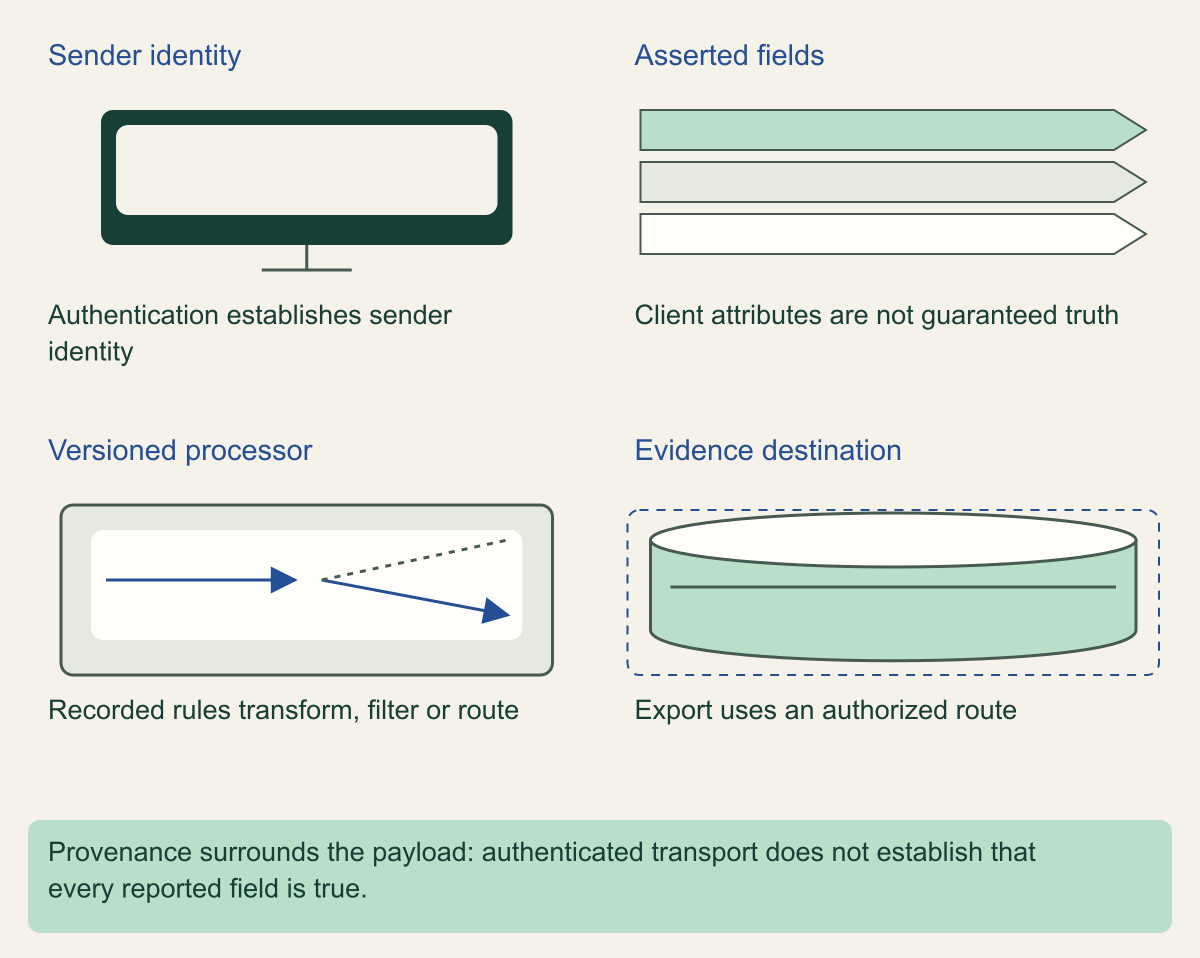
The explanatory illustration separates four kinds of provenance context. The sender supplies a record, the record carries assertions, processors change it under a configuration and an exporter selects a destination. None of those stages should be collapsed into a single trusted flag that conceals where authority was established or where meaning changed.
Review the contract after a new sender, distribution upgrade, processor change or destination migration. Those events can alter a boundary even when the main dashboard still shows data arriving. Keep the last verified scope visible so operators know when an assumption is based on an older configuration.
Connect this record to independent source-coverage and retention decisions. The Collector's trust controls cannot recover an event that the provider never emitted into the selected stream, and successful export does not establish how long the destination retains it. A useful evidence system needs those adjacent contracts without pretending they are the same control.
The operating result is a path whose claims can be examined. Delivery is observed, identity and routing authority are explicit, transformations are interpretable and failures have owners. That is the basis for using telemetry as evidence while preserving the limits of what a sender, collector and destination can each establish.
Provenance is carried across several boundaries
A useful evidence record needs its identity, transformation and destination context, not a single trusted flag.

Source. Primary documentation [7] [3] [4]. Reviewed August 28, 2026.
Method. Original conceptual synthesis reviewed August 28, 2026. Unit: qualitative states and relationships. Scope: OpenTelemetry Collector security evidence boundary. It is not measured performance, prevalence, risk or implementation proof. A useful evidence record needs its identity, transformation and destination context, not a single trusted flag.
Accessible table and figure data
| Layer | Question | Recorded context |
|---|---|---|
| Sender | Who was authenticated | Peer identity and allowed scope |
| Record | Which fields are asserted | Original schema and source |
| Processor | What changed | Configuration and component version |
| Destination | Where did it arrive | Route and export receipt |
| Layer | Question | Recorded context |
|---|---|---|
| Sender | Who was authenticated | Peer identity and allowed scope |
| Record | Which fields are asserted | Original schema and source |
| Processor | What changed | Configuration and component version |
| Destination | Where did it arrive | Route and export receipt |
Method and provenance
Primary documentation review and original operational analysis, checked August 28, 2026. Source versions, claim mappings and visual data are retained in the accompanying research dossier. This article was first published in the practitioner-guides collection on August 28, 2026.
No customer environment, incident evidence, production deployment or service performance was tested for this article. Hypothetical examples and conceptual diagrams are labeled. Organization-specific authorization, architecture and legal obligations require their own review.
AI assistance. Researched, drafted and checked against cited sources with AI assistance. No independent human editorial review or original empirical testing is claimed.
Published under the Cloud Security Desk organizational byline. Read the practitioner guide policy.
References
- Security | OpenTelemetry OpenTelemetry. Accessed .
- Collector configuration best practices | OpenTelemetry OpenTelemetry. Accessed .
- Collector hosting best practices | OpenTelemetry OpenTelemetry. Accessed .
- Configuration | OpenTelemetry OpenTelemetry. Accessed .
- Gateway deployment pattern | OpenTelemetry OpenTelemetry. Accessed .
- OpenTelemetry Protocol Exporter | OpenTelemetry OpenTelemetry. Accessed .
- Architecture | OpenTelemetry OpenTelemetry. Accessed .
- Release v0.159.0 · open-telemetry/opentelemetry-collector-releases · GitHub OpenTelemetry. Accessed .