
A semantic validation guide for Sigma migrations, covering specification and tool versions, logsource assumptions, processing pipelines, fixture design and promotion evidence. It distinguishes a generated query from tested behavior and synthetic results from operational detection quality.
At a glance
Key findings
- Treat schema validation, field transformation, conversion and event matching as separate checks. [1][2][3][4]
- Pin the converter, backend plugin and pipeline with the rule, then compare behavior against labeled fixtures.
- Passing synthetic fixtures does not establish production recall, precision or complete threat coverage.
A converted query can still miss the intended event
A Sigma rule can pass a structural check, convert without an error and still query the wrong field in a new backend. The failure may be quiet: the rule exists, its query is accepted and no alert appears. A migration review therefore needs to establish what the rule means after transformation, not merely whether the conversion command completed.
Consider a hypothetical migration in which a collector changes an operation field from one normalized name to another. The intended administrative event still arrives, but the query continues to search the previous field. Another rule might become too broad because a missing field is handled differently. These are authored examples of semantic failure, not results from a tested customer migration.
The useful evidence has four layers. The rule must have a valid structure. The processing pipeline must map its assumptions to the intended log environment. The backend must express the required logic. Finally, actual test events must produce the expected matches and nonmatches. Each layer supports a narrower claim than the complete detection outcome.
Sigma's specification describes a portable detection format, while its backend and processing-pipeline documentation explain how that format is adapted to targets. Those separate components are a reason to test the adaptation boundary, not a reason to dismiss portable rules. A shared rule can reduce duplicated expression while still requiring explicit local evidence. [1][3][4]
Start the migration record with a statement of intended behavior. Name the source event, the relevant fields and the condition that should produce a result. Also name a close event that should not match. This gives reviewers a decision they can test and prevents an attractive query from becoming the specification merely because it is the output of the current toolchain.
Pin the four moving parts
Record the rule specification, converter, backend plugin and processing pipeline independently. A rule repository commit identifies the authored detection, but it may not identify the code that converted it or the mapping applied during conversion. Preserve those inputs together so a later reviewer can explain why two generated queries differ.
For the source review on August 28, 2026, the pinned Sigma Rules Specification identifies version 2.1.0 with an August 2, 2025 release date. The reviewed tool releases are pySigma v1.5.0 and sigma-cli v3.1.0. Their existence does not establish compatibility with every backend plugin or mean that a reader should upgrade an operating detection stack immediately. [1][7][8]
pySigma provides the parsing and conversion library, and the command-line interface exposes related operations. Backend selection and pipeline selection remain meaningful choices. Treat the exact plugin and its supported features as part of the conversion environment rather than relying on an unqualified statement that Sigma supports the target. [4][6]
A practical version record should also identify the input rule, the relevant pipeline configuration and any conversion options. If a generated query is reviewed manually, retain that output with the inputs that produced it. A copied query without its provenance can be difficult to regenerate after the next change, even when its current behavior is understood.
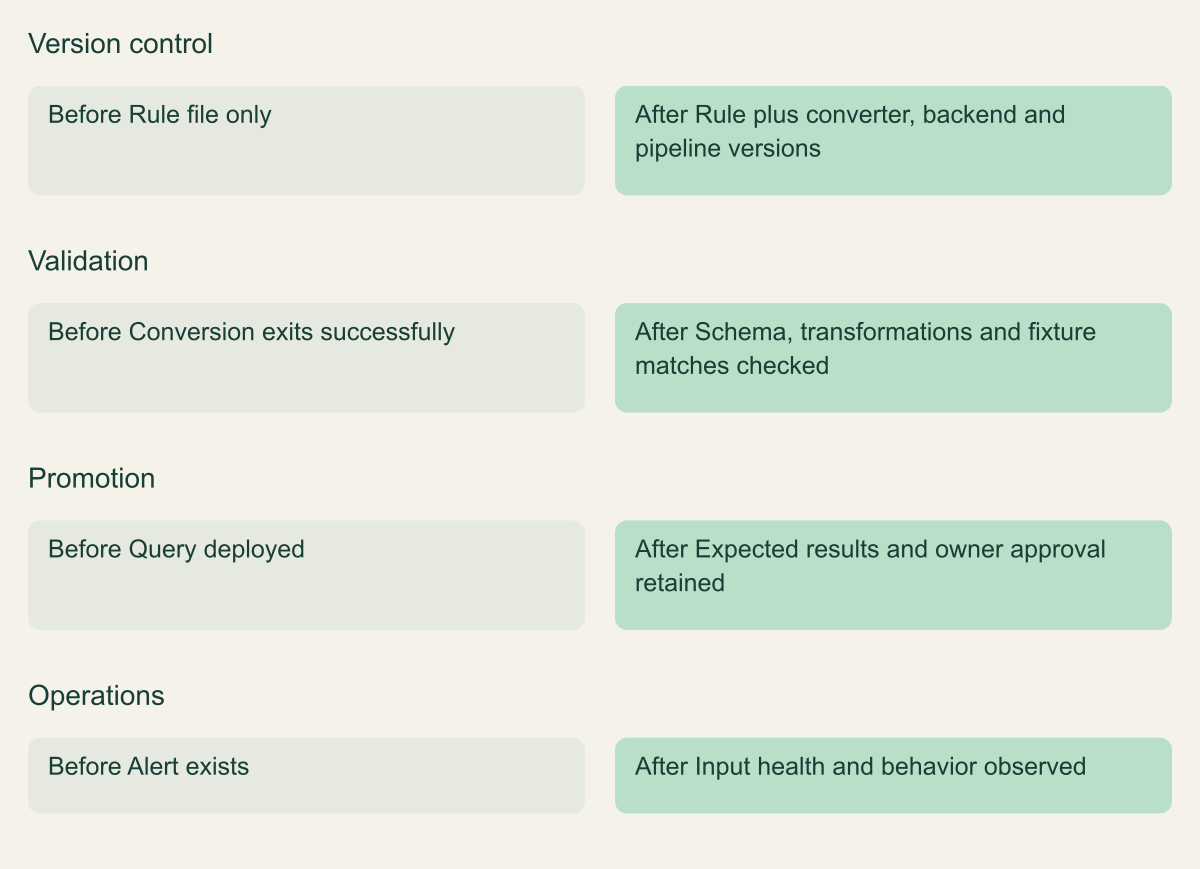
Change one boundary at a time where that is operationally feasible. If the rule, normalization pipeline and backend all change together, a changed result has several possible causes. Sometimes a combined migration is necessary, but the test record should still isolate the assumptions that changed. A migration plan should not confuse the number of successful package installations with the amount of behavior verified.
The before-and-after comparison shows this distinction. The proposed process adds versioned inputs, semantic checks and an accountable promotion decision. It does not claim that more process steps automatically improve detection. Their value depends on whether they expose differences that matter to the intended event-matching behavior.
From conversion success to a promotion receipt
The proposed release process distinguishes structural checks from event-match evidence.

Source. Primary documentation [1] [2] [3] [4]. Reviewed August 28, 2026.
Method. Original conceptual synthesis reviewed August 28, 2026. Unit: qualitative states and relationships. Scope: Sigma rule backend validation. It is not measured performance, prevalence, risk or implementation proof. The proposed release process distinguishes structural checks from event-match evidence.
Accessible table and figure data
| Boundary | Before | After |
|---|---|---|
| Version control | Rule file only | Rule plus converter, backend and pipeline versions |
| Validation | Conversion exits successfully | Schema, transformations and fixture matches checked |
| Promotion | Query deployed | Expected results and owner approval retained |
| Operations | Alert exists | Input health and behavior observed |
| Boundary | Before | After |
|---|---|---|
| Version control | Rule file only | Rule plus converter, backend and pipeline versions |
| Validation | Conversion exits successfully | Schema, transformations and fixture matches checked |
| Promotion | Query deployed | Expected results and owner approval retained |
| Operations | Alert exists | Input health and behavior observed |
Follow the log source into real fields
The logsource declaration expresses the kind of data a rule expects. It is not proof that an organization's collection path supplies that data. Follow the declaration into the configured source, the collected event and the fields indexed by the backend. Sigma's logsource guidance is the starting point for that mapping, not a replacement for inspecting the actual schema. [5]
A field contract should identify both names and meaning. An identity field may represent the initiating principal, an assumed role or a service acting on someone's behalf. An operation field may contain a normalized name or a provider-specific value. Two fields that look similar in a search interface can therefore support different security conclusions.
Processing pipelines can transform rule content to fit the target environment, including field mapping. Review that transformation alongside the rule. If the pipeline changes a field name, confirm which event source and normalization version make that substitution valid. A correct mapping for one ingestion route may be wrong for another that feeds the same backend. [3]
Missing data deserves an explicit outcome. If required events are not collected, a generated query cannot create them. If the event exists but a required field is unavailable, the team must decide whether a narrower rule is still useful or whether implementation remains blocked. Do not hide that limitation behind a technique tag or the presence of a scheduled query.
Keep timestamps and representation assumptions visible as well. A rule may depend on an event time, a sequence or a particular value shape. Arrays, nulls, case and escaping can change how a condition behaves. The appropriate tests depend on the specification and backend, so document the actual assumption instead of claiming that every target handles these cases identically.
This review also identifies collection responsibilities. The detection engineer may own the rule while a platform team owns the collector and another team owns source configuration. Record who can resolve a missing field or excluded event. Otherwise, a known data gap can remain indefinitely between teams while each component appears healthy in isolation.
Write fixtures around the intended decision
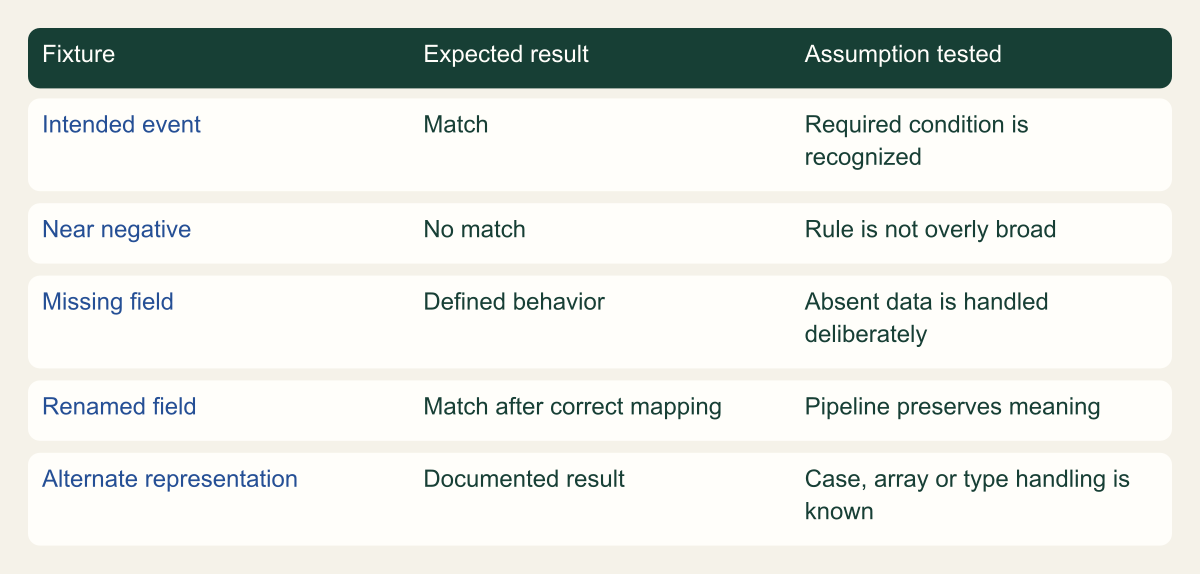
A fixture is a controlled input with an expected result. Begin with an event that should match and a close alternative that should not. Write those expectations before comparing backends. Otherwise, an existing query can become an unquestioned answer even when it contains the defect the migration should expose. The intended security decision, supported source semantics and field mapping need to agree.
Keep each case small enough to explain. An event that differs from the positive case only in its destination class tests a narrower boundary than a record with many unrelated changes. Missing fields, alternate representations and conflicting normalized values deserve separate cases when the deployed source can produce them. A larger fixture count does not automatically make the evidence more representative.
Synthetic inputs are safe to publish when they contain no real identifiers, but they express the author's assumptions. Sanitized operational samples can test those assumptions against collected events only when their use is authorized and sensitive fields are handled appropriately. Neither source establishes production precision or recall by itself. The fixture matrix below is a proposed testing framework, not a Sigma certification.
A synthetic mapping contract
The example below is entirely authored. ShareSnapshot is a fictional operation value for this fixture, and synthetic_cloud is not a provider log source. The intended decision is an event whose operation equals ShareSnapshot and whose destination_class equals external. The selection requires both conditions. An event with destination_class equal to internal is the close nonmatch; it should not be broadened into a match merely because the operation is the same. [1]
The old representation stores operation and destination_class at the top level. The new representation places the same information under event.action and target.class. The mapping declares how the rule fields reach the new schema. These dot-separated names describe field paths in this example; the actual backend and pipeline must implement the corresponding access and comparison behavior. This JSON manifest is not a ready-to-install processing pipeline. [2][3]
Each representation appears separately in the cases, so a query cannot pass by finding an accidentally retained old field alongside the new field. The expected result is true for the external case and false for the internal case in both representations. This creates an inspectable semantic contract: a migration that drops the destination constraint would incorrectly admit the near negative, while a missing field mapping could lose the positive.
The example records expectations, not execution results. Its JSON syntax was checked, but no Sigma schema validator, converter or detection backend was run for it. A deployment review must add the chosen tool versions, generated queries, actual runner output and disagreements before calling these cases validated. Keeping expectedMatch separate from any later observed result prevents a copied fixture from becoming a false test receipt.
{
  "kind": "authored-synthetic-fixture-manifest",
  "sigmaRule": {
    "title": "Synthetic external snapshot sharing fixture",
    "status": "experimental",
    "logsource": {
      "product": "synthetic_cloud",
      "service": "control"
    },
    "detection": {
      "selection": {
        "operation": "ShareSnapshot",
        "destination_class": "external"
      },
      "condition": "selection"
    },
    "level": "medium"
  },
  "mappingToNewSchema": {
    "operation": "event.action",
    "destination_class": "target.class"
  },
  "cases": [
    {
      "id": "old-external",
      "schema": "old",
      "event": {
        "operation": "ShareSnapshot",
        "destination_class": "external"
      },
      "expectedMatch": true
    },
    {
      "id": "old-internal",
      "schema": "old",
      "event": {
        "operation": "ShareSnapshot",
        "destination_class": "internal"
      },
      "expectedMatch": false
    },
    {
      "id": "new-external",
      "schema": "new",
      "event": {
        "event": {
          "action": "ShareSnapshot"
        },
        "target": {
          "class": "external"
        }
      },
      "expectedMatch": true
    },
    {
      "id": "new-internal",
      "schema": "new",
      "event": {
        "event": {
          "action": "ShareSnapshot"
        },
        "target": {
          "class": "internal"
        }
      },
      "expectedMatch": false
    }
  ],
  "executionStatus": "not executed"
}Fixtures answer different questions
Each authored fixture protects a specific semantic assumption.

Source. Primary documentation [1] [3] [5]. Reviewed August 28, 2026.
Method. Original conceptual synthesis reviewed August 28, 2026. Unit: qualitative states and relationships. Scope: Sigma rule backend validation. It is not measured performance, prevalence, risk or implementation proof. Each authored fixture protects a specific semantic assumption.
Accessible table and figure data
| Fixture | Expected result | Assumption tested |
|---|---|---|
| Intended event | Match | Required condition is recognized |
| Near negative | No match | Rule is not overly broad |
| Missing field | Defined behavior | Absent data is handled deliberately |
| Renamed field | Match after correct mapping | Pipeline preserves meaning |
| Alternate representation | Documented result | Case, array or type handling is known |
| Fixture | Expected result | Assumption tested |
|---|---|---|
| Intended event | Match | Required condition is recognized |
| Near negative | No match | Rule is not overly broad |
| Missing field | Defined behavior | Absent data is handled deliberately |
| Renamed field | Match after correct mapping | Pipeline preserves meaning |
| Alternate representation | Documented result | Case, array or type handling is known |
Compare behavior before promoting the migration
Run structural validation first, but name its scope accurately. Sigma's official validator checks rules using the JSON schema. It can identify structural problems; it cannot establish that a remote log source emits the expected fields or that a generated query behaves correctly in the organization's backend. A structural pass is an input to the review, not its conclusion. [2]
Next, inspect the processing and conversion output. Confirm that the selected backend and pipeline are the ones recorded in the version manifest. Review unsupported features and transformations that materially affect the rule. If the converter reports a limitation, preserve it rather than editing the warning out of the promotion record because a query string was produced.
Then execute the relevant query against the controlled fixture set in an authorized test environment. Compare results to the expected labels for each case. Record the generated query, the fixture version, the backend or runner configuration and the actual output. This article describes that required evidence; it does not claim to have executed a backend migration.
Where both old and new systems can be tested, compare each independently with the expected behavior. A difference is useful only after it is explained. The new system might fix an old mismatch, introduce a regression or expose an ambiguous fixture. Do not automatically classify every difference as failure or every agreement as correctness.
Define what blocks promotion. An unexplained missing positive match, an unexpected broad match or an unavailable required event should normally remain an unresolved finding for the responsible owner. A team may accept a scoped limitation, but the accepted scope and rationale must be visible. A waiver should not change the fixture result from failed to passed.
The promotion receipt should state what was checked and what was not. For example, a local runner may establish a transformation's output without proving the production SIEM's execution behavior. That can still be useful progress. Its wording should remain narrower than a claim that the entire detection was validated in production.
Interpret test results without inventing detection coverage
Passing the selected fixtures supports a statement about those inputs and that implementation. It does not establish recall against unknown attacks, precision across the organization's event volume or complete coverage of an ATT&CK technique. Those broader claims need different evidence and carefully defined populations. Avoid publishing a fixture pass rate as if it were operational detection accuracy.
A negative test also needs interpretation. An event that does not match may be the desired result, a data-quality failure or a query limitation. The expected label and its rationale are what distinguish those possibilities. Without that context, a table of matches and nonmatches can look precise while leaving the security decision unexplained.
Look for changes in breadth as well as missed positives. A query that becomes less selective might still match every positive fixture while creating more irrelevant results. Include close alternatives that challenge the intended boundary, then examine real operating behavior after promotion under the organization's approved monitoring process. Do not invent an alert-volume reduction to justify the migration.
Technique mappings should link to this evidence rather than replace it. A rule tagged with a technique describes an intended relationship. The supporting record should identify the data source, implemented logic, tested cases and operating scope. Where a strategy requires several kinds of evidence, one tested rule may cover only a part of that strategy.
Reviewers should also separate correctness from usefulness. A rule can implement its written condition exactly while the condition is too narrow for the intended investigation. Conversely, a broad exploratory query may be useful to an analyst without being suitable as an automated alert. State the deployment role so the validation criteria match the use.
Retain the evidence and observe the release
Keep the approved rule, tool versions, pipeline, generated query, fixture provenance and actual results together. The record should let a future maintainer reproduce the conversion and understand the behavior that supported promotion. A screenshot showing a rule enabled in a console is not an adequate substitute for those inputs and outcomes.
After release, observe whether the expected data continues to arrive and whether behavior changes unexpectedly. A migration can pass its controlled tests while an ingestion route later changes or a required source becomes unavailable. The operating review should therefore include input health and ownership, not only whether an alert object still exists.
Make rollback scope explicit. Reverting a query may not revert a collector transformation or restore an excluded source. Identify which components belong to the release and which have independent owners. If a rollback leaves a field contract inconsistent, the previous rule may no longer be a safe fallback even though its text has not changed.
Review the evidence after a backend upgrade, a processing-pipeline change or a material rule edit. Reuse fixtures where their assumptions still apply and add cases for the changed behavior. The aim is a maintained specification, not a growing archive of tests whose expected results no longer reflect the service.
A migration is ready for an owned promotion decision when its inputs are pinned, its field assumptions are explicit and its relevant behavior has been checked at the claimed boundary. Keep any remaining limits attached to that decision. That gives the next engineer something more useful than a successful conversion log: an explanation of what the rule is expected to recognize and the evidence supporting that expectation.
Method and provenance
Primary documentation review and original operational analysis, checked August 28, 2026. Source versions, claim mappings and visual data are retained in the accompanying research dossier. This article was first published in the practitioner-guides collection on August 28, 2026.
No customer environment, incident evidence, production deployment or service performance was tested for this article. Hypothetical examples and conceptual diagrams are labeled. Organization-specific authorization, architecture and legal obligations require their own review.
AI assistance. Researched, drafted and checked against cited sources with AI assistance. No independent human editorial review or original empirical testing is claimed.
Published under the Cloud Security Desk organizational byline. Read the practitioner guide policy.
References
- Sigma Rules Specification 2.1.0 SigmaHQ. Accessed .
- Processing Pipelines | Sigma Detection Format SigmaHQ. Accessed .
- Backends | Sigma Detection Format SigmaHQ. Accessed .
- Logsources | Sigma Detection Format SigmaHQ. Accessed .
- Release v1.5.0 · SigmaHQ/pySigma · GitHub SigmaHQ. Accessed .
- Release v3.1.0 · SigmaHQ/sigma-cli · GitHub SigmaHQ. Accessed .