
A migration guide for cloud detection mappings after ATT&CK's model changes. Reproducible Enterprise 19.1 counts establish a scoped inventory, while a technique-to-test evidence chain explains how strategies, analytics and local implementations support narrower coverage claims.
At a glance
Key findings
- ATT&CK detection strategies, analytics and data components describe relationships that must be connected to local implementation evidence. [1][8]
- The Enterprise 19.1 chart counts overlapping platform memberships, not attacks or detection efficacy. [3][4]
- A technique mapping should retain source version, available data, rule implementation, tests and operating scope.
A colored technique cell is an incomplete claim
MITRE's detection model now gives teams more explicit objects to connect a technique with a detection strategy, an analytic and relevant data components. That structure can improve the precision of a mapping, but it does not deploy a detector or establish that a cloud environment supplies the required events. The local evidence still has to be built and maintained.
The change is an opportunity to review what a coverage claim means. A colored matrix cell might indicate an intended rule, an implemented query, a passing test or a capability someone last reviewed several releases ago. Those states should not share one unexplained label if a service owner is using the map to make a security decision.
This guide uses the pinned Enterprise ATT&CK 19.1 dataset and the model documentation reviewed on August 28, 2026. The chart counts taxonomy memberships, not attack frequency or detection efficacy. The implementation chain is an original conceptual model, and no customer detection environment was tested.
The practical aim is a traceable claim: a particular strategy is supported by available data, implemented logic and evidence of behavior within a stated scope. Where one of those links is missing, report the gap directly. A larger inventory of technique tags is not a substitute for that chain.
Begin the migration by preserving existing evidence. Old mappings can still explain why a rule was written or what a previous test established. Replacing identifiers without carrying forward that context can make the new diagram look current while reducing the organization's ability to explain its actual detection decisions.
Understand what changed and what remains
MITRE's model documentation describes the detection-strategy framework introduced in October 2025. It uses detection strategy, analytic and data component objects, with a strategy-to-technique detects relationship and embedded references connecting other parts of the model. This is more specific than treating every detection description as text attached to a technique. [1]
The same documentation states that data-source objects are deprecated as of ATT&CK Specification 3.3.0. They remain supported for backward compatibility, with removal described for specification 4.0.0. Data components remain supported and integrated into the newer framework. Deprecation should therefore not be misreported as an already completed removal of all telemetry concepts. [1]
Keep version identifiers distinct. Enterprise ATT&CK 19.1 identifies the dataset used here. Specification 3.3.0 refers to the data-model specification. A tool's own package version is another identifier. Confusing them can produce an apparently precise migration record that does not actually identify the objects or schema the tool processed.
MITRE's April release notes record Enterprise v19's April 28, 2026 release and point to a subsequent v19.2 release. This article deliberately retains the immutable 19.1 dataset for a reproducible taxonomy inventory; it does not describe 19.1 as the latest available version. A query against a moving default branch can produce different counts later without any change to the organization's controls. The dataset version, source commit and observation date belong in the inventory record. [2][4]
A strategy describes an approach to detecting a technique, while analytics add more specific detection context. The strategy inventory and individual pages are useful starting points for selecting the relevant platform behavior. They should lead to an implementation review rather than being treated as ready-made rules with universal support in every backend. [8]
The migration should identify which legacy fields the organization's tooling actually uses. A reporting script, a rule repository and an assurance dashboard may depend on different parts of the old model. Review each consumer and its failure behavior before removing old fields from the local workflow.
Pin the inventory before comparing coverage
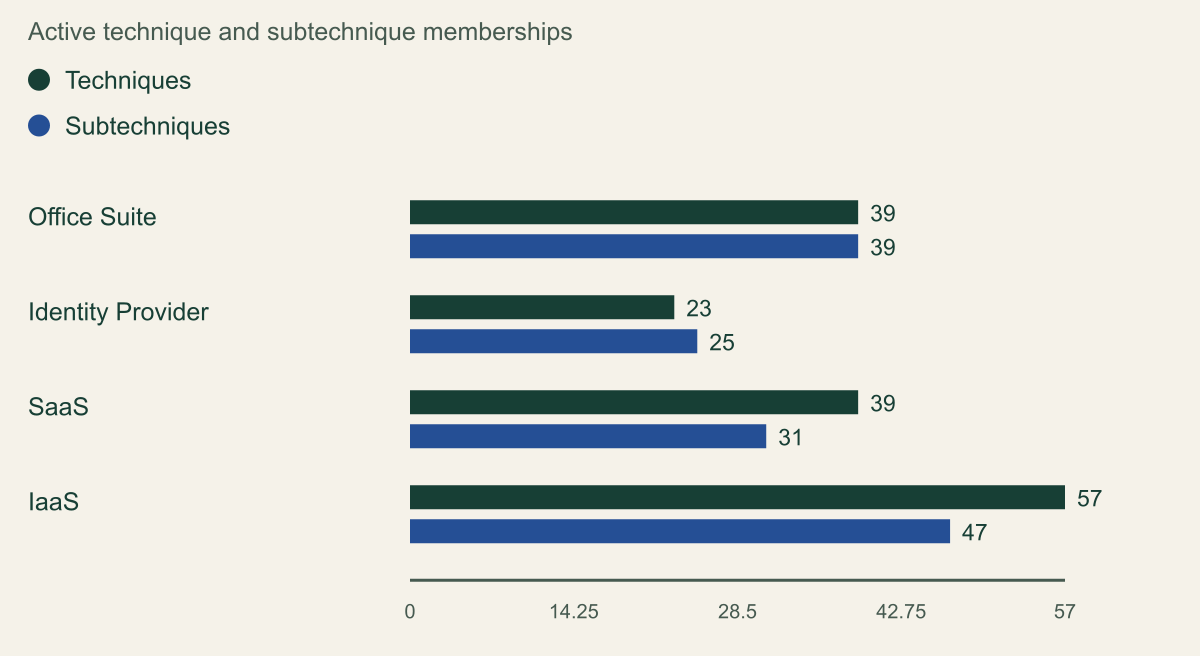
The chart starts from the official Enterprise 19.1 STIX dataset. The extraction selects attack-pattern objects, excludes revoked and deprecated entries and then identifies objects associated with the four cloud platform labels used in the current matrix: Office Suite, Identity Provider, SaaS and IaaS. Techniques and subtechniques are counted separately. [3][4][5]
The resulting platform memberships are 39 techniques and 39 subtechniques for Office Suite, 23 and 25 for Identity Provider, 39 and 31 for SaaS, and 57 and 47 for IaaS. The projection contains 152 unique active cloud objects across those categories. A single object can belong to more than one platform, so adding the bars does not produce that unique count. [4]
These values describe the knowledge base. They do not show how many attacks occurred, what fraction of a provider's customers are protected or whether one cloud is more secure than another. Differences can reflect the taxonomy's organization and platform associations, not a measured difference in defensive quality.
The source projection retains object identifiers, platform memberships and the subtechnique flag. Its reproduction script uses an immutable repository commit, records the raw dataset hash and repeats the filtering logic. That makes the chart updateable without implying that the full dataset's narrative content was manually reviewed object by object.
Choose the inventory boundary before calculating a local coverage measure. A program concerned with a particular service and platform may not need every object in the four-platform union. Conversely, an enterprise that spans several platform types should not omit relevant objects simply to improve a ratio. The boundary should follow the threat and service scope.
Review denominator changes separately from control changes. A new ATT&CK release can add, revise or retire objects while the deployed detection stack remains unchanged. A percentage that moves because the taxonomy changed should not be reported as a measured improvement or deterioration in the environment without explaining that cause.
Preserve MITRE attribution and licensing with copied source material. The accompanying projection includes MITRE's copyright designation and license. Its disclaimer also makes a substantive point: the knowledge base does not enumerate every possible adversary behavior, and covering its categories does not guarantee full defensive coverage. [9]
Cloud platform memberships in ATT&CK 19.1
MITRE Enterprise ATT&CK 19.1. Platform memberships overlap. Counts describe the knowledge base, not the percentage of threats detected or the security of any cloud.

Source. Primary source [4]. Reviewed August 28, 2026. MITRE Enterprise ATT&CK 19.1. Platform memberships overlap. Counts describe the knowledge base, not the percentage of threats detected or the security of any cloud.
Method. MITRE Enterprise ATT&CK 19.1, reviewed August 28, 2026. Unit: active technique and subtechnique memberships. The fixed STIX release was filtered to attack-pattern objects excluding revoked or deprecated entries. The subtechnique flag separates the two series for Office Suite, Identity Provider, SaaS and IaaS. An object can belong to more than one platform; the union contains 152 active objects, so summed platform memberships are not a unique-object count. These are taxonomy counts, not attack frequency, detection efficacy or provider security scores.
Accessible table and figure data
| Cloud platform | Techniques | Subtechniques |
|---|---|---|
| Office Suite | 39 | 39 |
| Identity Provider | 23 | 25 |
| SaaS | 39 | 31 |
| IaaS | 57 | 47 |
| Cloud platform | Techniques | Subtechniques |
|---|---|---|
| Office Suite | 39 | 39 |
| Identity Provider | 23 | 25 |
| SaaS | 39 | 31 |
| IaaS | 57 | 47 |
Trace one strategy to available evidence
T1537, Transfer Data to Cloud Account, provides a concrete example. MITRE associates it with DET0573, Cross-Platform Detection of Data Transfer to Cloud Account. The strategy page contains several analytics addressing different cloud contexts rather than one universal query that can be dropped into any environment. [6][7]
One listed analytic, AN1580, discusses cross-account transfer-related behavior and identifies sources such as CloudTrail snapshot and bucket-policy operations. Its mutable elements include local account context and timing or volume choices. These are inputs the implementing organization must define; the presence of the strategy does not supply a trustworthy local allowlist or a justified threshold. [6]
Follow the selected analytic into the actual collection configuration. Is the relevant event available? Does it include the fields needed for the proposed logic? Is the event retained long enough for the intended correlation or investigation? A generic statement that CloudTrail is enabled cannot answer every one of those questions.
Then inspect field meaning. An account identifier in an event may need to be compared with the organization's approved sharing relationships. The review should identify who owns that context and how changes are reflected. A hard-coded list copied from a test environment can make a query appear complete while leaving its operational assumptions wrong.
Keep ordinary administrative activity in the analysis. Snapshot sharing or policy modification can have legitimate purposes. The local implementation needs a documented decision about which behavior is suspicious and what additional evidence supports that decision. A technique mapping does not make every matching administrative operation malicious.
The article's evidence chain is therefore deliberately longer than technique to rule. It passes through available events and local context before reaching implementation and test evidence. Each link can fail independently, and a report should state which link remains unresolved rather than labeling the whole technique covered.
Use existing Cloud Security Desk guides for the adjacent controls. Resource-level runtime coverage and object-event selection each establish a different prerequisite. They can support the local strategy, but neither one by itself proves that the selected analytic has been implemented or that its behavior was validated.
Define what implemented and tested mean
Define local states in words before assigning colors. Planned means the organization intends to build a capability. Implemented means relevant logic exists in a named system and configuration. Tested means a specified procedure produced evidence about its behavior. Monitored means the organization has an operating process for detecting input or behavior changes. These are proposed reporting definitions, not MITRE certification levels.
For an implemented rule, retain the query, backend, field mapping and relevant configuration. Identify the source and environment where it runs. A rule copied into a repository is different from a rule deployed against usable events, and a deployed rule can remain ineffective if its data prerequisites are absent.
For a tested rule, retain the input cases, expected results and actual results. Include intended matches and meaningful nonmatches, and distinguish synthetic fixtures from authorized operational samples. The Sigma migration guide explains how conversion and field mapping can change semantics even when a query is accepted by the backend.
State the scope of the test. A successful fixture establishes behavior for that fixture under the recorded implementation. It does not establish production recall, precision or complete coverage of every procedure described by a technique. Avoid turning a small synthetic pass rate into an operational protection percentage.
A strategy can contain analytics for different platform contexts. Testing one implementation does not establish that all of those contexts are supported. The local record should identify the selected analytic, the relevant platform and any exclusions. This prevents a broad strategy title from expanding a narrow test result by implication.
Separate confidence in the mapping from confidence in the implementation. A reviewer may be confident that a rule relates to T1537 while still lacking evidence that the required events arrive consistently. Conversely, an operationally useful query may need a more precise technique mapping. Both issues deserve attention, but they are different maintenance tasks.
A local implementation record can identify the technique, strategy, analytic, platform, rule version, data schema and test receipt together. This is an authored record design, not a new MITRE object type. It prevents two deployments with different evidence from collapsing into one apparently uniform cell. It also lets a reviewer distinguish a shared analytic concept from the separate implementations and operating conditions that support it.
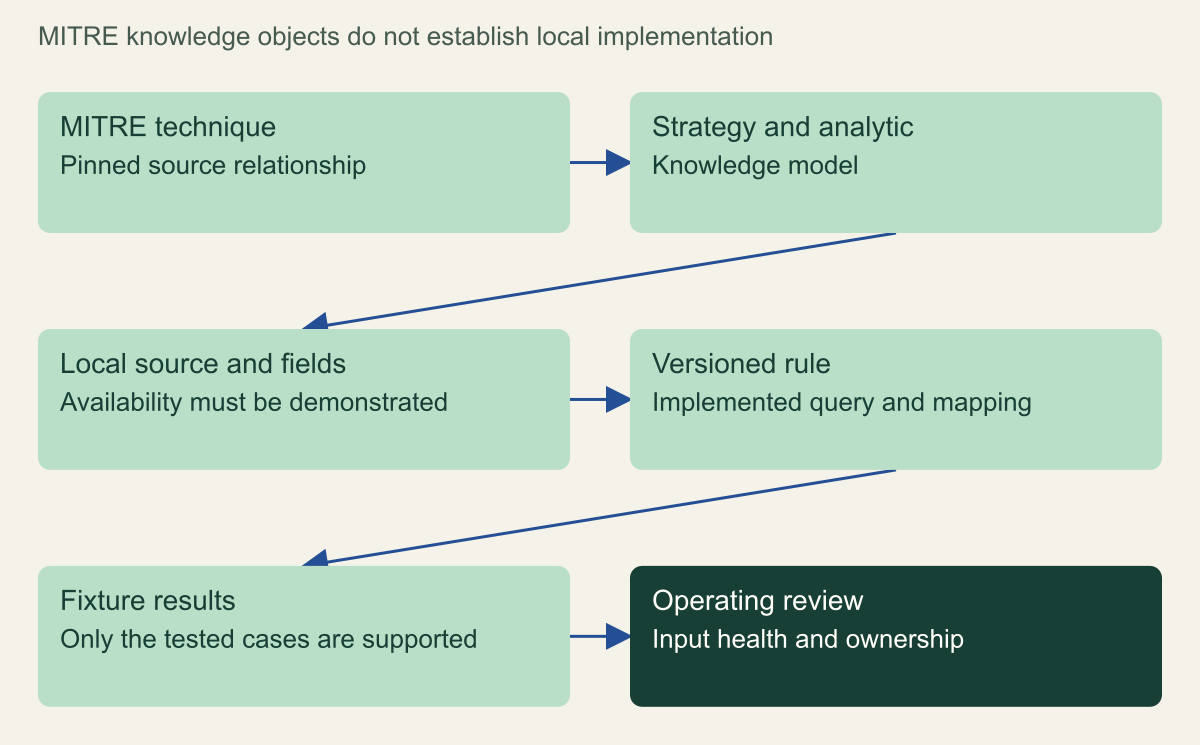
The control map makes these dependencies visible without assigning invented maturity scores. It connects the source relationship, available data, implemented logic, tested cases and operating review. A missing link is not a cosmetic problem to be hidden by a more elaborate dashboard; it identifies the next piece of work needed to support the claim.
A detection claim needs an evidence chain
Each ATT&CK mapping is connected to the local data, rule and validation that support its stated scope.

Source. Primary documentation [1] [6] [7]. Reviewed August 28, 2026.
Method. Original conceptual synthesis reviewed August 28, 2026. Unit: qualitative states and relationships. Scope: ATT&CK cloud detection strategy mapping. It is not measured performance, prevalence, risk or implementation proof. Each ATT&CK mapping is connected to the local data, rule and validation that support its stated scope.
Accessible table and figure data
| Link | Evidence | Question |
|---|---|---|
| Technique to strategy | Pinned ATT&CK relationship | What behavior is intended |
| Strategy to event | Required source and fields | Is the evidence available |
| Event to rule | Versioned query and mapping | What logic is implemented |
| Rule to test | Labeled fixtures and results | What behavior was verified |
| Test to operation | Input health and review owner | Does the claim remain current |
| Link | Evidence | Question |
|---|---|---|
| Technique to strategy | Pinned ATT&CK relationship | What behavior is intended |
| Strategy to event | Required source and fields | Is the evidence available |
| Event to rule | Versioned query and mapping | What logic is implemented |
| Rule to test | Labeled fixtures and results | What behavior was verified |
| Test to operation | Input health and review owner | Does the claim remain current |
Migrate relationships without losing history
Inventory the old references before replacing them. Identify which rule, dashboard, test or review record points to a deprecated field or object. Preserve the old identifier and its source version where it explains a prior decision. A migration should improve the model without making historical evidence impossible to interpret.
Use explicit relationships from the current dataset rather than reconstructing them from similar titles. Object names can change, and a text match can connect the wrong records. The official dataset and usage guidance provide the source structure for programmatic work. Record the identifiers and filters used by the migration script. [4][5]
Review revoked and deprecated objects deliberately. Excluding them from a current inventory is different from deleting every historical reference to them. An older incident report or test may legitimately describe the model in use at that time. Keep the temporal context instead of rewriting history to look as if the current model always existed.
Check the downstream consumers of the new mapping. A schema change may be accepted by an import job while a dashboard silently drops an unfamiliar object type. Validate the output used by reviewers, not merely the transport or parse result. A successful import is another intermediate step that needs a clearly bounded claim.
Reconcile changes in the local report. Identify objects added or removed, relationships that changed and capabilities whose evidence needs review. Separate taxonomy maintenance from new detection engineering. Otherwise, a routine data update can be misreported as a delivery of new security coverage.
Keep rollback and compatibility needs visible during transition. A team may need to support both an older reporting consumer and a newer model temporarily. That can be reasonable if the mapping and its limits are documented. The goal is a controlled migration, not an abrupt removal that breaks the only available assurance view.
Report the gaps in language an owner can act on
A useful gap names the missing evidence and the responsible owner. Required event unavailable, local context missing, rule not implemented, fixture behavior unexplained and operating health unreviewed are different states. A single red cell may signal concern, but it does not tell the next engineer what to repair.
Tie the gap to the service and selected strategy. A missing source in an irrelevant platform scope should not receive the same treatment as missing evidence for a critical local behavior. The inventory boundary and the threat model help explain that distinction without inventing an organization-wide risk score from technique counts.
Keep exceptions explicit. If the organization accepts a narrower implementation because a source is unavailable or a behavior is outside the service scope, record the rationale and review trigger. An exception can be a valid decision while remaining different from a tested capability.
Review mappings after changes to the ATT&CK release, source collection, backend, rule or local context. Each can alter what the claim means. The strongest-looking map is not necessarily the most current one; the useful map is the one whose supporting evidence and unresolved limits can still be found.
A cloud detection program benefits from the new model when the additional structure leads to clearer implementation questions. The finished claim should identify what behavior is intended, which data supports it, what logic exists and what was actually verified. The chart supplies an inventory reference. The evidence chain supplies the basis for decisions about the environment.
Method and provenance
Primary documentation review and original operational analysis, checked August 28, 2026. Source versions, claim mappings and visual data are retained in the accompanying research dossier. This article was first published in the practitioner-guides collection on August 28, 2026.
No customer environment, incident evidence, production deployment or service performance was tested for this article. Hypothetical examples and conceptual diagrams are labeled. Chart values retain their stated source scope and must not be interpreted as organizational risk or measured implementation success. Organization-specific authorization, architecture and legal obligations require their own review.
AI assistance. Researched, drafted and checked against cited sources with AI assistance. No independent human editorial review or original empirical testing is claimed.
Published under the Cloud Security Desk organizational byline. Read the practitioner guide policy.
References
- Detections, Data Sources, and STIX | MITRE ATT&CK Data Model MITRE. Accessed .
- MITRE ATT&CK April 2026 release notes MITRE. Accessed .
- Matrix - Enterprise - Cloud | MITRE ATT&CK® MITRE. Accessed .
- MITRE Enterprise ATT&CK 19.1 STIX dataset MITRE. Accessed .
- Detection Strategies | MITRE ATT&CK® MITRE. Accessed .
- MITRE ATT&CK license and disclaimers MITRE. Accessed .