
A substantial audit-policy guide for platform security teams. It connects upstream v1 semantics, sensitive resource handling, delivery tradeoffs, EKS/AKS/GKE differences and paired evidence-presence and payload-absence tests.
At a glance
Key findings
- First-match policy order and capture level determine which sensitive details can enter the audit pipeline. [1][2]
- Metadata and omitManagedFields are not general guarantees that logs contain no sensitive information. [2]
- Managed-service categories and permissions require provider-specific evidence checks. [3][4][5][6]
Keep the investigation question small
A useful Kubernetes audit policy records the API activity needed for an investigation without unnecessarily copying sensitive request and response bodies into another system. Begin with the question the evidence must answer, then choose capture level, request scope, stages and destination controls. More payload is not automatically better evidence.
Three questions illustrate the difference. Who requested access to a Secret? Who changed a RoleBinding? Which identity created a workload that could access sensitive data? These questions involve different resources and may need different details. None is equivalent to a complete recording of what happened inside a container after the API request finished.
Kubernetes audit records describe activity through the API server, and its policy controls the level recorded for matching requests. The audit system is not a general terminal-session recorder or a substitute for every runtime source. State that boundary early so an investigator does not infer in-container commands or application outcomes from an API event alone. [1]
Secret access also needs authorization context. Kubernetes guidance warns that list access can reveal Secret contents and that creating workloads can provide an indirect route to data a principal cannot read directly through a Secret get request. A policy focused only on one verb can therefore miss an important investigation question. [7]
Build an inquiry inventory before writing YAML. For each question, name the resource, relevant verbs, actor context, namespace, required stage and detail that would change the investigation. Put forbidden payload examples in a separate column. This is an original planning framework, not a claim that a universal policy can eliminate sensitive information from every cluster.
A hypothetical platform team might decide that Secret-read attribution needs identity and resource metadata, while a change to authorization requires carefully reviewed request detail. The choice should be documented as a tradeoff. If a requested detail does not support a concrete decision, do not collect it simply because the higher audit level makes it available.
This guide is pinned to current audit.k8s.io/v1 semantics and the provider documentation reviewed on September 2, 2026. No cluster policy was deployed and no sensitive test payload was generated. The example policy and acceptance cases are proposals for review, not evidence of a tested production configuration.
Choose the body level by data risk
The upstream API defines four levels: None, Metadata, Request and RequestResponse. They progress from no event to metadata, then request body, then request and response bodies. The distinctions matter because a read request can expose sensitive response content even when its request body is uninteresting. Select the least detail that serves the recorded investigation purpose. [1][2]
Metadata is a useful starting point for many sensitive resources, but it is not a privacy guarantee. Resource names, user identities, request URIs and annotations can themselves reveal sensitive context. Restrict the resulting evidence store and review its audience even when request and response bodies are omitted.
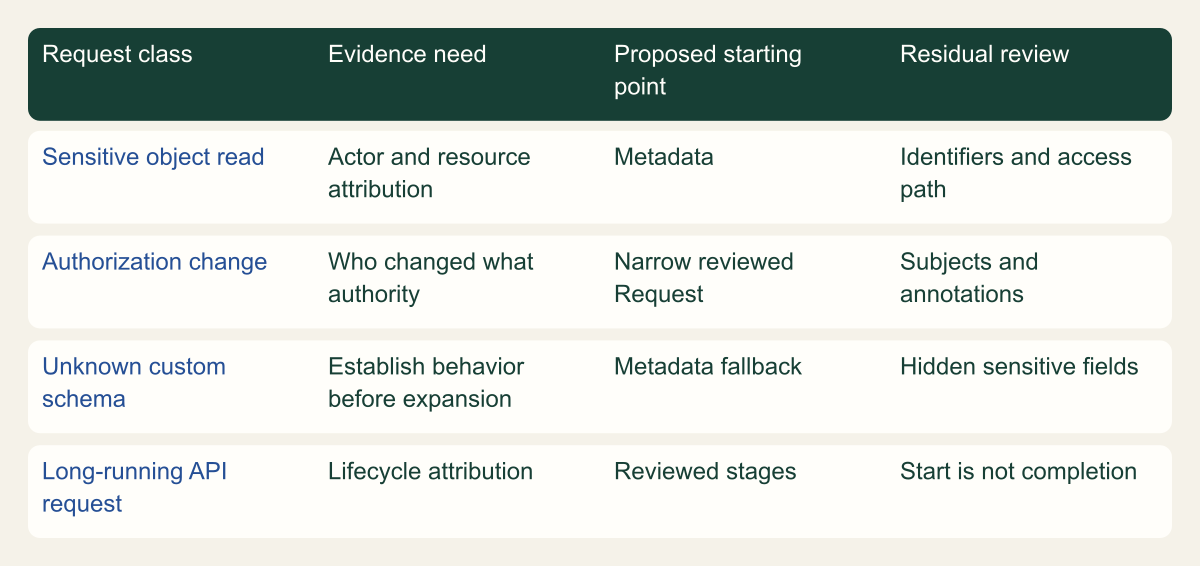
The sensitivity matrix is deliberately qualitative. It connects request classes to investigative needs and a proposed starting level without assigning fabricated risk scores. Its recommendations are not provider defaults or a certification that the selected level is safe for every organization. The actual resource schema and operational use remain part of the review.
Consider a hypothetical custom resource that stores credentials in an ordinary-looking specification field. A broad rule that captures request bodies for all custom resources could copy that value even though the object is not a Kubernetes Secret. Classify data by its contents and use, not only by the resource kind's familiar name.
Likewise, a workload definition can carry sensitive environment values, command arguments or annotations. The reviewer should identify where the organization permits such data and whether a body-capture rule would duplicate it. The correct response may be to reduce audit detail, improve workload configuration practices or use another source for the investigation question.
Where request detail is necessary, define a narrow justification and audience. Name the resource and verbs that need it, why metadata is insufficient and how the extra information will be retained and accessed. Do not let a temporary troubleshooting preference become an unexplained permanent RequestResponse fallback.
The decision should remain revisable. If a later investigation demonstrates that a needed fact was not captured, record that evidence gap and propose a specific change. Conversely, if a new schema introduces sensitive fields, re-review the capture rule before treating the old approval as still sufficient.
Choose detail by the investigation question
The proposed starting level is a review decision, not a universal safe policy.

Source. Original policy-review framework based on Kubernetes audit, Secret and RBAC documentation. [1][2][7][8]
Method. Conceptual recommendations with no risk score or claim of universal payload safety.
Accessible table and figure data
| Request class | Evidence need | Proposed starting point | Residual review |
|---|---|---|---|
| Sensitive object read | Actor and resource attribution | Metadata | Identifiers and access path |
| Authorization change | Who changed what authority | Narrow reviewed Request | Subjects and annotations |
| Unknown custom schema | Establish behavior before expansion | Metadata fallback | Hidden sensitive fields |
| Long-running API request | Lifecycle attribution | Reviewed stages | Start is not completion |
| Request class | Evidence need | Proposed starting point | Residual review |
|---|---|---|---|
| Sensitive object read | Actor and resource attribution | Metadata | Identifiers and access path |
| Authorization change | Who changed what authority | Narrow reviewed Request | Subjects and annotations |
| Unknown custom schema | Establish behavior before expansion | Metadata fallback | Hidden sensitive fields |
| Long-running API request | Lifecycle attribution | Reviewed stages | Start is not completion |
Make policy order a reviewable decision
Audit rules use first-match evaluation. A specific sensitive-resource exception must therefore appear before a broader rule that would capture its body. Review the policy as an ordered program, not as an unordered list of desirable settings. A rule that looks correct in isolation can be ineffective because an earlier rule already matched. [1]
Resource matching also needs precision. The core API group uses an empty group string, and resource/subresource distinctions matter. Kubernetes RBAC documentation uses related resource naming conventions and warns about wildcard scope. Align the authorization inventory with the audit inventory, while remembering that the two policies have different purposes. [2][8]
The simplified fragment below illustrates a conservative fallback with a narrow request-body rule for authorization changes. It does not claim to be a complete cluster policy. In particular, even Role or RoleBinding request bodies can contain sensitive identifiers or annotations that require review. The sample's purpose is to make precedence and scope visible.
Walk representative requests through the rules in order. Include a Secret read, a ConfigMap update, a token-related request, an authorization change and an unlisted resource. Record the first matching rule and expected level. This review can expose an overly broad early rule without running a production API request.
Include subresources explicitly where the question requires them. A parent resource name should not be assumed to cover every subresource behavior under every matching expression. Use the current audit API definition and confirm the actual request path. The receipt should preserve the expression reviewed rather than a paraphrase such as all Pod activity.
A fallback is an important design decision. An explicit Metadata fallback makes the intended treatment of unlisted requests visible in this example. A policy with no applicable rule can produce no record, so the organization should decide whether new resource types should default to metadata or require another deliberate treatment. [1]
Review the whole policy when adding a rule. A change can affect requests outside the motivating incident through order, wildcard or namespace interactions. Keep a versioned diff and a test expectation for the adjacent populations, not only the newly added request class. The acceptance criteria should include unchanged sensitive exclusions as well as newly captured evidence.
apiVersion: audit.k8s.io/v1
kind: Policy
omitStages:
  - RequestReceived
rules:
  - level: Metadata
    resources:
      - group: ""
        resources: ["secrets", "configmaps", "serviceaccounts/token"]
      - group: "authentication.k8s.io"
        resources: ["tokenreviews"]
  - level: Request
    verbs: ["create", "update", "patch", "delete"]
    resources:
      - group: "rbac.authorization.k8s.io"
        resources: ["roles", "rolebindings", "clusterroles", "clusterrolebindings"]
  - level: Metadata
Keep stage and request semantics visible
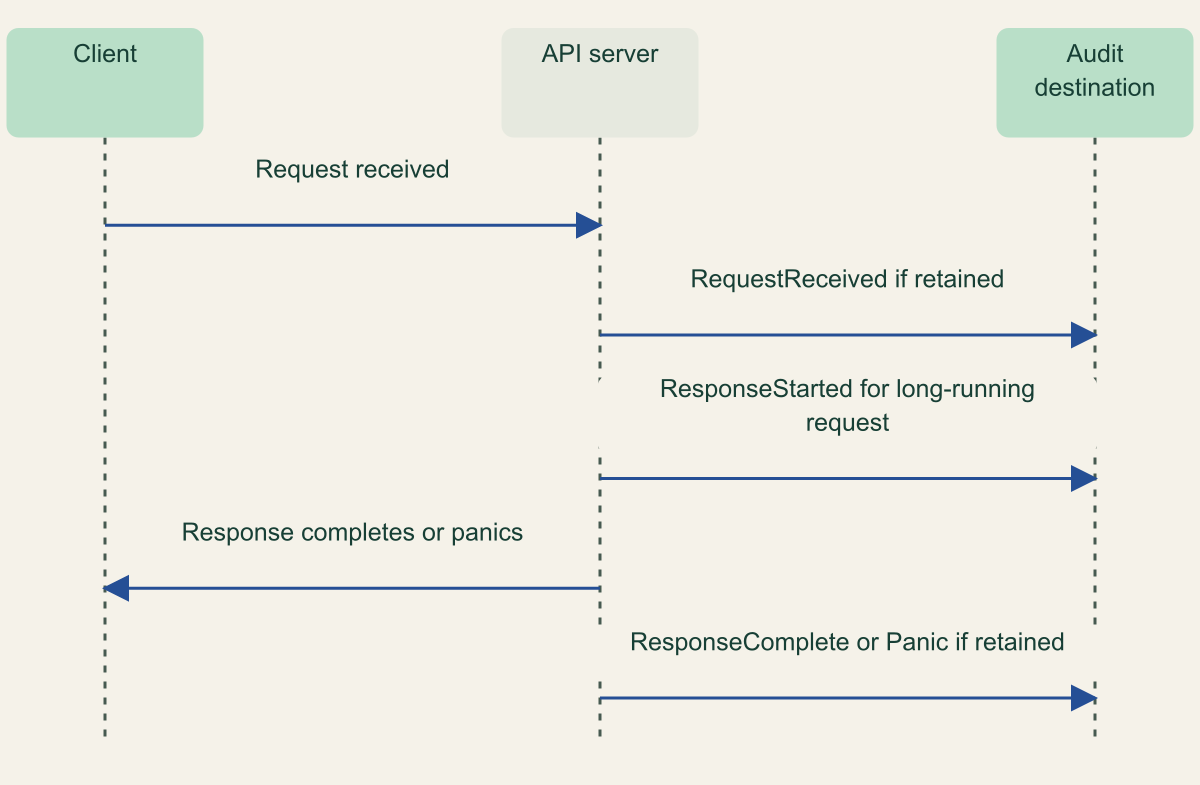
Audit stages describe different points in the API request lifecycle. RequestReceived occurs before handling; ResponseStarted applies to long-running requests; ResponseComplete follows response completion; Panic records a panic path. Stage selection therefore changes the evidence available about a request, rather than merely changing duplicate volume. [1][2]
The sequence figure keeps the ordinary and long-running paths distinct. A watch can have a ResponseStarted event while remaining active, so that stage should not be relabeled as a completed operation. Conversely, the absence of that stage for an ordinary request is not automatically evidence of a collection failure.
Correlate related stages through the request's audit identity where available, while retaining stage and timestamp fields. Several stages for one request are not necessarily duplicate delivery. A normalization process that deduplicates only on auditID could discard meaningful lifecycle evidence if it ignores the intended stage population.
Policy-wide and rule-level omitStages settings combine as a union. A rule cannot restore a stage already omitted at the broader policy level. This makes global omission a consequential choice that should be included in every rule's expected result. [2]
Before omitting RequestReceived, ask which failure or incomplete-request questions the investigation needs to answer. Reducing repeated lifecycle events may be reasonable, but it changes the evidence contract. The sample omits that stage only to demonstrate the configuration shape; the reader must decide whether the omission serves the actual requirements.
For a hypothetical fixture, define both a normal completed request and a long-running request with an expected start observation. Add an error or interrupted case where appropriate to the authorized environment. Record expected stages rather than demanding a uniform number of events from every request type.
Keep response status and business outcome separate. A completed API exchange can establish a request-level result without proving that a controller reconciled the desired state or that an application later performed useful work. When the incident question reaches beyond the API, link the audit record to the relevant controller, workload or application evidence.
Stages preserve different lifecycle evidence
ResponseStarted is specific to long-running requests and is not completion. [1][2]

Source. Kubernetes auditing and audit configuration API documentation. [1][2]
Method. Source-derived lifecycle model. No invented timing; omitted stages depend on policy.
Accessible table and figure data
| Stage | Meaning | Interpretation limit |
|---|---|---|
| RequestReceived | Before handling | No completed outcome |
| ResponseStarted | Long-running response begins | Not ordinary completion |
| ResponseComplete | Response completed | Not application business success |
| Panic | Panic path | Separate exceptional outcome |
| Stage | Meaning | Interpretation limit |
|---|---|---|
| RequestReceived | Before handling | No completed outcome |
| ResponseStarted | Long-running response begins | Not ordinary completion |
| ResponseComplete | Response completed | Not application business success |
| Panic | Panic path | Separate exceptional outcome |
Separate payload minimization from redaction
Capture minimization and redaction are different controls. Selecting Metadata can avoid recording request and response bodies for a matching request. A downstream transformation operates after some source material has already been emitted or received. Do not describe those two arrangements as providing the same exposure boundary.
The audit API's omitManagedFields option concerns managedFields, not arbitrary secret removal. It is not a general sanitizer for bodies, annotations or custom resource fields. Its rule-level behavior must also be interpreted according to the documented API rather than guessed from its name. [2]
Parsing needs similar care. Audit request objects are not always full typed resource objects; patch requests can contain a patch representation such as an array. A pipeline that assumes every request body is a resource map can lose information or mishandle sensitive content. Review the actual operation and schema before normalizing it. [1]
Use a data-flow review to locate every copy. If a collector receives a sensitive field and removes it before indexing, ask whether raw buffers, error messages, dead-letter storage or backups can still contain it. These are original review questions, not claims about a specific collector implementation. Inspect the actual pipeline rather than trusting a diagram label that says redacted.
A useful hypothetical negative test uses a clearly synthetic marker, never a real credential. The marker's purpose is to verify that an approved forbidden field does not appear in the relevant captured or exported material. Its absence in one dashboard is insufficient if the pipeline retains another accessible raw copy.
Do not turn a successful marker check into a universal no-secrets guarantee. It demonstrates a particular field, operation, schema and path under the tested configuration. New resource types, admission behavior or processing changes can create different exposure. Keep the exact tested scope beside the result and revisit it when those inputs change.
If body detail is indispensable for a specific investigation, consider a restricted, time-bounded collection design through the organization's approval process. Preserve the rationale, intended population and cleanup obligations. Avoid quietly broadening the default policy during an incident and leaving the additional sensitive evidence store behind afterward.
Choose how audit failure affects serving
Audit delivery behavior can affect both evidence preservation and API availability. Upstream auditing supports log and webhook backends, with delivery modes and buffering behavior that require deliberate configuration. A policy file alone does not establish that matching events reach a durable destination. [11]
The documented blocking-strict mode can cause a request to fail when audit logging fails at the relevant stage, while batching can involve buffered events and loss conditions. These are different failure tradeoffs. The organization should decide who accepts the availability and evidence consequences rather than inheriting a mode from an unexplained example. [1][11]
Separate the capture policy from the delivery contract in the design record. The policy says what should be recorded; the backend and destination determine how it is transported and retained. A request matching the correct level does not prove that the receiver accepted it, and a healthy receiver does not prove that the policy captured the intended request.
Review pressure behavior without inventing a universal buffer size. Ask what happens when the destination is slow, unavailable or rejecting records, and which observation identifies that condition. The appropriate limits depend on the actual workload and implementation. This article has no measurements of API overhead, event loss or memory use.
A hypothetical acceptance exercise can deliberately examine a supported failure condition in an isolated, authorized environment. Define whether the expected result is a visible delivery error, a bounded request failure or another documented behavior. Do not perform a production outage simply to prove that the pipeline's alarm changes color.
Preserve failures as evidence about the collection system. If a backlog or drop condition occurred during an incident, the final investigation should know that its audit history may be incomplete. A recovery of the destination does not retroactively establish that every omitted or dropped record was recovered.
The serving-versus-evidence decision should have an owner and a review trigger. Changes to request volume, destination architecture or service criticality can alter the tradeoff. Keep it adjacent to the audit policy so the collection is not reviewed only for field sensitivity while its failure behavior remains an undocumented assumption.
Translate the plan to managed clusters
Managed Kubernetes offerings do not expose the same controls as a self-managed API server. Translate the evidence objective into the provider's supported log categories, export options and access controls. Do not recommend changing API-server flags that the customer cannot control, or present the sample upstream policy as an EKS, AKS or GKE deployment procedure.
EKS documents separately selectable control-plane log types, disabled by default, with best-effort delivery to CloudWatch Logs. Its best-practices guide publishes policy context and authorization annotations. That guide still displays a v1beta1 policy header, so treat it as provider-behavior context rather than a current upstream template to copy. [3][9]
AKS distinguishes AKSAudit from AKSAuditAdmin: the former includes get and list operations, while the latter excludes them. Resource-specific diagnostic routing determines the dedicated table destination. A cost-oriented choice of the admin category therefore changes what read activity can be investigated. [4][5]
Microsoft's AKS monitoring guide also publishes audit-policy details and explains collection through diagnostic settings. Its recommendations to reduce collected volume have evidence consequences. Review the required question before excluding a category, and verify the actual setting after a change instead of assuming the requested configuration took effect. [10]
GKE's audit documentation identifies Kubernetes API audit activity under k8s.io, with Admin Activity always enabled and Data Access disabled by default. Access to private Data Access logs also requires the relevant permissions. A missing record can therefore reflect category enablement or investigator visibility rather than an absent API action. [6]
Create a provider-specific acceptance row for each cluster type in use. Name the supported category, destination, expected request population, applicable policy constraints and investigator role. Do not force every provider into a false equivalence merely to make a comparison table symmetrical.
Keep documentation date and cluster context in that row. Provider-managed policies and export features can evolve independently of the upstream API version. The durable requirement is the investigation question and forbidden-data boundary; the implementation must be checked against the current supported service behavior.
Test for presence and absence
An audit acceptance test needs two kinds of expectation. Presence checks ask whether required actor, resource, verb, stage and outcome evidence arrived. Absence checks ask whether the approved forbidden payload markers stayed out of the relevant evidence path. Testing only the first can produce useful logs that also create an unnecessary sensitive-data copy.
Prepare synthetic cases in an isolated, authorized scope. Use harmless resource names and artificial marker values, and document the expected first matching rule. No real credential is needed to test a capture boundary. This guide proposes the cases but did not execute them or inspect a cluster's output.
Include at least one sensitive resource read, a reviewed authorization change, an unlisted resource using the fallback and a request whose lifecycle differs from an ordinary short operation. Add schema-specific cases such as a patch representation where the pipeline processes bodies. The exact set should follow the inquiry inventory rather than a generic test count.
Observe the relevant boundaries separately. Check the source or provider-export record where available, the collector input and the final investigator view. If the platform exposes only a managed destination, state that visibility limit. A missing field in the final table does not prove that an upstream copy never existed.
Record failures precisely. Required identity metadata absent, forbidden marker present, unexpected stage omitted and parser rejection are different defects. Assign each to the policy, provider configuration, delivery or transformation owner supported by the evidence. Avoid a single audit-test-failed label that sends every team back through the same broad checklist.
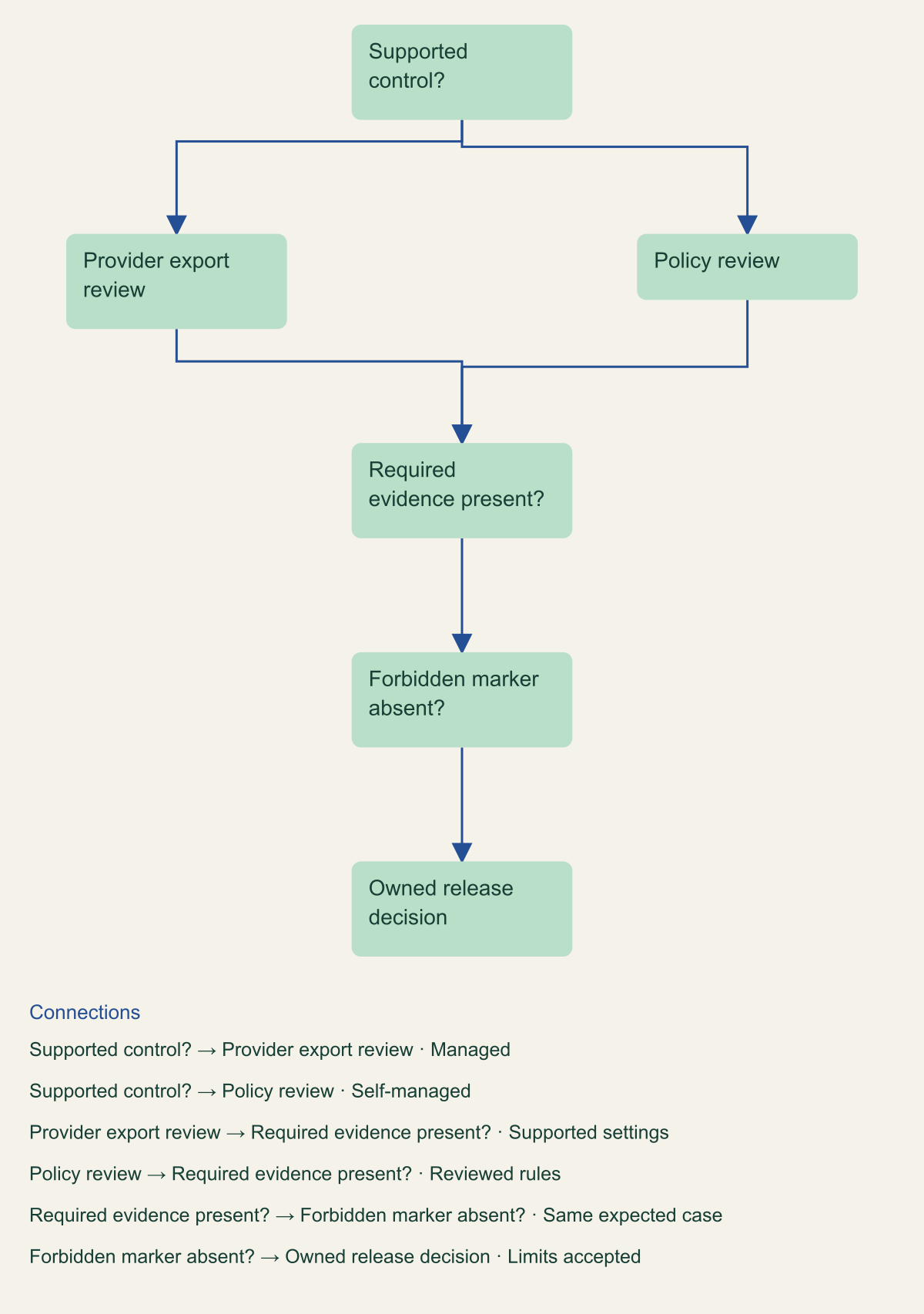
Negative expectations also need context. If a forbidden marker is absent because the entire event was dropped, the privacy check did not establish a useful capture boundary. Presence and absence should be evaluated together for the same intended case. This paired test is an original framework, not an empirical claim about detection quality.
Retain the fixture definition, configuration version, observed raw references and result. A later reviewer should be able to distinguish a proposed expectation from an executed check. If only YAML structure was parsed, report that limited validation; do not call it a successful cluster audit test.
Place a forbidden marker only in the field whose capture behavior the test intends to examine. If the same marker is also used in the resource name, namespace or annotation, a legitimate metadata record may contain it and make the test appear to fail for the wrong reason. Use distinct harmless identifiers for attribution and a separate marker for the payload boundary. Record both roles in the fixture so the reviewer can tell a required identifier from a forbidden value.
Keep an expected event identity or correlation method in the fixture. A marker absent from unrelated records does not prove that the intended request was minimized. The positive evidence must establish that the relevant case reached the reviewed boundary before the negative check is interpreted. If the source cannot provide that relationship, report the test as inconclusive rather than claiming successful suppression from an empty result.
Truncation is another reason to preserve both expectations. The API-server command-line reference documents optional size-related behavior that removes request and response content first and can discard an event if it remains too large. That mechanism is not a sensitivity policy. If truncation affects a case, record the lost evidence and the actual settings rather than treating accidental body removal as proof of the intended privacy boundary. [11]
Require useful evidence and bounded payloads
An absent secret marker is not a pass when the entire expected event is missing.

Source. Original acceptance framework informed by upstream and managed-service documentation. [1][2][3][4][5][6][9][10]
Method. Conceptual test plan; no live tests were run.
Accessible table and figure data
| Gate | Pass evidence | If unresolved |
|---|---|---|
| Control surface | Supported policy or export setting | Review provider boundary |
| Presence | Required actor/resource/stage arrives | Repair capture or delivery |
| Absence | Forbidden synthetic marker absent | Review payload path |
| Failure behavior | Operational consequences understood | Owner accepts or revises |
| Gate | Pass evidence | If unresolved |
|---|---|---|
| Control surface | Supported policy or export setting | Review provider boundary |
| Presence | Required actor/resource/stage arrives | Repair capture or delivery |
| Absence | Forbidden synthetic marker absent | Review payload path |
| Failure behavior | Operational consequences understood | Owner accepts or revises |
Protect the new evidence store
Audit logs can become a sensitive system in their own right. Restrict who can read them, define retention and identify every exported copy. Minimizing bodies reduces one exposure but does not eliminate sensitive metadata, identity information or operational details from the retained records.
Separate administration from investigation where the organization's design supports it. An investigator may need read access without the ability to change capture or retention. A collection operator may need to maintain delivery without unrestricted use of the evidence. These are recommended authority questions, not a claim that one role layout fits every platform.
Provider permissions must be reviewed at the actual destination. GKE's distinction around private Data Access log visibility illustrates why a general viewer role should not be assumed to reveal every category. Equivalent access questions belong in each managed-service row, even when the permission names differ. [6]
Keep integrity, completeness and interpretation separate. A protected object can preserve received bytes without proving that every matching request was captured. A complete-looking event can still require context to explain its actor or business consequence. The existing collector-evidence guide can supply downstream trust mechanics without turning this article into another collector setup tutorial.
Review retention against the investigation purpose and data sensitivity. Keeping every audit artifact indefinitely is not automatically the best answer. The organization should decide which records it needs, who can approve exceptions and how copies are managed. Do not infer a legal retention mandate from the technical availability of longer storage.
When sharing an incident finding, use a concise explanation with controlled references to the source material. Avoid copying full request bodies or identity inventories into broadly visible tickets. The evidence should remain accessible to authorized reviewers without turning every operational discussion into another uncontrolled archive.
Retain the policy review receipt
A release receipt should make the policy and its evidence contract reproducible. Record the policy version or hash, cluster and provider context, supported API version, backend or export settings, destination and investigator scope. Include the inquiry inventory and the cases used to check both required evidence and forbidden payloads.
Keep three states explicit: proposed design, structurally reviewed configuration and observed behavior. A valid YAML file is not a demonstrated capture policy, and a successful request is not proof of durable audit delivery. The release decision should identify which state each requirement reached and which remains unverified.
Define go and no-go conditions before deployment. Required investigation fields must be available for the approved cases, forbidden markers must be absent at the reviewed boundaries, and failures must have an understood operational effect. If a managed provider cannot expose an intended check, record the limitation and the evidence used instead.
Retain a rollback or correction plan appropriate to the environment. For self-managed policy changes, identify the approved previous configuration and how restoration will be verified. For provider-managed exports, identify the supported settings and the effect of disabling or changing categories. Do not imply that a correction recovers records never captured.
Re-review the design after new resource schemas, sensitive data placement, identity models, provider policies or pipeline transformations change. These changes can alter both evidentiary value and exposure without making the original policy syntactically invalid.
The final standard is a bounded, useful audit record. It should answer the chosen API investigation questions, preserve its own capture and delivery limits and avoid collecting sensitive detail without a reason. A policy that can explain those decisions is more valuable than one that logs every body and leaves the resulting risk to the next incident.
Method and provenance
Source-led technical analysis of directly reviewed project and vendor documentation, with original decision frameworks and explicitly hypothetical examples. Sources were reviewed on September 2, 2026.
No customer environment, live configuration, workload measurement or production test was inspected. Product behavior and limits are bounded to the cited documentation and stated review date.
AI assistance. AI assisted research synthesis, drafting, diagram planning and deterministic editorial checks. No personal deployment experience, independent human review or live test is claimed.
Published under the Cloud Security Desk organizational byline. Read the practitioner guide policy.
References
- Auditing Kubernetes. Accessed .
- Audit configuration API v1 Kubernetes. Accessed .
- Send control plane logs to CloudWatch Logs AWS. Accessed .
- AKSAudit table reference Microsoft. Accessed .
- AKSAuditAdmin table reference Microsoft. Accessed .
- GKE audit logging information Google Cloud. Accessed .
- Good practices for Kubernetes Secrets Kubernetes. Accessed .
- Using RBAC Authorization Kubernetes. Accessed .
- EKS auditing and logging AWS. Accessed .
- Monitor Azure Kubernetes Service Microsoft. Accessed .
- Kubernetes API server command line reference Kubernetes. Accessed .