
A rollout and reconciliation guide for AWS IAM Identity Center. It separates permission definitions from asynchronous provisioning, examines customer-managed policy drift and turns documented API and account limits into a practical change-evidence contract.
At a glance
Key findings
- A successful provisioning request is not the same as completed account reconciliation.
- Customer-managed policies can share a name and path while granting different permissions in different accounts.
- Collective request throttles, asynchronous concurrency and per-account role-update limits require separate scheduling controls.
Separate the states behind a permission change
Prove an IAM Identity Center permission change by reconciling the intended permission definition, its provisioning results and the assignments in every targeted AWS account. If the permission set references customer-managed policies, verify those account-local policy documents too. An API request accepted successfully is useful evidence that work was submitted; it is not a complete statement about who can now do what in all the accounts. [2][3][4][5]
Four questions keep the workflow understandable. What definition should be deployed? Which accounts should receive it? Which users or groups should have assignments? What policies and conditions actually govern a request in each account? A change can answer one question correctly while leaving another unresolved. For example, an updated definition can coexist with an unsuccessful deployment in one account, or a successfully provisioned role can exist without the intended assignment.
The APIs reflect these differences. UpdatePermissionSet changes attributes such as description, relay state and session duration. ProvisionPermissionSet performs the separate provisioning operation and returns a status object. DescribePermissionSetProvisioningStatus retrieves the result of that operation. Do not use the name of one API as shorthand for every kind of permission-set change, and do not interpret a successful attribute update as evidence that all target-account permissions have been reconciled. [2][4][6]
Start with a desired-state record that names the Identity Center instance, its relevant Region, the permission set and the explicit target-account list. Include the intended assignment principals and the source of that inventory. A dynamically generated list may be appropriate, but the execution record needs to identify which list was actually used. Otherwise, a newly added account can disappear between a planning query and the final success count.
This guide concerns the organization-level AWS account access workflow. Account instances do not provide an interchangeable version of that capability. Identity Center account access uses permission sets with IAM roles and assignments; the relevant instance type, administrator authority and account relationships must be established before applying the rollout model. A familiar console name is not enough to determine which workflow is available. [3]
Keep existing-session handling outside the definition of this rollout. A permission-set deployment and an incident decision to revoke already-issued credentials are related but different tasks. The completion record should not promise that every established session has disappeared merely because the permission definition or assignment changed. If containment requires session invalidation, coordinate it through the appropriate separately verified procedure.
Compare policy content rather than a familiar name
Customer-managed IAM policies are a particularly important source of hidden differences. Identity Center does not create these policy documents in each target account. The matching policy must already exist with the required name and path before assignment can succeed. AWS also explicitly allows the policies to grant different permissions in different accounts. Matching the reference therefore does not establish semantic equivalence. [5]
That flexibility can be intentional. Two accounts might use the same named policy to grant access only to their own resources. It can also conceal drift: one account may retain an older wildcard resource while another has the reviewed narrower scope. The rollout must say whether equivalent content, account-specific content or some other approved relation is expected. Without that rule, a content difference cannot be distinguished from a defect.
Use a policy-content review that understands the chosen variation. Comparing raw file bytes alone can flag irrelevant formatting differences, while comparing only names misses permission differences. A proposed reconciliation process can normalize documents for stable comparison, retain the original policy representation and review account-specific substitutions against an approved template. Normalization is an implementation choice to validate, not an AWS guarantee that two differently written policies are equivalent.
The name match is also not case sensitive, according to the customer-managed policy guidance. Do not make a case-sensitive string comparison the entire prerequisite test and then assume the deployment will behave identically. Check the actual IAM object and its path, then inspect the content appropriate to the rollout. The point is to establish the referenced policy, not merely reproduce the spelling in an input spreadsheet. [5]
Consider a hypothetical read-only operations permission set. The production account's named policy grants access to a narrow resource set, while a development account's version permits broader reads. If that distinction is approved, the desired-state record should encode it explicitly. If the same broader policy appears unexpectedly in production, the record should identify a content deviation even when provisioning reports success. No account data or observed fleet drift is implied by this example.
The effective request remains subject to other applicable IAM and resource controls. A matching customer policy does not prove that an organization guardrail allows the action, nor does it make the permission set the only source of authority. Keep the account-local content check focused on what it establishes, then use selected allowed and denied operations to examine the resulting boundary in an authorized environment.
Schedule work inside the correct limits
Identity Center's documented limits describe different dimensions. IAM Identity Center APIs have a collective throttle of twenty transactions per second. CreateAccountAssignment has a limit of fifteen outstanding asynchronous calls, which AWS says cannot be increased. The guidance separately permits up to three concurrent ProvisionPermissionSet calls. Treating these numbers as a single queue size would mix request rate with work already in progress. [1]
There is a further account-level constraint: only one IAM role, represented by a permission set, can be updated at a time in a particular AWS account. A scheduler can stay below a global concurrency threshold while still submitting conflicting work against that account. Maintain account-scoped serialization where the operation requires it, rather than assuming that a small global worker pool prevents every conflict. [1]
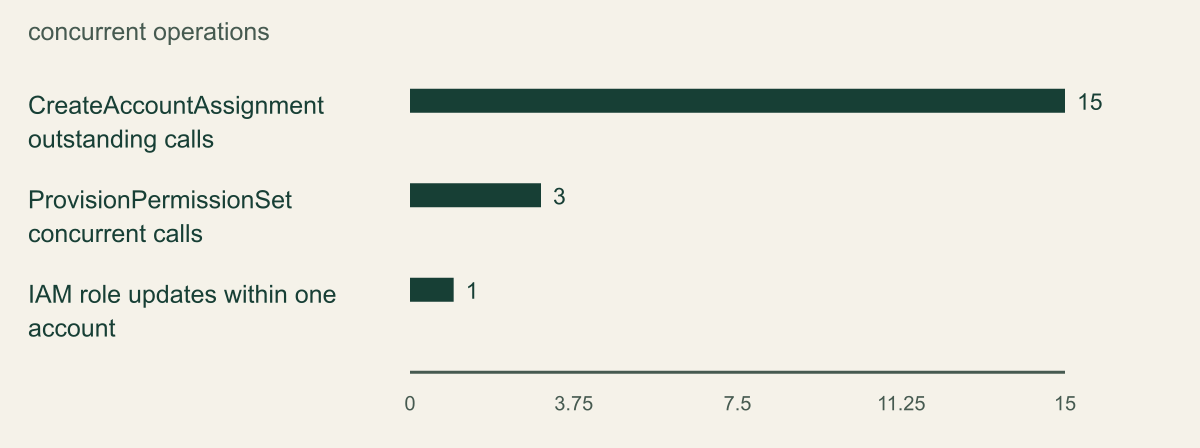
The chart shows the three concurrency values with their scopes in the labels. It is not a throughput comparison and does not say that assignment provisioning is five times faster than permission-set provisioning. Service duration, retry behavior and target-account state are not measured here. The separate twenty-TPS throttle is intentionally absent from the chart's concurrent-operations axis because it has a different unit. [1]
Polling consumes requests too. A rollout that submits work conservatively but checks every status aggressively can still create avoidable throttling pressure. Use bounded polling and appropriate backoff, and retain each request identifier so a retry does not lose the relationship to the original operation. The exact intervals should reflect the API and operating requirements; this guide does not invent a universal polling period or a completion-time guarantee.
Distinguish a transport retry from a decision to begin another logical change. If the client loses a response, the operation's state may be uncertain rather than definitely absent. The orchestration design should use available request and status evidence to resolve that uncertainty. Automatically repeating a whole account batch can create overlapping writes while making the audit trail harder to interpret. Review recovery behavior with the same care as the normal submission loop.
Capacity prerequisites also exist at the IAM-role layer. Identity Center documents twenty-five AWS managed and customer-managed policies per permission set, but its footnote explains that IAM's default managed-policies-per-role quota is ten. Target accounts need the relevant increase before using the larger permission-set capacity. An organization-level definition can therefore be syntactically reasonable while an account cannot accommodate its policy attachments. [1]
Make the scheduler report unresolved work, not merely exhausted retries. A throttled request, a missing policy and an account-specific authorization failure call for different next actions. Preserve the service's failure reason alongside the account, operation and intended version. Operators should be able to retry the affected subset after correcting its prerequisite without blindly resubmitting every successful account.
Three concurrency limits govern different scopes
The documented concurrency limits apply to different operations and scopes: 15 outstanding assignment calls, three provisioning calls and one role update within an account. Documentation checked 2026-09-02. Distinct operation and account scopes, not directly comparable throughput. The 20 TPS limit is deliberately not plotted on this axis.

Source. AWS, IAM Identity Center quotas and limits, Instance/account capacities, API throttles and asynchronous provisioning concurrency. [1].
Method. Source-derived documented values, not measured performance. No numeric transformation; values transcribed from the throttle, additional-quota and account-quota sections. Reviewed 2026-09-02.
Accessible table and figure data
| Operation scope | Documented maximum concurrent operations |
|---|---|
| CreateAccountAssignment outstanding calls | 15 |
| ProvisionPermissionSet concurrent calls | 3 |
| IAM role updates within one account | 1 |
| Operation scope | Documented maximum concurrent operations |
|---|---|
| CreateAccountAssignment outstanding calls | 15 |
| ProvisionPermissionSet concurrent calls | 3 |
| IAM role updates within one account | 1 |
Reconcile each target account
For each provisioning operation, retain the returned request ID and follow it to a terminal result using the documented status API. The status response includes fields such as account ID, permission-set ARN, status and failure reason. Those fields let the change record connect a submitted operation to its outcome. A summary that records only the initial HTTP response discards the evidence needed to distinguish accepted work from completed work. [2][4]
Assignments have their own asynchronous status records. DescribeAccountAssignmentCreationStatus identifies the principal, target, permission set, status and failure reason. Use that evidence when the rollout includes adding access for a user or group. A provisioning success does not substitute for an assignment-creation success, and a successful assignment request does not prove that the current principal membership source has the intended people. [7]
After terminal operation results are available, compare the observed account set with the original target list. Account for every intended account as verified, failed or still unresolved. Exclude accounts only through an explicit scope decision. Counting successful operations without checking which accounts they represent can hide a duplicated request and a missing target behind the same total.
The proposed ledger can include the permission-set version, expected policy relation, account-local document evidence, request ID, terminal status and assignment check. These are distinct columns because each can diverge independently. A single green row should mean that the row's named checks passed, not that all possible authorization behavior in the account has been proven. Keep unknown states visible rather than translating missing evidence into success.
Use negative cases to test the intended restriction. If the change narrows a resource scope, an allowed action within scope and a denied action outside scope provide more relevant evidence than opening the AWS console. Choose safe operations and a permitted test identity. The test should identify the exact account, principal, role and resource involved, because a result from a different session or broader administrator identity can invalidate the inference.
When observed state differs, preserve the contradiction. A terminal success with an unexpected account-local policy is not repaired by discarding the read-back result. Likewise, a failed operation followed by apparently correct current state may require investigation rather than an immediate second write. The reconciliation process is intended to explain the state and choose a safe next action, not force every observation into the status of the most recent API call.
The rollback record needs an equally specific target. Restoring an earlier permission-set definition does not necessarily restore an account-local policy that another workflow changed, and restoring that policy does not automatically restore a removed assignment. Name the previous approved state for each affected layer before beginning the change. A rollback that deliberately leaves a restrictive assignment removal in place should say so instead of reporting that every earlier permission has been restored.
Preserve evidence in a form that does not expose unnecessary identity details. Account and principal identifiers can be operationally useful, but they should be available only to the people investigating or approving the change. Routine summaries can identify the unresolved scope without publishing full access maps. This is a recommendation about the resulting rollout artifact, which can itself reveal sensitive relationships even when it contains no credentials.
A provisioning result still needs account reconciliation
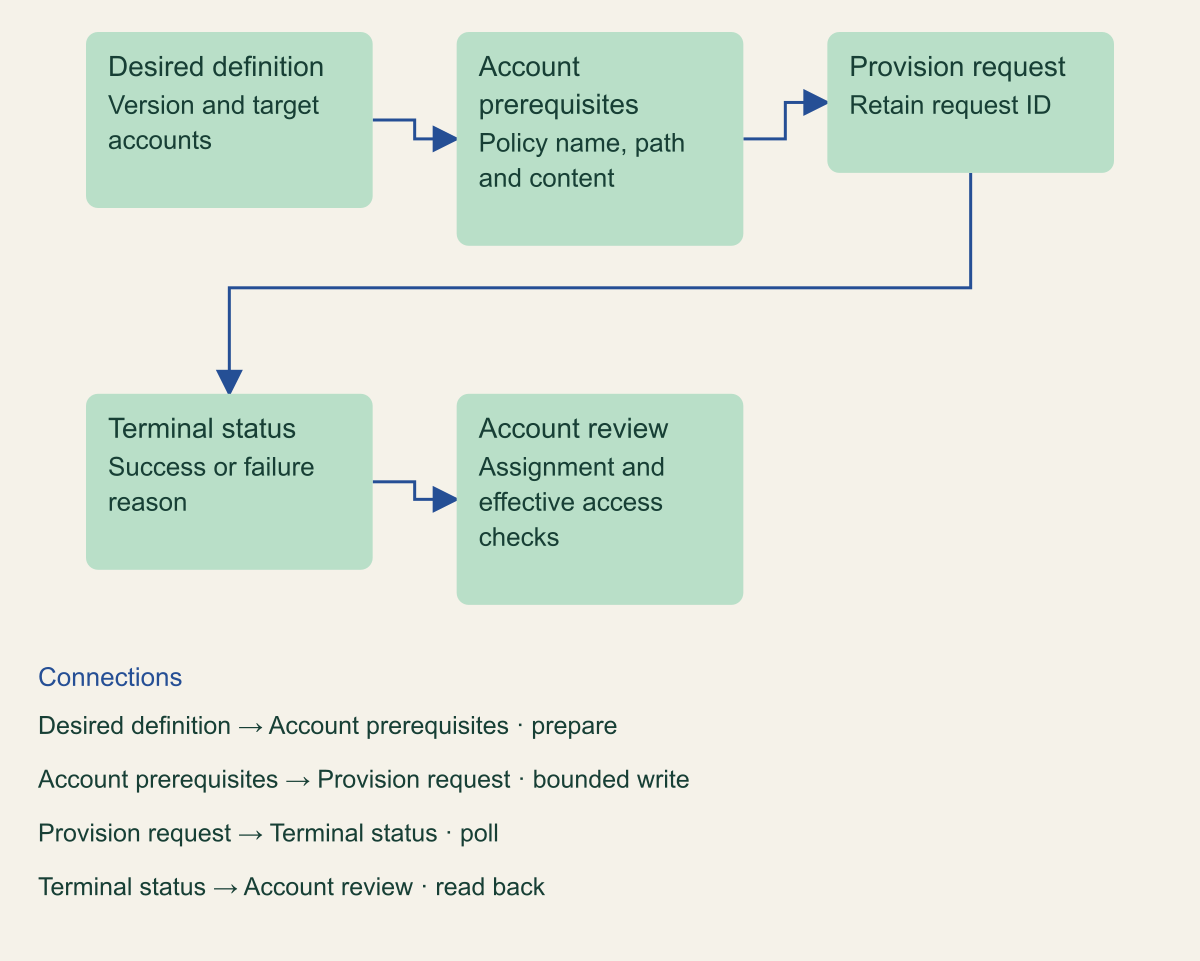
The provisioning request ID and terminal status are inputs to account reconciliation, not substitutes for it. Conceptual flowchart, not a measured result.

Source. AWS, ProvisionPermissionSet API, Asynchronous permission-set deployment and request/status objects. [2]; AWS, Permission-set provisioning status, RequestId, Status and FailureReason [4]; AWS, Customer-managed policies in permission sets, Same name and path, differing permissions and prerequisite creation [5]; AWS, Account assignment creation status, Asynchronous assignment status [7].
Method. Original conceptual flowchart synthesizing the cited documentation. It represents design relationships, not observed test results. Reviewed 2026-09-02.
Accessible table and figure data
| Component | Role |
|---|---|
| Desired definition | Version and target accounts |
| Account prerequisites | Policy name, path and content |
| Provision request | Retain request ID |
| Terminal status | Success or failure reason |
| Account reconciliation | Assignment and effective access checks |
| Component | Role |
|---|---|
| Desired definition | Version and target accounts |
| Account prerequisites | Policy name, path and content |
| Provision request | Retain request ID |
| Terminal status | Success or failure reason |
| Account reconciliation | Assignment and effective access checks |
Keep management-account access exceptional
Delegated administration reduces the need to perform routine work in the AWS Organizations management account, but it does not make that account ordinary. AWS documents restrictions on managing permission sets provisioned in the management account. The rollout should identify these operations explicitly and use the appropriate authority rather than treating a permission error as an invitation to broaden the automation role. [3][8]
Group membership is another authority path. AWS warns that when a group is assigned management-account access, whoever can modify that group's membership can influence who receives that access. The effective administrator set therefore includes relevant identity-source or group administrators, not only the person editing the permission set. Review this relationship when deciding which principals can approve or execute sensitive changes. [8]
Separate routine reconciliation credentials from emergency access. The automation may need to inspect policies and assignment state across accounts, while a repair could require a different, more privileged action. Define how that escalation is approved and recorded. A permanent broad role added to avoid occasional manual work can become a larger authority change than the permission-set rollout it was meant to simplify.
Upstream provisioning and offboarding can also change the result after the rollout completes. A group assignment can remain correct while its membership becomes stale or overly broad. Coordinate the account-access record with the identity lifecycle owner, but do not pretend that a permission-set deployment validates every upstream synchronization process. Those systems have separate completion signals and failure modes.
Approve convergence evidence
The release decision should name the intended scope and show which evidence supports it. For each account, retain the reviewed permission definition, applicable customer-policy expectation, terminal provisioning result and relevant assignment result. Add the bounded effective-access checks that matter to the change. The useful summary is not simply all API calls succeeded; it is that the intended account and principal boundaries are accounted for.
Do not bury exceptions in an aggregate success percentage. An unresolved production account can matter more than many completed development accounts, and a management-account exception has a different authority profile. Describe unresolved targets individually with an owner, reason and next action. If the rollout is intentionally partial, state which accounts remain on the previous approved definition and whether that mixed state is acceptable.
Reconcile again when the account inventory changes or a customer-managed policy is modified independently. A completed rollout is evidence about the reviewed scope at that time, not a permanent guarantee of equivalence. The policy-reference behavior makes this especially important: an account owner can change the document behind a familiar policy name. The content relationship should remain an explicit maintained requirement. [5]
This process also clarifies where cloud identity stops. Identity Center can provide account access under AWS permissions; an application can still need its own business authorization model. Keep those layers distinct in the evidence record. When a reviewer can trace definition, asynchronous operation and actual account state separately, both failed rollouts and unexpected access become easier to investigate without guessing which successful-looking step concealed the difference.
Method and provenance
Primary documentation and standards were reviewed on September 2, 2026. The guide combines source-supported behavior with explicitly framed implementation recommendations and hypothetical examples.
No customer deployment, production environment or live cloud configuration was tested. Product behavior is limited to the cited documentation and stated scope; actual versions, policies and application behavior require verification.
AI assistance. AI-assisted research synthesis, drafting and consistency checks. No human review or firsthand deployment experience is claimed.
Published under the Cloud Security Desk organizational byline. Read the practitioner guide policy.
References
- IAM Identity Center quotas and limits AWS. Accessed .
- ProvisionPermissionSet API AWS. Accessed .
- Configure access to AWS accounts AWS. Accessed .
- Permission-set provisioning status AWS. Accessed .
- Customer-managed policies in permission sets AWS. Accessed .
- UpdatePermissionSet API AWS. Accessed .
- Account assignment creation status AWS. Accessed .
- Identity Center delegated administration AWS. Accessed .