
An implementation-review guide to OAuth Demonstrating Proof of Possession. It explains request proofs, token hashes, key binding, nonce and replay handling, provider-specific support and the authorization checks that remain outside DPoP.
At a glance
Key findings
- DPoP binds token use to a client proof key, but that binding must be verified by the relevant token and resource endpoints.
- A DPoP proof covers defined request information, not the complete request body or a business authorization decision.
- Nonce, replay and key-custody behavior remain explicit deployment requirements, not benefits inferred from a signed JWT alone.
A stolen token should not be sufficient
Use DPoP when the client, authorization server and resource server can enforce a consistent sender-constraint contract. The resource should require both a valid token and a valid proof from the key to which that token is bound. Keep audience validation, token validity and business permission checks in place. A DPoP deployment is incomplete if it produces impressive-looking proof JWTs but the endpoint accepting the token never checks the binding. [1][2]
A bearer token, as defined by RFC 6750, can be used by a party possessing it without demonstrating possession of a cryptographic key. DPoP changes that presentation model by introducing a proof key and a signed request proof. The intended benefit concerns reuse of an obtained token without its associated key; it is not a promise that token theft becomes harmless in every client compromise scenario. [1][6]
RFC 9449 defines DPoP, while RFC 9700 places sender-constrained tokens within the broader OAuth security model. The latter distinguishes sender constraints from audience restrictions. An audience identifies the resource for which a token is intended; a sender constraint limits who can present it successfully. Both can be necessary. A token bound to the correct client key can still be inappropriate for the API receiving it. [1][2]
Begin the design with a capability inventory. Identify the authorization endpoint and token endpoint behavior, the type of token being bound, the client's key storage and the resource servers expected to verify proofs. A provider announcement that mentions DPoP does not establish that all its token types and APIs support the entire RFC. The implementation review needs an endpoint-specific answer before the application adopts a new token presentation scheme.
This guide describes protocol requirements and proposed acceptance checks, not a deployed OAuth implementation. It deliberately avoids a hand-written cryptographic validator. A production implementation should use an appropriate maintained library and verify that the library and surrounding application perform the required checks. Correct JWT parsing is only one part of the contract between the issuer, key holder and protected resource.
Read the proof as a request-bound object
A DPoP proof is a JWT signed by the client's private key. Its protected header identifies the proof type and signing algorithm and contains the corresponding public JWK. The payload includes a unique identifier, HTTP method, target URI and creation time. For a protected-resource request carrying an access token, it also includes ath, a defined hash of that token. These fields have specific validation purposes; merely verifying that the JWT has a signature is insufficient. [1]
The proof's method must match the request being handled. Its target URI must match under the RFC's rules, which exclude query and fragment components. The creation time participates in freshness checks, and the identifier supports replay detection. The ath value ties the proof to the presented access token. A validator that omits one of these checks can accept a proof outside the request context the client intended. [1]
Token-endpoint and resource-endpoint proofs should not be treated as identical messages. The resource proof must carry the access-token hash, while a token request has different available context. Follow the RFC requirements for the relevant endpoint. A shared helper that unconditionally accepts or omits ath can hide the distinction if its callers never identify which kind of proof they are validating. [1]
The token's key binding must match the key used to sign the proof. DPoP uses a JWK thumbprint representation for this relationship. RFC 7638 defines the required JWK members and canonical computation for thumbprints. Do not replace it with an arbitrary serialization hash of a public-key object: including different members or ordering representations inconsistently can produce a different identifier for the intended key. [1][5]
The public key in a proof is not an independent authorization grant. A client can possess a key and produce a self-consistent signature without having permission to use a particular token. The endpoint must connect the proof key to the binding established by the authorization server. Treat signature validity, token validity and key-binding equality as separate review items rather than allowing one to stand in for the others.
JWT verification hygiene still matters. RFC 8725 calls for algorithm verification and discusses explicit typing to prevent confusion between kinds of JWTs. Configure the accepted algorithms and validate the expected DPoP type instead of trusting whichever algorithm the received header requests. Keep proof handling separate from validation rules for unrelated identity tokens or application session tokens. Shared parsing code should not erase their different security contexts. [7]
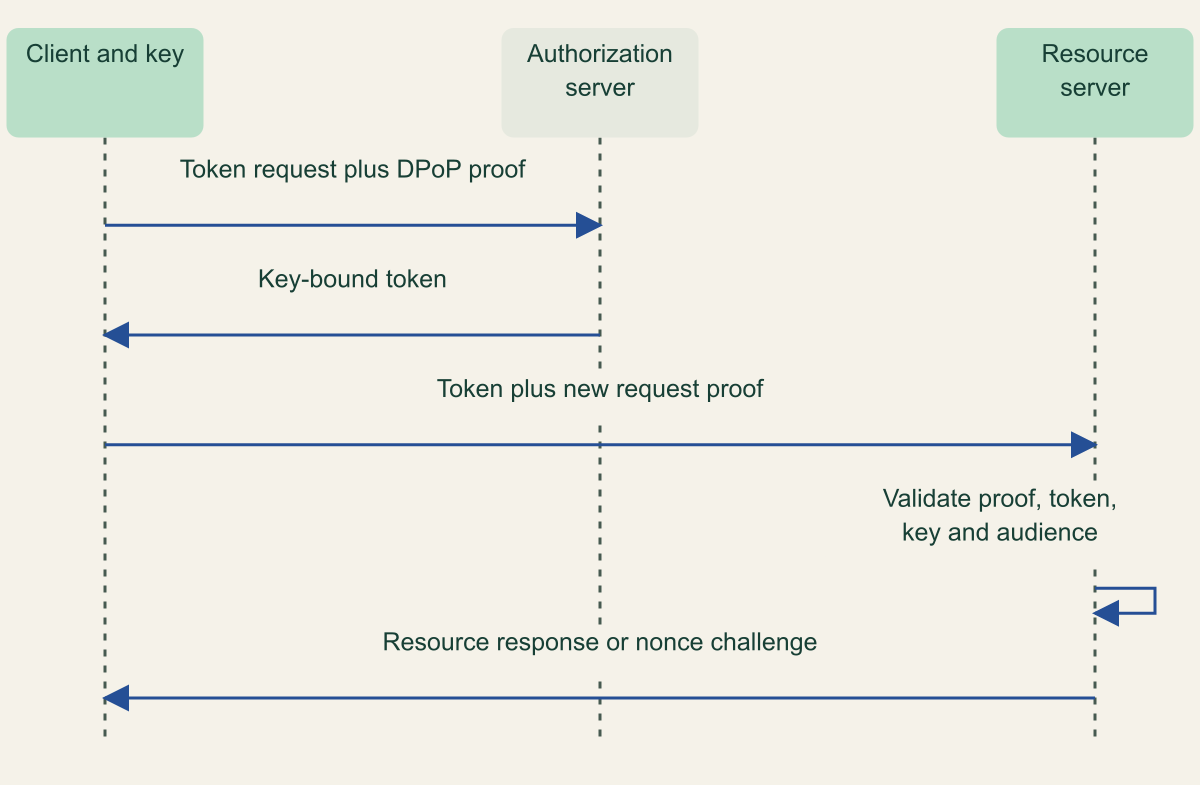
Issuance and resource access use different proofs
The client supplies a proof when obtaining a key-bound token and a new request proof when presenting that token. Conceptual sequence, not a measured result.

Source. IETF, OAuth demonstrating proof of possession, Proof validation, token binding, nonces and replay threats. [1]; IETF, OAuth security best current practice, Sender constraints and audience restrictions in the wider OAuth threat model. [2].
Method. Original conceptual sequence synthesizing the cited documentation. It represents design relationships, not observed test results. Reviewed 2026-09-02.
Accessible table and figure data
| From | To | Message |
|---|---|---|
| Client and key | Authorization server | Token request plus DPoP proof |
| Authorization server | Client and key | Key-bound token |
| Client and key | Resource server | Token plus new request proof |
| Resource server | Resource server | Validate proof, token, key and audience |
| Resource server | Client and key | Resource response or nonce challenge |
| From | To | Message |
|---|---|---|
| Client and key | Authorization server | Token request plus DPoP proof |
| Authorization server | Client and key | Key-bound token |
| Client and key | Resource server | Token plus new request proof |
| Resource server | Resource server | Validate proof, token, key and audience |
| Resource server | Client and key | Resource response or nonce challenge |
Design for replay and pre-generated proofs
A signed proof is not automatically a one-time message. Its identifier and timestamp provide inputs to replay handling, but the deployment must define how the server uses them. RFC 9449 discusses replay detection, bounded proof acceptance and server-provided nonces. Read those requirements as part of the resource implementation, not as optional log fields appended after the token has already been accepted. [1]
The acceptance window needs an explicit relationship to clock behavior. A validator that accepts arbitrarily old proofs loses useful freshness protection, while a rule that ignores reasonable clock differences can reject legitimate clients. Choose and test the actual policy supported by the server and library. This article does not invent a universal proof lifetime or claim that every OAuth provider uses the same tolerance.
Server nonces add a value that a client cannot predict before the server issues it. The RFC describes this as a defense relevant to pre-generated proofs and defines nonce handling for authorization and resource servers. When a server requires a nonce, the client's subsequent proof must carry the appropriate value. A client that blindly resends an identical proof after a nonce challenge has not completed that exchange. [1]
Replay detection also interacts with multiple server instances. If the design depends on remembering recently seen proof identifiers, identify the scope of that memory and how requests routed to another instance are handled. A process-local cache may have different properties from a coordinated service. This is an implementation question to resolve against the intended threat model; the presence of jti in the JWT does not establish a distributed replay guarantee.
Keep transport retries distinct from proof reuse. An application may need to retry a logical request after a network failure, but the proof should follow the protocol's freshness and replay requirements for the new attempt. Even a newly valid proof does not make a repeated business write safe. The API still needs an appropriate operation-level replay or idempotency design if repeating the request can produce a second side effect.
Nonce state can itself become an operating dependency. Decide how clients recover from a challenge, how servers handle a changed or expired nonce and which error information is retained for diagnosis. Do not solve a recurring compatibility problem by silently accepting missing nonces wherever they were supposed to be required. That changes the security contract and should be a reviewed policy decision rather than a hidden fallback.
Check the issuer and resource server separately
Provider support must be read at the level of the actual flow. Google's DPoP adoption guide, for example, describes binding a refresh token during an authorization-code exchange and including proof in subsequent token-endpoint requests. That documented flow is useful evidence of a particular integration. It is not evidence that every Google resource API accepts DPoP-bound access tokens or enforces the same proof contract. [3]
The guide also describes client requirements and limitations for its supported flow. Preserve those qualifications rather than borrowing the RFC's broad concept and presenting it as uniform provider availability. An application can use DPoP for a refresh-token path while a later access token follows a different presentation model. The architecture should label which credential is bound at each step and which endpoint verifies the proof. [3]
Reverse proxies introduce another integration question. The client constructs htu from the target it calls, while the application server may see an internal host, scheme or path after forwarding. Define the canonical target that the validator uses and how trusted forwarding information is established. Do not fix a mismatch by removing URI validation or trusting arbitrary forwarded headers from an untrusted caller. The check must retain the RFC's request-binding meaning. [1]
Query parameters and request bodies require separate attention because the DPoP target URI definition excludes query and fragment components and the proof is not a signature over the complete payload. If application correctness depends on body or parameter integrity beyond the protected transport and ordinary request validation, design that control explicitly. Calling a request DPoP-protected should not imply that every byte was covered by the proof signature. [1]
Map token validation ownership across gateways and services. If a gateway verifies DPoP and forwards a request internally, the downstream service must understand what authenticated context it can trust and how that context is protected. If the service validates independently, it needs the correct external-request context and token-binding information. A diagram with a single box labeled OAuth cannot explain these different enforcement arrangements.
Review fallback behavior explicitly. A resource that accepts a key-bound token without requiring its proof has removed the intended sender constraint for that path. Compatibility handling must distinguish legitimately supported bearer tokens from DPoP-bound tokens whose proof is missing or invalid. Do not turn a failed proof check into an automatic second attempt under a weaker validation mode. The token's binding remains part of its acceptance contract. [1]
Create an interoperability record for the actual client and endpoint combination. It should identify supported algorithms, token type, key-binding representation, nonce behavior, accepted target normalization and error handling. This is a proposed operational artifact, not a new protocol profile. Its purpose is to stop a capability confirmed for one provider endpoint from being silently generalized to a different endpoint or resource server.
Keep key custody in the threat model
DPoP depends on the client's ability to use the private proof key. If an attacker obtains both a token and the ability to invoke that key, the protection against possession of the token alone no longer describes the situation. Key storage, process isolation and the signing interface therefore belong in the design. A non-exportable key can reduce some exposure paths without proving that compromised code cannot ask the legitimate client to sign. [1]
Choose how the key is created, retained and retired for the supported flow. The application needs to understand what happens when the key is lost, replaced or unavailable after a restart. A token bound to one key does not become bound to a new key because the client generated a replacement locally. Recovery may require a provider-supported token or authorization flow, and should not be implemented as accepting whatever new proof key the client sends.
Mutual TLS certificate-bound access tokens offer another sender-constraint mechanism. RFC 8705 describes token use tied to a client certificate. That mechanism has different deployment requirements from a signed application-layer DPoP proof, particularly around TLS termination and certificate handling. Compare the actual client and infrastructure constraints instead of declaring one universally superior because it sounds more hardware-oriented or more convenient for a browser. [4]
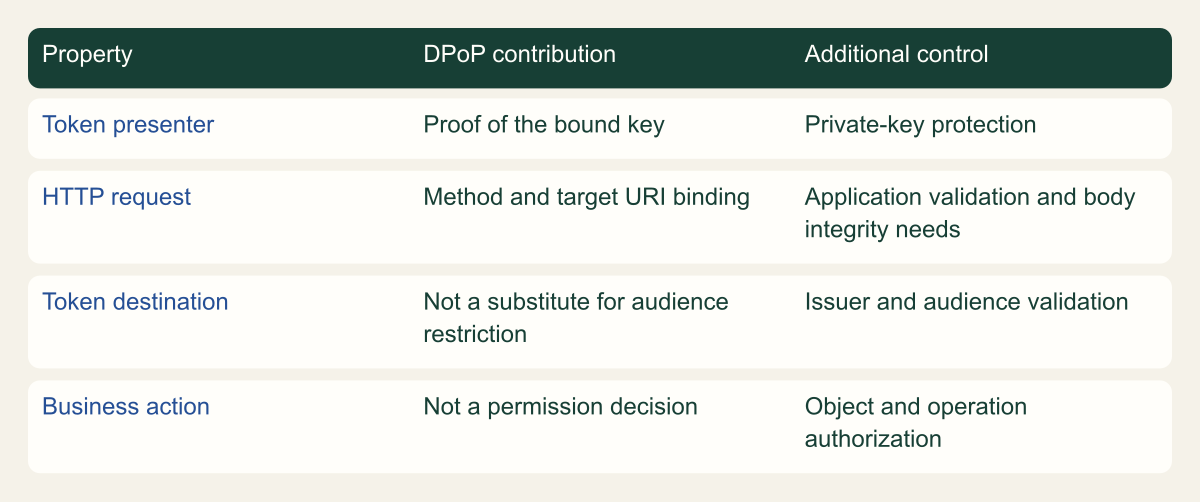
The boundary matrix makes the remaining responsibilities explicit. DPoP contributes key possession and defined request binding. TLS protects transport; token validation establishes issuer and intended audience; the application authorizes the business object and operation. These layers can reinforce each other, but they are not interchangeable. The matrix is a conceptual scope comparison, not a measured ranking of defenses.
Do not confuse a proof key with a user's authentication method. A passkey used to sign a user into an application and a DPoP key used to present OAuth tokens serve different protocol roles. Their lifecycle and recovery designs can interact, but a successful user authentication does not by itself establish the security of every client process holding a token or invoking a proof key.
Sender constraint leaves other security decisions intact
Key possession and request binding complement, but do not replace, audience validation and business authorization. Conceptual matrix, not a measured result.

Source. IETF, OAuth demonstrating proof of possession, Proof validation, token binding, nonces and replay threats. [1]; IETF, OAuth security best current practice, Sender constraints and audience restrictions in the wider OAuth threat model. [2]; IETF, OAuth mutual TLS and certificate-bound tokens, Certificate-bound access tokens [4].
Method. Original conceptual matrix synthesizing the cited documentation. It represents design relationships, not observed test results. Reviewed 2026-09-02.
Accessible table and figure data
| Property | DPoP contribution | Additional control |
|---|---|---|
| Token presenter | Proof of the bound key | Private-key protection |
| HTTP request | Method and target URI binding | Application validation and body integrity needs |
| Token destination | Not a substitute for audience restriction | Issuer and audience validation |
| Business action | Not a permission decision | Object and operation authorization |
| Property | DPoP contribution | Additional control |
|---|---|---|
| Token presenter | Proof of the bound key | Private-key protection |
| HTTP request | Method and target URI binding | Application validation and body integrity needs |
| Token destination | Not a substitute for audience restriction | Issuer and audience validation |
| Business action | Not a permission decision | Object and operation authorization |
Make negative cases the acceptance evidence
An acceptance suite should reject a proof with the wrong method, target, token hash or bound key. It should also exercise stale proofs, repeated identifiers and the server's nonce challenge behavior. These cases directly test the relationships DPoP is intended to enforce. A test that signs a JWT and receives one successful response establishes only a narrow happy path, not the validator's resistance to mismatched or repeated presentation. [1]
Test the resource's ordinary authorization checks at the same time. A correctly bound token for the wrong audience must still fail. A valid proof from an authenticated user must not grant access to another tenant's object. Keeping these cases distinct helps identify whether a failure belongs to proof validation, token validation or business permission, rather than treating every denial as proof that DPoP worked. [1][2]
Include operational failure cases: lost client key, unexpected proxy rewriting, nonce state changes and temporarily unavailable replay state. Define the intended response and recovery path without silently weakening the required checks. These tests should use the actual library, server configuration and provider flow selected for deployment. No such runtime validation or production interoperability test was performed in preparing this guide.
Retain non-secret evidence of which check rejected the request. Avoid logging complete tokens or private-key material. Useful diagnostic categories can identify a target mismatch, unacceptable time, missing nonce or failed key binding without creating a new credential exposure. The precise telemetry design belongs to the implementation and should preserve both troubleshooting value and the sensitivity of authentication data.
The result should be a clear statement of scope: this token type, issued through this flow, is accepted by these resources only with the defined proof checks and application permissions. That is more defensible than saying the system uses proof of possession. A sender constraint becomes valuable when each accepting component enforces its part of the contract and the remaining authorization boundaries remain visible.
Method and provenance
Primary documentation and standards were reviewed on September 2, 2026. The guide combines source-supported behavior with explicitly framed implementation recommendations and hypothetical examples.
No customer deployment, production environment or live cloud configuration was tested. Product behavior is limited to the cited documentation and stated scope; actual versions, policies and application behavior require verification.
AI assistance. AI-assisted research synthesis, drafting and consistency checks. No human review or firsthand deployment experience is claimed.
Published under the Cloud Security Desk organizational byline. Read the practitioner guide policy.
References
- OAuth demonstrating proof of possession IETF. Accessed .
- OAuth security best current practice IETF. Accessed .
- Google DPoP adoption guide Google. Accessed .
- OAuth mutual TLS and certificate-bound tokens IETF. Accessed .
- JSON Web Key thumbprints IETF. Accessed .
- OAuth bearer-token usage IETF. Accessed .
- JWT best current practices IETF. Accessed .