
An AWS NAT diagnostic guide covering per-destination limits, metric semantics, idle resets, zonal and regional address scope, account quotas and stateful change acceptance.
At a glance
Key findings
Identify the gateway mode
Before adding NAT capacity, determine whether the failure is source-port allocation, idle connection reuse, packet pressure or a different access-path problem. Then identify the gateway mode. Current AWS documentation distinguishes zonal and regional NAT gateways, with different address scope and metric dimensions. An old description of one zonal gateway is not a universal model for every deployment.
Record the gateway identifier, connectivity type, Availability Zone footprint and relevant routes. Regional NAT metrics include Availability Zone context, while zonal metrics use their documented gateway dimension. A graph that combines those scopes without explanation can hide which part of the path is under pressure. [3]
The regional feature changes the planning question. AWS documents per-AZ address allocation and automatic or manual zone management, rather than simply treating a regional gateway as a larger zonal object. Verify the deployed mode and its current configuration before applying a published ceiling to the workload. [6]
Start with the failing application path. Identify the client population, destination IP, destination port and protocol involved in the symptom. If those are unknown, a gateway-wide connection total may be useful orientation but cannot establish whether the relevant destination pool is exhausted.
A hypothetical service can fail only when many clients converge on one external endpoint, while other outbound requests continue normally. That pattern suggests a more specific investigation than a general claim that NAT is down. The goal is to connect the symptom to a constrained resource with the correct scope.
No gateway or application was inspected for this guide. The calculations use documented limits, not measured usable capacity. Any routing, address or client-pool change requires the reader's own configuration review, authorization and application-level acceptance checks.
Locate the destination concentration
AWS documents 55,000 simultaneous connections per IPv4 address to each unique destination, defined by destination IP, port and protocol. This is a per-destination constraint. It is not a single connection allowance shared in the same way across every remote service, and it is not equivalent to an application request count. [1]
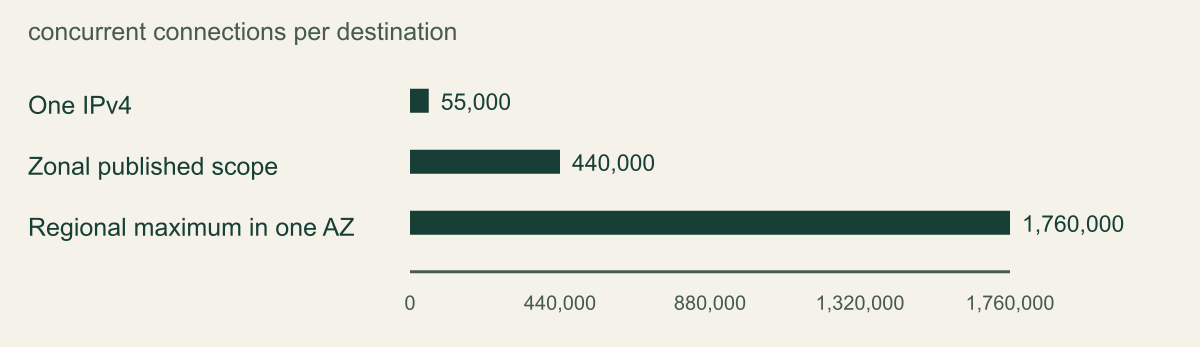
The chart multiplies that documented per-address value by selected published address scopes: one address, the zonal eight-address scope and a regional maximum of thirty-two addresses within one AZ. The resulting ceilings are 55,000, 440,000 and 1,760,000 connections for the stated destination scope. They are arithmetic limits, not benchmark results or guaranteed workload capacity. [1][5][6]
Destination concentration can be hidden by application naming. Several services or jobs may connect to the same destination tuple even though they appear as separate components in an architecture diagram. Conversely, one application may distribute work across several destinations. Map the actual network destination population before deciding which capacity model applies.
Review connection ownership on the client side. Identify which process or pool opens connections, how concurrency is bounded and whether failed work causes additional connections. This is a recommended diagnostic inventory, not an assertion about any particular application's behavior. The relevant owner may be an SDK, proxy or worker framework rather than the business service's top-level code.
Do not turn the chart into a scaling promise. The reader still needs account quotas, mode-specific configuration, application behavior and other gateway or instance limits. A larger published address ceiling cannot establish that a receiver accepts the traffic or that an application can use the additional capacity correctly.
Preserve the destination definition in every derived worksheet. A row labeled connections without the IP, port and protocol scope invites later misuse as an aggregate gateway limit. The table should make both the multiplier and its scope explicit so another reviewer can reproduce the calculation without inferring hidden assumptions.
Published address scopes change the ceiling
The calculation is per destination within the stated address and AZ scope, not measured gateway performance.

Source. AWS NAT basics, VPC quota and regional NAT documentation, reviewed September 2, 2026. [1][5][6]
Method. 55,000 multiplied by 1, 8 and 32. Only column 2 is plotted. Public zonal default quota is two EIPs; other constraints and private-quota uncertainty remain.
Accessible table and figure data
| Address scope | IPv4 addresses | Derived connections per destination |
|---|---|---|
| One IPv4 | 1 | 55000 |
| Zonal published scope | 8 | 440000 |
| Regional maximum in one AZ | 32 | 1760000 |
| Address scope | IPv4 addresses | Derived connections per destination |
|---|---|---|
| One IPv4 | 1 | 55000 |
| Zonal published scope | 8 | 440000 |
| Regional maximum in one AZ | 32 | 1760000 |
Read the error before buying capacity
ErrorPortAllocation counts failures to allocate a source port, and AWS recommends the Sum statistic for that metric. ActiveConnectionCount describes active TCP connections and is interpreted with Maximum. These measurements answer different questions; a large connection total is not itself evidence that allocation failed. [3]
NAT metrics are published at one-minute intervals. That monitoring cadence is a property of the source, not proof that every application-visible burst is represented by an intuitive single dashboard value. Preserve the statistic, interval, dimensions and relevant time window when comparing gateway observations with application failures. [7]
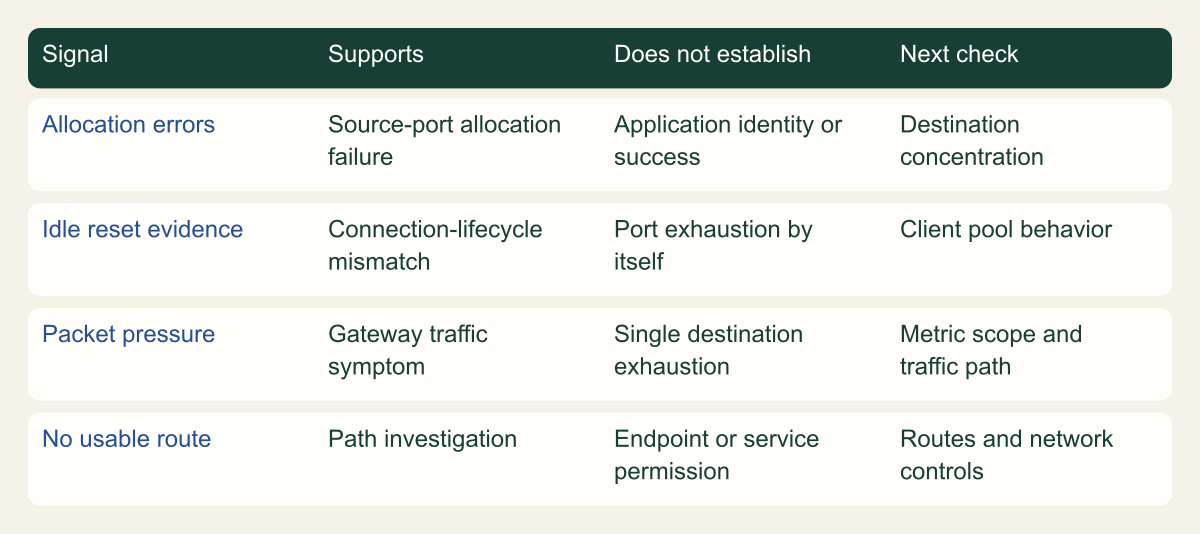
The diagnostic matrix separates symptoms rather than assigning invented thresholds. Allocation errors support a source-port pressure hypothesis. Idle-reset evidence supports a connection-lifecycle hypothesis. Packet drops or route failures require their own review. Several conditions can coexist, so a single metric should not be forced to explain every reported error.
Be careful with request-like counters. AWS documents that connection-attempt and connection-established metrics have details involving SYN traffic and retransmissions. Do not automatically divide them into a clean application success rate. Peak-byte and peak-packet metrics also have their own aggregation semantics. Use the definitions before building ratios or a causal narrative. [3]
Correlate time and scope with the application owner. An allocation error on one gateway or AZ should be matched to clients actually using that path. A service-wide incident count can include unrelated failures, and a regional aggregate can conceal a local concentration. Retain that uncertainty if the mapping is not available.
An investigation receipt should include raw metric queries or export references and the application symptom they are intended to explain. A screenshot without its statistic and dimension choices is difficult to review later. The useful output is a supported hypothesis and next check, not merely a red chart that appears to justify a capacity purchase.
When several applications share a gateway, ask each owner to identify the destination and client pool associated with its failures. Do not apportion the gateway's allocation errors by application traffic share unless a measured method supports that attribution. A small client population can concentrate on a constrained destination while a larger population uses many unrelated paths. Preserve unknown attribution as a limitation and use it to guide the next observation, rather than manufacturing application-specific exhaustion counts from an aggregate metric.
Match the signal to the constrained resource
A connection count, reset and allocation error do not establish the same diagnosis.

Source. Original diagnostic synthesis based on AWS metrics and troubleshooting guidance. [1][3][4][6]
Method. Conceptual matrix with no invented thresholds, scores or measurements.
Accessible table and figure data
| Signal | Supports | Does not establish | Next check |
|---|---|---|---|
| Allocation errors | Source-port allocation failure | Application identity or success | Destination concentration |
| Idle reset evidence | Connection-lifecycle mismatch | Port exhaustion by itself | Client pool behavior |
| Packet pressure | Gateway traffic symptom | Single destination exhaustion | Metric scope and traffic path |
| No usable route | Path investigation | Endpoint or service permission | Routes and network controls |
| Signal | Supports | Does not establish | Next check |
|---|---|---|---|
| Allocation errors | Source-port allocation failure | Application identity or success | Destination concentration |
| Idle reset evidence | Connection-lifecycle mismatch | Port exhaustion by itself | Client pool behavior |
| Packet pressure | Gateway traffic symptom | Single destination exhaustion | Metric scope and traffic path |
| No usable route | Path investigation | Endpoint or service permission | Routes and network controls |
Separate idle resets from port pressure
AWS documents a 350-second idle timeout for NAT gateway connections and a reset response when a client attempts to reuse a connection after that timeout. This behavior can cause application failures even when the immediate problem is not a lack of available source ports. [4]
Read IdleTimeoutCount as evidence about connection lifecycle, not as a count of business transactions lost. Match it to client behavior and observed resets. A pool that retains connections longer than the path supports may need a lifecycle correction; adding addresses would not by itself explain or repair that mismatch.
A hypothetical worker opens a connection, leaves it idle and later tries to reuse it. If the path has expired that state, the first reuse can fail. The relevant review includes the pool's idle policy, retry behavior and whether work can be safely repeated. This example is conceptual and contains no observed failure rate or proposed universal timeout.
Ask the application owner where connection reuse is configured and how stale connections are detected. A setting may belong to a client library or intermediary rather than the service code. Preserve the exact component and version in the change record so the correction remains understandable after a dependency upgrade.
Do not prescribe keepalive as a universal answer without checking the protocol and application. A mechanism that maintains idle state can also preserve more concurrent connections, changing the pressure elsewhere. The decision should account for both connection lifetime and useful work, with a bounded authorized test of the chosen behavior.
Use the related retry review to prevent a transient failure from becoming a wider load problem. Retries and reconnection can be appropriate, but their concurrency and side effects need explicit limits. The NAT investigation should identify the resource symptom while the application owner validates safe recovery from it.
Choose the smallest relevant capacity change
If allocation evidence supports per-destination pressure, compare client-side and gateway-side options. Reusing connections, bounding concurrent work, adding address capacity or separating client populations change different parts of the system. The smallest relevant change is the one that addresses the demonstrated constraint while preserving application correctness.
Connection reuse can reduce repeated connection creation, but the idle-reset discussion shows why its lifecycle matters. Bounded concurrency can reduce simultaneous demand, but it may affect queueing and job completion. These are operational tradeoffs to test, not measured improvements promised by this guide.
Address changes introduce additional egress identities. Review destination allowlists, monitoring assumptions and ownership of those addresses before deployment. A capacity change can appear successful at the gateway while a remote service rejects traffic from an unexpected source address. Include the external dependency owner where that acceptance is required.
AWS's working guide documents secondary-address considerations and connection draining associated with address changes. Treat the change as stateful network maintenance rather than an instantaneous arithmetic adjustment. Preserve current associations and the intended drain behavior in the approved plan. [2]
Splitting clients across paths can also change failure domains, cost and operational complexity. Do not recommend it solely because a diagram looks more distributed. Establish which clients and destinations move, how routing is verified and what happens to existing connections. The acceptance test should follow the same application operation that originally failed.
If the evidence does not support port exhaustion, stop treating more addresses as the default remedy. Return to the diagnostic matrix and investigate the actual signal. A successful capacity modification is not proof that the original hypothesis was correct unless the observed behavior and scope support that conclusion.
Apply regional limits with their scope
Regional NAT gateways have a documented maximum of thirty-two IP addresses per Availability Zone and do not support private NAT connectivity. Their automatic expansion into a newly active zone can take up to sixty minutes under the documented conditions, and traffic may use another zone during that interval. These are mode-specific behaviors to review before choosing the design. [6]
The chart's regional value therefore means a published per-destination ceiling within one AZ under the stated address scope. It should not be labeled simply regional gateway capacity. That broader phrase could imply an aggregate guarantee across zones and workloads that the calculation does not establish.
Review automatic versus manual zone management in the deployed configuration. The presence of a regional resource does not eliminate the need to understand where clients run and which routes they use. Preserve the zone-level view when investigating a symptom that occurs only during expansion or a workload move.
Mode conversion is also a change boundary. AWS documents that conversion resets existing connections. It should be planned with application owners and a recovery check, not presented as an incident-time toggle that adds capacity without disruption. [6]
A hypothetical architecture review may choose regional NAT for its operational characteristics while retaining a separate migration plan for existing clients. Keep those decisions distinct. The first evaluates the desired steady state; the second accounts for the transition and its accepted effect on active work.
Avoid reproducing older guidance that assumes every NAT gateway must be managed as the same zonal pattern. Equally, do not erase zonal behavior from an environment that still uses it. The reliable starting point remains the actual resource mode, current documentation and the request path under investigation.
Resolve quota and change preconditions
Published capacity and account entitlement are different. AWS lists a default public zonal quota of two Elastic IP addresses per NAT gateway, adjustable up to eight. A chart using the eight-address scope is not evidence that a particular account can attach eight addresses immediately. [5]
The current documentation is inconsistent about private NAT address adjustability: the working guide describes an eight-address limit as non-adjustable, while the quota table describes an adjustable entry. This guide does not silently choose one as universally authoritative. Verify the actual account quota and supported operation before planning a private NAT change. [2][5]
Keep that conflict in the review record if it affects the decision. The next step may be a read-only quota check or confirmation through the organization's normal provider-support process. Do not resolve documentary uncertainty by attempting a production change merely to see whether it succeeds.
Other preconditions include address availability, destination acceptance, routing ownership and a rollback or recovery approach appropriate to the stateful path. Identify which checks are complete and which depend on another team. A change request should not describe itself as ready when a critical allowlist or quota assumption remains unverified.
Recheck the documented limits near execution if the plan is delayed. Product features and quotas can change independently of the application. Retain the review date and the specific scope used for the capacity calculation so later readers do not treat a historical planning value as a permanent entitlement.
Close on observed service recovery
Close the incident with both resource and application evidence. If allocation errors stop, say that the relevant metric no longer shows that symptom for the reviewed path and interval. Then verify whether the application operation succeeds. Gateway recovery and useful service recovery are related but distinct outcomes.
Record the gateway mode, zone, destination scope, metric statistics, client population and authorized change. Include any connection resets, unresolved paths or downstream acceptance issues. This receipt should let another engineer understand why the selected intervention was expected to help and what the follow-up actually demonstrated.
Do not report a measured capacity gain from the documented chart. Its values remain published limits and arithmetic. If the organization later performs an authorized load test, that is a separate dataset with its own workload, environment and limitations.
The durable correction may be a client-pool policy, a quota preparation step, a mode-aware dashboard or a clearer route inventory. Choose the correction that follows from the evidence. Port exhaustion is a specific constrained-resource problem, and it is solved most reliably when the destination, address scope and application behavior remain visible together.
Method and provenance
Source-led technical analysis of directly reviewed project and vendor documentation, with original decision frameworks and explicitly hypothetical examples. Sources were reviewed on September 2, 2026.
No customer environment, live configuration, workload measurement or production test was inspected. Product behavior and limits are bounded to the cited documentation and stated review date.
AI assistance. AI assisted research synthesis, drafting, diagram planning and deterministic editorial checks. No personal deployment experience, independent human review or live test is claimed.
Published under the Cloud Security Desk organizational byline. Read the practitioner guide policy.
References
- NAT gateway basics AWS. Accessed .
- Work with NAT gateways AWS. Accessed .
- NAT gateway metrics and dimensions AWS. Accessed .
- Troubleshoot NAT gateways AWS. Accessed .
- Amazon VPC quotas AWS. Accessed .
- Regional NAT gateways AWS. Accessed .
- Monitor NAT gateways AWS. Accessed .