A retry-policy analysis with an explicitly theoretical 3^n attempt model. AWS and Google primary guidance inform retry ownership, deadlines, overload budgets, idempotency, and version-aware SDK configuration.
At a glance
Key findings
- Independent retry loops can multiply downstream attempts even when each individual setting looks modest.
- In the stated worst-case model, three total attempts at each of five layers produce 243 deepest-service attempts for one logical request.
- Retry budgets, deadlines, overload handling, and idempotency solve different problems and should be reviewed together.
Count logical requests and attempts separately
During an outage, a dashboard can show growing request volume even when the number of users has not changed. One possible contributor is retry amplification: clients, gateways, services, and SDKs each repeat work that a deeper dependency is already failing to complete. The review should begin by separating one intended operation from the number of attempts made on its behalf.
AWS's Builders' Library explains why retries at several layers can multiply load on the deepest service. It recommends considering where retries occur alongside timeouts, backoff, and jitter. [1] The useful operational question is not simply whether retries are enabled. It is how many attempts the complete path can generate before the original operation ends.
Inventory every retry owner, including code that is not visible in the main request handler. Record the triggering errors, total attempt limit, delay behavior, deadline, and cancellation behavior. Use the phrase total attempts consistently: in this article, three total attempts means the initial call plus two retries. That definition avoids an off-by-one ambiguity that can materially change a capacity calculation.
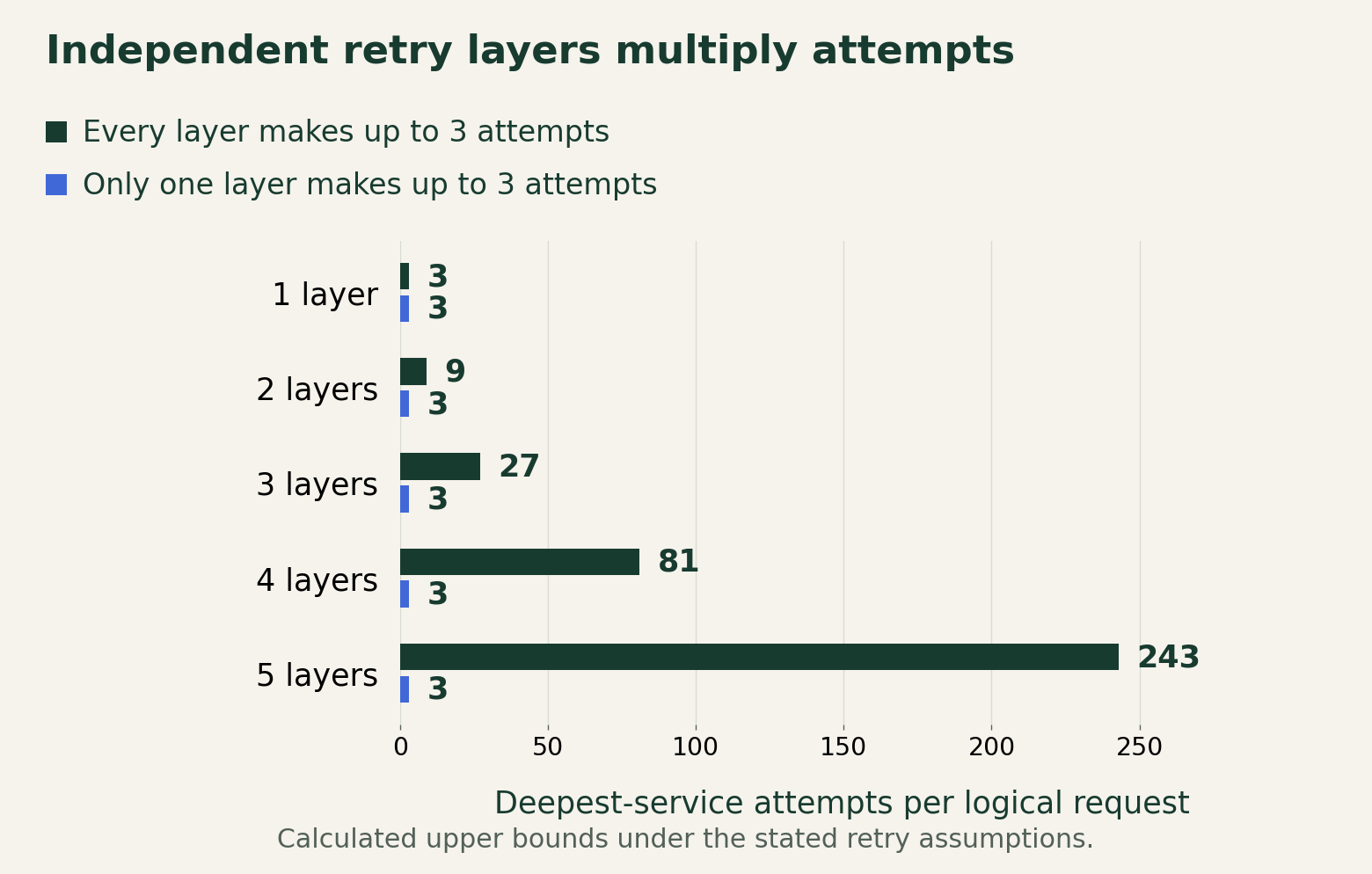
Independent retry layers multiply attempts
Five layers with three total attempts each can generate 243 deepest-service attempts in this worst-case model.

Source. Retry-composition example in the AWS Builders' Library [1], extended by exact arithmetic for one through five layers.
Method. Theoretical worst case for one logical request through a linear chain: every attempt reaches and fails at the deepest service, each retrying layer permits three total attempts including the initial call, and no deadline or cancellation truncates work. Compare 3^n with 3. These are calculated attempts, not measured traffic, latency, or effectiveness scores.
Accessible table and figure data
| Layers in the chain | Every layer makes up to 3 attempts | Only one layer makes up to 3 attempts |
|---|---|---|
| 1 | 3 | 3 |
| 2 | 9 | 3 |
| 3 | 27 | 3 |
| 4 | 81 | 3 |
| 5 | 243 | 3 |
| Layers in the chain | Every layer makes up to 3 attempts | Only one layer makes up to 3 attempts |
|---|---|---|
| 1 | 3 | 3 |
| 2 | 9 | 3 |
| 3 | 27 | 3 |
| 4 | 81 | 3 |
| 5 | 243 | 3 |
Make the multiplication visible
Consider one logical request passing through a linear chain of retrying layers. Assume every attempt reaches the deepest service and fails, every retrying layer makes three total attempts, and no deadline or cancellation truncates the sequence. With n retrying layers, the deepest service receives 3^n attempts. Five layers therefore produce 243 attempts under those assumptions.
If only one layer retries while the others make one attempt, the same simplified model produces three deepest-service attempts. The chart compares those two policies from one through five layers. It does not estimate latency, success probability, normal traffic, or the behavior of a branching call graph. Those would require additional assumptions and measurements.
Use the arithmetic to identify where evidence is missing. If the observed path has different attempt limits, multiply the relevant limits for that path and document the assumptions. Then compare the model with an authorized failure-injection test. A smaller observed count may reflect deadlines, cancellation, caching, or a failure that occurred before the deepest call; it does not make the model a measured benchmark.
Choose a retry owner and a finite budget
There is no universal rule that every retry belongs at the outermost client. Retrying high in the stack can repeat useful work already completed below it, while retrying close to a failing dependency can hide the total effort from the caller. AWS and Google's SRE guidance discuss retry placement and budgets in their respective overload contexts. [1][3]
Choose the owner for each logical operation deliberately. Give it an overall deadline and a finite attempt budget, and define how inner components communicate retryable failure without creating another independent loop. Include asynchronous workers and queue redelivery in the review when they participate in the same business action. A request timeout should not quietly leave an unlimited background retry sequence behind it.
Preserve the distinction between a temporary failure and an invalid operation. Repeating an unauthorized, malformed, or permanently rejected request can consume capacity without improving the outcome. The exact classification is API-specific, so retain the service's documented behavior and test the application's interpretation. A broad catch-and-retry block is difficult to audit because it erases the reason the operation failed.
Bound overload as well as waiting
Backoff spaces attempts over time, while jitter reduces synchronized retry timing. Neither changes an unlimited retry policy into a finite one. [1] Keep the total operation deadline visible when selecting delays, so the caller is not asked to wait through attempts that can no longer produce a useful response within the accepted service window.
Google's overload chapter discusses retry budgets as a way to limit the additional traffic retries create. [3] Translate that concept into a policy the service can observe: how much retry work is permitted, when the budget is exhausted, and how rejected work is reported. Avoid copying an example percentage as a universal production threshold without workload evidence.
SDK configuration also needs a scope review. The current AWS guide distinguishes standard and adaptive behavior and describes client-level effects, including adaptive delays. [4] Determine whether unrelated resources share a client and could therefore influence one another's requests. Record the library version, environment settings, and effective configuration in the test receipt; a mode name alone is not a complete description of runtime behavior.
Make side effects safe to repeat
A timeout does not establish that a remote operation failed before committing its side effect. Retrying a payment, job creation, or resource request can therefore duplicate work unless the API and application define how repeated intent is recognized. AWS's idempotent-API guidance describes caller-provided request identifiers and the need to distinguish repeated intent from a different request. [2]
For an application-owned API, specify the identifier's scope, the request fields that define the intent, the result returned for a repeat, and the policy for late arrivals. The side effect and the record used to recognize it must be coordinated so a failure cannot leave one committed without the other. Treat reuse of the same identifier for a different intent as an explicit conflict, not an accidental match.
Keep idempotency separate from admission control. A service may correctly avoid duplicate business effects while still spending substantial work validating repeated requests. Conversely, a small retry budget does not make a non-idempotent operation safe to repeat. The release review should ask both how much repeated work is allowed and what happens if a request was committed before its response was lost.
Test the complete failure path
Use a controlled dependency that can fail before execution, delay a response, or commit an operation and then lose the response. Count logical requests, attempts at each layer, deepest-service calls, and distinct committed effects. These observations let the team distinguish amplification from duplication, which are related but different failures.
Record the stopping conditions as carefully as the attempts. Confirm that the overall deadline ends useful work, that cancellation reaches the components expected to stop, and that exhausted budgets produce a clear result. Test a repeated idempotency identifier with both matching and conflicting intent. Keep generated load bounded and isolated from production dependencies.
The resulting policy should be explainable without reading every retry loop: this component owns retries, these failures qualify, this budget limits the work, and this contract prevents duplicate effects. Preserve the theoretical chart as a warning about composition, then use actual request traces and operation records to establish what the deployed path does under the failure scenarios the organization chose to test.
Method and provenance
Primary documentation review completed August 28, 2026. Figure values were calculated as 3^n and 3 for integer n from one through five under the stated assumptions.
No application, SDK, load test, or failure-injection experiment was run. The model is an upper-path attempt calculation under explicit assumptions, not an empirical outage or performance result.
AI assistance. AI assistance was used to research sources, draft and structure the article, and prepare the visual specification. No human technical review is claimed.
Published under the Cloud Security Desk organizational byline. Read the series policy.
References
- Timeouts, retries, and backoff with jitter AWS Builders' Library. Accessed .
- Making retries safe with idempotent APIs AWS Builders' Library. Accessed .
- Handling Overload, Site Reliability Engineering chapter 21 Google. Accessed .