
A vulnerability-management guide that separates KEV evidence, CVSS severity, EPSS probability and local consequence. A pinned CISA dataset supports the discussion of asset matching, queue ownership, exceptions and verification, with explicit limits on what catalog membership can establish.
At a glance
Key findings
- Join a dated KEV signal to verified asset applicability, exposure, ownership and closure evidence before treating it as an actionable cloud remediation decision. [1][2][3]
- CVSS severity, EPSS probability and known exploitation have different meanings and do not automatically form a calibrated risk score. [5][6][7]
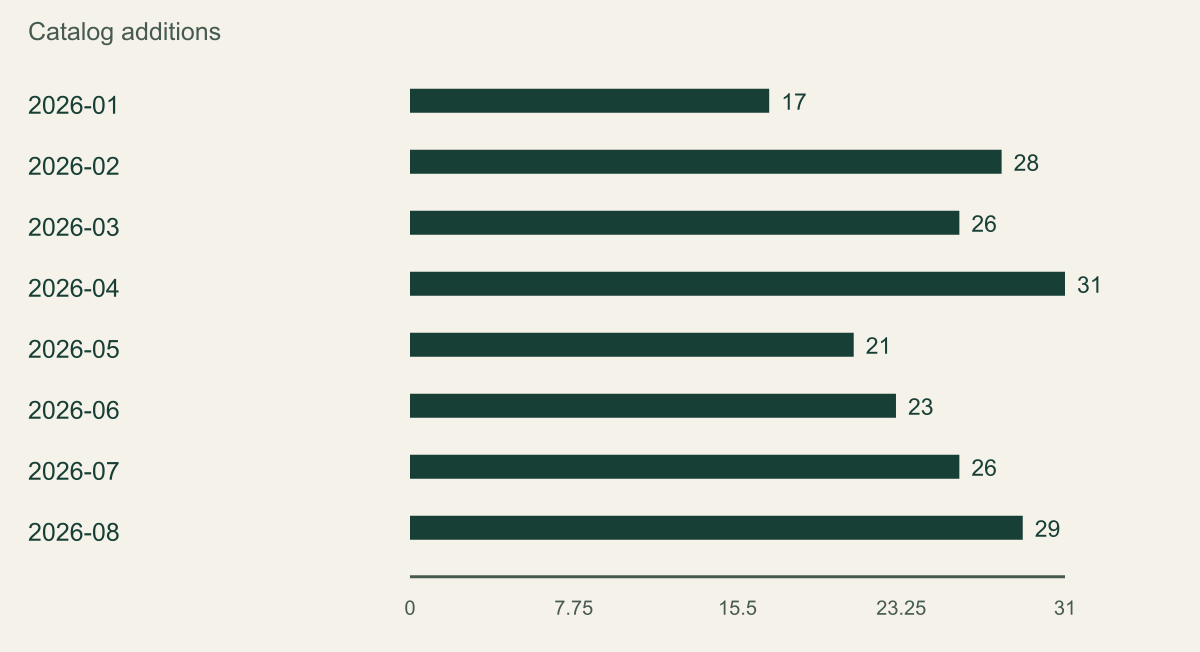
- The chart counts catalog additions through August 27, 2026; it does not measure vulnerability publication, incident frequency or organizational risk. [2][3]
An urgent finding still needs an asset decision
An exploited vulnerability is a strong reason to act, but it is not yet an instruction that identifies the affected cloud asset, the responsible owner or the evidence required to close the work. A defensible patch queue connects those decisions. It preserves the exploitation signal while making local applicability and consequence explicit.
Consider a hypothetical team receiving a catalog entry for a product name found in two inventory records. One record represents a service operated by a supplier. The other represents a self-managed workload whose exact package build is uncertain. Both matches deserve attention, but they do not necessarily require the same action from the same team. The example is fictional and does not describe a customer environment.
The queue should produce an owned next step: confirm applicability, remediate, apply a bounded mitigation, accept a time-limited exception or verify closure. A sorted list of CVEs is useful input, but it leaves those operating decisions unresolved. The goal is to move from a public vulnerability signal to a specific action against an understood asset and exposure.
CISA's Known Exploited Vulnerabilities catalog is a source of known-exploitation evidence, not a cloud-only inventory or a complete risk model. Its entries become useful to a cloud team when they are connected to the software, services and responsibilities in that team's environment. A catalog match should start the local analysis rather than replace it. [1][2]
This guide separates KEV membership, CVSS severity, EPSS probability and stakeholder-specific decision criteria. It also separates the desired action from evidence that the action worked. The framework is an original operational synthesis; the quantitative chart comes from a pinned official dataset. No customer scanner backlog or production patch operation was tested.
An effective queue should make uncertainty easy to find. Unknown package versions, disputed ownership and unverified mitigations are not administrative details to hide after sorting. They are conditions that determine whether the next action is appropriate. Give them an owner and a review trigger rather than silently treating them as either safe or confirmed vulnerable.
Read the exploitation evidence on its own terms
The chart uses CISA catalog version 2026.08.27, released on August 27, 2026, with 1,685 entries. The official mirror is pinned to an immutable repository commit for reproduction. The stored projection retains CVE identifiers and dateAdded values, while the source hash identifies the original JSON used for the calculation. [1][2]
For January through August 2026, the grouped addition counts are 17, 28, 26, 31, 21, 23, 26 and 29. August includes only entries through August 27. The displayed subtotal is 201 additions, not the complete catalog count. The incomplete month must not be compared as if it covered the same elapsed period as the earlier months. [2]
The schema defines dateAdded as the date an entry was added to the catalog. It is not the vulnerability's publication date, the first date it was exploited or the number of incidents caused by it. A rise in additions cannot be used to claim that organizational risk increased by the same amount. The chart describes the catalog's administrative history. [3]
Other fields also require disciplined interpretation. The ransomware-use field can contain Known or Unknown. Unknown does not establish that ransomware use never occurred; it states the catalog's recorded status. Preserve the source meaning instead of translating it into a stronger negative claim in the local queue. [3]
Keep the original feed fields separate from local enrichment. The source can identify a CVE and published action guidance, while the organization adds asset matching, exposure, ownership and verification records. If a local analyst changes the action or interpretation, retain that as a local decision rather than making it appear to be a field supplied by CISA.
Record the feed version used when a queue decision is made. A live catalog can change after a ticket is created, and a later reviewer may need to understand which evidence was available at the time. The queue should support both a current view and a history of the source that informed earlier actions.
Catalog absence also has a boundary. A curated list is not a complete census of every exploited vulnerability, and a missing entry should not be converted into proof that a vulnerability is safe to ignore. The queue needs other justified inputs for affected assets outside KEV, with the nature of each signal clearly identified.
The chart is useful for explaining why feed operations need repeatability, not for creating a threat forecast. A reproducible update can identify newly added records and preserve their source context. The next step still depends on whether those records apply to the organization's assets and what action is supported for them.
KEV additions during 2026
CISA KEV catalog 2026.08.27. Counts show when entries were added to the catalog. August ends on August 27. These are not vulnerability publication dates, incident counts, exploit prevalence or changes in organizational risk.

Source. Primary source [2]. Reviewed August 28, 2026. CISA KEV catalog 2026.08.27. Counts show when entries were added to the catalog. August ends on August 27. These are not vulnerability publication dates, incident counts, exploit prevalence or changes in organizational risk.
Method. CISA catalog 2026.08.27, reviewed August 28, 2026. Unit: catalog additions. The fixed official JSON contains 1,685 records. Records were grouped by the year and month of dateAdded, retaining January 1 through August 27, 2026; the displayed subtotal is 201. August is a partial month ending August 27 and has not been extrapolated. Addition dates describe catalog administration, not vulnerability publication, incident frequency, exploit prevalence or organizational risk. The catalog is not limited to cloud vulnerabilities.
Accessible table and figure data
| Catalog addition month | Entries added |
|---|---|
| 2026-01 | 17 |
| 2026-02 | 28 |
| 2026-03 | 26 |
| 2026-04 | 31 |
| 2026-05 | 21 |
| 2026-06 | 23 |
| 2026-07 | 26 |
| 2026-08 | 29 |
| Catalog addition month | Entries added |
|---|---|
| 2026-01 | 17 |
| 2026-02 | 28 |
| 2026-03 | 26 |
| 2026-04 | 31 |
| 2026-05 | 21 |
| 2026-06 | 23 |
| 2026-07 | 26 |
| 2026-08 | 29 |
Resolve applicability before estimating urgency
A product-name match is a lead, not complete applicability evidence. Resolve the product, version, build and relevant configuration against the supplier's vulnerability information. The exact evidence needed varies by ecosystem, but the principle is stable: the queue should distinguish a confirmed affected state from a broad inventory match.
Package naming can create ambiguity. A scanner may report a version string that requires interpretation alongside a distribution's backports or a supplier's supported build. The team should use the relevant authoritative advisory rather than assuming that a familiar-looking version proves the package contains an unpatched vulnerability. Record the advisory and matching logic used.
Cloud responsibility adds another decision. The customer may control a guest package, container image or application dependency, while a supplier controls an underlying managed service. An inventory record that names a product does not settle that responsibility. Identify who can change the affected component and which supplier evidence is needed when the customer cannot patch it directly.
Map software evidence to an actual deployed asset. A repository dependency, an image in a registry and a running workload can represent different states. The queue needs the relevant deployment, account, region or service context, with enough identity to avoid closing work against an artifact that is no longer the one in use.
The image-provenance guide explains one adjacent control: identifying the exact deployed image. The SBOM and VEX guide addresses product applicability evidence in more depth. Use those records to support the match, but do not assume that possessing an SBOM automatically establishes exposure or that a supplier statement covers every deployment configuration.
In the hypothetical two-record example, the managed service may require a supplier confirmation while the self-managed workload requires build identification. Put both into an investigation state with distinct owners and evidence requests. A shared product label does not justify a shared remediation command or a claim that both assets have the same exposure.
Make investigation a bounded state. State the unresolved question, the person who can answer it and the trigger for review or escalation. Otherwise, unconfirmed findings can remain indefinitely outside the patch workflow. A team should not reward itself for reducing the visible backlog by moving difficult matches into an unowned unknown category.
Also distinguish not affected from not currently exposed. A vulnerable component may be present but unreachable through the relevant path, or an affected feature may be disabled under a documented configuration. Those conditions can influence the action, but their evidence and change sensitivity differ from proof that the vulnerable component is absent.
Keep severity probability and consequence separate
CVSS, EPSS and KEV answer related but different questions. CVSS provides a severity framework. EPSS estimates exploitation probability over a stated horizon. KEV records known exploitation according to catalog criteria. None of those inputs alone describes the complete consequence of a particular asset failing under the organization's operating conditions. [2][5][6][7]
CVSS v4.0 separates Base, Threat, Environmental and Supplemental metric groups. Preserve which metrics and score are being used, rather than treating every displayed number as the same kind of context-free ranking. FIRST's specification and FAQ explain the framework's purpose and limits; a score should retain that meaning when copied into a ticket. [5][6]
FIRST's Using EPSS guidance describes a probability of observed exploitation over the next 30 days and discusses the need for local applicability and impact context. That is not the probability that a particular customer will be breached, nor is it a prediction of the financial loss from such a breach. Keep the horizon and observation scope attached to the value. [7]
Do not multiply CVSS by EPSS and label the result calibrated organizational risk. Such arithmetic combines quantities with different meanings without automatically creating a validated loss model. A local prioritization method can use both inputs, but it should state the decision rule and its rationale rather than laundering the result into an apparently scientific score.
Known exploitation can justify urgent attention without settling every local branch. The team still needs to know whether the asset is affected, how the relevant path is exposed and what harm is plausible. Conversely, a lower public severity score does not make an actively exploited, consequential local exposure unimportant simply because it falls below a familiar scanner color.
SSVC provides a stakeholder-specific decision approach rather than a universal ranking. Its value here is the discipline of making decision points explicit for the party choosing an action. Use the relevant stakeholder context and document any local adaptation instead of presenting an arbitrary internal tree as the official SSVC model. [8]
Business consequence should be stated in terms the service owner can review. Identify sensitive data, privileged authority, service dependencies or time-sensitive functions that matter to the action. Where the organization lacks a validated quantitative impact model, a precise qualitative statement is better than an invented currency estimate or numerical risk multiplier.
Keep incident response separate from backlog management. If evidence suggests active compromise, the team may need investigation and containment as well as a patch. The incident-severity guide addresses the service-impact decision for that situation. A high-priority remediation ticket should not become a substitute for an incident process that the evidence requires.
Choose an action with explicit decision points
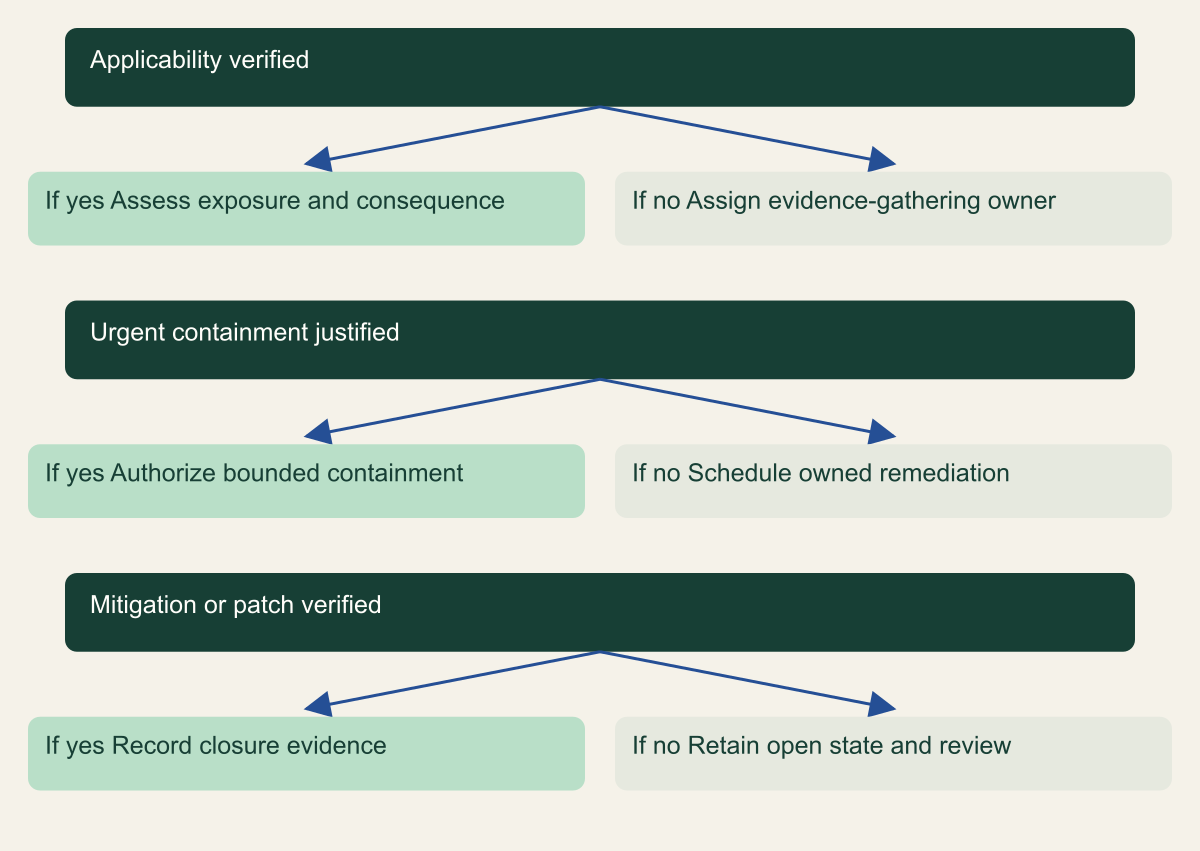
A local decision tree should begin with applicability and preserve unresolved branches. If the affected state is unconfirmed, assign the evidence-gathering action. If it is confirmed, assess the relevant exposure, consequence and available remediation or mitigation. The output should identify what happens next, who owns it and what evidence will show that it worked.
The tree in this article is conceptual. It is not a new CISA policy or an official SSVC decision tree. It combines the cited sources into a review model for cloud operations. Organizations should adapt its questions to their authority, asset classes and supported change process while keeping the reasons for each branch visible.
CISA's current official bulletin reviewed for this guide refers to BOD 26-04 and states that it applies to Federal Civilian Executive Branch agencies. It also encourages other organizations to use risk-based vulnerability management and prioritize KEV remediation. Do not silently reuse older directive language or present federal requirements as universal private-sector legal deadlines. [4]
Local deadlines should have a stated policy basis. A due date can reflect a binding obligation, an approved service policy or an incident decision, but those are different sources of authority. Record the applicable basis instead of attaching a number that appears urgent without explaining why it governs this asset.
Evaluate a mitigation by its actual boundary. A configuration change may block the relevant path without removing the vulnerable code. That can be useful when a patch is unavailable or carries substantial operational risk, but the queue should retain the affected state and the conditions under which the mitigation is expected to work.
A temporary mitigation also needs a change trigger. If a firewall rule, disabled feature or restricted route is the reason the exposure is considered controlled, identify who can alter it and what would invalidate the decision. A compensating control should not become an unexplained permanent reason to suppress the finding.
When immediate containment is justified, record the tradeoff with service continuity and evidence preservation. The decision should identify the authority that approved disruption and the scope of the action. A generic instruction to shut down every matching asset may create harm without establishing that each asset was affected or that the action addressed the relevant path.
Avoid making the queue's sorting algorithm the only place where policy exists. Reviewers need a human-readable explanation of why one action is chosen over another. A transparent decision record is easier to revise when a supplier advisory changes or a service owner corrects an assumption about the asset.
From catalog entry to owned action
The branches separate applicability, urgency and proof of remediation.

Source. Primary documentation [3] [7] [8] [9]. Reviewed August 28, 2026.
Method. Original conceptual synthesis reviewed August 28, 2026. Unit: qualitative states and relationships. Scope: CISA KEV cloud vulnerability prioritization. It is not measured performance, prevalence, risk or implementation proof. The branches separate applicability, urgency and proof of remediation.
Accessible table and figure data
| Question | If yes | If no |
|---|---|---|
| Applicability verified | Assess exposure and consequence | Assign evidence-gathering owner |
| Urgent containment justified | Authorize bounded containment | Schedule owned remediation |
| Mitigation or patch verified | Record closure evidence | Retain open state and review |
| Question | If yes | If no |
|---|---|---|
| Applicability verified | Assess exposure and consequence | Assign evidence-gathering owner |
| Urgent containment justified | Authorize bounded containment | Schedule owned remediation |
| Mitigation or patch verified | Record closure evidence | Retain open state and review |
Give every queue state an owner
NIST's enterprise patch-management guidance treats identifying, prioritizing, acquiring, installing and verifying updates as an ongoing management process. The queue should reflect that lifecycle through owned work rather than ending at a notification or a scanner label. A ticket that nobody can act on is not a completed prioritization decision. [9]
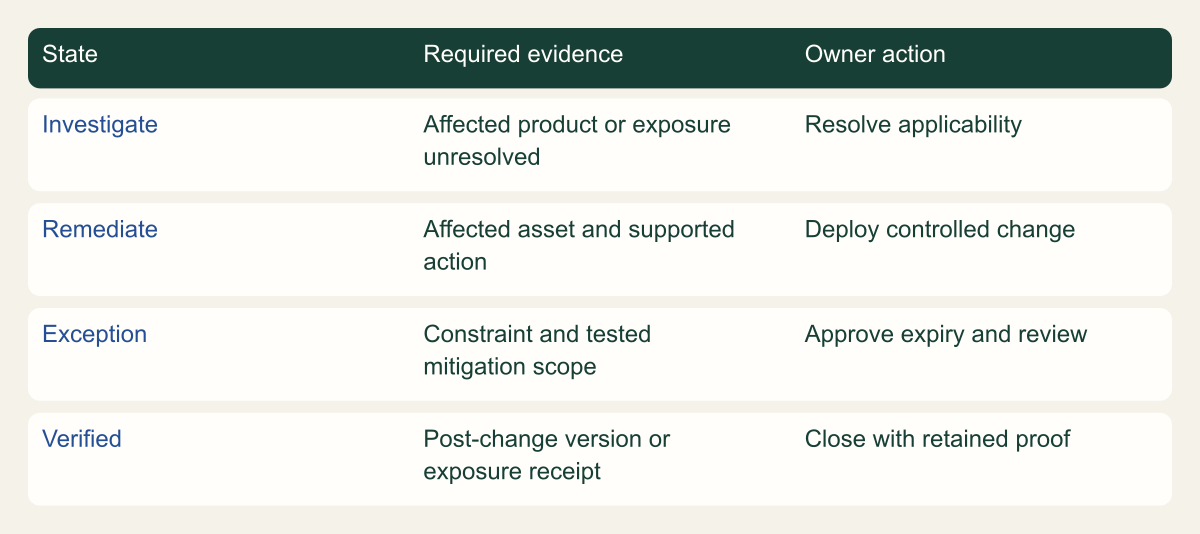
For an investigation state, name the unresolved applicability or exposure question. For remediation, identify the affected asset and supported change. For mitigation, record the control and its tested scope. For an exception, retain the constraint and review authority. For verification, identify the observation that will support closure.
Ownership should follow the ability to perform the next action. A vulnerability team may maintain the feed and decision policy, while a platform owner controls the workload and a supplier controls a managed service. Assigning every item to the scanner administrator can obscure those authority boundaries and leave technically correct findings without an effective path to resolution.
Use a stable asset identity in the record. Cloud resources can be replaced or renamed, and an old ticket can outlive the instance that originally triggered it. A replacement should be checked against the relevant state rather than assumed safe because its identifier is new. Link the remediation evidence to the asset or artifact actually deployed.
Keep source and local timestamps distinct. The catalog addition date, local discovery date, assignment date, deployment date and verification date describe different events. Combining them into a single age field can distort the account of how long the organization has known about a particular exposure or which step is delayed.
A specimen queue record can contain the source version, CVE, asset identifier, matching evidence, exposure statement, action owner, policy basis, exception expiry and verification receipt. Those are proposed local fields, not a CISA schema. Any example values should be visibly fictional unless they come from a documented, publishable record.
A practical local model separates the public vulnerability record from its relationships to deployed assets. One CVE can affect several components and many resource instances, each with a different owner or exposure path. A proposed relationship key can combine the CVE, a stable asset identity and the relevant component identity. The exact database design is local, but the distinction prevents one public catalog entry from being mistaken for one unit of remediation work.
An exception approved for one relationship should not silently close the others. For example, an isolated test workload and a customer-facing service can contain the same vulnerable component while requiring different actions. When an asset is replaced, retain the prior relationship and link the successor to fresh applicability evidence. If identifiers cannot be reconciled confidently, keep that join unresolved. A fuzzy name match is useful investigation input, not sufficient proof that the replacement was checked or that every affected deployment was repaired.
The state transition should require the evidence appropriate to the claim. Deployment requested is not deployment completed. Deployment completed is not exposure removed. An exception approved is not vulnerability remediated. Keeping these transitions separate prevents a reporting system from turning administrative progress into an unsupported technical result.
Make blocked work visible without blaming the current assignee for a constraint they cannot change. A supplier dependency, unavailable maintenance window or missing asset evidence needs an escalation path. The queue should show the blocker and responsible decision maker so the next action remains clear.
Close on verified behavior
Define closure before deployment begins. The team needs to know whether success means a fixed package is running, a vulnerable feature is absent, an exposure path is blocked or a supplier has supplied evidence for a managed component. Those are different claims with different verification requirements.
An installation receipt is useful but incomplete. It can show that a change operation finished while leaving questions about which process or workload is actually running. A deployment may update a template without replacing every instance, or a service may continue using previously loaded code. Verify the state relevant to the vulnerability rather than assuming the control-plane action proves it.
A rescan can provide additional evidence, but its scope and timing matter. Identify what the scanner examined and how it recognized the fixed state. A missing finding can result from a changed inventory or an unavailable target as well as a successful remediation. Preserve the actual observation and investigate material discrepancies.
For a mitigation, test the path the control is intended to block under an authorized procedure. A configuration screenshot can show the intended setting without proving its effect in the relevant network or execution context. State what was checked and keep any untested alternative paths in the record.
For supplier-managed components, retain the supplier's relevant statement and the local applicability mapping. A general assurance about a product family may not identify the service, region, version or configuration that matters to the customer. The queue should show the scope of the evidence rather than converting a broad announcement into a universal closure.
Patch deployment can introduce its own service risk. Use the approved change and rollback process, and verify that the service still meets its required behavior. The database-compatible rollback guide explains one adjacent problem: reverting code does not necessarily reverse a data transition. A security fix needs a usable recovery plan where the architecture requires one.
If compromise may have occurred before remediation, patching does not by itself resolve that incident question. The current CISA bulletin discusses checking for compromise in its federal policy context. More broadly, the organization should route supporting evidence into its incident process instead of treating a new package version as proof that no earlier unauthorized activity matters. [4]
The closure receipt should identify the changed asset, the verification method, the observed result and the unresolved limits. A later reviewer should be able to connect the receipt to the original applicability decision. That connection is what makes the queue an evidence-backed operating record rather than a list whose labels gradually turned green.
Evidence needed to change queue state
State changes depend on a specific evidence receipt, not a scanner label alone.

Source. Primary documentation [9] [8]. Reviewed August 28, 2026.
Method. Original conceptual synthesis reviewed August 28, 2026. Unit: qualitative states and relationships. Scope: CISA KEV cloud vulnerability prioritization. It is not measured performance, prevalence, risk or implementation proof. State changes depend on a specific evidence receipt, not a scanner label alone.
Accessible table and figure data
| State | Required evidence | Owner action |
|---|---|---|
| Investigate | Affected product or exposure unresolved | Resolve applicability |
| Remediate | Affected asset and supported action | Deploy controlled change |
| Exception | Constraint and tested mitigation scope | Approve expiry and review |
| Verified | Post-change version or exposure receipt | Close with retained proof |
| State | Required evidence | Owner action |
|---|---|---|
| Investigate | Affected product or exposure unresolved | Resolve applicability |
| Remediate | Affected asset and supported action | Deploy controlled change |
| Exception | Constraint and tested mitigation scope | Approve expiry and review |
| Verified | Post-change version or exposure receipt | Close with retained proof |
Make exceptions visible without concealing the backlog
An exception is a decision to retain a condition under stated constraints, not a technical remediation. Record the affected scope, the reason the preferred action is delayed or inappropriate, the compensating measures and the authority accepting the decision. The exception should be understandable without reading an informal conversation from months earlier.
A maintenance constraint and an unsupported product are different problems. One may require scheduling and preparation; the other may require replacement, supplier engagement or a change in service scope. A generic exception category can hide those differences and prevent the organization from addressing the underlying cause.
Give the exception an expiry or an event that forces review. The appropriate interval depends on the organization's policy and the condition being accepted, so this guide does not invent a universal number of days. The key is that the accepted state is not allowed to persist indefinitely without someone examining whether its assumptions still hold.
Review compensating controls as living dependencies. A mitigation can become ineffective after a network change, a new feature deployment or a permission adjustment. Identify those dependencies in the exception record and connect their owners to the review trigger. Otherwise, an exception can remain administratively valid after its technical basis disappears.
Report exception volume and unresolved applicability honestly. Do not count suppressed or accepted findings as fixed merely because they no longer appear in the ordinary remediation view. Separate verified closure from accepted exposure, investigation and blocked work. Those categories support different management decisions.
Keep the reporting unit consistent. A CVE affecting several assets, several findings about one asset and a single supplier-managed exposure are not interchangeable counts. Choose the unit appropriate to the question and explain it. A reduction in ticket count can reflect consolidation rather than a reduction in affected resources.
An exception review should be willing to change the action. New exploitation evidence, changed exposure or a supplier fix can make the original acceptance inappropriate. Conversely, better applicability evidence can establish that an assumed affected state was wrong. Preserve the correction and its reason rather than rewriting the history to imply that the answer was always known.
Operate the feed and review the decisions
Run the feed process with reproducible inputs and visible failures. A successful fetch should identify the catalog version and the records processed. A failed update should not leave a dashboard implying it is current. The team needs to distinguish no new matching entries from an update that never completed.
Reevaluate decisions when the relevant inputs change. New KEV evidence, supplier guidance, asset replacement, exposure changes and failed verification can all alter the next action. The queue should connect those events to the existing record rather than opening disconnected duplicates that conceal the current state.
Choose process measures that answer an operating question. Missing owners, unresolved applicability and exceptions awaiting review can identify work that needs attention. Do not invent a performance improvement or claim a risk reduction solely because the queue has been reorganized. A new workflow is a design change until its results are actually measured.
Review a sample of closed records for the strength of their evidence. Can the reviewer find the affected asset, the source that established applicability, the action taken and the result that supported closure? Missing links are useful findings about the process. They should lead to a targeted correction rather than a cosmetic change to the status vocabulary.
The first adoption step can be narrow: one supported asset class, a current feed snapshot and a small set of explicit states. Verify the handoffs and evidence requirements before extending the process across every cloud service. A limited workflow that produces explainable decisions is a better foundation than a broad queue whose matching and ownership remain opaque.
Keep the public signals in their proper role. KEV provides exploitation evidence, CVSS describes severity, EPSS supplies a probability estimate and stakeholder-specific criteria help choose an action. The organization supplies the asset context, authority and proof of remediation. A defensible cloud patch queue makes those contributions visible from intake through closure.
Method and provenance
Primary documentation review and original operational analysis, checked August 28, 2026. Source versions, claim mappings and visual data are retained in the accompanying research dossier. This article was first published in the practitioner-guides collection on August 28, 2026.
No customer environment, incident evidence, production deployment or service performance was tested for this article. Hypothetical examples and conceptual diagrams are labeled. Chart values retain their stated source scope and must not be interpreted as organizational risk or measured implementation success. Organization-specific authorization, architecture and legal obligations require their own review.
AI assistance. Researched, drafted and checked against cited sources with AI assistance. No independent human editorial review or original empirical testing is claimed.
Published under the Cloud Security Desk organizational byline. Read the practitioner guide policy.
References
- GitHub - cisagov/kev-data: Mirror of cisa.gov/kev data files · GitHub Cybersecurity and Infrastructure Security Agency. Accessed .
- CISA Known Exploited Vulnerabilities catalog 2026.08.27 Cybersecurity and Infrastructure Security Agency. Accessed .
- CISA KEV JSON schema Cybersecurity and Infrastructure Security Agency. Accessed .
- CISA Adds Four Known Exploited Vulnerabilities to Catalog Cybersecurity and Infrastructure Security Agency. Accessed .
- CVSS v4.0 Specification Document FIRST. Accessed .
- CVSS v4.0 Frequently Asked Questions FIRST. Accessed .
- Using EPSS FIRST. Accessed .
- SSVC: Stakeholder-Specific Vulnerability Categorization CERT Coordination Center. Accessed .
- SP 800-40 Rev. 4, Guide to Enterprise Patch Management Planning: Preventive Maintenance for Technology | CSRC National Institute of Standards and Technology. Accessed .