
A Kubernetes platform guide to custom admission webhooks. It distinguishes explicit denial from failurePolicy behavior, compares native policy alternatives, defines matching and TLS requirements and builds an acceptance model for timeout, reinvocation and recovery dependencies.
At a glance
Key findings
- An explicit webhook denial rejects a request under either failurePolicy; Ignore governs call errors rather than overriding a valid denial.
- Matching rules and recovery dependencies determine how broadly a webhook outage can affect the control plane.
- Native CEL policies can remove an external callback where they fit the requirement, but their version and authorization requirements remain.
First decide whether this needs an external call
Give each admission webhook an explicit failure contract before enabling it broadly. State which requests it intercepts, what happens when it denies a request, what happens when the call fails and how the cluster can repair the webhook's dependencies. First ask whether the requirement can be expressed through a supported in-process policy or schema mechanism, because an external callback adds availability and transport dependencies to matching API writes. [1][2]
Kubernetes admission runs after authentication and authorization. Mutating admission precedes validating admission, and a rejection in either phase rejects the request. Ordinary get, list and watch reads do not pass through admission in the same way. A webhook is therefore not a universal replacement for RBAC or every read-access control. Name the operations it can govern rather than describing it as a gate for all cluster access. [5]
For custom resources, schema validation and defaulting may express the requirement without a separate service. Kubernetes documents validation rules, including CEL expressions, as part of CustomResourceDefinition capabilities. Use those facilities where their supported semantics fit the resource. A requirement for an external lookup or more complex behavior may justify a webhook, but the decision should begin with the actual rule rather than an assumption that policy always needs another controller. [6]
ValidatingAdmissionPolicy provides an in-process CEL alternative for supported validation and is stable from Kubernetes 1.30. MutatingAdmissionPolicy provides an in-process mutation alternative and is stable from Kubernetes 1.36. Pin those version claims when comparing designs, and verify the managed cluster's supported version and feature configuration. Current upstream documentation does not mean every deployed cluster exposes the same capability. [3][4]
Removing an external callback removes that particular network dependency, not the need for correct policy or controlled changes. A native policy can still deny an important operation if configured incorrectly. Its parameters, bindings and administrative permissions need review. The architectural advantage should be described precisely: fewer external-call dependencies for an expressible rule, rather than a blanket claim that in-process policy is automatically safe.
Keep this decision separate from Pod Security Admission. A cluster can use built-in Pod Security controls and still need a custom admission rule for another invariant. Conversely, deploying a webhook does not establish that Pod Security settings or runtime controls are appropriate. Identify the invariant each mechanism owns so a platform reviewer can see gaps and overlaps without treating every admission component as interchangeable.
Separate an explicit deny from a call failure
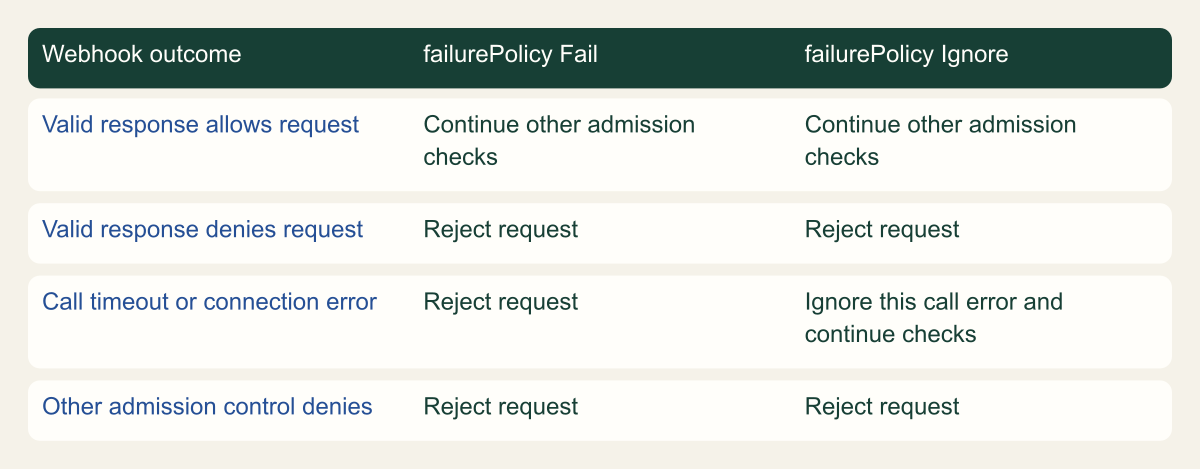
The failurePolicy field accepts Fail or Ignore and defaults to Fail. The API reference describes it as behavior for errors calling the webhook. It is not a switch that determines whether an explicit valid deny response should be respected. If a webhook successfully returns a rejection, choosing Ignore does not turn that rejection into an allow. That distinction is essential to both the security model and the outage runbook. [2][8]
Under Fail, a call error can reject a matching request because the required callback did not complete successfully. Under Ignore, that error is ignored and the request continues through the remaining admission process. Continuing is not the same as unconditional acceptance: another admission control can still reject the request. The outcome matrix separates the callback's result from the final decision of the whole admission chain. [5][8]
Select the policy against the invariant the webhook owns. A validator enforcing a mandatory security condition has different failure consequences from a mutator adding a convenience field that a later independent control verifies. Kubernetes best-practice guidance discusses designing webhook failure behavior together with validation. If a mutator can fail open safely only because another validator enforces the invariant, that validator must actually cover the missing or incorrect mutation. [1]
Do not describe fail-open behavior as purely an availability improvement. It changes what evidence is required before a matching request can proceed when the callback fails. Likewise, fail-closed behavior can protect an invariant while blocking operational changes needed during an outage. The owner should approve both consequences explicitly. The choice is not a universal security score; it is a control responsibility and service-dependency decision.
Match-condition errors can also interact with failurePolicy, as the API reference explains. Keep the distinction between a condition evaluating false, a condition failing to evaluate and a callback deliberately rejecting the request. A false match may mean the webhook should not run at all; an evaluation error has a different configured consequence. An operator needs enough evidence to tell those paths apart before changing policy. [8]
The user-facing error may be concise, but operational classification should preserve the actual cause. An intentional policy denial, a TLS failure, an unreachable endpoint and a timeout require different owners and repairs. Collapsing them into webhook rejected can encourage operators to weaken the rule when the policy itself was functioning correctly and the real problem was a broken transport dependency.
A denial and a failed callback are different outcomes
An explicit webhook denial rejects a request under either failure policy; Ignore changes how call errors are handled. Conceptual matrix, not a measured result.

Source. Kubernetes, ValidatingWebhookConfiguration API, clientConfig, caBundle, matchPolicy, failurePolicy and timeoutSeconds [8]; Kubernetes, Kubernetes dynamic admission control, Protocol fields, TLS trust, failure policy, timeout and side-effect semantics. [2]; Kubernetes, Kubernetes admission controllers, Admission relative to authentication and authorization [5].
Method. Original conceptual matrix synthesizing the cited documentation. It represents design relationships, not observed test results. Reviewed 2026-09-02.
Accessible table and figure data
| Webhook outcome | failurePolicy Fail | failurePolicy Ignore |
|---|---|---|
| Valid response allows request | Continue other admission checks | Continue other admission checks |
| Valid response denies request | Reject request | Reject request |
| Call timeout or connection error | Reject request | Ignore this call error and continue checks |
| Other admission control denies | Reject request | Reject request |
| Webhook outcome | failurePolicy Fail | failurePolicy Ignore |
|---|---|---|
| Valid response allows request | Continue other admission checks | Continue other admission checks |
| Valid response denies request | Reject request | Reject request |
| Call timeout or connection error | Reject request | Ignore this call error and continue checks |
| Other admission control denies | Reject request | Reject request |
Keep the webhook out of its own recovery path
Matching scope determines the outage's reach. Review operations, API groups, versions, resources and namespace or object selection against the intended rule. A broad wildcard may be simpler to write but can pull unrelated changes into the callback's dependency chain. The selection should identify the objects the webhook can meaningfully validate, not every resource that happens to pass through the API server. [1][2]
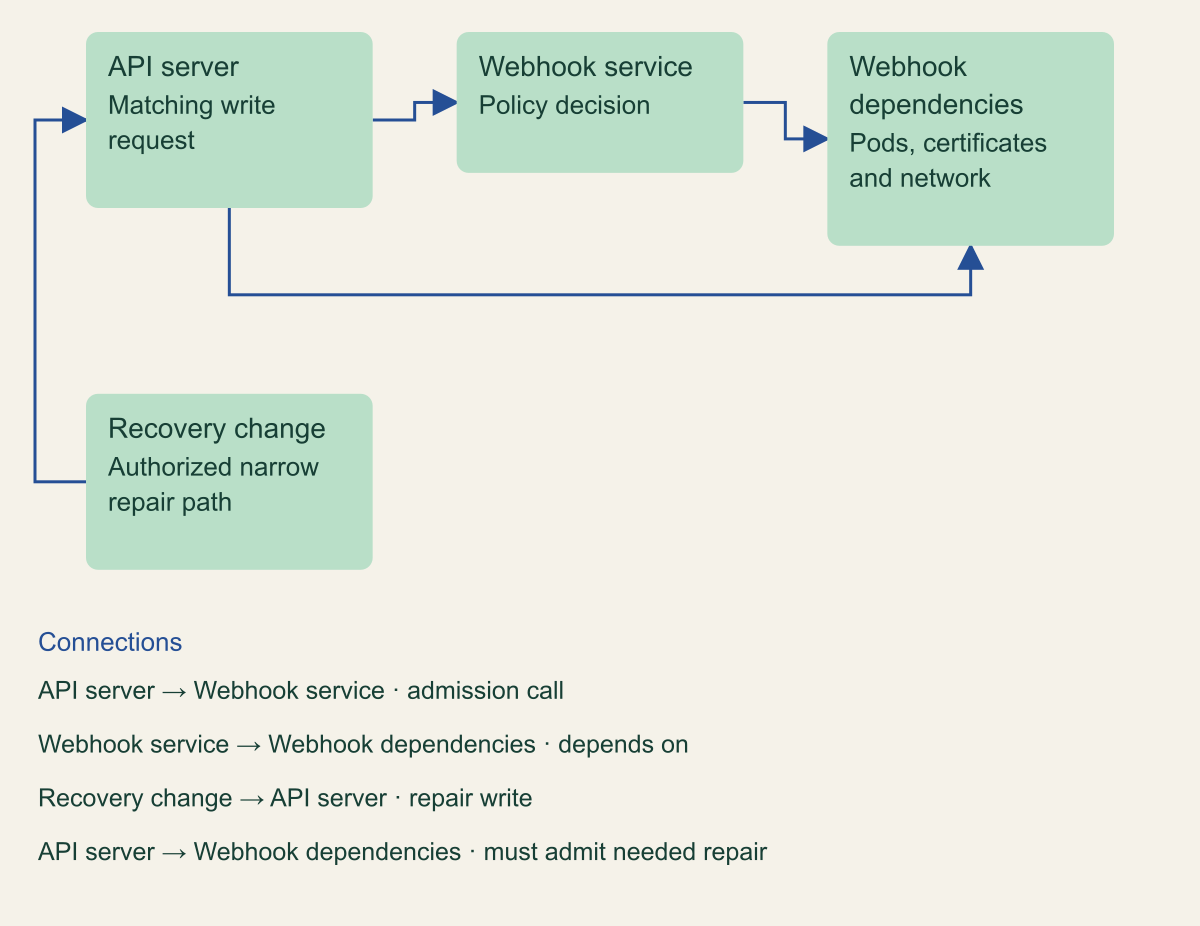
Avoid circular dependencies involving the webhook's own operation. A service can depend on Pods, certificates, Secrets or networking that need API writes to recover. If a failed webhook blocks those repair writes, an availability problem can prevent the normal recovery mechanism from fixing it. Kubernetes best practices explicitly warn about self-mutation and dependency loops. Map the actual dependency path instead of assuming that running the webhook in a separate namespace solves the problem automatically. [1]
The diagram shows a conceptual repair write crossing the API server while the webhook depends on the resources being repaired. It does not claim that every admission configuration object is itself intercepted by webhooks. The relevant recovery review concerns the concrete dependent resources and operations in the chosen deployment. State exactly which repair path must remain possible and what authorization controls that path.
A recovery exclusion is a form of bypass authority and should be treated accordingly. Narrow it to the resources and operations necessary for the supported repair, identify who can use or change it and test that ordinary workloads cannot obtain the same exemption unintentionally. A permanent exclude-everything-in-this-area rule can become much broader than the original availability requirement.
Selection based on labels needs an ownership review. If a user can change the label that determines whether a mandatory rule applies, the selector may provide an opt-out path. Kubernetes cautions about object selectors in security-sensitive matching scenarios. The policy should not depend on a user-controlled label as if it were an independent authorization boundary. Choose selectors whose mutability and intended use fit the rule. [2]
Tenant isolation adds another scope question. A shared webhook can become a dependency for writes across multiple tenants, while a tenant-specific instance needs trustworthy routing and configuration. Record the administrative ownership and affected tenant scope. Compute isolation, network policy and admission matching can reinforce one another, but none makes the others' configuration irrelevant.
The webhook must not obstruct its own repair dependencies
A webhook depends on resources that may themselves require admission, so its recovery path must avoid a circular dependency. Conceptual architecture, not a measured result.

Source. Kubernetes, Kubernetes admission webhook practices, Narrow matching, CEL alternatives, dependency loops and final-state validation. [1]; Kubernetes, Kubernetes dynamic admission control, Protocol fields, TLS trust, failure policy, timeout and side-effect semantics. [2]; Kubernetes, Kubernetes admission controllers, Admission relative to authentication and authorization [5].
Method. Original conceptual architecture synthesizing the cited documentation. It represents design relationships, not observed test results. Reviewed 2026-09-02.
Accessible table and figure data
| Component | Role |
|---|---|
| API server | Matching write request |
| Webhook service | Policy decision |
| Webhook dependencies | Pods, certificates and network |
| Recovery change | Authorized narrow repair path |
| Component | Role |
|---|---|
| API server | Matching write request |
| Webhook service | Policy decision |
| Webhook dependencies | Pods, certificates and network |
| Recovery change | Authorized narrow repair path |
Specify the transport and timeout contract
The API server must be able to reach and authenticate the webhook endpoint. With clientConfig.service, Kubernetes requires the webhook server certificate to be valid for the service and namespace DNS name. The caBundle field supplies a trust bundle for validating that server certificate. A successful request from a developer's laptop does not prove that the API server has the same route, hostname view or trust material. [2]
Keep certificate issuance, serving and trust distribution as distinct states. A renewed certificate stored somewhere is not proof that the webhook serves it, and a healthy service endpoint does not prove the API server trusts its issuing CA. Plan overlap and rollout using the actual certificate and trust mechanism. The recovery test should exercise the admission call path rather than relying only on the certificate controller's status.
timeoutSeconds accepts values from one through thirty seconds and defaults to ten. Those are documented configuration bounds, not recommended latency objectives or measured webhook performance. Set a deliberate timeout based on the rule's dependency behavior and the acceptable effect on matching API writes. A longer value can increase how long a failed dependency holds up a request without making the dependency more reliable. [8]
Budget the callback's own work inside that bound. An external policy lookup, cache miss or downstream service call can add another dependency to admission. The webhook should have explicit behavior when that information is unavailable. Do not allow a chain of unbounded retries inside the callback to consume the API server's entire timeout and then report an unexplained failure.
Use the actual request path for network tests. Confirm service selection, endpoint readiness, relevant network restrictions and certificate verification from the control-plane perspective supported by the environment. Managed Kubernetes platforms can expose different diagnostic options, so the test procedure must fit the platform. This article does not claim that a generic connectivity command or local TLS probe verifies every managed control plane.
Certificate rotation belongs in the failure contract because a trust mismatch can look like a policy outage to every matching write. Define the owner of the serving certificate, the caBundle update and the acceptance test. Preserve a narrow authorized repair path before changing trust, especially if the resources used by the rotation mechanism are themselves subject to the webhook's matching rules.
Design mutations to tolerate the admission sequence
Mutating admission can change an object before validating admission evaluates it. A mutator should not assume that its output is the only change applied to the object or that every other webhook runs in a convenient order. Kubernetes guidance recommends idempotent mutations and addresses reinvocation when later changes require another look. Design the mutation around the final invariant rather than around one observed ordering in a test cluster. [1][2][5]
Idempotence means another permitted invocation should not keep adding equivalent elements or repeatedly changing a value in a way that prevents convergence. A conceptual sidecar injector, for example, should recognize whether the intended component is already present rather than append another copy blindly. This example illustrates the property to test; it is not a complete injector implementation or proof that a particular patch is correct.
Reinvocation policy and the documented admission sequence matter when mutations interact. Test the webhook with other mutations present, including changes that affect the fields it inspects. Do not infer a general guarantee from a case in which the webhook was the only mutator installed. The acceptance record should identify the relevant other admission components and the conditions under which another invocation may occur. [2]
Final validation should check the required invariant independently where the architecture relies on it. If the design permits a mutator call to fail open, a validator may need to reject an object missing the required result. Merely deploying both a mutator and validator does not establish that relationship. Review the validator's actual condition and the object state it receives after mutation, including unexpected or partially modified forms. [1][5]
Dry-run behavior has its own contract. The webhook's sideEffects declaration and implementation must correctly reflect whether a dry-run request can be handled without prohibited external effects. A dry-run should not create unrelated resources or send an irreversible request merely because the webhook ordinarily does so during admission. Use the documented None or NoneOnDryRun semantics appropriate to the implementation and verify the behavior rather than treating the declaration as proof. [2]
Keep webhook implementation changes inside an explicit build and release review. A policy service with narrow Kubernetes permissions can still execute code that reaches external systems or handles sensitive admission data. Image identity, build inputs and credential handling remain relevant. Admission is a powerful integration point, so its implementation should not acquire an unreviewed distribution or secret-exposure path while the platform focuses only on the configuration object.
Test failure modes before enforcing broadly
Build an acceptance table with separate cases for an allowed object, an explicitly denied object, callback timeout, TLS trust failure, unavailable endpoint, repeated mutation and an authorized repair. State which behavior comes from the webhook, which comes from failurePolicy and which comes from another admission control. These are proposed cases for an authorized cluster; no runtime webhook or failure injection was executed while preparing this guide.
Kubernetes exposes admission metrics that can support this distinction. The current metrics reference lists a stable webhook admission-duration histogram and an alpha webhook rejection counter with labels describing error type and rejection details. Check the metric's stability and available labels before making a dashboard a permanent acceptance dependency. A useful metric can change at a different compatibility level from the admissionregistration API itself. [7]
Pair metrics with the request and configuration context needed to interpret them. A rejection increase after rollout may represent the intended rule, an endpoint failure or an unexpected match scope. The response should depend on which occurred. Avoid a generic rollback threshold that treats all denied requests as equivalent without considering whether the control is successfully blocking the prohibited behavior it was deployed to prevent.
Run a bounded rollout against representative resources and owners before expanding scope. Include the recovery dependencies in the test rather than reserving them for the first real outage. The explicit contract should say whether a callback failure permits further evaluation or rejects the write, and how an authorized operator can restore the dependency without opening a broad bypass to ordinary users.
Maintain the contract when cluster versions, native policy support, certificates or mutation dependencies change. An old successful test does not prove a new webhook image is idempotent or a replacement CA is trusted by the control plane. The durable result is a control whose denial, failure and recovery paths can each be explained. That is more useful than describing the webhook as simply fail-open or fail-closed while leaving its actual dependencies implicit.
Method and provenance
Primary documentation and standards were reviewed on September 2, 2026. The guide combines source-supported behavior with explicitly framed implementation recommendations and hypothetical examples.
No customer deployment, production environment or live cloud configuration was tested. Product behavior is limited to the cited documentation and stated scope; actual versions, policies and application behavior require verification.
AI assistance. AI-assisted research synthesis, drafting and consistency checks. No human review or firsthand deployment experience is claimed.
Published under the Cloud Security Desk organizational byline. Read the practitioner guide policy.
References
- Kubernetes admission webhook practices Kubernetes. Accessed .
- Kubernetes dynamic admission control Kubernetes. Accessed .
- Kubernetes validating admission policies Kubernetes. Accessed .
- Kubernetes mutating admission policies Kubernetes. Accessed .
- Kubernetes admission controllers Kubernetes. Accessed .
- CustomResourceDefinition validation and defaulting Kubernetes. Accessed .
- Kubernetes metrics reference Kubernetes. Accessed .
- ValidatingWebhookConfiguration API Kubernetes. Accessed .