
An exposure review for Docker BuildKit credentials that separates secret mounts, SSH and context authentication from command authority, cache behavior, image contents, logs and provenance. The guide includes a bounded rotation and rebuild acceptance model.
At a glance
Key findings
- A secret mount makes a credential temporarily available to a build instruction; it does not establish that the instruction handles it safely.
- Changing a secret value does not invalidate the BuildKit cache, while changing a secret identifier or mount path can.
- Image contents, logs, cache exports and provenance are different exposure surfaces and need separate review.
A temporary mount is not a trustworthy command
Use BuildKit secret mounts to deliver build credentials, then review the command that receives them and every output the build retains. The mount solves a specific problem: making a secret available for a build instruction without using ordinary persistent Dockerfile arguments or environment configuration. It does not establish that the instruction, dependency installer or script consuming the secret will keep it confidential. Those are different boundaries. [1][3]
Docker describes a secret mount as temporary access for the duration of a build instruction. A command with access to the mounted value can use it to authenticate to a package service. It can also, through error or malicious behavior, place the value into a generated file or log message. That second statement is a threat-model inference about command authority, not a claim that BuildKit automatically copies secret mounts into images. [1]
The distinction changes the review question. Asking whether the Dockerfile contains a secret mount is useful, but asking which code executes while that mount is available is more revealing. A package download may trigger installation scripts. A wrapper may enable verbose output. A diagnostic branch may print configuration after an authentication failure. The build instruction is the exposure window for all code it invokes, not only the short command visible on the first line.
Keep the credential's purpose narrow. A build that fetches one private artifact should not inherit an account-wide publishing token because that token is already available in the CI environment. Scope and lifetime limit the consequences of exposure, although they do not remove the need to protect the value. Decide whether the credential can read, publish, delete or administer, and give the build only the authority its documented task requires.
Consider a hypothetical image build that downloads a private package and then installs it. A secret mount can keep the repository credential out of the Dockerfile's persistent configuration. If the installation phase executes untrusted package code with the same mount available, however, the credential boundary includes that code. A useful design review asks whether fetching and later processing can be separated safely. This is an architectural question, not a claim that one generic Dockerfile arrangement works for every package ecosystem.
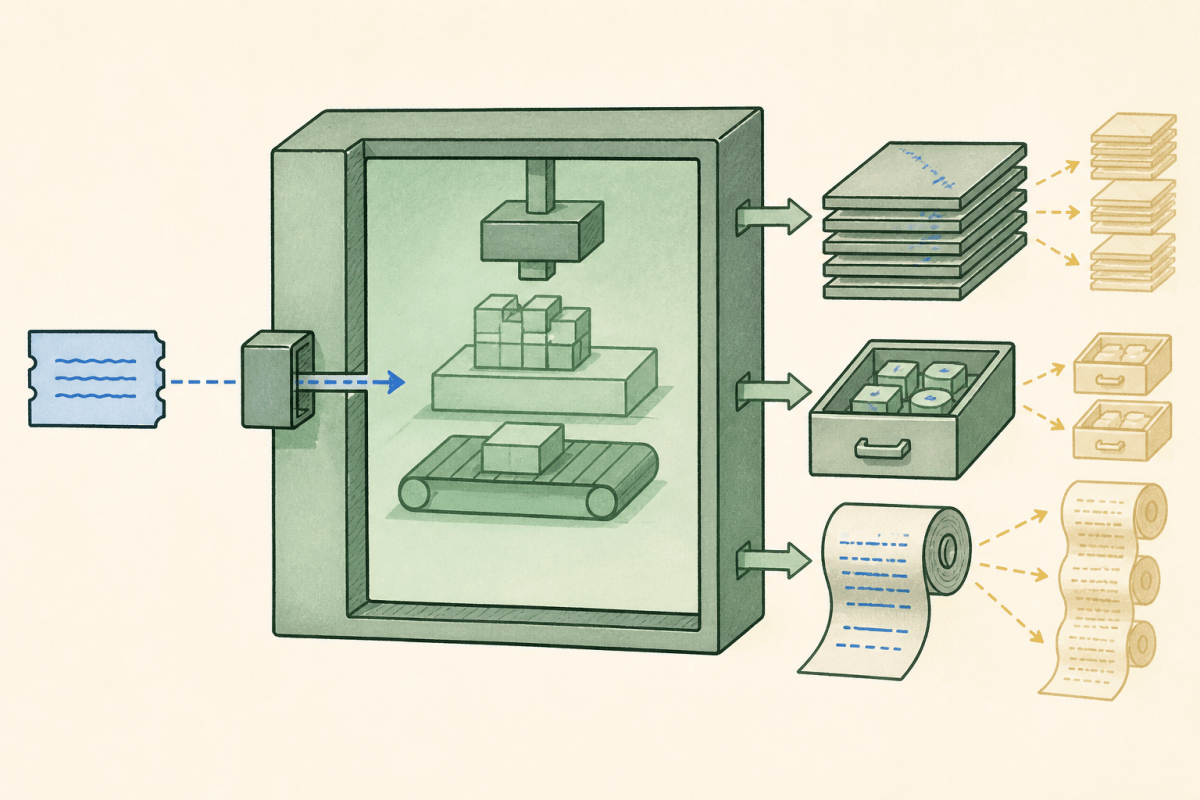
The illustration makes these distinctions visible. The temporary input, executing command and retained outputs have different lifetimes. A clean final image would not by itself establish clean build logs, and a clean log would not establish that a cache export is appropriate to share. Evidence about one surface should keep its scope when the build is approved.
Mount lifetime and output retention are separate boundaries
A temporary credential reaches one build step, but artifacts, logs and cached outputs have separate retention and inspection requirements. Conceptual illustration, not a measured result.

Source. Docker, Docker build secrets, BuildKit secret and SSH mounts instead of persistent arguments or environment values. [1]; Docker, Docker build cache invalidation, Secret value changes and cache checksums [4]; Docker, Docker provenance attestations, Provenance modes and sensitive build arguments [7].
Method. Original conceptual illustration synthesizing the cited documentation. It represents design relationships, not observed test results. Reviewed 2026-09-02.
Accessible table and figure data
| Boundary | Meaning | Review question |
|---|---|---|
| Temporary mount | Credential exists during the selected instruction | Which command and dependencies can read it? |
| Retained image layers | Files produced by the build remain in the artifact | Did the command copy credentials into generated content? |
| Log spool | Build logs can outlive the instruction | Which messages contain sensitive values? |
| Cache drawer | Earlier output can be reused | Does rotation require this step to execute again? |
| Boundary | Meaning | Review question |
|---|---|---|
| Temporary mount | Credential exists during the selected instruction | Which command and dependencies can read it? |
| Retained image layers | Files produced by the build remain in the artifact | Did the command copy credentials into generated content? |
| Log spool | Build logs can outlive the instruction | Which messages contain sensitive values? |
| Cache drawer | Earlier output can be reused | Does rotation require this step to execute again? |
Choose the right secret delivery path
BuildKit provides more than one credential path. General-purpose secret mounts expose a supplied value to an instruction. SSH mounts expose an SSH socket or key for operations such as fetching a private repository. Remote Git-context authentication supplies credentials before the instruction executes, so the builder can obtain the context itself. Docker calls these pre-flight secrets. Selecting the correct mechanism starts with identifying which actor needs the credential and at which stage. [1]
A secret used to fetch a remote context is not necessarily the secret used by a later RUN instruction. Treating those stages as interchangeable can produce an awkward workaround in which credentials are embedded into a repository URL or copied into the build context. Keep context retrieval and instruction-level authentication separate in the inventory. That makes it possible to restrict the issuer and destination of each credential without granting the entire build a shared administrative identity.
Docker advises against using ARG or ENV for secrets. Build arguments can appear in metadata or history, and environment variables become part of image configuration and persist into containers. Their convenient visibility is appropriate for ordinary build configuration, not evidence of a secure credential channel. A variable name that sounds temporary does not change those storage properties. [2][3]
The secret-mount reference includes a required option that can fail an instruction when the expected secret is unavailable. That is useful when silently falling back to anonymous access would change the artifact being fetched or the behavior being reviewed. Set the intended failure mode explicitly. The absence of a credential should not accidentally select a public package source merely because a tool has a convenient fallback. [6]
The surrounding workflow has its own delivery rules. GitHub Actions does not automatically pass secrets to reusable workflows, and an unset secret expression returns an empty string. A build can therefore receive a missing value even when the calling repository has a secret configured. Check the reusable-workflow boundary and the BuildKit invocation separately. Do not print the value to distinguish absent from present; a controlled presence check or non-secret configuration observation is enough. [8]
Document versions at the point where executable configuration is adopted. Docker, Buildx, BuildKit and the Dockerfile syntax frontend do not name the same component. This guide intentionally avoids presenting an unexecuted universal build command as a validated solution. Use the reference for the installed frontend and verify the relevant mount option in an authorized test environment before depending on it in production.
Limit what the builder can see and execute
The build context determines which files and sources are available to the build. Docker's context guidance describes local directories, remote sources and dockerignore filtering. An unexpectedly broad context can expose files to instructions even when they were never intended to become part of the final image. Review the context boundary before reviewing individual COPY statements, because the available input set influences what arbitrary build code can inspect. [5]
A narrower context is easier to reason about than a large repository with a long list of exceptions. Where a broader context is necessary, inspect the applicable ignore file and its actual location. Treat exclusions as a maintained part of the build contract. A new credentials file, generated diagnostic bundle or local configuration format can invalidate an exclusion strategy that was adequate for the previous repository layout.
Do not confuse context exclusion with secret delivery. A file removed from the context can still be supplied intentionally as a secret mount. That is a useful separation: the build receives a credential through a controlled mechanism instead of gaining access to a directory containing unrelated credentials. The reviewer should identify the exact file or environment source passed to BuildKit and confirm that it is not also included through the ordinary context. [1][5]
The code executing inside the instruction is the next boundary. A trusted build definition can invoke dependencies or scripts whose behavior is less controlled. Pinning an input identifies the expected version, but it does not prove that the version treats credentials safely. Keep dependency intake, allowed network destinations and credential scope in the same review, especially when the instruction processes content obtained from an external source.
Separate output identity from output confidentiality. An image digest and a provenance statement can help establish which artifact was produced and what build claims accompany it. They do not prove the artifact is free of credentials. Conversely, removing a detected credential from a later image does not necessarily remove earlier layers, caches or logs that already retained it. The exposure response must identify the places the value actually reached before declaring cleanup complete.
Make rotation and cache behavior agree
Changing a BuildKit secret's value does not invalidate the build cache. Docker documents that the contents of build secrets are not part of the cache key used for this purpose. An instruction that previously ran with one credential can therefore remain cached after the secret is replaced. The absence of a new authentication failure is not evidence that the replacement credential was used. [4]
This behavior is often desirable. Credentials should not become public build arguments merely so their values influence cache selection. It also means the team must decide when a credential change should cause a build instruction to run again. Rotating a password while downloading identical immutable content may not require a different artifact, but validating the new credential still requires a controlled fresh authentication somewhere in the acceptance process.
Docker's cache guidance describes using a changed build argument to invalidate the relevant cache when a secret changes. Use a non-secret marker for that purpose. Do not pass the credential itself, or a sensitive derivative of it, into a visible argument. The marker can identify a reviewed rebuild generation without exposing the secret's contents. Keep its meaning separate from the version of the artifact expected from the repository. [4]
Secret identifiers and mount paths do participate in cache checksums. Changing either can invalidate a step even if the credential value did not change. This creates another reason to distinguish credential identity, mounting configuration and artifact identity in the build record. Renaming a secret is not simply an administrative cleanup when the name participates in the build's cache behavior. [4]
For a hypothetical private-package build, define two acceptance questions. First, can the intended build step authenticate using the replacement credential when it actually executes? Second, does the resulting artifact match the intended dependency and configuration? A cache hit cannot answer the first question. A successful authentication cannot answer the second. If the repository's accessible content changes with credential scope, both questions become especially important.
Cache exports deserve an access decision of their own. A build output that is acceptable in a restricted CI project is not automatically acceptable in a broadly shared cache. Evaluate what the producing instructions can write and what downstream consumers can retrieve. This is a recommendation about artifact custody, not a claim that secret mounts are automatically exported. If exposure is suspected, credential replacement and cache retention should be investigated together.
Inspect the image and its surrounding evidence
Docker's provenance documentation gives a concrete metadata hazard: mode=max exposes build-argument values. If a workflow has used build arguments for credentials, enabling more detailed provenance can reveal information that was already handled through an inappropriate channel. The same documentation states that secret mounts are not included as secret values in provenance. That is a property of the automatic metadata path, not permission for the build command to print secrets into unrelated output. [7]
Do not respond by removing useful provenance indiscriminately. Correct the credential channel and review the metadata that will be published. Provenance can remain valuable for identifying source, materials and build configuration. Confidentiality review asks which fields are suitable for the intended audience. Artifact-verification review asks whether the statement, signer and subject satisfy policy. Keeping these questions separate avoids trading one useful assurance away without fixing the underlying exposure.
Docker's SecretsUsedInArgOrEnv check detects names suggesting that an ARG or ENV contains sensitive data. It is a useful warning, not a proof that arbitrary build code cannot leak a value. A harmless-looking argument name can still carry confidential information, and a properly named secret mount can still feed an unsafe command. Describe the check result narrowly and combine it with review of actual credential paths and generated outputs. [2]
Logs need attention during failures as well as success. Tools can print more configuration after an authentication error, and debugging options may change output substantially. GitHub's guidance warns against passing secrets through command-line arguments where process listings or audit mechanisms can expose them. Its masking guidance also requires sensitive values outside the configured secret mechanism to be handled explicitly. Do not rely on a green build or a masked happy-path log as comprehensive leakage evidence. [8]
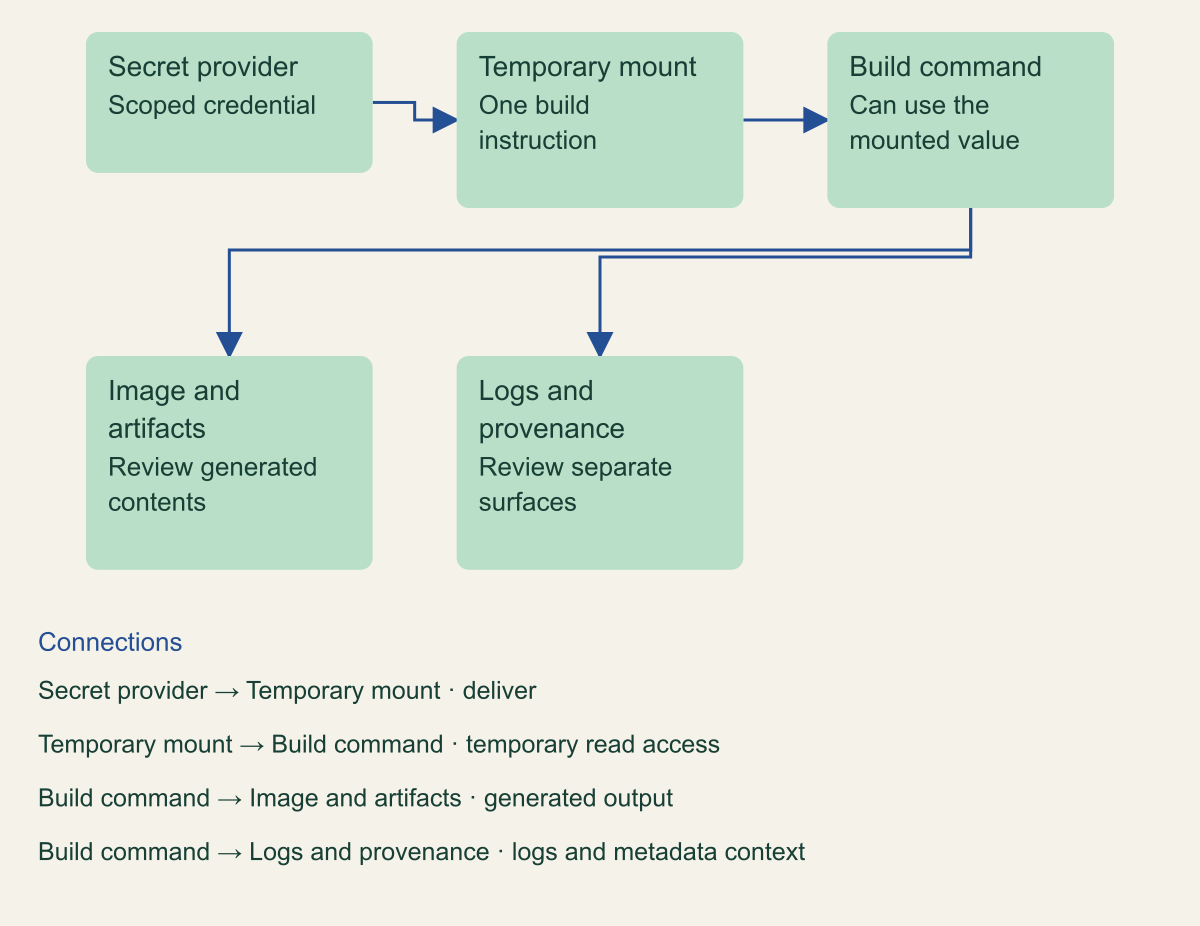
The exposure map groups the surfaces by how they are produced, not by whether they look like code. Image files, history and configuration, build logs, attestations and separately retained artifacts can have different readers and retention periods. List the actual destinations in the workflow. A CI job that pushes an image privately but attaches a diagnostic artifact to a public release has crossed a different distribution boundary.
If a credential is discovered in an output, treat removal of the visible copy as one response step. Determine the credential's authority and whether revocation or rotation is needed, then identify copies in earlier artifacts and retained evidence. The exact containment sequence depends on the affected service and authorized incident process. This guide does not prescribe a destructive cache purge or imply that deleting a file makes a previously exposed credential trustworthy again.
Temporary input can reach several retained outputs
Temporary secret delivery, command-controlled artifacts and retained evidence are separate exposure surfaces. Conceptual architecture, not a measured result.

Source. Docker, Docker build secrets, BuildKit secret and SSH mounts instead of persistent arguments or environment values. [1]; Docker, Docker build variables, Build arguments and environment-variable persistence [3]; Docker, Docker provenance attestations, Provenance modes and sensitive build arguments [7]; Docker, Docker build cache invalidation, Secret value changes and cache checksums [4].
Method. Original conceptual architecture synthesizing the cited documentation. It represents design relationships, not observed test results. Reviewed 2026-09-02.
Accessible table and figure data
| Component | Role |
|---|---|
| Secret provider | Scoped credential |
| Temporary mount | One build instruction |
| Build command | Can use the mounted value |
| Image and artifacts | Review generated contents |
| Logs and provenance | Review separate surfaces |
| Component | Role |
|---|---|
| Secret provider | Scoped credential |
| Temporary mount | One build instruction |
| Build command | Can use the mounted value |
| Image and artifacts | Review generated contents |
| Logs and provenance | Review separate surfaces |
Keep an exposure review beside the build
A concise build-credential record can connect the issuer, allowed service, permission scope, lifetime and consuming instruction. Add the credential's delivery mechanism and the code that runs while it is available. Then list retained outputs and their audiences. The record should make an unexpected expansion obvious, such as a read-only repository credential being replaced with a publishing token or a private build log becoming a public artifact.
Test missing and invalid credentials intentionally in a permitted environment. Confirm that the build fails at the intended boundary without revealing the value or selecting an unintended anonymous source. Exercise the supported rotation path with cache behavior made explicit. These are proposed acceptance tests; no Docker build or live credential was executed to prepare this article. A syntax-valid Dockerfile would not by itself establish these runtime properties.
The Terraform and deployment workflows around the build also deserve scrutiny. Credentials may remain protected inside BuildKit while a surrounding job stores them in a plan, environment dump or artifact bundle. Trace the value through the complete workflow rather than declaring success at the boundary of one tool. Each system has its own persistence and approval rules, and the same secret can cross more than one of them.
Revisit the record when the package manager, base image, build frontend, provenance mode or workflow reuse changes. Those changes can alter what executes, what is retained or whether the credential is supplied at all. The durable result is a build contract whose credential input, authority and retained evidence can be explained independently. A temporary mount is an important part of that contract, but it is not its completion certificate.
Method and provenance
Primary documentation and standards were reviewed on September 2, 2026. The guide combines source-supported behavior with explicitly framed implementation recommendations and hypothetical examples.
No customer deployment, production environment or live cloud configuration was tested. Product behavior is limited to the cited documentation and stated scope; actual versions, policies and application behavior require verification.
AI assistance. AI-assisted research synthesis, drafting and consistency checks. No human review or firsthand deployment experience is claimed.
Published under the Cloud Security Desk organizational byline. Read the practitioner guide policy.
References
- Docker build secrets Docker. Accessed .
- Docker build secret argument check Docker. Accessed .
- Docker build variables Docker. Accessed .
- Docker build cache invalidation Docker. Accessed .
- Docker build context Docker. Accessed .
- Dockerfile reference Docker. Accessed .
- Docker provenance attestations Docker. Accessed .
- GitHub Actions secrets GitHub. Accessed .