A practical model artifact intake process using Python and Hugging Face documentation. It separates safe weight serialization from custom-code execution and explains reviewed revisions, scanner limitations, reproducible loading, and controlled promotion.
At a glance
Key findings
- Approve the complete model-loading path, not only the tensor file or repository name.
- A reviewed revision, a safer serialization format, and approval for custom code are separate controls with separate limits.
- Keep enough artifact and runtime identity to explain exactly what changed when a model is refreshed.
Inventory the loading path before approving the model
A request to deploy a model often arrives as a repository name and an expected hardware requirement. That is not a sufficient change record. The runtime may also need configuration, tokenizer assets, custom modeling files, packages, and an inference image. An approval process should establish which of these artifacts will enter the environment and which components will interpret them.
Start with a small intake manifest. Record the source repository, reviewed revision, expected files, artifact digests, loader version, dependency lock, and deployment image. Add the intended use and the privileges of the runtime. These are proposed review fields, not a claim that a particular model requires every type of artifact. Their purpose is to make the execution boundary visible before loading begins.
The scope here is software and artifact trust, not model quality. A model can perform well on an evaluation and still arrive through an unsafe loading path. Equally, a carefully controlled loading process does not establish that the model's outputs are accurate, appropriate, or resistant to misuse. Those questions need separate evaluation and should not be hidden behind one approval label.
Separate tensor storage from executable deserialization
File extensions can obscure an important distinction: some loading operations reconstruct data, while others can invoke behavior during reconstruction. Python's documentation warns that malicious pickle data can execute arbitrary code when unpickled. That is a documented property of the format, not evidence that an arbitrary named model is malicious. [1]
Hugging Face's Transformers security policy recommends safetensors and documents an option that refuses loading when the expected safe-format weights are absent. That is useful as a specific loading constraint. It should not be described as a certificate for the complete repository or as a reason to ignore custom code and dependencies. [2]
In the proposed intake process, the reviewer records the expected weight format and how the selected loader behaves if those files are missing. A quiet fallback to another format would change the approved loading path. Make the desired failure behavior explicit and test it with harmless fixtures in an isolated environment. The release record should say what was allowed, what was rejected, and which loader configuration enforced that choice.
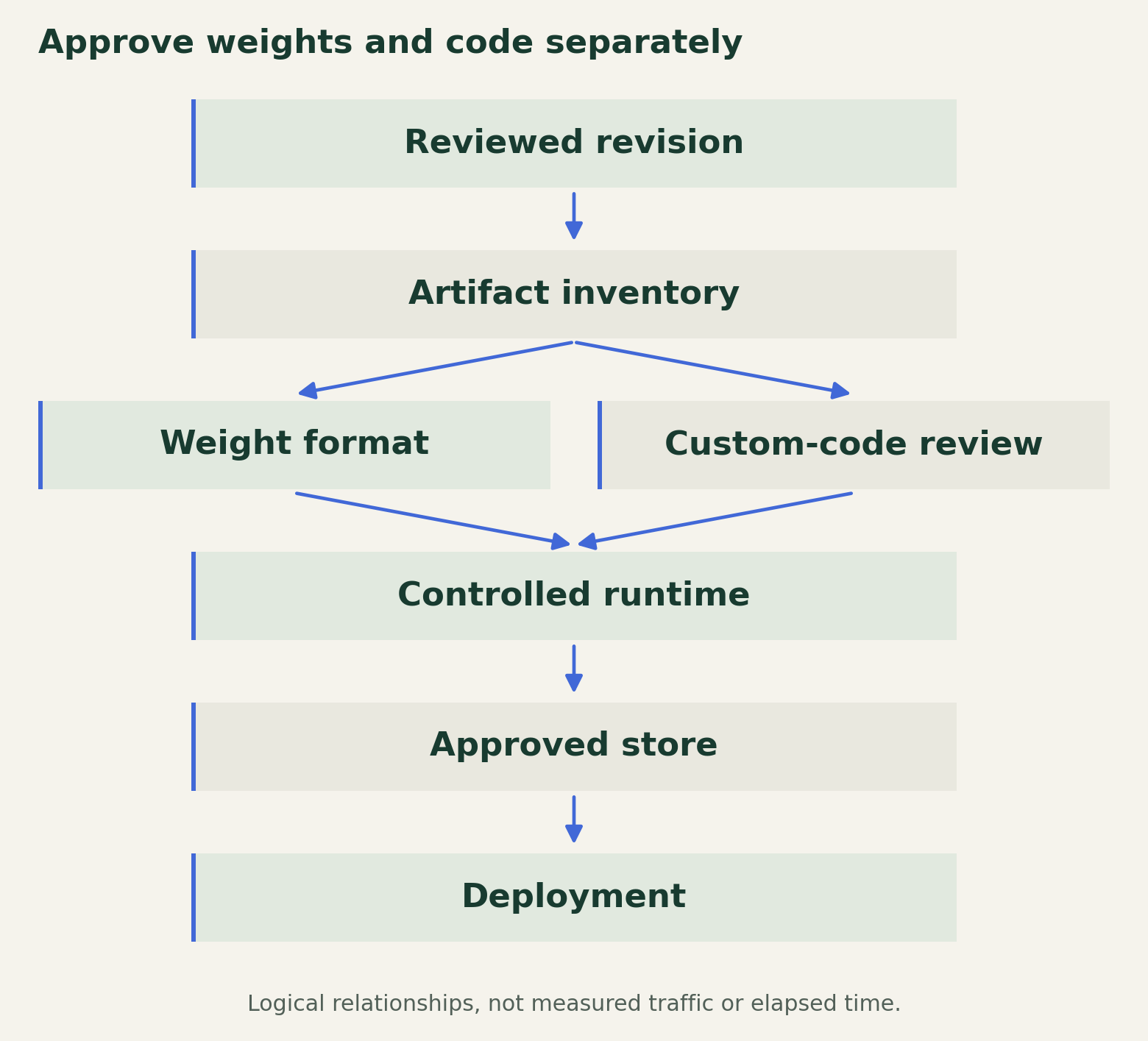
Approve weights and code separately
Model promotion should preserve the identity of the artifacts and the distinct decisions that allow them to run.

Source. Python and Hugging Face loading/security documentation [1]-[4].
Method. Original proposed artifact intake and promotion process. It is not a completed scanner evaluation, model audit, or proof of sandbox effectiveness.
Accessible table and figure data
| Artifact or decision | Identity to retain | Review question |
|---|---|---|
| Repository revision | Exact reviewed commit | Is this the material that received approval? |
| Weights | Files, digests, and expected format | Does the loader refuse an unapproved format? |
| Custom code | Reviewed files and entry points | Why is repository-provided execution required? |
| Dependencies | Package lock and runtime image | Which software interprets the artifacts? |
| Runtime authority | Approved resources and destinations | What can the process access if review misses a problem? |
| Promotion | Approved artifact record | Can deployment reproduce the reviewed loading path? |
| Artifact or decision | Identity to retain | Review question |
|---|---|---|
| Repository revision | Exact reviewed commit | Is this the material that received approval? |
| Weights | Files, digests, and expected format | Does the loader refuse an unapproved format? |
| Custom code | Reviewed files and entry points | Why is repository-provided execution required? |
| Dependencies | Package lock and runtime image | Which software interprets the artifacts? |
| Runtime authority | Approved resources and destinations | What can the process access if review misses a problem? |
| Promotion | Approved artifact record | Can deployment reproduce the reviewed loading path? |
Approve custom code separately from the weights
A data-format decision does not answer whether code supplied with a model may run. Transformers documents custom models that require trust_remote_code=True, and its security policy asks users to inspect those modeling files before enabling that behavior. Treat the setting as a separate trust decision with an identified reviewer and purpose. [2][4]
Review the entry points the runtime will load, their imports, and their expectations about files, network access, and available credentials. An intake record should explain why any custom behavior is needed and whether a supported implementation without repository-provided code can meet the requirement. Do not turn a request for a model into an automatic exception for arbitrary code.
Review is not a guarantee that every defect will be found. Limit the consequences of a mistaken approval by designing a runtime with only the resources its job needs. Separate evaluation credentials from deployment credentials, keep unrelated secrets out of the environment, and establish which destinations the process may contact. These are editorial containment recommendations; they do not represent a tested sandbox or a claim of complete isolation.
Pin the revision that was actually reviewed
A review of a moving branch is difficult to reproduce. Hugging Face's loading documentation shows selecting a specific commit revision for custom models so later repository changes are not silently loaded in its place. Preserve that exact identity in the change record, alongside the artifacts and runtime configuration used for the decision. [4]
Pinning answers which version, not whether that version deserves trust. A malicious or vulnerable revision does not become acceptable because its identifier is stable. The value is that another reviewer can inspect the same material and that a later change becomes visible. Keep those two claims separate when describing the control to an approval board.
For a refresh, compare the proposed revision against the approved one. Identify changed executable files, weight shards, tokenizer assets, configuration, dependencies, and loading options as applicable. Route each change to the relevant review rather than assuming that an unchanged model family name means the software boundary is unchanged. A narrow update can still require a broad decision if it changes what the loader executes.
Interpret scanner results as evidence with limits
A clean scan can be useful evidence, but its meaning depends on what was examined and what the scanner can recognize. Hugging Face describes pickle import scanning without executing the file and explicitly states that the approach is not foolproof. Do not convert that statement into an invented detection rate or a promise that every unsafe import is caught. [3]
An intake receipt should record the scanner, its version or service context when available, the files covered, the scan time, and any unresolved findings. If a scanner only examines one artifact type, the review should not imply it covered the entire loading environment. Missing coverage is a reason to explain the remaining control, not to relabel the repository as safe.
The same discipline applies to manual inspection. State what was reviewed and what was not. For example, a team might review custom modeling code while relying on a separately maintained base runtime. That division can be reasonable if its ownership is explicit. It becomes misleading when the final approval suggests an exhaustive audit of every package, transitive dependency, and possible model behavior.
Make artifact promotion a repeatable change
Use an approved artifact store as the handoff between intake and deployment in this proposed design. The deployment should identify the approved revision and files rather than rediscovering a moving repository at startup. Keep the approval record close enough to the artifact that an operator can determine what is running without reconstructing a sequence of chat messages.
Before adoption, test the intake process with harmless changes: a different revision, a missing expected weight file, an unexpected executable file, and a changed loader option. Each case should either receive an explicit new approval or stop promotion with a clear explanation. These are suggested acceptance tests, not experiments completed for this article.
Plan retirement as carefully as promotion. If an approved revision later becomes unacceptable, identify which deployments and cached artifacts still depend on it, what replacement is approved, and how to verify the replacement took effect. The practical outcome is traceability from a model request to a specific runtime. It does not replace model evaluation, but it prevents the software supply chain from disappearing behind the word model.
Method and provenance
Primary documentation review completed August 28, 2026, with an original artifact-intake design and proposed acceptance cases.
No artifacts were executed or scanned. No named model, repository, runtime, or containment mechanism was audited. Living documentation may change after retrieval.
AI assistance. AI assistance was used to research sources, draft and structure the article, and prepare the visual specification. No human technical review is claimed.
Published under the Cloud Security Desk organizational byline. Read the series policy.
References
- Python pickle documentation, Python 3.14.7 observed on retrieval Python Software Foundation. Accessed .
- Transformers Security Policy Hugging Face. Accessed .
- Pickle Scanning Hugging Face. Accessed .
- Loading models and selecting custom model revisions Hugging Face. Accessed .