
An evidence review for coding model comparisons, using a pinned SWE-bench Verified repository distribution and dated benchmark audits. It separates task population, test validity, leakage, harness changes and local acceptance decisions without ranking models.
At a glance
Key findings
- A coding benchmark measures a configured system on selected tasks. Its score alone does not establish safe deployment in another repository.
- The pinned SWE-bench Verified test file contains 500 unique tasks across 12 repositories; Django accounts for 231 tasks.[1]
- Keep task population, harness, test validity, exposure and local acceptance as separate evidence questions.
- OpenAI's February and July 2026 audits must be read together; the later article withdrew the earlier recommendation of SWE-bench Pro.[6][7]
The score answers a narrower question
A coding benchmark percentage answers a question about a particular experiment. It does not, by itself, identify the best model for a repository or establish that generated patches are safe to merge. Before using the result, name the decision it is supposed to support. Selecting candidates for a local trial requires less evidence than delegating production changes without review. Treating those decisions as equivalent is how a narrow measurement becomes an unsupported claim about software engineering capability.
SWE-bench was built around repository issues and corresponding code changes, giving evaluations a more concrete task than answering isolated programming questions.[3] That is useful context, but the benchmark name is only the beginning of the measurement description. Variants contain different populations, and evaluation tracks can differ in their setup.[2][4] A result attached to one variant cannot silently inherit the scope of another. A percentage without the dataset, harness, scoring rule, and execution budget is missing information needed to interpret it.
The decision framework in this article separates five questions: which tasks were selected, which system attempted them, what the tests establish, what exposure is known, and what evidence exists for the intended application. None is a substitute for the others. A well-documented harness does not make a skewed task population representative. A carefully selected population does not repair a test that omits an important requirement. A strong result can remain useful while its limitations prevent a broader conclusion.
For an engineering manager choosing a coding assistant, the immediate output should be a comparison record with explicit unknowns. Use public results to narrow investigation, then decide which unresolved questions require local evidence. NIST's Generative AI Profile supports context-sensitive evaluation and cautions against treating benchmark measurements as complete accounts of deployment behavior.[9] The practical consequence is to write the intended conclusion before collecting scores. If the conclusion concerns your repository, somebody must establish a connection to that repository's work.
Identify the system that produced the result
The measured system includes more than model weights. An agent may search files, edit code, invoke tests, retry failed attempts, or choose among candidate patches. Its prompts and tools can materially affect what work it completes. Record the model version where available, agent implementation, repository access, permitted tools, stopping rule, and resource budget. A comparison between two models using different scaffolds is a comparison between two systems unless a controlled experiment isolates the model change.
The same distinction applies to attempts. One run per issue and several attempts followed by selection answer different questions. If a report allows repeated attempts, identify how the final patch is chosen and which information the selector sees. Do not compare that result with a single-attempt score as though the units were identical. Similar care is needed for unavailable tasks, environment failures, and exclusions: the reported denominator should reveal what was attempted rather than quietly retain only cases that completed cleanly.
Inspect's log documentation illustrates how an evaluation can preserve task, model, and generation configuration alongside results.[10] The principle matters even if the benchmark uses another harness. Keep the configuration and logs that actually produced the reported result. A reconstructed settings file written later is weaker evidence because it may omit a retry policy or tool setting that influenced the run. Recording a provider alias also does not prove that the same underlying model will be available for a later reproduction.
For locally hosted candidates, connect the model artifact record to the evaluation manifest. For hosted services, retain the identifiers and metadata the service genuinely provides and mark what remains undisclosed. This is an evidence boundary, not an excuse to invent precision. If a vendor cannot identify a relevant configuration detail, the comparison may still inform a trial, but the missing detail belongs in its limitations. Readers should be able to distinguish a verified version from a familiar product name.
Read the task population before the percentage
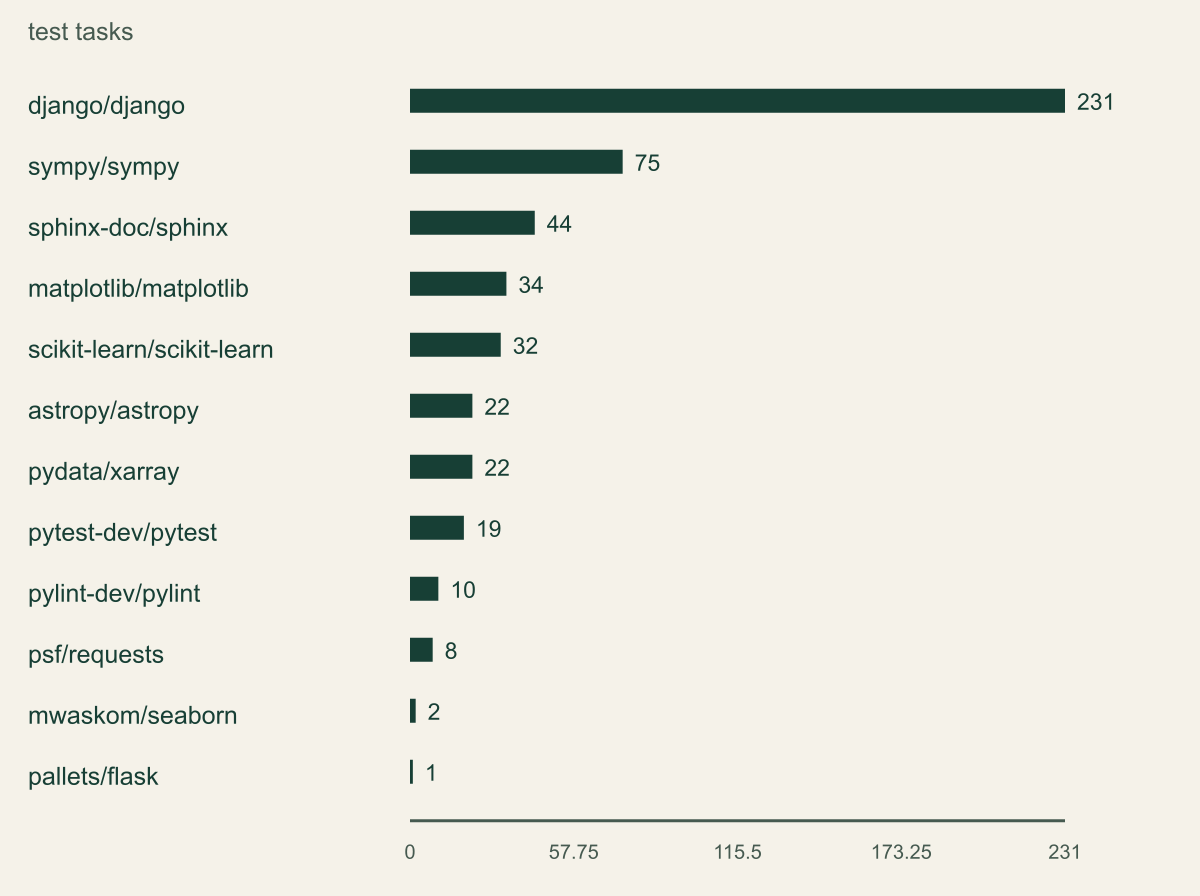
Cloud Security Desk independently counted the repository field in the author-hosted SWE-bench Verified test file at revision c104f840cc67f8b6eec6f759ebc8b2693d585d4a. The file contains 500 records with 500 unique instance identifiers. Grouping those records without filtering produces 12 repository groups. Django contributes 231 tasks, SymPy 75, and Sphinx 44. The remaining nine groups account for 150 tasks. The chart publishes these counts, not a model score or an estimate of task difficulty.[1]
The calculation is deliberately simple enough to repeat. Read the pinned parquet file, group by repo, count records, and sort by count and repository name. The accompanying source record preserves the file hash and revision. The aggregation does not publish issue text, patches, or a new copy of the benchmark. That separation lets a reader verify the factual denominator without confusing the site's derived chart with the upstream dataset or assuming that every upstream content item has the same reuse conditions.
Django's 231 tasks are 46.2 percent of the 500-record population. That is a composition statement derived by division, not a criticism of Django or proof that the benchmark is unusable. It tells a reviewer that an overall result is heavily influenced by performance on that repository's selected tasks. A team maintaining a different language, deployment model, or security boundary should not assume that the headline average measures its work in the same proportions.
Use the chart to ask for a slice of evidence that matches the decision. A repository-specific breakdown may reveal a pattern hidden by the average, but a small slice can also be too sparse for a strong comparison. Do not compensate by inventing weights that supposedly represent enterprise difficulty. Describe the gap and collect local cases where it matters. The dataset guide and original Verified introduction explain the benchmark's construction and variants; neither makes its selected population a census of software engineering.[2][5]
The repositories behind 500 Verified tasks
Original count of the repo field in the pinned SWE-bench Verified test set. These are task counts, not model results or a measure of repository difficulty.

Source. Source checked 2026-08-28. SWE-bench Verified dataset. repo column of all 500 test rows. [1]
Method. Original aggregation by Cloud Security Desk. Source version c104f840cc67f8b6eec6f759ebc8b2693d585d4a. Unit: test tasks. Scope: The 500-row author-hosted SWE-bench Verified test split at the pinned revision. Method: SELECT repo, COUNT(*) AS tasks FROM read_parquet(?) GROUP BY repo ORDER BY tasks DESC, repo. No filtering or deduplication. Validate 500 unique instance_id values. Limits: Composition is not a model score, difficulty measure or proof of representative enterprise work. No source issue text or patches are republished.
Accessible table and figure data
| Repository | Tasks |
|---|---|
| django/django | 231 |
| sympy/sympy | 75 |
| sphinx-doc/sphinx | 44 |
| matplotlib/matplotlib | 34 |
| scikit-learn/scikit-learn | 32 |
| astropy/astropy | 22 |
| pydata/xarray | 22 |
| pytest-dev/pytest | 19 |
| pylint-dev/pylint | 10 |
| psf/requests | 8 |
| mwaskom/seaborn | 2 |
| pallets/flask | 1 |
| Repository | Tasks |
|---|---|
| django/django | 231 |
| sympy/sympy | 75 |
| sphinx-doc/sphinx | 44 |
| matplotlib/matplotlib | 34 |
| scikit-learn/scikit-learn | 32 |
| astropy/astropy | 22 |
| pydata/xarray | 22 |
| pytest-dev/pytest | 19 |
| pylint-dev/pylint | 10 |
| psf/requests | 8 |
| mwaskom/seaborn | 2 |
| pallets/flask | 1 |
Passing a test is evidence about that test
A passing test is evidence about the behavior the test observes. It may be strong evidence for a specified requirement, but it does not establish every property of the patch. A test suite can miss an authorization regression, a performance problem, or a maintenance burden that matters to the team. Conversely, a failing test can be misleading when its expectations conflict with the issue or depend on an unstated implementation detail. These are measurement questions that deserve investigation before a score is treated as ground truth.
Separate the issue specification, acceptance tests, and judgment of the generated patch. If the issue permits several correct implementations but the tests recognize only one, a failure may reflect a narrow test rather than an invalid solution. If the tests exercise only the happy path, a pass may omit a consequential failure. Reviewing such cases should preserve the original result and add the audit finding. Quietly replacing unfavorable cases would change the benchmark population while leaving readers with the impression of an unchanged experiment.
OpenAI's February 2026 audit of SWE-bench Verified reported problems in a selected set of difficult cases. Its 59.4 percent statement concerned 138 selected cases, not an audit of all 500 tasks.[6] That denominator matters: the selection process limits what can be inferred about the full population. The finding can justify closer scrutiny of test validity without becoming a universal estimate of defective benchmark tasks or a claim that every published result is worthless.
For a procurement or adoption decision, ask what happens when a benchmark pass conflicts with code review. Preserve both observations and decide which property each supports. A model can satisfy a task test while producing an unacceptable change for the repository's security or operational requirements. The appropriate response is to add the missing acceptance evidence, not to make the score carry a property it never measured. Security review, regression testing, and patch maintainability remain distinct parts of the local decision.
Check what changed after the benchmark introduction
Benchmark evidence has a publication history. The 2024 introduction of SWE-bench Verified describes why its authors created a human-filtered subset.[5] It is evidence about that construction, not a permanent warranty that no later audit will identify problems. A current review should read subsequent corrections and methodology changes before relying on the original announcement. This is especially important when a source's recommendation changes while the older recommendation remains widely linked.
The February 2026 OpenAI audit recommended moving away from Verified and discussed SWE-bench Pro. In its July 2026 follow-up, OpenAI withdrew that Pro recommendation after further investigation.[6][7] The two sources should be read together. Quoting the earlier replacement recommendation as current would misrepresent the provider's later position. These are provider-authored audits with their own scope, not an independent ranking of every available evaluation. The useful lesson is to preserve dates and update the conclusion when its supporting evidence changes.
Exposure is another limit that a score alone cannot resolve. Public issues, patches, or benchmark solutions may overlap with material available during model or agent development. Known exposure can weaken an interpretation that the result demonstrates generalization to unseen work. But the absence of disclosed training data is not proof that a particular task was memorized. Record known overlap, the developer's exposure policy, and unresolved uncertainty separately. Avoid turning a suspicion into a factual allegation about a model.
A local evaluation also needs an exposure policy. Keep acceptance cases separate from prompt tuning and do not repeatedly optimize against the same supposedly unseen tasks while continuing to describe them as held out. When cases become development fixtures, reclassify them and add fresh acceptance work. Maintain a history of those transitions so later comparisons remain interpretable. This is a control over what the evaluation can claim, not a guarantee that every influence on a model's training can be reconstructed.
Build a comparison record with explicit limits
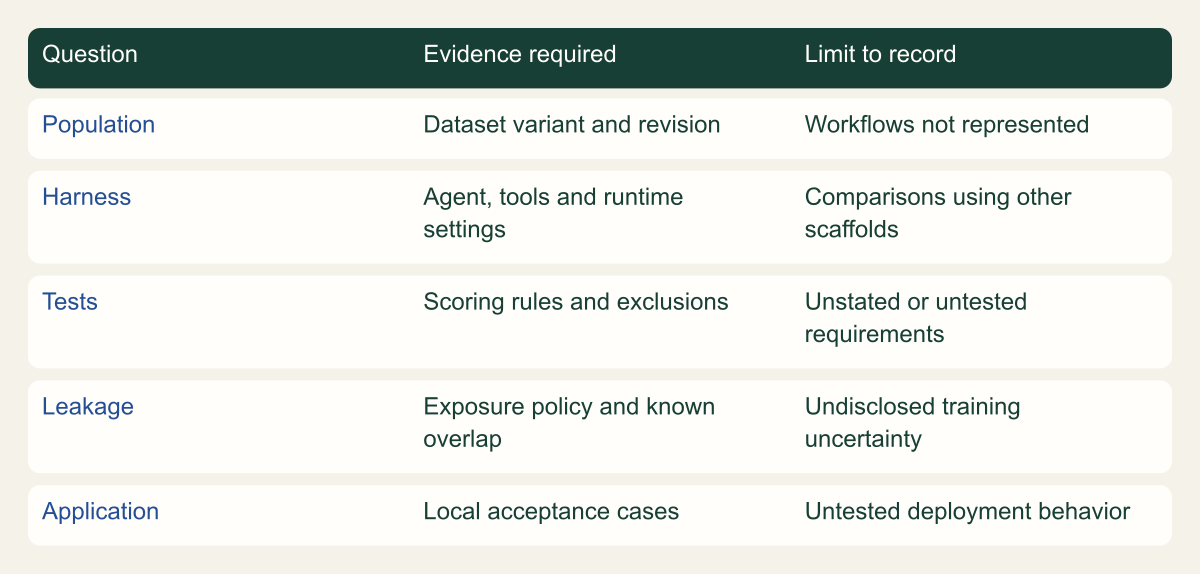
The five-question framework below is intended as a review record rather than a scoring formula. For each question, attach the evidence and state the limit. Under population, record the variant and revision plus workflows absent from the set. Under harness, identify the agent and budget. Under tests, preserve scoring rules and exclusions. Under leakage, distinguish known exposure from undisclosed uncertainty. Under application, link the local acceptance evidence or say that it does not yet exist.
This format makes incomplete comparisons usable without making them look complete. Suppose one vendor publishes an agent revision and task-level logs while another supplies only an aggregate score. The record should show that difference. It may justify requesting more evidence or limiting the second result to candidate discovery. It does not justify assigning a made-up confidence percentage. The decision maker should see which claims are supported, which are conditional, and which cannot be compared from the available material.
Keep outcomes at the task level where the evidence permits it. If two systems both attempt the same cases, their disagreements can identify work worth reviewing. A small change in the overall score may conceal different failure modes or a changed set of completed tasks. Preserve execution errors and exclusions alongside successes. When access to raw logs is restricted, request an appropriate review path or an independently inspectable summary, rather than assuming that a polished chart represents an auditable experiment.
The record should end with a disposition tied to the actual decision. It might authorize a limited local trial, request a matched-harness rerun, or decline to compare results whose denominators differ. NIST's evaluation guidance and the dataset documentation support stating these limits; Fullscript's engineering account provides a concrete example of a team building evidence around its own repository.[9][2][8] This article's framework is an editorial synthesis, not a claim that those sources prescribe one universal procurement process.
Five questions before a coding benchmark comparison
Conceptual evidence framework proposed by Cloud Security Desk. No confidence score or risk weighting is implied.

Source. Cloud Security Desk conceptual synthesis, 2026-08-28, informed by NIST, SWE-bench authors, Fullscript Engineering. [9][2][8]
Method. Conceptual design, not measured data. Unit: process steps or control relationships; no numeric scale. Scope: The evidence fields needed to compare two reported benchmark results. Limits: Conceptual evidence framework proposed by Cloud Security Desk. No confidence score or risk weighting is implied.
Accessible table and figure data
| Question | Evidence required | Limit to record |
|---|---|---|
| Population | Dataset variant and revision | Workflows not represented |
| Harness | Agent, tools and runtime settings | Comparisons using other scaffolds |
| Tests | Scoring rules and exclusions | Unstated or untested requirements |
| Leakage | Exposure policy and known overlap | Undisclosed training uncertainty |
| Application | Local acceptance cases | Untested deployment behavior |
| Question | Evidence required | Limit to record |
|---|---|---|
| Population | Dataset variant and revision | Workflows not represented |
| Harness | Agent, tools and runtime settings | Comparisons using other scaffolds |
| Tests | Scoring rules and exclusions | Unstated or untested requirements |
| Leakage | Exposure policy and known overlap | Undisclosed training uncertainty |
| Application | Local acceptance cases | Untested deployment behavior |
A local task that can change the adoption decision
Consider a hypothetical team evaluating a storage-client migration in its export service. The proposed coding assistant may prepare a patch for review, but it may not deploy changes or receive production credentials. The migration must preserve an existing rule: a caller can export only records belonging to its authorized account. This is a worked acceptance design, not a completed benchmark or an observed candidate result. It turns the broad question of coding capability into a specific repository change whose important consequences can be examined.
The task brief should identify the client interface being replaced, the supported export behavior, and the authorization rule that must survive. An ordinary fixture checks that an allowed caller receives the expected export. A boundary fixture requests another account's records and expects denial before a storage read. A failure fixture supplies a storage error and checks that the handler does not fall back to an unrestricted route. These are proposed assertions for this fictional service. They assess different properties, so an ordinary export pass cannot compensate for a failed authorization check.
Validate the acceptance case before evaluating an assistant. Fullscript describes checking that a reference change satisfies its task gate while an empty patch does not.[8] Apply that principle to the migration requirement: the unchanged client should fail the migration-specific assertion, while a reviewed reference implementation should satisfy it. The authorization regressions may already pass on the base revision and should continue to pass afterward. Keeping those two kinds of assertions separate prevents the test designer from demanding that every security test fail before a legitimate maintenance change.
Supply only the context the intended workflow permits. The assistant may need repository instructions, the old client interface, and public replacement documentation. Keep the reference patch and acceptance answers outside that context, and record any access the harness grants to tests or history. If the assistant can inspect the exact hidden solution, the experiment answers a different question. Execute the generated build and tests as untrusted work with a controlled environment. Neither a benchmark task identifier nor a proposed patch authorizes access to the real export data.
Review the patch and the result together. A candidate might meet the migration assertion while expanding the caller's resource scope, introducing an undocumented dependency, or bypassing error handling. Those possibilities justify separate review criteria; they are not claims that a particular assistant made those changes. An environment timeout should remain an execution failure until investigated, rather than being counted as a correct patch or quietly removed. Preserve the task-level evidence so the reviewer can distinguish an implementation defect, an inadequate fixture, and a harness problem.
The resulting disposition can authorize a reviewer-assisted trial of this migration workflow, request another comparison under matched settings, or hold adoption because essential evidence is missing. It cannot authorize unattended changes across the repository merely because the public score was attractive. Record which local assertions support the decision and what remains outside them, including other services and more consequential autonomy. NIST's deployment-context guidance and Fullscript's repository-specific account support this bounded use of evidence.[9][8] The next useful benchmark result is the one that closes an identified decision gap.
| Fixture | Required observation | Decision if the assertion fails |
|---|---|---|
| Authorized export | Expected records returned through the new client | Investigate functional correctness |
| Another account requested | Denied before any unauthorized storage read | Hold the proposed workflow |
| Storage dependency error | No unrestricted fallback executes | Hold and review error handling |
| Unchanged implementation | Migration-specific assertion detects the missing change | Repair the fixture before using its results |
Method and provenance
Reviewed the author-hosted SWE-bench dataset and documentation, the original paper, dated OpenAI benchmark publications, Fullscript's engineering account, NIST guidance and Inspect documentation on August 28, 2026. Downloaded the pinned Verified test file with the Hugging Face CLI, checked its SHA-256 digest and grouped its repo column with DuckDB. All 500 instance identifiers were unique. Only aggregate counts are republished.
No model ranking, generated patch trial or coding benchmark execution was performed. The chart measures dataset composition, not capability, difficulty or security. Provider audits and another team's engineering experience are attributed to their authors and are not generalized to all benchmark tasks or deployments.
AI assistance. AI assisted source research, drafting, the reproducible dataset aggregation and original visual preparation. Source revisions, calculation results and dated audit claims were checked against the cited evidence.
Published under the Cloud Security Desk organizational byline. Read the practitioner guide policy.
References
- SWE-bench Verified dataset SWE-bench authors, princeton-nlp. Accessed .
- SWE-bench datasets guide SWE-bench authors. Accessed .
- SWE-bench Can Language Models Resolve Real-World GitHub Issues Carlos E. Jimenez and coauthors. Published . Accessed .
- SWE-bench leaderboards SWE-bench authors. Accessed .
- Introducing SWE-bench Verified OpenAI. Published . Accessed .
- Why we no longer evaluate SWE-bench Verified OpenAI. Published . Accessed .
- Separating signal from noise in coding evaluations OpenAI. Published . Accessed .
- Benchmarking the Agents That Write Our Code Fullscript Engineering. Published . Accessed .
- Generative Artificial Intelligence Profile NIST. Published . Accessed .
- Inspect evaluation log files UK AI Security Institute and Inspect contributors. Accessed .