
A practical assurance design for AI application releases. NIST, OWASP and a reproducible HarmBench aggregation support a change-to-evidence record, differentiated release blockers, documented uncertainty and a path from operating incidents back to acceptance tests.
At a glance
Key findings
- Approve a defined application capability and operating scope, not a model name or aggregate safety score.
- Keep behavioral evaluation separate from tests of the controls that enforce access, output and resource boundaries.
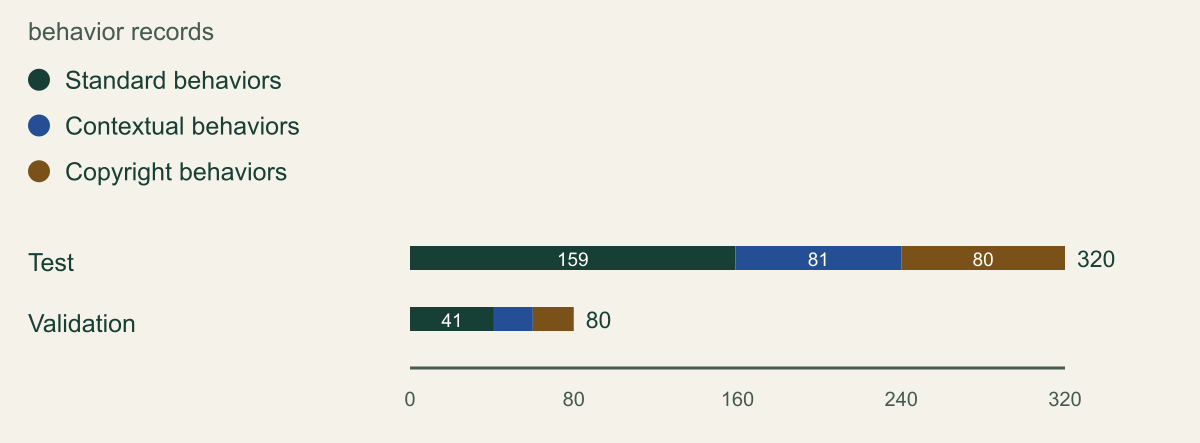
- The pinned HarmBench text collection has 320 test and 80 validation records. Those counts describe benchmark composition, not model performance.[8]
- Give reused evidence explicit dependencies and reopen approval when a model, input, consumer or runtime change invalidates them.
- A restricted release needs enforceable limits, an accountable owner and a tested response when its assumptions fail.
What the release decision actually covers
An AI release review becomes difficult when the decision is described as approving a model. A model identifier does not describe the application that users will encounter. The same model can draft a private note, populate a customer record, or supply text to a component that interprets it as a command. Each application creates a different consequence from the same output. The first release question is therefore concrete: what capability will become available, to whom, using which information, and under which enforced limits?
Consider a proposed support summarizer. It reads an authorized case, produces a suggested summary, and displays that suggestion to a support employee. The intended release does not send messages, modify customer records, or select a different case. That distinction is an acceptance boundary. A review that silently includes those additional powers is approving a different system. Record the allowed workflow and its exclusions before discussing the model's benchmark results. This example is a design exercise, not a description of a deployment tested by Cloud Security Desk.
NIST's AI Risk Management Framework separates measurement from management decisions, while its Generative AI Profile asks organizations to ground capability claims in evidence and make relevant test results available to release decision makers. Neither document supplies a universal score that makes every AI application acceptable.[1][2] A practical implementation is a release record with four connected parts: the application change, the protected outcomes, the evidence supporting those outcomes, and the person authorized to accept remaining uncertainty. The record should permit a reviewer to challenge any connection between them.
The protected outcome should be observable. For the summarizer, an outcome might be that the response cannot cause the application to load another customer's case. Another is that incomplete output never becomes a saved final summary. A third concerns the quality of the summary itself, such as whether it preserves a documented product limitation. The first two can often be enforced by ordinary application controls. The third needs a task-specific assessment. Combining these into one average would conceal the distinction between a broken boundary and an imperfect suggestion.
Name the scope of the approval as carefully as the scope of the tests. An approval for an internal suggestion workflow does not automatically cover customer-facing publication. A trial using synthetic cases does not establish behavior on every production document format. A reviewer can accept a narrow release while leaving those expansions unapproved. The purpose of the record is to make that limit durable enough that a later feature request cannot mistake an old green result for permission to add new authority.
Record the change before selecting tests
The change record is the starting point for test selection. Include the model identifier or artifact digest, tokenizer where applicable, application revision, prompt revision, context assembly logic, output contract, and runtime configuration. Also identify dependencies that transform inputs or consume results. For a hosted model, distinguish the name requested by the application from the version information the provider actually exposes. If a stable alias can change its underlying service, record that uncertainty rather than assigning a version that cannot be verified.
This is related to software supply chain work but has a different purpose. NIST's AI profile for secure software development extends development practices to the AI lifecycle and considers both producers and acquirers.[3] An artifact signature can support a claim about origin or integrity. It cannot establish that the signed model follows this application's output contract. Preserve both records, then link them: the artifact admitted into the build is the artifact whose behavior the evaluation examined. If that connection is missing, an excellent evaluation may describe a different candidate.
For the example summarizer, a prompt-only change still deserves a named change record. Perhaps the team changes the instruction from a short synopsis to a detailed customer chronology. The model remains the same, but response length, evidence selection, and the tendency to merge separate events may change. Relevant tests now include ordering, omission of uncertainty, output bounds, and handling of unusually long histories. It is reasonable to carry forward unrelated infrastructure evidence only when the reviewer can explain why the change did not affect it.
Changes to context handling deserve the same discipline. A new document converter can alter headings or remove a warning that previously separated quoted customer text from application instructions. A new fallback route can change the model, region, or logging behavior after a timeout. Those are application changes even when the primary request path is untouched. NCSC guidance treats secure deployment and subsequent operation as continuing responsibilities, which supports reviewing these handoffs rather than ending assurance at model selection.[4]
Keep the record small enough to use. A machine-readable manifest can identify revisions and link to detailed evidence stored elsewhere; it need not contain sensitive transcripts. What matters is that a reviewer can answer whether the evaluated input path, consumer, and deployment configuration match the intended release. When a field is unavailable, identify the owner of that uncertainty and the consequence for approval. Missing provider internals should not become fictitious precision, but they may justify narrower use, stronger observation, or a different dependency.
A benchmark measures its selected tasks
Public benchmarks can supply useful evidence about selected capabilities and failure classes. They cannot supply the application's entire release argument. HarmBench, for example, was designed to standardize automated red teaming and robust refusal evaluation.[7] That purpose makes it relevant to behavioral testing, but it does not turn its result into proof that a deployed summarizer enforces case access, handles incomplete responses, or limits work after a client disconnects. Those claims require evidence from the components that actually enforce them.
The chart below makes the benchmark population explicit. Cloud Security Desk counted the functional categories in the HarmBench text datasets at commit 8e1604d1171fe8a48d8febecd22f600e462bdcdd. The test partition contains 159 standard, 81 contextual, and 80 copyright behavior records, totaling 320. The validation partition contains 41, 19, and 20 respectively, totaling 80. The two partitions are disjoint by behavior identifier and together form the 400-record text collection at that revision. Multimodal data is outside this count.[8]
These numbers describe the denominator, not the result. There is no model performance measurement in the chart. A larger category is not necessarily more severe, more prevalent in production, or more important to the support workflow. Nor should the 400-record union be added to the test and validation totals as if it were an independent set. Reporting the revision, split, exclusions, and category counts prevents a reader from confusing dataset size with independent coverage or treating a changing dataset name as a fixed experiment.
Use the benchmark to ask which behavioral questions deserve further investigation. Then construct application cases around the actual trust boundaries. A malicious instruction inside a support attachment should not become authority to select another customer's record. A response that contradicts the attached product notice should be detected by the quality assessment or routed for review. A response that exceeds the consumer's size contract should be rejected before rendering. These tests have different assertions and may belong in different suites even when one model response can exercise several of them.
NIST's Generative AI Profile discusses limitations in transferring benchmark measurements to deployment contexts.[2] In the release record, express that limitation operationally: list the claims that the public benchmark supports and the claims it leaves open. Preserve held-out cases so prompt tuning does not gradually turn the acceptance suite into a rehearsal. If a test case must be removed, retain its identifier and reason. A shrinking denominator should be visible to the approver, especially when the removed cases are the ones the application finds hardest.
HarmBench text coverage by split
Original aggregation of the pinned HarmBench text splits. Counts describe benchmark composition, not attack success or risk severity.

Source. Source checked 2026-08-28. HarmBench behavior datasets. FunctionalCategory and BehaviorID columns in the three pinned CSVs. [8]
Method. Original aggregation by Cloud Security Desk. Source version 8e1604d1171fe8a48d8febecd22f600e462bdcdd. Unit: behavior records. Scope: Pinned text test and validation splits; the all split contains their union. Method: Read with csv.DictReader; group FunctionalCategory within each split. Validate test and validation BehaviorID sets are disjoint and their union matches all. Plot the two partitions, not all plus its children. Limits: Not model performance, attack success, severity or real-world prevalence. Text only; multimodal rows are deliberately excluded.
Accessible table and figure data
| Split | Standard behaviors | Contextual behaviors | Copyright behaviors |
|---|---|---|---|
| Test | 159 | 81 | 80 |
| Validation | 41 | 19 | 20 |
| Split | Standard behaviors | Contextual behaviors | Copyright behaviors |
|---|---|---|---|
| Test | 159 | 81 | 80 |
| Validation | 41 | 19 | 20 |
Give each claim a test and an observable failure
Write an assertion before choosing an evaluator. For the claim that incomplete output cannot be saved, the fixture can supply a truncated response and the assertion can inspect the consumer's state transition. The expected result is rejection with no final record created. For the claim that another tenant's case cannot be selected, the fixture can include a validly shaped but unauthorized identifier. The assertion belongs at the application's authorization boundary, not in a model grader that decides whether the response looks helpful.
OWASP AISVS 1.0 provides versioned requirements that can help organize this work.[5] Its model behavior chapter distinguishes output schema checks, output bounds, and control of outbound requests.[6] Record the identifiers and interpretations actually used. Calling a test suite AISVS aligned should not imply that every requirement applies, every requirement was examined, or an external certification occurred. A useful control record says what was tested, how it was tested, and which failure would have stopped promotion.
Some claims need an evaluator rather than an exact comparison. Summaries can preserve meaning while using different wording, so matching one reference sentence is usually a poor completeness test. Define the important facts, permitted uncertainty, and unacceptable omissions. Use examples that challenge those distinctions. If an automated grader is involved, record its model, prompt, rubric, and handling of ambiguous cases. A disagreement between graders is evidence about assessment uncertainty; silently taking the favorable result would hide the very uncertainty the release review should examine.
Test controls with model-independent fixtures as well as generated responses. A deterministic specimen can establish that the parser rejects an unknown field even when the chosen model never happened to emit it during a sample run. A deliberately delayed provider stub can establish whether the deadline closes the application request. Behavioral tests answer whether the model tends to produce an undesirable result under selected conditions. Enforcement tests answer whether the application prevents that result from crossing a boundary. The two forms of evidence complement each other.
For every assertion, preserve a failure artifact that a reviewer can inspect without rerunning the entire suite. That might be a redacted response, a rejected schema path, a state transition trace, or an outbound request decision. Include enough context to distinguish a genuine pass from a skipped call or a broken fixture. A test that never reached its target control cannot support that control. When infrastructure errors prevent execution, report unavailable evidence separately from model failures and successful cases.
Separate blockers from judgments that need an owner
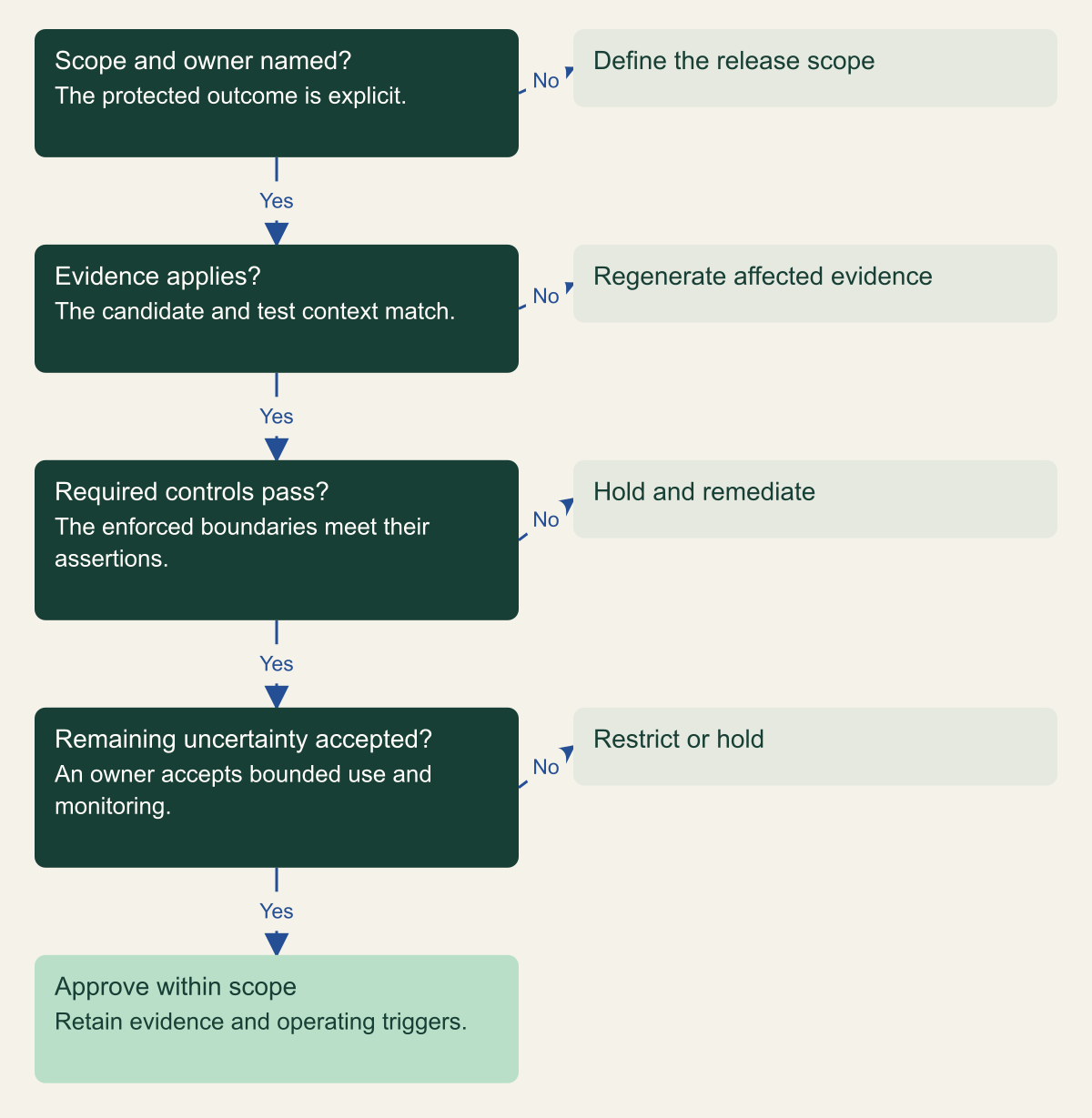
The proposed decision flow below starts with applicability, because evidence that describes the wrong configuration cannot justify the intended release. Confirm the claim and owner, confirm the tested version and environment, examine required control results, and then consider remaining uncertainty. This order prevents a large successful test run from distracting the reviewer from a missing output validator or a changed data path. It is an editorial operating design informed by NIST and OWASP, not a prescribed certification process.[1][2][5]
Define release blockers in advance. In the summarizer example, a demonstrated unauthorized case read, an ability to save incomplete output, or a failure to enforce an approved execution limit should hold the affected capability. Missing evidence for those boundaries should also hold it. That is different from a quality result that falls into an explicitly defined review band. The approver may accept a restricted suggestion workflow with visible uncertainty and human review, but should not relabel a failed access control as a tolerable language-model imperfection.
An exception needs a scope, owner, expiration condition, and compensating control. Suppose the team cannot yet evaluate an uncommon attachment format. One defensible choice is to exclude that format at admission and return a clear unsupported-format response. The approval then concerns the reduced input set. It would be misleading to record the original broad scope as passed while relying on an undocumented operator habit. The compensating control should itself have a test demonstrating that excluded inputs cannot reach the unsupported path.
Avoid averaging incompatible outcomes. A high aggregate quality result cannot compensate for a single observed cross-tenant read. Equally, one ambiguous summary does not prove that every deterministic boundary failed. Present the evidence in groups that correspond to decisions: enforced controls, assessed behavior, operational readiness, and unresolved questions. Within a behavioral group, show the denominator and failure distribution needed to understand the result. Set thresholds according to the consequence and intended use, with a named decision maker, rather than borrowing a percentage from an unrelated benchmark.
A release can have more than two dispositions. Hold, restrict, approve within scope, and require further review are useful distinctions if they map to deployable states. A restriction that cannot be enforced by configuration or access policy is merely a note. The reviewer should be able to point from the disposition to the mechanism that implements it, then to evidence that the mechanism worked. This makes the approval a decision about an operating system rather than a favorable interpretation of a presentation.
A release decision requires applicable evidence
Conceptual release workflow proposed by Cloud Security Desk, informed by NIST and OWASP. It is not a prescribed certification process.

Source. Cloud Security Desk conceptual synthesis, 2026-08-28, informed by NIST and OWASP. [1][2][5]
Method. Conceptual design, not measured data. Unit: process steps or control relationships; no numeric scale. Scope: Evidence requirements for a release disposition before aggregate scores are compared. Limits: Conceptual release workflow proposed by Cloud Security Desk, informed by NIST and OWASP. It is not a prescribed certification process.
Accessible table and figure data
| Decision | Proceed when | Otherwise |
|---|---|---|
| Claim scope | Protected outcome and owner are named | Hold and define scope |
| Evidence applicability | Version, dataset and environment match | Regenerate affected evidence |
| Control result | Required enforcement checks pass | Hold and remediate |
| Remaining uncertainty | Owner accepts bounded use and monitoring | Restrict or hold |
| Decision | Proceed when | Otherwise |
|---|---|---|
| Claim scope | Protected outcome and owner are named | Hold and define scope |
| Evidence applicability | Version, dataset and environment match | Regenerate affected evidence |
| Control result | Required enforcement checks pass | Hold and remediate |
| Remaining uncertainty | Owner accepts bounded use and monitoring | Restrict or hold |
Preserve enough context to challenge a green result
Preserve the experiment that produced the result. At minimum, identify the application candidate, dataset and revision, case selection, exclusions, harness revision, model configuration, evaluator, and result artifacts. Include the execution time and environment so later investigators can distinguish a current run from an older imported result. An immutable reference is more useful than a file named latest. If the provider exposes only an alias, record the alias and response metadata that actually exist, along with the limits this places on later reconstruction.
Inspect's evaluation log documentation illustrates the value of keeping structured run records and exportable configurations.[9] That documentation is not evidence that a particular evaluation was performed here. Nor does retaining a configuration guarantee that rerunning it will reproduce identical outputs. A hosted dependency may change or disappear, sampling may vary, and a grader may have its own variability. The immediate purpose of the record is to make the original claim inspectable: which cases were attempted, what happened, and how the reported result was calculated.
Distinguish case failure, execution failure, exclusion, and cancellation. A malformed fixture should not become a model success. A provider outage should not be silently removed from the denominator of an availability claim. A skipped case may be legitimate when the approved scope excludes its modality, but the exclusion must be traceable to that scope. Make these states explicit in the report and in machine-readable results, so a chart or summary cannot accidentally count only completed favorable cases.
Evidence access also needs design. Evaluation transcripts can contain customer information, credentials placed in test fixtures, or material unsuitable for broad distribution. Store sensitive artifacts under appropriate access controls and provide a redacted decision summary. Preserve the relationship between the redacted view and the controlled original. A release approver needs sufficient access to challenge the result, but that does not require attaching every raw prompt to an unrestricted ticket. Retention and deletion decisions should be planned alongside the evaluation.
Make the record survive a handoff. A colleague who did not run the suite should be able to trace one failed assertion from summary to fixture to observed response and disposition. Try that exercise before treating the evidence system as ready. If the trail depends on the original engineer's memory, the system will be weakest precisely when an incident or urgent rollback removes that engineer from the conversation. A short, linked record is preferable to a large archive with no reliable way to identify what supported the approval.
Decide what a new change invalidates
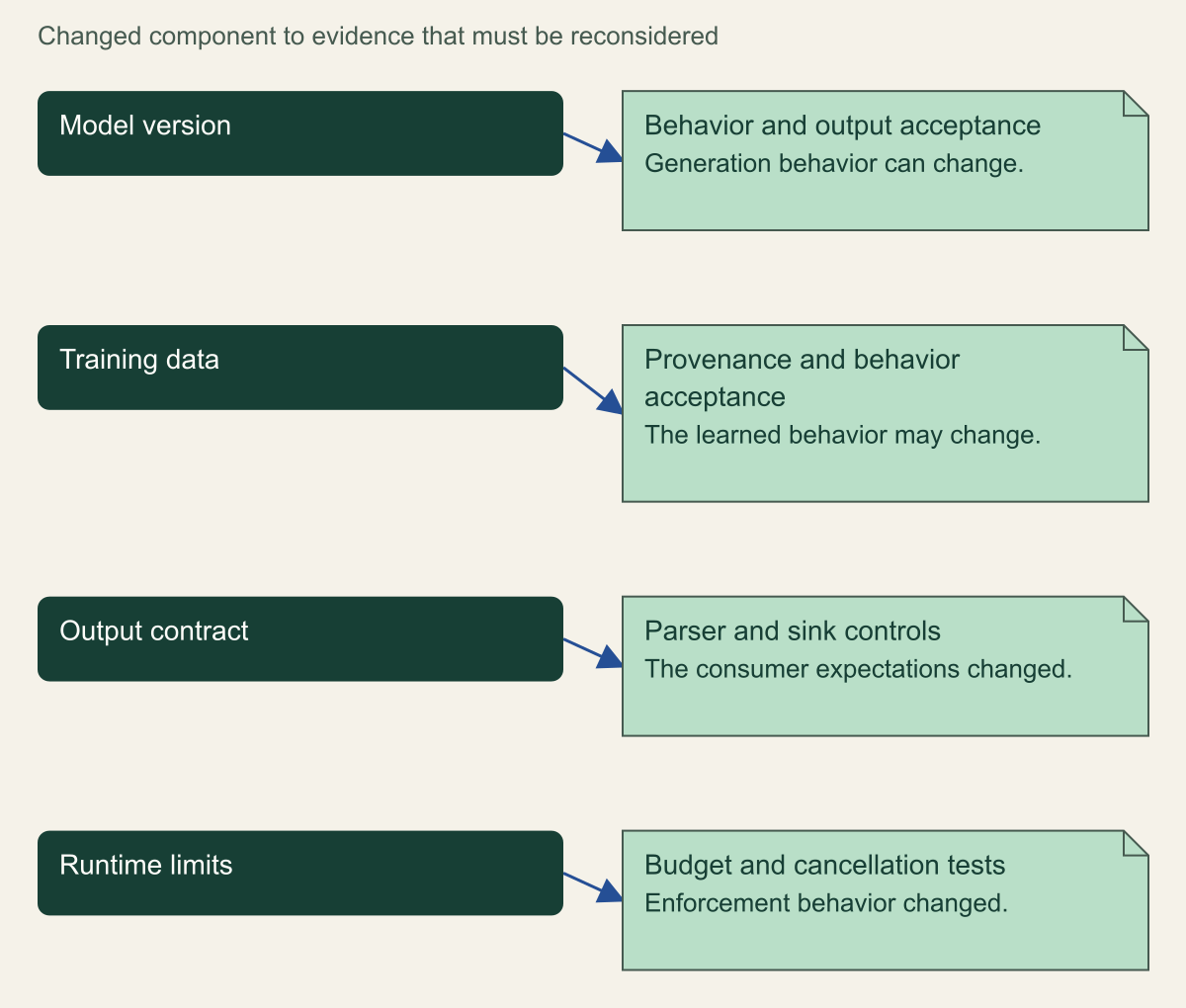
Evidence has dependencies. A parser test depends on the parser and contract it examined. A behavioral evaluation depends on the model, prompt, input preparation, and evaluator. A cancellation test depends on the request path and runtime. The dependency map below shows selected relationships that should trigger reconsideration after a change. It is deliberately not an exhaustive model of every application. The owner must add dependencies that exist in the deployed system, including fallback paths that ordinary traffic rarely exercises.
When the model changes, revisit behavioral evidence and the consumer's tolerance for new response shapes. When a training snapshot changes, revisit provenance and the learned behaviors that the new data could affect. When the output contract changes, retest parsing, semantic validation, and destination controls. When runtime limits change, retest admission, cancellation, and accounting. These are reasons to select tests, not claims that every change always requires every historical experiment. Secure development and operation guidance support maintaining assurance through such changes.[3][4]
A useful carry-forward rule requires a positive explanation. The owner identifies the evidence being reused, the dependencies it assumes, and why those dependencies remain applicable. Merely observing that a file was not edited is insufficient when its inputs or callers changed. For example, an unchanged HTML renderer can receive a newly allowed rich-text field. Its implementation is the same, but the previous plain-text test no longer describes the input contract. The evidence record should make that change in assumptions visible.
Also track evaluation changes. Replacing a grader or correcting a reference answer can change a score without changing the application. Preserve both versions when comparing results and explain which question each answers. If a flawed fixture is repaired, rerun the affected candidates where possible. Do not present the new score as an application improvement when the measurement itself changed. A release review needs a distinction between improved behavior, changed coverage, and changed assessment, because each supports a different conclusion.
Use incident discoveries to expand the dependency map. If a provider fallback bypassed the usual output limit, the lesson is not simply to add one regression case. The fallback should become an explicit dependency of the budget claim, with an owner and an invalidation trigger. That turns a discovered gap into a durable review rule. The result is selective retesting with reasons, rather than either rerunning everything reflexively or carrying old evidence forward until a failure proves it stale.
Changed components invalidate different evidence
Conceptual dependency map. The application owner must add its own dependencies and cannot assume unchanged components imply unchanged risk.

Source. Cloud Security Desk conceptual synthesis, 2026-08-28, informed by NIST, UK NCSC and international partners. [3][4]
Method. Conceptual design, not measured data. Unit: process steps or control relationships; no numeric scale. Scope: Changed system components and the evidence dependencies that require retesting. Limits: Conceptual dependency map. The application owner must add its own dependencies and cannot assume unchanged components imply unchanged risk.
Accessible table and figure data
| Changed component | Evidence to revisit | Reason |
|---|---|---|
| Model version | Behavior and output acceptance | Generation behavior can change |
| Training data | Provenance and behavior acceptance | Learned behavior may change |
| Output contract | Parser and sink controls | Consumer expectations changed |
| Runtime limits | Budget and cancellation tests | Enforcement behavior changed |
| Changed component | Evidence to revisit | Reason |
|---|---|---|
| Model version | Behavior and output acceptance | Generation behavior can change |
| Training data | Provenance and behavior acceptance | Learned behavior may change |
| Output contract | Parser and sink controls | Consumer expectations changed |
| Runtime limits | Budget and cancellation tests | Enforcement behavior changed |
Carry the decision into operation
Release approval should describe the observations required to keep using the capability. For the summarizer, relevant signals include rejected output contracts, repeated incomplete responses, unexpected case-selection attempts, and failures in the evidence path itself. These signals are not interchangeable with a generic uptime measure. A service can remain available while its consumer rejects most results, or while its monitoring no longer identifies which model revision served a request. The operational record should preserve those distinctions.
Choose an action for each signal before it occurs. A missing required validator should stop the affected path. A sudden rise in ambiguous summaries may justify restricting the input types or routing more cases for review while the cause is investigated. A provider notice that changes model behavior should reopen the relevant evaluation decision. Thresholds and response times depend on the workflow; the sources do not supply one universal setting. NIST and NCSC place monitoring and response within the continuing management of AI systems.[1][4]
Verify the fallback with the same care as the primary path. A manual workflow may be the safest recovery for some applications. A smaller model may be suitable for others, but only if its output contract, data handling, and limitations have been assessed for that role. Silently switching to an unreviewed service can invalidate the assumptions that justified release. Treat the fallback as an approved operating mode with its own evidence, not as an emergency exemption from the application boundary.
Connect operating events to the original decision record. If an incident contradicts a release claim, identify the claim, the evidence that supported it, and the assumption that failed. Perhaps the assertion was incomplete, the runtime drifted, or the observed behavior lies outside the tested population. These lead to different corrective actions. A new evaluation case may help, but it cannot repair a missing deterministic control or a deployment process that allows the tested configuration to be replaced without review.
Finally, decide who can restrict or stop the capability. The person on call needs an executable action, a clear scope, and enough evidence to avoid disabling unrelated services. Exercise that action under ordinary access controls. An emergency procedure that depends on a retired operator or an unavailable dashboard is not operational readiness. The release record should link to the response procedure and identify when a control failure, harmful event, or unavailable telemetry requires a fresh approval.
Start with one approval record that can be challenged
For a first implementation, choose one real capability and write a reviewable record before building a broad scoring dashboard. The record can say that the support summarizer is approved only to suggest text for an authorized case, that no downstream write is permitted, and that unsupported attachments are rejected. It can link the candidate manifest, deterministic consumer tests, behavioral case set, evaluator record, and recovery exercise. Each link should identify a revision rather than depend on the current contents of an editable page.
Then name what the evidence does not establish. The public refusal benchmark does not establish summary fidelity. The local quality cases do not establish every future customer's language or document format. The artifact record does not establish benign learned behavior. These are different limitations, so give each an operational consequence. Exclude an unsupported use, require review where uncertainty matters, or gather additional evidence before widening scope. A limitation without a consequence is easy to omit from the next product announcement.
The approval discussion should challenge one positive result and one failure. Ask whether the positive result could occur if the intended control were absent. Ask whether the failure artifact reveals enough to determine what happened. This exercise can uncover a fixture that never exercised the boundary, a grader that rewards fluent but unsupported text, or a report that excludes timeouts. It also gives reviewers a practical understanding of the evidence, rather than asking them to accept a test count as a proxy for assurance.
Set the next review trigger in terms of changes and events as well as a calendar date. A model replacement, new input source, broader output destination, or incident can invalidate the record before its scheduled review. Conversely, an unchanged date on a document is not itself evidence that the system is stable. The record should identify the configuration it covers and the mechanisms that detect departures from it. Structured evaluation records and explicit lifecycle decisions provide the supporting practices; the application owner supplies the actual boundaries.[2][9]
The resulting approval is intentionally narrow but useful. It states which application may operate, which controls were examined, which uncertainties remain, and what will reopen the decision. That is enough to guide a deployment, challenge a proposed expansion, and investigate a later contradiction. The work does not end with a green result. It produces an evidence trail that allows the next person to determine whether that result still applies to the system in front of them.
Method and provenance
Source-based analysis of NIST AI RMF 1.0, the Generative AI Profile, SP 800-218A, NCSC development guidance, OWASP AISVS 1.0, HarmBench and Inspect documentation, checked August 28, 2026. HarmBench category counts were independently reproduced from three CSV files at the cited Git revision; split identifiers and source hashes were checked. The release record and decision flow are original editorial proposals.
No model evaluation, penetration test or production release exercise was performed for this article. The support summarizer is an illustrative design scenario. Dataset composition does not establish model behavior or application security, and the proposed acceptance decisions must be adapted to the actual workflow and authority.
AI assistance. AI assisted source research, drafting, data aggregation and the preparation of original visuals. References, data transformations and editorial claims were checked against the cited sources.
Published under the Cloud Security Desk organizational byline. Read the practitioner guide policy.
References
- AI RMF Core NIST. Published . Accessed .
- Generative Artificial Intelligence Profile NIST. Published . Accessed .
- Secure Software Development Practices for Generative AI and Dual-Use Foundation Models NIST. Published . Accessed .
- Guidelines for secure AI system development UK NCSC and international partners. Published . Accessed .
- AI Security Verification Standard OWASP. Accessed .
- Model Behavior, Output Control and Safety Assurance OWASP. Accessed .
- HarmBench A Standardized Evaluation Framework for Automated Red Teaming and Robust Refusal HarmBench authors. Published . Accessed .
- HarmBench behavior datasets Center for AI Safety and HarmBench authors. Published . Accessed .
- Inspect evaluation log files UK AI Security Institute and Inspect contributors. Accessed .