
A training-data trust design grounded in NIST, joint government guidance and original poisoning research. It follows examples through quarantine, transformation, approval, independent evaluation and recovery while explaining the limits of signatures and filtering.
At a glance
Key findings
- Treat acquisition, transformation, snapshot approval and model acceptance as separate trust decisions.
- A matching digest identifies bytes; it does not establish that their meaning or learned effect is acceptable.
- Preserve lineage from raw examples to transformed records, training snapshots and model candidates so a disputed source can be traced.
- Filtering has domain-specific blind spots and costs. Independent evaluation must not simply reuse the filter as its definition of success.
- Removing a source record does not remove its influence from an already trained model; recovery needs a reviewed artifact or retraining and acceptance evidence.
The trust decision happens before training
A fine tuning pipeline makes a trust decision when it allows examples to influence model parameters. That decision can be hidden inside an apparently routine step: exporting support feedback, accepting a partner dataset, or converting reviewed documents into instruction-response pairs. A file can have the expected format and a valid checksum while containing examples the organization should never teach. The admission question is therefore broader than whether the download succeeded. Who may contribute learned behavior, and who approves the resulting change?
NIST's 2025 adversarial machine learning taxonomy distinguishes poisoning objectives and mitigation limits, including targeted behavior and backdoors.[1] OWASP likewise treats data and model poisoning as a lifecycle problem that can involve several kinds of data use.[3] This article narrows the scope to pipelines that change model parameters. Retrieval access controls, runtime prompt injection, and artifact loading have adjacent trust boundaries, but they require different evidence. An authorized document is not automatically an approved training example, and a safe artifact loader cannot inspect every behavior learned from its contents.
Consider an internal assistant trained from corrected support responses. Employees can improve the source material, but customers may influence the original conversations and automated tools may transform the corrections. A pipeline that takes every positive-rated response directly into the next training run grants those upstream contributors influence over the model. The rating may indicate that a response was useful in one context; it does not establish that the text is appropriate as a general instruction or that all its claims remain current.
The proposed design treats acquisition, transformation, snapshot approval, and model acceptance as separate decisions. Each has an owner and evidence. This separation does not guarantee detection of poisoned content. It makes the trust assumptions inspectable and the effects of a questionable input recoverable. Joint government guidance on AI data security emphasizes provenance, integrity, and controls across data handling.[2] Applying those ideas to fine tuning means controlling which revision is allowed to teach, not merely recording where a file once came from.
Track both the bytes and the meaning of an example
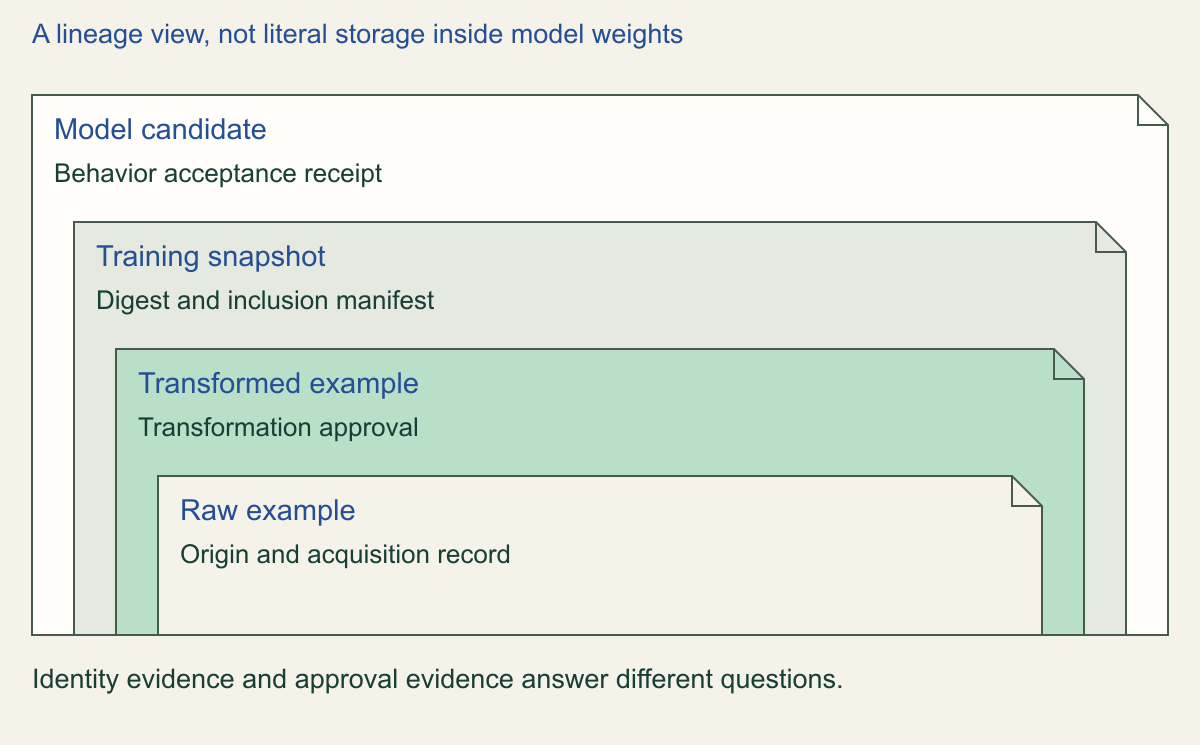
Follow one example through the pipeline. The raw record has an origin, acquisition time, access conditions, and source identity. A transformation may remove personal information, split a conversation, normalize labels, or create a target response. The transformed example then enters a selected training snapshot. Finally, a training run combines that snapshot with a base model and configuration to produce a candidate. These are related objects, but they are not the same object and should not share one ambiguous version label.
Integrity checks answer whether the bytes match an expected object. Signatures can add evidence about who endorsed that object, depending on key management and verification. Neither tells the consumer that every example expresses approved behavior. A compromised or mistaken contributor can sign an undesirable dataset. A preparation job can faithfully preserve a harmful instruction. Keep integrity verification and semantic review as distinct controls so a successful checksum comparison cannot close a question it was never designed to answer.[2]
The illustration below represents separate evidence receipts for those objects. An acquisition record supports the origin decision. A transformation revision supports an explanation of how the example changed. An inclusion manifest and content digest identify the training snapshot. The run and evaluation record support a decision about the candidate's behavior. Dataset documentation, such as the questions proposed in Datasheets for Datasets, helps describe composition, collection, processing, and intended use; it does not certify that an example is benign.[6]
Preserve stable internal identifiers through transformations where practical. If a conversation produces several training examples, record that relationship. If deduplication removes a record, retain the selection rule and relevant audit information. This allows an investigation to ask which model runs included descendants of a disputed source. Without that relationship, a team may know that it used a named dataset but be unable to determine whether the questionable example survived cleaning, appeared more than once, or was excluded before training.
Treat source references as pointers rather than immutable evidence. Research on web-scale dataset poisoning examined threats arising when referenced content can change between collection and later acquisition.[5] The operational lesson is to preserve the authorized snapshot and its acquisition record, not to assume that revisiting a URL will reconstruct the original bytes. A current page may be legitimate yet different from the version used in a training run. Provenance is stronger when it identifies the actual acquired object and its transformations, with retention appropriate to the data's sensitivity.
Semantic review begins with the intended learning objective. For the support assistant, ask whether examples teach current product behavior, preserve uncertainty, and distinguish customer requests from approved staff instructions. Examine label consistency and transformations that can change meaning. Removing a warning sentence while retaining the associated recommendation can create a misleading target response without introducing malformed data. Review the transformations as software changes and inspect their effects on representative examples, including cases likely to be altered substantially.
Reconcile counts at each transformation boundary. If a preparation job splits, filters, or deduplicates records, preserve the expected relationship between input and output counts and investigate unexplained changes. Counts are operational evidence, not a poisoning detector: a malicious replacement can leave every total unchanged. The value is in locating unexplained pipeline behavior and making a snapshot reproducible enough to investigate. Pair those checks with review of content, source authority, and the learned change rather than treating any one signal as conclusive.
One example can have several trust decisions
Conceptual illustration of a training example and its evidence receipts. It does not imply that provenance alone detects poisoned content.

Source. Cloud Security Desk conceptual synthesis, 2026-08-28, informed by NSA, CISA, FBI, ASD ACSC, NCSC-NZ and NCSC-UK, Timnit Gebru and coauthors. [2][6]
Method. Conceptual design, not measured data. Unit: process steps or control relationships; no numeric scale. Scope: Training example identity, lineage and approval evidence. Limits: Conceptual illustration of a training example and its evidence receipts. It does not imply that provenance alone detects poisoned content.
Accessible table and figure data
| Object | Attached evidence | Decision it supports |
|---|---|---|
| Raw example | Origin and acquisition record | May this source contribute data |
| Transformed example | Transformation revision and review | Does the approved meaning survive processing |
| Training snapshot | Content digest and inclusion manifest | Which examples entered this run |
| Model candidate | Training and evaluation record | Is the resulting behavior acceptable |
| Object | Attached evidence | Decision it supports |
|---|---|---|
| Raw example | Origin and acquisition record | May this source contribute data |
| Transformed example | Transformation revision and review | Does the approved meaning survive processing |
| Training snapshot | Content digest and inclusion manifest | Which examples entered this run |
| Model candidate | Training and evaluation record | Is the resulting behavior acceptable |
Replace direct ingestion with an admission process
Direct ingestion turns an upstream edit into a downstream model change with too little opportunity to challenge it. Replace that handoff with an explicit admission process. Newly acquired records enter restricted quarantine, where they can be inspected without becoming eligible for training. Preparation produces a versioned candidate snapshot. Approval identifies the exact snapshot and intended use. Training consumes that approved version, and promotion depends on evaluation of the resulting model rather than the mere completion of a job.
Quarantine should be a real separation in permissions and workflow. The identity that collects feedback should not also be able to approve its own training snapshot or promote the resulting model. An automated preparation job can produce a manifest and checks, but a successful job status is not itself semantic approval. Choose the level of independent review according to the source, influence, and consequence. The design need not require manual inspection of every record to make the approval boundary enforceable.
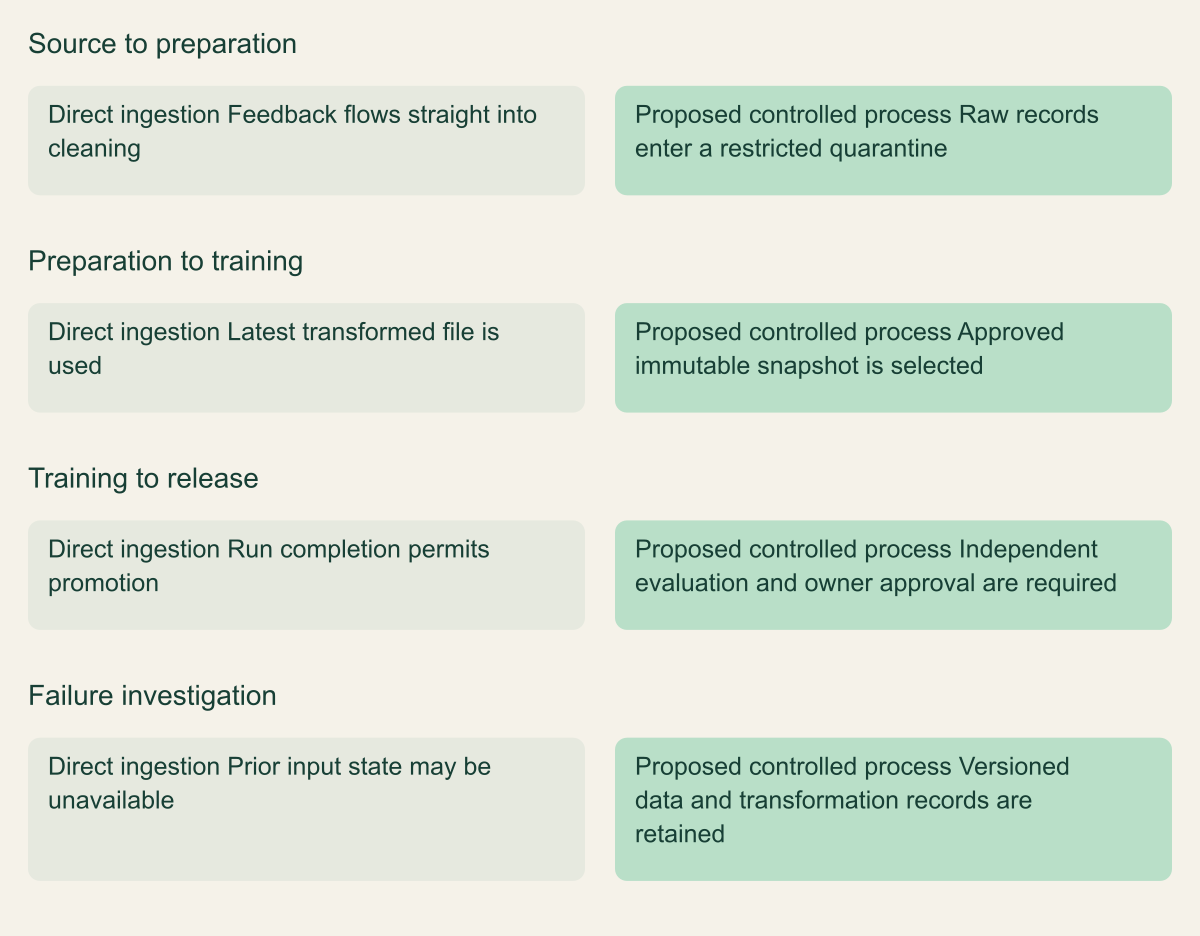
The comparison below shows the intended handoffs without assigning a reduction in attack probability. The controlled lane introduces restricted intake, immutable approved snapshots, independent evaluation, and retained revision evidence. These are proposed practices informed by government guidance, NIST's secure development profile, and its Generative AI Profile.[2][8][7] Their effectiveness depends on the implementation and the threat model. A process diagram should not be presented as an experimental result or a promise that all malicious examples will be recognized.
Make exceptions visible at admission. A partner may supply a dataset whose original collection records are incomplete. A transformation may rely on a service whose model version cannot be pinned. The owner can reject the input, limit its use, request better evidence, or accept a documented uncertainty under an appropriate policy. What should not happen is silently treating missing lineage as if it were verified. The snapshot record should preserve both the decision and the limitations that downstream evaluators need to understand.
Training admission before and after explicit review
Conceptual comparison. The controlled process is a proposed design; no attack-reduction percentage or detection guarantee is claimed.

Source. Cloud Security Desk conceptual synthesis, 2026-08-28, informed by NSA, CISA, FBI, ASD ACSC, NCSC-NZ and NCSC-UK, and NIST. [2][8][7]
Method. Conceptual design, not measured data. Unit: process steps or control relationships; no numeric scale. Scope: Trust handoffs before and after explicit training data review. Limits: Conceptual comparison. The controlled process is a proposed design; no attack-reduction percentage or detection guarantee is claimed.
Accessible table and figure data
| Handoff | Direct ingestion | Proposed controlled process |
|---|---|---|
| Source to preparation | Feedback flows straight into cleaning | Raw records enter a restricted quarantine |
| Preparation to training | Latest transformed file is used | Approved immutable snapshot is selected |
| Training to release | Run completion permits promotion | Independent evaluation and owner approval are required |
| Failure investigation | Prior input state may be unavailable | Versioned data and transformation records are retained |
| Handoff | Direct ingestion | Proposed controlled process |
|---|---|---|
| Source to preparation | Feedback flows straight into cleaning | Raw records enter a restricted quarantine |
| Preparation to training | Latest transformed file is used | Approved immutable snapshot is selected |
| Training to release | Run completion permits promotion | Independent evaluation and owner approval are required |
| Failure investigation | Prior input state may be unavailable | Versioned data and transformation records are retained |
Filtering is a control with costs and blind spots
Filtering can reduce exposure to some undesirable material, but its tradeoffs belong in the admission decision. A keyword rule may remove legitimate technical discussion while missing a subtly misleading example. A classifier may behave differently on a new domain or language. An outlier detector may reject rare but valuable cases. Record what a filter is intended to detect, the data on which it was assessed, and the consequences of false positives and false negatives. A filter name is not an assurance claim.
Original instruction-tuning poisoning research demonstrated risks under the authors' tested conditions and examined defensive tradeoffs.[4] Those results justify taking training admission seriously; they do not establish a universal minimum number of poisoned examples or a defense that works for every model and task. NIST's taxonomy also discusses mitigation limitations, and many established defenses were developed in settings unlike a modern fine-tuned language model.[1] Avoid translating a research result into a guaranteed production detection rate without an evaluation that supports that transfer.
Layer controls according to the influence an input can have. Review who can submit records, how submissions become approved targets, whether one source can dominate a snapshot, and whether transformations amplify repeated material. These checks can make manipulation harder and failures easier to trace even when content inspection is imperfect. They should remain explicit policy decisions. An arbitrary trust score attached to a contributor would not explain which behavior is allowed or why a particular snapshot was admitted.
Preserve a path for challenging the filters themselves. When reviewers discover a missed case, keep the original evidence and update the detection hypothesis. When a filter removes legitimate material, examine whether the learning objective is being distorted. Independent evaluation should not simply reuse the same filter as its definition of acceptable model behavior. Otherwise the process can certify that the candidate learned what the filter approves while never checking whether that approval corresponds to the application's actual requirements.
Work a disputed correction back to its source
Use a hypothetical correction to exercise the admission process. In this fictional support workflow, a staff response says that a feature is available only in managed mode. A preparation rule removes the qualification and produces a target response saying the feature is available. Both strings can be well formed and their digests can be recorded correctly. The concern is the changed meaning. This is an illustrative design case, not an observed poisoning incident, and it does not establish that an attacker caused the transformation.
Give the raw correction an internal identity such as feedback-a and the prepared example a different identity such as example-a-1. These are synthetic labels, not customer identifiers. The preparation record should link them and identify the rule revision that removed the qualification. An investigator needs the authorized source version to compare with the prepared target, not a fresh download of whatever the support system displays now. The permitted-use decision also remains relevant: a correction approved for a customer response may still need separate approval before it is used for training.
Next trace inclusion rather than guessing from filenames. Determine which approved snapshots list example-a-1 or its later descendants, then identify the model runs that consumed those snapshots. A snapshot that excluded the example and a run that failed before consuming data need different treatment from a completed training run that included it. Preserve the evidence supporting those distinctions. Inclusion identifies a candidate for investigation; it does not prove that the example caused a particular output. The learned effect still needs assessment under a documented model and evaluation configuration.
Exercise exclusion as well. Suppose feedback-b was withheld because its permitted use was unresolved. The admission record should explain that decision and show that no eligible prepared descendant entered the approved snapshot. Searching only for the raw identifier in a training file would be insufficient if transformations normally replace identifiers or split records. Trace the relationship through the inclusion manifest. A useful benign test therefore asks both where an admitted record went and why a withheld record could not enter, without introducing a malicious payload or claiming a measured detection rate.
A corrected transformation creates a new candidate snapshot and a new review decision. Retain the earlier revision where authorized so investigators can explain the difference; do not edit its manifest to make the disputed run appear to have used the corrected data. Review examples that legitimately require the managed-mode qualification, then evaluate the new model on independent cases that test that distinction. If the new preparation also removes useful rare examples, that cost belongs in the decision. The release owner needs evidence about the corrected learning change, not merely confirmation that the raw source record was edited.
Test the learned change before accepting the model
Training completion proves that a job reached its terminal state, not that the resulting behavior is acceptable. Evaluate the candidate against the intended learning objective and relevant regressions before promotion. Compare with the approved base or previous model under a documented configuration. Include cases that were not used to select or refine the training data. The Generative AI Profile's emphasis on empirical evaluation supports keeping the release decision connected to observed behavior rather than treating data admission as the final assurance step.[7]
For the support assistant, examine whether the candidate preserves product limitations, handles conflicting evidence, and declines unsupported conclusions. Include ordinary tasks as well as cases motivated by the data threat model. If a source group contributed a large change, add relevant evaluations without claiming that a small selected test set proves all possible learned behavior is benign. Preserve the case selection, expected properties, actual responses, and assessment method so another reviewer can understand what changed and what remains uncertain.
Keep evaluation data outside the authority of routine training preparation. A pipeline that can rewrite both training examples and acceptance answers can make a harmful change appear successful. Access separation, versioned evaluation snapshots, and review of changed criteria reduce that ambiguity. This is also a reason to preserve unsuccessful candidates and their evidence under an appropriate retention policy. Later investigators may need to distinguish a problematic training snapshot from a change in how the candidate was scored.
Connect the accepted candidate to its artifact provenance and deployment record. The approved training snapshot, transformation revision, base model, configuration, and evaluation should lead to the exact artifact promoted. NIST's secure development guidance and NCSC lifecycle guidance support maintaining these connections through deployment and operation.[8][9] If a deployment substitutes another artifact or a later training run, the old acceptance record does not automatically apply. Model intake and release evidence are adjacent controls that complete the training admission story.
Make a suspected data problem recoverable
When a data concern appears, preserve the relevant state before ordinary pipeline activity overwrites it. Identify the suspect source, acquired snapshot, transformations, approved training snapshots, and candidate models that may contain descendants of the records. Restrict further promotion while the team assesses scope. The immediate question is which capabilities may be affected and which evidence can establish that relationship. It is not necessary to assert malicious intent before containing a plausible harmful learned behavior.
Keep observations separate from explanations. A candidate that begins recommending an incorrect action may reflect poisoned data, a labeling error, a changed base model, or a flawed evaluation. Record the observed behavior and configuration first. Then test hypotheses against the lineage and run history. NCSC's operation and maintenance guidance supports preparing for investigation and response throughout the lifecycle.[9] A useful investigation can conclude that the cause remains uncertain while still identifying the revisions and capabilities that require restriction.
Recovery may require returning to a previously accepted artifact or retraining from a reviewed snapshot. Do not assume that deleting a source record removes its influence from an already trained model. Likewise, rerunning the same preparation process against a changed source URL may produce a new dataset rather than reconstruct the old one. Retain the evidence needed to identify what changed, and evaluate the recovery candidate under the applicable release criteria. A restored file path is not proof that the learned behavior has been restored.
Coordinate retention and access with the sensitivity of the records. A poisoning investigation is not permission to copy every customer conversation into an unrestricted incident ticket. Preserve authorized originals, provide redacted working views where appropriate, and record collection and access decisions. The resulting evidence package should connect data revisions to model behavior without overstating causation. That connection supports both containment and a later decision about whether the admission process, transformation, evaluation, or contributor permissions need to change.
Method and provenance
Reviewed the March 2025 NIST adversarial machine learning taxonomy, joint government AI data security guidance, OWASP poisoning guidance, original poisoning research, dataset documentation research and lifecycle guidance on August 28, 2026. The lineage illustration and admission comparison are original conceptual designs, not quantitative security measurements.
No model was trained and no poisoning experiment was conducted. Research findings remain scoped to the authors' tested conditions. The support assistant is an illustrative design scenario. Provenance, filtering and approval records do not guarantee detection of malicious learned behavior, and retention must respect the actual data permissions.
AI assistance. AI assisted source research, drafting and the preparation of original conceptual visuals. Technical distinctions and source claims were checked against the cited primary evidence.
Published under the Cloud Security Desk organizational byline. Read the practitioner guide policy.
References
- Adversarial Machine Learning A Taxonomy and Terminology of Attacks and Mitigations NIST. Published . Accessed .
- AI Data Security Best Practices for Securing Data Used to Train and Operate AI Systems NSA, CISA, FBI, ASD ACSC, NCSC-NZ and NCSC-UK. Published . Accessed .
- LLM04 2025 Data and Model Poisoning OWASP. Accessed .
- Poisoning Language Models During Instruction Tuning Alexander Wan, Eric Wallace, Sheng Shen and Dan Klein. Published . Accessed .
- Poisoning Web-Scale Training Datasets is Practical Nicholas Carlini and coauthors. Published . Accessed .
- Datasheets for Datasets Timnit Gebru and coauthors. Published . Accessed .
- Generative Artificial Intelligence Profile NIST. Published . Accessed .
- Secure Software Development Practices for Generative AI and Dual-Use Foundation Models NIST. Published . Accessed .
- Guidelines for secure AI system development UK NCSC and international partners. Published . Accessed .