
An AWS endpoint-denial investigation guide covering opt-in NetworkActivity collection, advanced selector hazards, conditional event fields, policy ownership and narrowly authorized validation.
At a glance
Key findings
- Network activity events are a distinct, opt-in evidence category for supported endpoint activity. [1][5]
- Switching to advanced selectors can remove previous data-event selections unless the full configuration is preserved. [1]
- An endpoint policy supplements other authorization controls rather than replacing them. [4]
Identify the denying layer
An access failure at a VPC endpoint should be investigated at the boundary that denied it. A route problem, a network control rejecting traffic, an endpoint policy refusal and a service authorization failure are different explanations. Start by identifying which evidence supports each possibility before changing a policy. An API error is not automatically a packet drop.
CloudTrail network activity events provide a distinct way to observe supported AWS API activity through VPC endpoints. They complement management and data events rather than replacing them. The important distinction is the question each event category answers, not which category sounds most comprehensive. [5]
For endpoint-policy violations, VpceAccessDenied is the relevant documented error code. A matching event can identify this policy boundary; its absence does not establish that the network path worked or that another authorization layer allowed the request. Scope the conclusion to the event collected and the configuration that made it visible. [1]
Imagine an authorized application that begins failing after a private-access rollout. The team could be facing an endpoint policy that excludes its action, an identity that lacks permission, or a path that never reaches the endpoint. Opening several controls at once would make a subsequent success difficult to explain. Preserve the failure evidence and test one bounded hypothesis at a time.
This guide is an investigation design, not a report of a live denial. No endpoint, customer account or policy was accessed. It recommends read-only review first and separately authorized benign validation when necessary. The objective is to attribute a failure accurately enough that the responsible owner can make a narrow, reviewable correction.
The initial case note should include the caller's intended action, target resource, endpoint and observed error. Keep the application's wording separate from the provider's raw response. A wrapper may summarize several different failures as access denied, and an incident ticket that retains only that summary can erase the distinction the investigation needs.
Different boundaries need different evidence
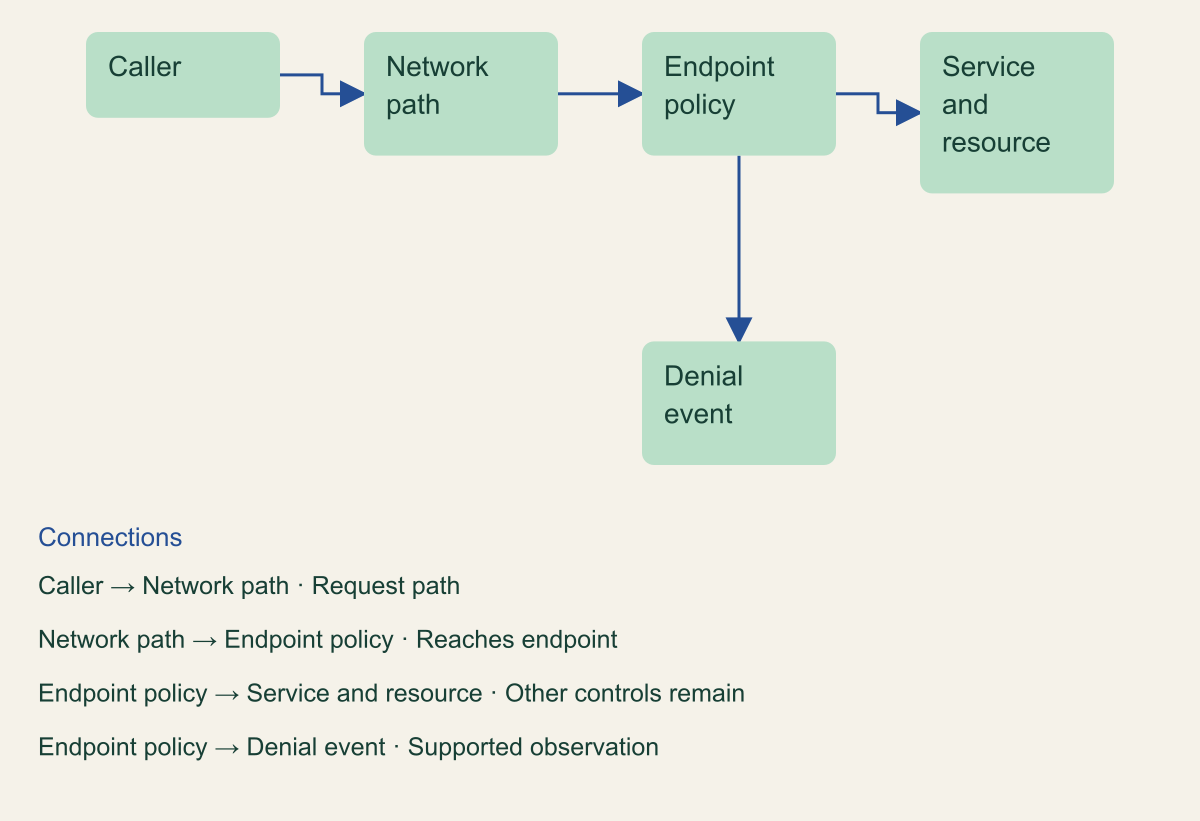
A denied API operation and a blocked network path are not the same observation.

Source. Original model based on AWS endpoint and event documentation. [1][4][5]
Method. Conceptual boundaries, not a universal policy evaluation order.
Accessible table and figure data
| Boundary | Evidence question | Limit |
|---|---|---|
| Connectivity | Did the path reach the endpoint? | No permission conclusion |
| Endpoint policy | Was a supported request denied here? | No full authorization trace |
| Service and resource | Did remaining controls allow the action? | Requires relevant service evidence |
| Boundary | Evidence question | Limit |
|---|---|---|
| Connectivity | Did the path reach the endpoint? | No permission conclusion |
| Endpoint policy | Was a supported request denied here? | No full authorization trace |
| Service and resource | Did remaining controls allow the action? | Requires relevant service evidence |
Confirm what the endpoint owner can log
Collection scope comes before event interpretation. Network activity events are opt-in, and support is tied to documented event sources and VPC endpoint behavior. The endpoint owner should verify that the source and endpoint involved in the question are included. Do not infer coverage from the presence of an unrelated management trail. [1]
AWS's general-availability announcement explains why endpoint-owner visibility matters and provides historical context. Its original service examples are not a current exhaustive support list. For a new collection design, use the current logging documentation and retain the reviewed date rather than reproducing a launch-era list as a permanent limit. [6]
Ownership deserves explicit attention in cross-account paths. Identify the endpoint-owning account, the caller and the account or resource receiving the request. These identities can represent different administrative responsibilities. A record available to one owner should not be assumed to appear in every participant's familiar console view.
Build a coverage record for the actual question. State the event source, selected endpoint, collection destination, enablement time and intended investigator. If the relevant collection began after the failure, say that historical coverage was not demonstrated. Turning on a useful source now is preparation for later evidence; it does not manufacture a record of the earlier request.
An absence review should therefore ask two questions in order. Was this event expected under the documented collection contract? If so, where should the authorized investigator retrieve it? Reversing that order encourages repeated searches against a source that was never configured to answer the question. It also makes ordinary collection gaps look like unexplained service behavior.
Avoid treating a supported-source list as a numerical coverage score. Counting services would conceal differences in endpoints, selectors and the actions a team actually uses. A small, verified list of the organization's relevant request paths is more useful than an unqualified percentage of AWS services allegedly covered.
Review selectors before changing them
Network activity uses advanced event selectors. The current API specifies required event-category and event-source fields and allows additional supported filters. The errorCode filter supports VpceAccessDenied for this category. Some selector capabilities differ between trails and event data stores; userIdentity.arn filtering for network activity is a trails-only detail. [3]
A selector review should start with the entire existing configuration, not only the new condition. AWS warns that switching from basic to advanced selectors clears previous data-event selections. A narrow-looking addition can therefore remove unrelated evidence if the operator reconstructs only the part needed for the endpoint investigation. [1]
Before proposing a change, preserve the current selector document and describe the events it is intended to retain. Compare that intended coverage with the proposed full replacement. Ask a second reviewer to look specifically for omitted data-event sources, unintended exclusions and resource filters that are broader than the investigation requires.
Do not use a production write as a way to discover syntax. The safe sequence is to review the documented schema, construct the intended selector representation, validate it through the organization's established change workflow, and obtain authorization for deployment. This article supplies no command that changes a trail and does not claim an account-level validation.
A useful acceptance comparison has both positive and negative cases. The relevant denied request should be included, while an unrelated resource outside the approved scope should remain excluded if that is the design. Existing evidence sources should still have their intended selection. These are proposed test expectations, not observed results.
Preserve the reason for each filter. A future incident responder should be able to distinguish a deliberate exclusion from an accidental omission. If collection is limited to denied endpoint-policy activity, document that successful activity is outside that particular view. Otherwise a convenient troubleshooting filter can later be mistaken for a complete endpoint activity history.
Document alternate paths explicitly. If a workload can use a different endpoint or a public service route, a selector restricted to one endpoint answers only part of the access question. The investigation should establish which path the failing request used instead of expanding the meaning of a correctly scoped collection after the fact.
Read the event without inventing fields
Read the raw record before building a narrative around it. CloudTrail documents fields such as event time, identity, error code, error message, request identifiers and endpoint context, but field availability is conditional. The current record schema does not justify assuming that every example field exists in every network activity event. [2]
Keep eventID and requestID distinct in the analysis. They refer to different identities in the event model and should not be relabeled as a universal transaction key. When correlating across sources, document the exact fields used and what makes the match credible. If the available fields support only a probable association, retain that qualification.
An endpoint-policy denial is also not a complete authorization stack trace. It does not list every other policy that might have denied the same request after a correction. Once one boundary is repaired, another failure can become visible. That possibility should be part of the change expectation rather than treated as proof that the original diagnosis was wrong.
Normalize records carefully. Preserve raw error strings and identity structure before creating simplified dashboard labels. A summary that collapses several principal forms into a display name may help navigation but weaken attribution. Keep the original account and principal context available to the authorized investigator, with sensitive values restricted appropriately.
For a worked interpretation, consider a hypothetical raw event with the documented endpoint denial code and a matching endpoint identifier. The defensible conclusion is that the recorded request encountered an endpoint-policy violation within the captured scope. It is not that the caller was malicious, that the resource was exposed, or that no other authorization problem exists.
Record unknowns as fields in the case note. If an expected identifier is absent, do not fill it from a nearby event merely to complete the worksheet. Identify the alternative corroboration used, or leave the relationship unresolved. The strength of the conclusion comes from traceable evidence, not from a visually complete table.
Keep the endpoint identifier in the correlation record even when the application normally uses only one private route. An alternate deployment or regional path can make that assumption stale. A policy review against the familiar endpoint should not be accepted as an explanation of a request whose actual endpoint context remains unverified.
Correlate with the access path
An endpoint policy is an additional access control. AWS explicitly states that it does not replace identity-based or resource-based policies, and endpoint-policy support itself varies by service. A successful endpoint-policy review therefore cannot be presented as proof that the caller has every permission needed for the operation. [4]
The architecture diagram separates boundaries without claiming a universal evaluation order for all AWS policy combinations. Network reachability belongs to one set of observations. Endpoint-policy selection belongs to another. Principal, resource and organization controls need their own relevant evidence. Connect these records through the actual request context rather than through assumptions about which team usually owns the problem.
Ask the application owner which resource was intended. A request can use the right endpoint but address a different resource from the one named in a policy review. Likewise, the identity used by a running workload can differ from the identity used by an operator's successful manual check. Preserve the caller and resource from the failing path.
Compare policy versions applicable to the incident window. A current policy that appears correct does not necessarily describe the failed request's conditions. The investigation should distinguish historical configuration evidence from the configuration now under review. If version history is unavailable, state that limit instead of confidently attributing the failure to a change that cannot be demonstrated.
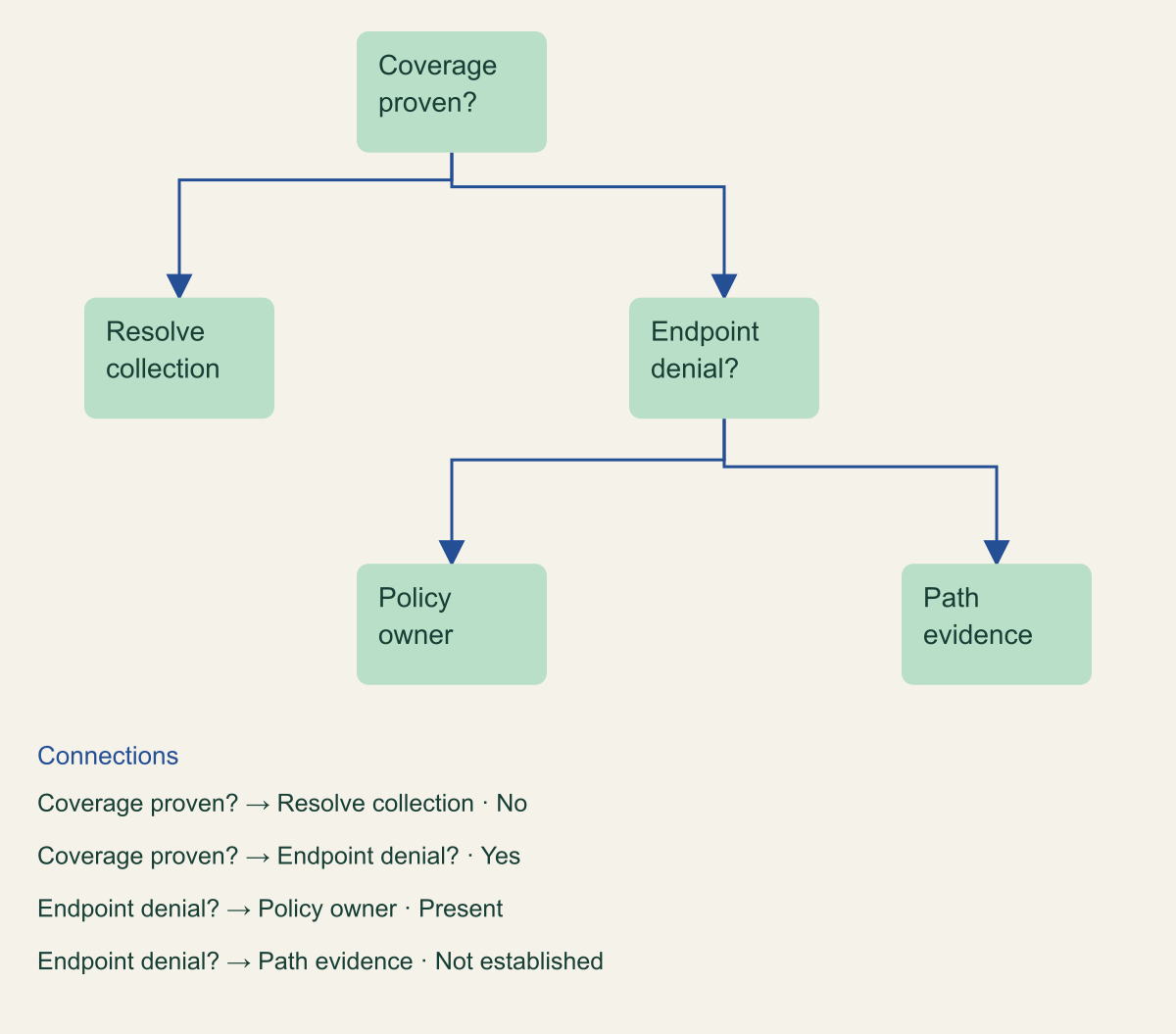
Use the triage flow to select a next owner, not to automate permission expansion. A network observation may route the question to connectivity engineering; a supported endpoint denial may route it to the endpoint policy owner; a service authorization error may require IAM or resource-owner review. Some cases need more than one owner, and the case record should preserve that dependency.
This is where related evidence guides remain useful without being repeated. S3 data-event selection addresses object-operation visibility, while principal and resource guardrails address authorization boundaries. Link those mechanics when the request requires them. Keep this investigation focused on the specific endpoint observation that ordinary searches may have missed.
Choose the next evidence owner
Check collection scope before using an absent endpoint event to eliminate a hypothesis.

Source. Original triage framework informed by AWS documentation. [1][2][3][4]
Method. Conceptual decision aid. Absence remains inconclusive when collection is not demonstrated.
Accessible table and figure data
| Question | If yes | If no |
|---|---|---|
| Supported source captured? | Inspect raw event | Resolve coverage |
| VpceAccessDenied observed? | Review endpoint policy | Check other evidence |
| Path reached endpoint? | Review service authorization | Review connectivity |
| Question | If yes | If no |
|---|---|---|
| Supported source captured? | Inspect raw event | Resolve coverage |
| VpceAccessDenied observed? | Review endpoint policy | Check other evidence |
| Path reached endpoint? | Review service authorization | Review connectivity |
Validate the narrow evidence contract
A proposed validation should use an owned endpoint, an approved identity and a harmless action whose consequences are understood. Define the expected denial before execution and keep the relevant policy version available. The test should demonstrate a particular collection path, not attempt to provoke failures across unrelated services or accounts.
Include a permitted comparison only when it is separately authorized and meaningful. The two cases should differ in the intended control condition, not in several hidden variables such as caller, region, resource and route. If the cases use different identities or paths, record those differences rather than treating the result as a controlled comparison.
Validate retrieval as well as generation. The designated investigator needs to find the raw event in the intended destination and interpret the required fields. A successful request in a developer's terminal does not prove the security team's collection is usable. Conversely, a delivered record does not prove that a dashboard transformation preserved its important details.
Keep ordinary failure alternatives in the test record. If the request never reaches the endpoint, the endpoint-policy evidence expectation may not apply. If collection was enabled too late, the absence may be inconclusive. A responsible exercise can finish with an unresolved condition and an assigned next step; it should not force every result into success or failure.
The receipt should state the action, caller, resource, endpoint, policy version, collection configuration and observed result, plus timestamps with their meanings. Do not put secrets or unnecessary sensitive request data in a broadly shared change ticket. Preserve a controlled reference to raw evidence and a concise summary suitable for the operational audience.
No such exercise was run for this article. The diagrams and cases are conceptual tools for planning authorized work. Their value is in making the evidence contract explicit enough to test later, while keeping a source-supported product capability distinct from a capability the reader has actually demonstrated in their environment.
Close the denial with an owned change
Close the investigation on the smallest supported explanation. If a captured event identifies an endpoint-policy violation, state the selected request context and policy evidence. If the failure is instead a routing or downstream authorization issue, explain why the endpoint event was not the deciding source. The final label should follow the evidence rather than the name of the original ticket.
A corrective proposal should identify the owner of the denying boundary, the intended permission or path and the resource scope. Avoid a broad allow-all change framed as temporary troubleshooting. Such a change can alter the security question and make the resulting success difficult to attribute. Use the established approval process for any production modification.
Retain the pre-change state and the expected post-change observation. After an authorized correction, check the application operation that originally mattered, not merely whether the error string disappeared. A request can progress beyond the endpoint and still fail to perform useful work. New evidence may reveal a second issue that deserves its own bounded explanation.
Finally, restore the collection design to its intended ongoing scope if the investigation introduced approved temporary changes. Preserve useful endpoint-denial visibility without accidentally losing existing data-event coverage. Assign a review date for source support and selector behavior, because the documentation and the organization's request paths can evolve independently.
The result should be an understandable handoff: what failed, which layer the evidence supports, what changed under whose authority, what was verified and what remains uncertain. That is more valuable than a general statement that private access is fixed. It leaves the next responder with a reusable explanation instead of a collection of unexplained policy edits.
Method and provenance
Source-led technical analysis of directly reviewed project and vendor documentation, with original decision frameworks and explicitly hypothetical examples. Sources were reviewed on September 2, 2026.
No customer environment, live configuration, workload measurement or production test was inspected. Product behavior and limits are bounded to the cited documentation and stated review date.
AI assistance. AI assisted research synthesis, drafting, diagram planning and deterministic editorial checks. No personal deployment experience, independent human review or live test is claimed.
Published under the Cloud Security Desk organizational byline. Read the practitioner guide policy.
References
- Logging network activity events AWS. Accessed .
- CloudTrail record contents AWS. Accessed .
- AdvancedEventSelector API reference AWS. Accessed .
- Control access using endpoint policies AWS. Accessed .
- Understanding CloudTrail events AWS. Accessed .
- CloudTrail network activity events general availability AWS. Accessed .