A practical review of backup authority and retention protection. AWS Backup and S3 examples distinguish protected units, override behavior, logically air-gapped storage, account limits, and the separate need to validate restoration.
At a glance
Key findings
- Retention protection and administrative separation answer different questions. A recovery design needs both a surviving copy and an authorized path to restore it.
- AWS Backup Vault Lock modes and S3 Object Lock protect different units and have different override behavior.
- An immutable copy can still be unusable because of missing keys, account access, dependencies, or a failed application restore.
Start with the authority an attacker could inherit
A backup policy can look healthy while sharing the same failure boundary as production. Consider a hypothetical administrator who can modify the live workload, change backup retention, manage encryption keys, and assume the recovery role. Placing a second copy in another storage location does not automatically remove those shared powers. The first design question is which authorities a compromised production session would inherit.
Build an authority map before choosing a retention setting. List the principals that create copies, alter retention, delete protected data, change key policy, administer the owning account, and initiate a restore. Include indirect routes through role assumption or administrative automation. A separate account helps only to the extent that the relevant authorities are actually separated.
The objective is a specific surviving recovery path under a stated compromise scenario. For example, production operators may be unable to shorten retained copies while a separately governed recovery team can restore into an isolated environment. Write down which compromise that arrangement addresses and which it does not. This makes the claim testable without describing any cloud feature as an unconditional guarantee.
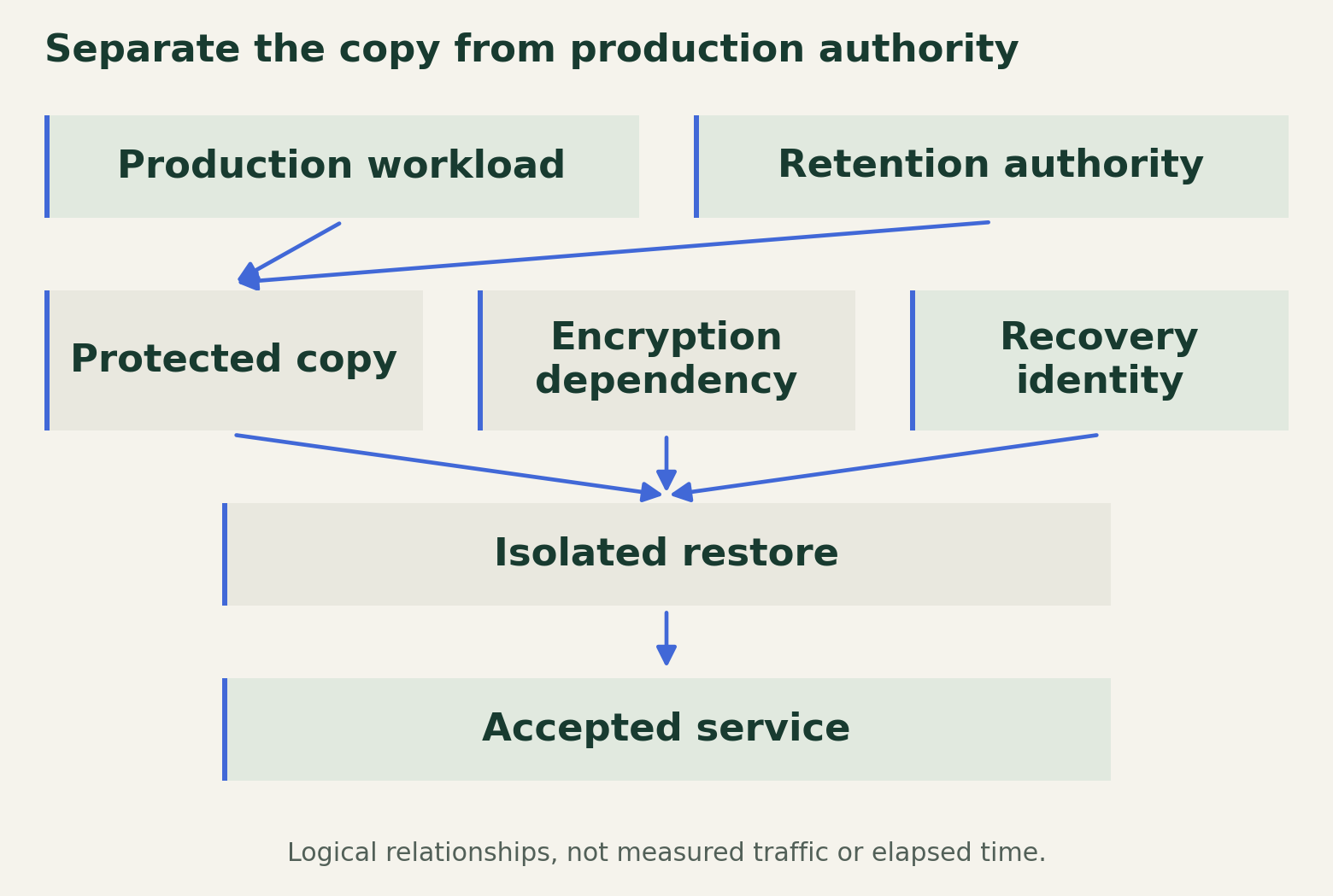
Separate the copy from production authority
A retained copy and a usable recovery identity must survive the chosen compromise independently.

Source. AWS Backup and S3 documentation, with NIST recovery guidance [1]-[4].
Method. Original authority map. Arrows describe responsibilities in a proposed recovery design, not a deployed account topology or measured resistance to compromise.
Accessible table and figure data
| Boundary | Authority to review | Remaining recovery dependency |
|---|---|---|
| Production | Write data and create backups | A usable recovery point was actually created |
| Retention | Change or remove protection | Correct protected unit and retention period |
| Account | Administer ownership and access | Account continuity and recovery access |
| Encryption | Manage keys and decryption rights | The selected copy can be decrypted |
| Restore | Select and restore a copy | Destination permissions and dependencies |
| Application | Accept restored service | Data and business behavior pass validation |
| Boundary | Authority to review | Remaining recovery dependency |
|---|---|---|
| Production | Write data and create backups | A usable recovery point was actually created |
| Retention | Change or remove protection | Correct protected unit and retention period |
| Account | Administer ownership and access | Account continuity and recovery access |
| Encryption | Manage keys and decryption rights | The selected copy can be decrypted |
| Restore | Select and restore a copy | Destination permissions and dependencies |
| Application | Accept restored service | Data and business behavior pass validation |
Choose the protected unit and override policy
AWS Backup Vault Lock distinguishes governance mode, which authorized users can remove, from compliance mode, which becomes immutable after its grace period while protected recovery points remain. S3 Object Lock instead protects object versions. Those differences matter when translating a general requirement such as prevent deletion into an actual control. [1][3]
A version-protected object can coexist with a newer version or a delete marker. An application that requests the current object may therefore behave differently from a recovery process that selects a retained version. The retained bytes and the ordinary application view are separate questions. S3 documents that simple deletion can add a delete marker without removing the protected version. [3]
Record the exact protected unit in the runbook: a recovery point, a version identifier, or another service-specific object. Then identify the operation the control rejects and any authorized override. Avoid reducing this to a green lock icon. A reviewer should be able to explain which action fails, who can change that result, and how the recovery operator locates the surviving data.
Separate the recovery path from normal administration
AWS Backup's logically air-gapped vault uses service-owned account storage and compliance-mode Vault Lock. Current documentation permits an AWS-owned key by default or an optional customer-managed KMS key. Sharing and multi-party approval provide documented recovery arrangements, but their prerequisites and supported resources still matter. The feature is logical isolation, not a physically disconnected medium. [2]
Translate that service model into an ownership plan. Identify who can configure sharing, who can approve recovery, which account receives restored resources, and how those people reach the required records during an incident. Keep recovery instructions available independently of the application being restored. A protected copy has limited value when its identifier or required approval process is inaccessible.
Key choice also belongs in the authority map. If the selected design uses a customer-managed key, review its administrators and restore permissions alongside the vault configuration. Do not assume a named isolation feature removes every customer-controlled dependency. Record the actual key type and recovery arrangement in the evidence, rather than relying on a service's default setting to describe an existing vault.
Treat irreversible retention as a production change
Retention is a commitment to keep data and pay for its storage, not merely a security toggle. Before an irreversible lock becomes effective, check the selected period against the organization's data handling requirements, expected backup volume, resource lifecycle, and recovery needs. A mistaken setting may create a costly obligation or preserve data longer than intended.
Use a disposable, authorized test arrangement to validate the proposed configuration before applying it to valuable recovery points. Review both successful copy creation and expected rejection of incompatible retention settings. Record the configuration before and after the change, the authorized approver, and the point after which an ordinary administrator cannot undo it. Never experiment by attempting destructive operations against the only recovery copy.
Account lifecycle remains a boundary. AWS documents account-closure limitations for locked backups and logically air-gapped recovery access. Retention protection should therefore not be presented as preserving data indefinitely after the owning account relationship ends. [1][2] Include account administration and billing continuity in the recovery design, with an owner who understands that they are dependencies outside an individual backup job.
Test survival and usability separately
A useful exercise has two distinct outcomes. First, demonstrate in a controlled environment that the production role cannot perform the prohibited retention or deletion change. Second, demonstrate that the recovery role can locate, decrypt, and restore a selected copy into the approved destination. One result does not stand in for the other.
The restored environment should then pass application checks appropriate to the service. Confirm representative records, required secrets and configuration, dependency connectivity, and the ability to complete a safe business operation. Keep outbound integrations contained so a test restore cannot send real notifications or duplicate external transactions. The exercise should have a cleanup plan that respects retained source copies.
NIST's cyber-event recovery guidance treats recovery planning, exercises, and improvement as continuing activities. [4] Apply that approach to evidence quality: preserve the scenario, identities, recovery point, timestamps, expected denials, application results, and unresolved dependencies. A screenshot showing that a backup exists is useful inventory evidence, but it does not establish either resistance to the chosen compromise or application recoverability.
Keep the protection claim narrow and current
Publish the internal recovery claim in plain operational terms. State that a named production role cannot shorten a specified class of retained copies under the reviewed configuration, and that a named recovery process restored a particular fixture on a recorded date. Preserve exceptions instead of hiding them behind the word immutable.
Revisit that claim when account ownership, key policy, sharing, backup selection, resource type, or retention changes. A new database or storage service may use a different encryption or restore path. The original exercise can remain valid for its recorded configuration while no longer covering the expanded system.
The final decision is whether the organization has a copy that survives the selected failure and a practical route from that copy to a working service. Retention locks contribute to the first requirement. Administrative separation, accessible keys, recovery procedures, and application validation complete the design. Keeping those responsibilities visible makes the next review more useful than simply checking whether the backup schedule is enabled.
Method and provenance
Primary documentation review completed August 28, 2026, with an original authority map and proposed recovery acceptance checks.
No backup vault, retention lock, account-sharing arrangement, or restore was created or tested. The article does not determine regulatory compliance, customer-account eligibility, or resistance to every account compromise.
AI assistance. AI assistance was used to research sources, draft and structure the article, and prepare the visual specification. No human technical review is claimed.
Published under the Cloud Security Desk organizational byline. Read the series policy.
References
- AWS Backup Vault Lock AWS. Accessed .
- Logically air-gapped vault AWS. Accessed .
- Using S3 Object Lock AWS. Accessed .