A staged EC2 IMDSv2 migration review for container workloads. It distinguishes metadata tokens, hop limits, tokenless-request metrics, launch defaults, existing-instance changes, and evidence that credentials still work without exposing them.
At a glance
Key findings
- The IMDSv2 token authorizes metadata requests; it is not the temporary AWS role credential later used for service API calls.
- A token lifetime and a PUT response hop limit are different controls. Container networking can affect whether the token response reaches the caller.
- New-instance defaults do not migrate a running fleet. Verify applied metadata options and the workload's behavior on existing and replacement instances.
Identify the two credentials on the path
A containerized service can lose access to AWS APIs after an instance metadata change even though nobody edited its IAM role. The failure may occur earlier: the process cannot obtain the metadata token or retrieve the role credentials it expects. Start the investigation by separating those steps. Otherwise, a network-path problem can be misdiagnosed as a permissions problem and trigger an unnecessary expansion of the role.
IMDSv2 begins with a PUT request that obtains a metadata token. Subsequent metadata requests include that token, whose selected lifetime can range from one second to six hours. The token is bound to the instance. It is distinct from role credentials returned by metadata and later presented to AWS service APIs. Requiring IMDSv2 makes missing or expired metadata tokens fail rather than permitting an IMDSv1 request. [1]
For each workload, record which process requests metadata, why it does so, and which SDK or helper owns that behavior. Include startup scripts and sidecars rather than assuming the main application is the only caller. Document a safe way to observe success without printing the token, access key, secret key, or session token. The migration report needs a decision and a result, not usable credentials.
Find callers across the workload's schedule
AWS documents MetadataNoToken for successful tokenless requests while IMDSv1 is permitted, and MetadataNoTokenRejected for blocked tokenless requests when IMDSv2 is required. The two metrics address different configurations; they should not be read as interchangeable counters. AWS also provides an IMDS Packet Analyzer to help identify callers during migration. Check its operating requirements before introducing it into an instance. [2]
Choose an observation window that includes a fresh boot, normal traffic, scheduled tasks, credential refresh, and maintenance work. A quiet hour on a long-running instance may miss the initialization script that will break every replacement. Ask each owner to identify rare paths and state whether the chosen observation period includes them. When it does not, add an explicit exercise or leave the path unresolved.
Associate a tokenless request with the responsible package or process before changing settings. Prefer updating the supported client or its configuration to adding a blanket compatibility exception. If the workload only needs a known setting that can be supplied directly, assess that option as well. Keep the desired migration state attached to the finding so a temporary exception does not become an undocumented launch default.
Inspect the response hop from inside the container
The PUT response hop limit constrains how far the metadata token response can travel. It is not the token's lifetime. AWS notes that container networking can add a hop and that a limit of one can prevent the response from reaching a container. Its launch guidance recommends two for container environments, while the correct choice still depends on the actual network path. [3][4]
Reproduce the check from the workload's own network context. A successful token request in an administrator's host shell does not establish that the container receives the response. Record the instance option, the relevant networking arrangement, and the observed success or failure. Do not raise the limit merely until a test turns green without understanding which path required the change.
Some SDK behavior can make this failure appear as latency rather than an immediate error, including attempts to fall back to IMDSv1. AWS discusses that behavior in its metadata access considerations. Check the installed SDK and whether the application can use explicitly supplied settings instead of metadata for the particular purpose. An API timeout should not automatically be attributed to the downstream AWS service. [4]
Two controls on the metadata path
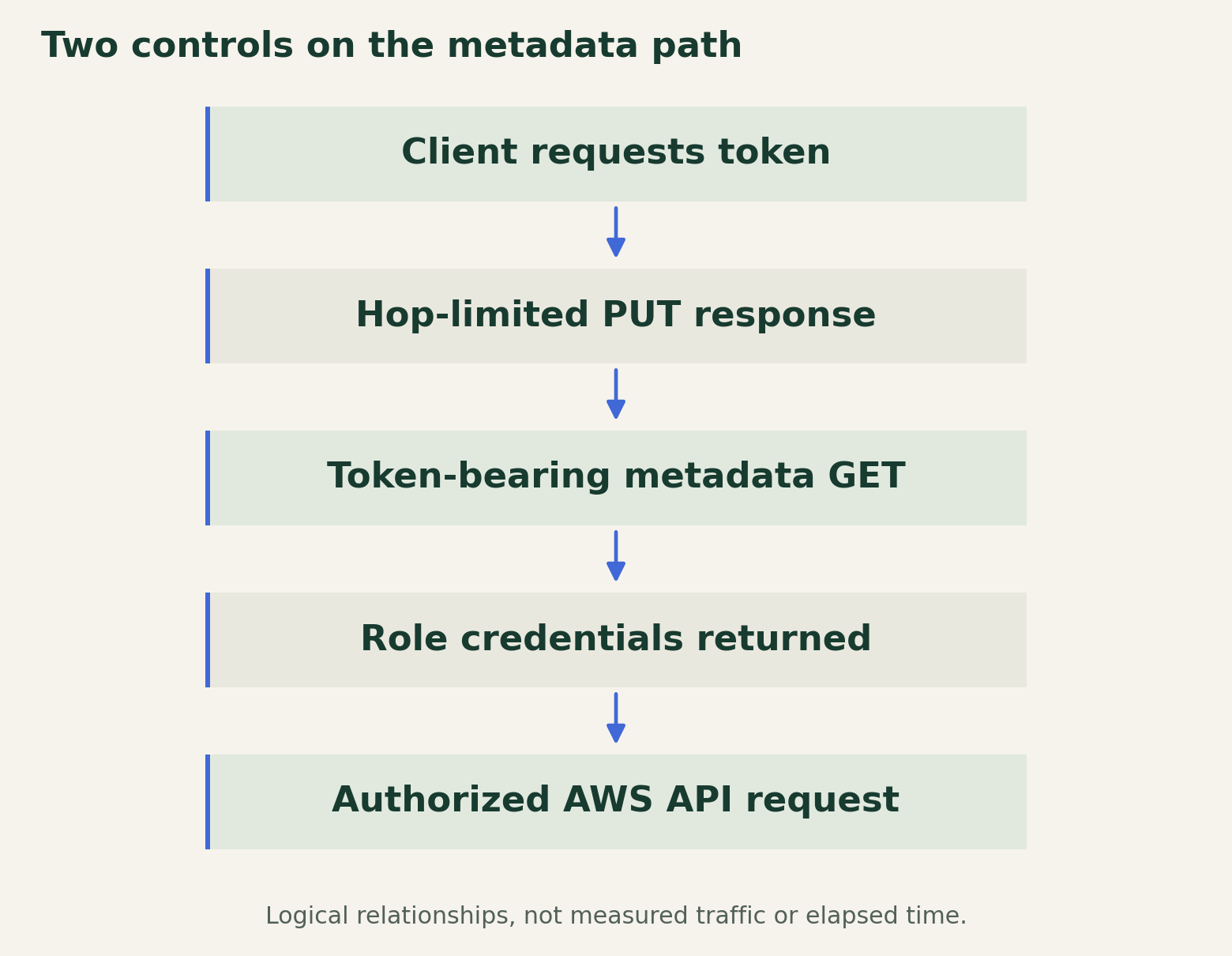
Token validity controls the metadata request; the response hop limit affects whether the caller receives its token.

Source. AWS EC2 metadata request and networking documentation [1][3][4].
Method. Original request-path explanation using documented controls. No packet timing, security score, or fleet migration result is shown. The actual container network path determines hop requirements.
Accessible table and figure data
| Control or credential | Purpose | Do not confuse it with |
|---|---|---|
| Metadata token requirement | Require a valid token on metadata requests | IAM permissions for service API calls |
| Token lifetime | Select validity from 1 second to 6 hours | A network hop count |
| PUT response hop limit | Limit travel of the token response | Credential expiration |
| Role credentials | Authenticate later AWS API requests | The metadata session token |
| Control or credential | Purpose | Do not confuse it with |
|---|---|---|
| Metadata token requirement | Require a valid token on metadata requests | IAM permissions for service API calls |
| Token lifetime | Select validity from 1 second to 6 hours | A network hop count |
| PUT response hop limit | Limit travel of the token response | Credential expiration |
| Role credentials | Authenticate later AWS API requests | The metadata session token |
Separate the current fleet from the next launch
Treat running instances and future launches as two inventories. For the running fleet, record the applied token requirement, endpoint state, and hop limit on each in-scope instance. For future capacity, identify the launch template, image settings, account defaults, and any enforced organizational configuration that determine the resulting options. A migration is incomplete if its next replacement silently returns to the old behavior.
EC2 account metadata defaults are regional and affect new launches rather than retroactively changing existing instances. Launch settings and AMI-related defaults participate in the documented precedence rules. AWS separately documents changing metadata options on existing instances. Review the resolved configuration rather than assuming that one account-level change describes every current instance and every future launch path. [3][5]
Use a bounded workload group for the first change and launch a replacement through its ordinary automation. Compare the replacement's applied options with the intended policy. Include less obvious capacity paths such as recovery templates and scheduled workers in the inventory. Preserve the existing settings in the change record, but do not assume that every prior setting will remain permissible after an organization-level enforcement change.
Verify credentials without copying their values
After requiring tokens, test a legitimate metadata request and the workload's intended harmless AWS operation. Separately test that a tokenless metadata request is rejected. These checks cover different parts of the path. A healthy metadata endpoint cannot prove that the IAM role permits the application operation, and an application using a different credential source cannot prove that IMDSv2 works.
Exercise the tests from the actual container and from a freshly launched instance. Record the client version, applied options, request outcome, and application health signal. When testing credential refresh, preserve only timing and sanitized success information. Never place the returned credential document in a build artifact, ticket, screenshot, or public example. The person reviewing the change does not need possession of the credential to evaluate the result.
Investigate rejected tokenless requests after the change rather than treating them all as expected noise. Some may be obsolete probes, but others can identify a caller that still needs repair. Tie each finding to the process inventory and its owner. Continue using ordinary application health monitoring so a successful metadata test does not conceal a failure in the workload's subsequent operation.
Define recovery within the governing policy
A rollback plan should identify the observed failure that triggers it, the permitted setting to restore, the affected workload group, and the authority required. AWS documents circumstances in which organizational enforcement prevents changing metadata options directly or restoring an optional token requirement. Verify those constraints before the maintenance window, rather than discovering them while an application is unavailable. [5]
Where a policy relaxation is unavailable or inappropriate, prepare a recovery that keeps the security requirement intact, such as a corrected client or a previously tested image. Review that option with the application owner before rollout. The point is to restore the required service behavior under the governing policy, not to promise that every possible metadata change can be reversed with one command.
Finally, keep the instance role's resource permissions under their own review. Requiring IMDSv2 changes the metadata request mechanism; it does not establish that every process able to obtain role credentials should have every permission in that role. The completed record should show a working token path, rejected tokenless access, a healthy application, and a replacement launch that preserves the intended configuration.
Method and provenance
Primary documentation reviewed on August 28, 2026. The article combines the cited platform behavior with an original review procedure and visual explanation. Suggested acceptance cases are not reported experiments.
No EC2 instance, SDK, metadata endpoint, or container network was tested. The procedure does not claim that IMDSv2 eliminates every SSRF or credential exposure risk. Organizational policies and actual networking can constrain the available migration and recovery choices.
AI assistance. AI assistance was used for source research, drafting, editorial checks, and figure preparation. No human technical review or production experiment is claimed.
Published under the Cloud Security Desk organizational byline. Read the series policy.
References
- AWS IMDSv2 request mechanics Amazon Web Services. Accessed .
- AWS transition to IMDSv2 Amazon Web Services. Accessed .
- AWS configure new instance metadata options Amazon Web Services. Accessed .
- AWS instance metadata access considerations Amazon Web Services. Accessed .
- AWS modify metadata options for existing instances Amazon Web Services. Accessed .