
A confidential-GPU architecture guide separating hardware appraisal from application and key-release authority. It covers CPU-GPU association, claim schemas, NRAS and MAA compatibility, failed evidence and NVIDIA's September 2026 SDK deadline.
At a glance
Key findings
- A passing GPU result is an input to key release, not complete authorization.
- CPU, GPU, application and recipient evidence must refer to the intended composite environment and exchange.
- Azure Key Vault's documented MAA integration is not direct acceptance of arbitrary NVIDIA NRAS claims.
- NVIDIA's Python Attestation SDK reaches end of support on September 15, 2026, as documented at this review.
- Key release does not eliminate application, tool, output or diagnostic trust.
Name the release decision
A confidential GPU should receive a decryption key only after a release service has verified the required evidence, applied the key owner's policy and bound the release to the intended recipient and purpose. A successful GPU-attestation result is one input to that decision. It is not, by itself, proof that the surrounding application is approved, the caller is authorized or the eventual output will remain confidential.
Start with the asset that must not be released to the wrong execution environment: a model key, a data key or another secret needed to process protected material. Identify its owner and the conditions under which that owner permits use. The infrastructure operator may supply a suitable platform without being entitled to the model or data. NVIDIA's confidential-AI architecture discussion distinguishes model, data and infrastructure owners, which is a useful starting point for these separate interests. [6]
Then draw the intended protected boundary. It may include a confidential CPU environment, a supported GPU configuration, a protected communication path and an application that receives or derives the released key. Name what sits outside: ingress, logging, object storage, orchestration, model registries and tool services. A component outside the boundary is not automatically unsafe, but its access must be justified separately.
RFC 9334 describes the Remote Attestation Procedures architecture and distinguishes the verifier's appraisal of evidence from the relying party's decision about how to use the result. It is an informational architecture, not a vendor-neutral implementation protocol. [1] This distinction is essential for key release: evidence that a platform matches expectations still has to be evaluated against the purpose for which this particular secret may be used.
Consider a hypothetical model owner licensing a private model to a customer workload. The GPU can present acceptable platform evidence, but the request might originate from an unapproved application build or ask for a key intended for another model. The release service must reject that request even if the hardware evidence is valid. Conversely, an authorized customer cannot override a failed evidence check merely by presenting a valid account credential.
This guide provides a release-policy design and an evidence checklist, not a runnable cross-cloud recipe. Actual CPU attestations, GPU evidence, recipient binding and key-service integrations differ. Before implementation, choose a supported end-to-end protocol and establish which component verifies each property. The important deliverable is a complete release decision whose assumptions are visible, rather than a collection of successful command outputs.
The policy should also name the residual trust. If approved application code can send plaintext to an external tool, the key owner is trusting that code and its enforced egress policy. If a release broker can substitute a recipient, the key owner is trusting the broker's authorization and cryptographic implementation. Attestation can reduce some infrastructure trust without eliminating every trusted component.
Separate CPU and GPU evidence
CPU and GPU evidence address different parts of the execution path. A confidential CPU environment can report properties of its protected workload, while GPU attestation concerns the accelerator and its supported integrity state. The foundational H100 architecture describes confidential execution in combination with a CPU trusted execution environment and protected CPU-to-GPU communication. [5] A valid report from one component should not be treated as evidence for all the others.
Separate the artifacts before reading their claims. Measurements describe observed state. Certificates and endorsements support trust in the source of evidence. Reference integrity information describes expected values against which measurements can be checked. A challenge or other freshness mechanism helps connect the report to a current exchange. None of these artifacts is interchangeable with the application's release authorization.
NVIDIA's version 3.0 GPU claims documentation includes results associated with nonce checks, certificates, reference integrity manifests and measurements. [4] A reference integrity manifest is not a fresh measurement from the workload that is asking for a key. Likewise, a decoded JSON object that contains plausible claim names is not evidence that a trusted issuer signed those claims or that the verifier validated them.
The CPU and GPU results must also describe the intended composite environment. A broker cannot safely combine a passing CPU result from one workload with a passing GPU result from an unrelated machine and call the pair approved. The chosen implementation must establish how the components, session and recipient are associated. This article treats that association as a required design property, not as something guaranteed by placing two tokens in the same request.
Hardware topology changes the question. A single-GPU example does not establish the state of a multi-GPU fabric. NVIDIA documents separate GPU and switch attestation prerequisites, with support depending on hardware, mode and deployment. [2] Inventory the devices and links that can participate in processing the protected workload. If a topology adds a required evidence source, the release policy and tests need to change with it.
Use an evidence map with one row per required property. For each row, name the attester, verifier, reference values, freshness mechanism and recipient association. Identify properties that have no hardware claim at all, such as business authorization or approved output destinations. This prevents a long claims document from creating the impression that everything important must already be covered somewhere in it.
A hypothetical request that moves from one GPU to several illustrates the problem. The original policy accepted one accelerator result and a known CPU workload. A scheduler change now permits other devices to participate. The old report may still be valid for the first device while saying nothing about the additional participants. The right response is to reassess the composite boundary, not simply to copy the first device's passing status across the new topology.
Keep the architecture explanation separate from a support matrix. A historical diagram can explain why a protected channel matters without establishing that a specific cloud instance, driver combination or accelerator mode supports the intended release design today. Verify the actual deployment against current vendor documentation before treating any of these relationships as an implemented control.
Check the supported toolchain
As reviewed on September 2, 2026, NVIDIA's Python Attestation SDK is deprecated, with deprecation dated March 15, 2026 and end of support scheduled for September 15, 2026. The migration guide directs users toward the C++ NVIDIA Attestation SDK, NVAT, and the nvattest command-line tool. It states that the Python SDK will receive no fixes, security patches or official support after the end-of-support date. [3]
This is a near-term review item, not a cosmetic modernization suggestion. An architecture can be sound while its implementation depends on a component about to leave support. Inventory scripts, orchestration hooks, containers and applications that import the older SDK or depend on its behavior. A popular example found through search may still be useful historically, but it is not a reason to start a new release path on the deprecated interface.
The migration guide also identifies behavior changes, including policy handling, return-value conventions and GPU-ready-state management. [3] Do not assume that changing an import or executable name preserves all application semantics. In particular, review who handles failed calls, which policy is actually evaluated and which operational steps the surrounding service must now perform. These details belong in a migration test plan.
Record the exact SDK or CLI version, GPU and switch topology, driver and firmware requirements, confidential-computing mode and claims schema used by the chosen implementation. NVIDIA's attestation prerequisites are configuration-dependent. [2] A sample driver number copied from an older tutorial should not substitute for the current compatibility requirements of the selected stack.
Version the release policy with the claims it consumes. The GPU claims guide contains multiple schema versions; claim names or structures from older and newer tables must not be casually mixed. [4] An unrecognized schema should produce an explicit unsupported-evidence result, not an empty object that a permissive policy treats as acceptable.
No SDK was installed or attestation command executed for this article. The guidance deliberately avoids a pseudo-runnable configuration spanning incompatible products. Before release, the implementation owner should verify the supported path and exercise it in the intended environment. This article's next review is scheduled before the September 15 support deadline because the advice is unusually time-sensitive.
Bind evidence to the recipient
Freshness and recipient binding answer different questions. Freshness asks whether the evidence belongs to an acceptably current exchange. Recipient binding asks whether the released secret will be usable only by the approved environment participating in that exchange. A fresh passing result is insufficient if a requester can substitute its own delivery key or redirect the response after verification.
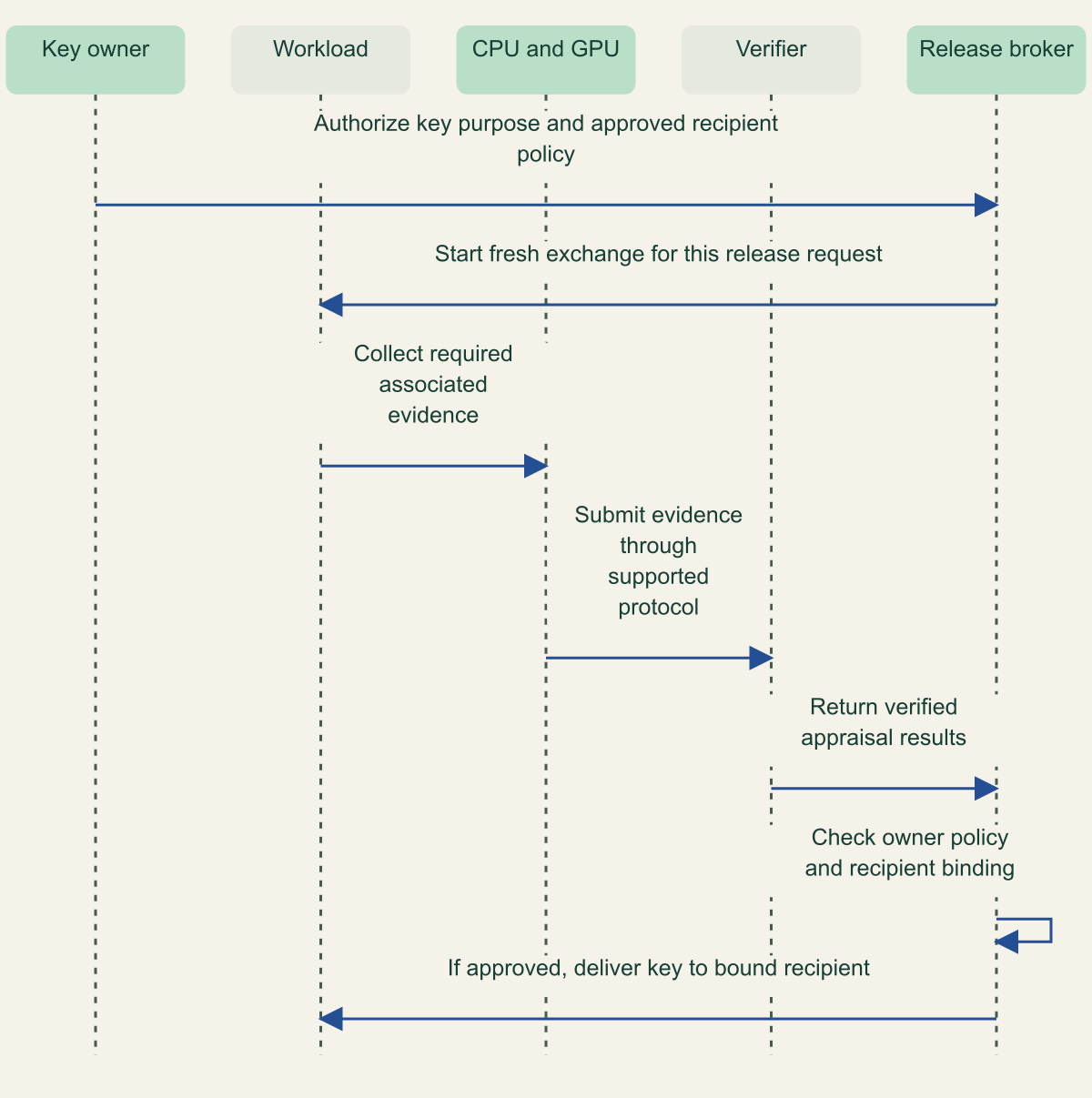
The conceptual sequence starts with a release request naming the protected asset and intended operation. The release service issues or validates the freshness challenge according to the chosen protocol. The confidential workload obtains the required CPU and GPU evidence and presents it through the supported verification path. The verifier appraises the evidence; the release service then applies the asset owner's additional policy before delivering a key to the bound recipient.
Do not interpret the sequence as a prescription to invent a protocol. RFC 9334 discusses freshness approaches, including nonce-based exchanges, and the separation of evidence appraisal from relying-party policy. [1] Use the recipient-binding and channel mechanisms supported by the chosen attestation and key-release stack. The implementation review must identify how the recipient's encryption material or secure channel is authenticated and associated with the approved workload.
A common reasoning error is to validate an attestation token, then read an unrelated public key from the same JSON request and encrypt the secret to it. Mere proximity in a message does not establish that the approved environment controls that key. The relevant protocol must bind the recipient through authenticated evidence or a verified channel relationship. This is a conceptual warning, not a report of a vulnerability in a named product.
Apply the same discipline to the requested asset. An attested workload approved for one model must not receive every key available to the broker. Bind the decision to the key identifier, intended use, authenticated requester and approved application identity. If a policy service authorizes the requester separately, ensure its result refers to the same request and asset rather than a reusable generic success flag.
Validate signed artifacts with the appropriate trust roots, issuer expectations and validity rules. Do not treat decoding as signature verification, or a successful parser return as policy approval. NVIDIA's claims documentation explains the properties represented by particular claim sets. [4] The release implementation must still consume those properties through the verified path and reject missing or unrecognized required results.
Race conditions deserve explicit limits. The environment can change after evidence is produced, and time passes between appraisal and use. A nonce makes a replayed old exchange distinguishable under the protocol; it does not make the environment permanently trustworthy. Minimize unnecessary delay, define permitted evidence age where the protocol uses it, and decide which events require renewed appraisal. State what the design cannot observe after release.
An illustrative negative case helps reveal a missing binding. Take a valid synthetic test exchange in an authorized environment and substitute a different recipient or requested key before the release step. The expected outcome is refusal, even if the underlying platform evidence remains valid. This is an acceptance-test idea, not an executed attack or a complete test harness. Similar cases should cover a stale challenge and evidence from an unrelated workload.
The release receipt should identify the decision, not disclose the secret. Record protected references to the evidence, policy version, asset identifier and recipient binding. Keep raw evidence under access controls appropriate to the identifiers it contains. The operator needs enough information to explain why a release occurred without placing decryption material or unnecessary workload detail in routine logs.
A composite evidence decision before key release
Evidence appraisal, owner policy and recipient binding must all precede release.

Source. Original architecture informed by RFC 9334 and NVIDIA GPU attestation documentation reviewed September 2, 2026. [1] [2] [4]
Method. Conceptual sequence, not a runnable protocol or a claim that Azure Key Vault consumes NVIDIA NRAS results directly. Actual binding and verification mechanisms depend on the supported implementation.
Accessible table and figure data
| Stage | Required relationship | What must not substitute |
|---|---|---|
| Release request | Asset and purpose tied to authenticated requester | Generic account success |
| Fresh exchange | Challenge associated with current request | Unrelated old passing token |
| Composite evidence | CPU and GPU participants linked to workload | Independent passing reports from unrelated systems |
| Appraisal | Verified evidence under recognized issuer and schema | Decoded but unverified JSON |
| Release policy | Owner approves environment, purpose and recipient | Overall GPU success alone |
| Key delivery | Supported binding to intended recipient | Unbound public key in same request |
| Stage | Required relationship | What must not substitute |
|---|---|---|
| Release request | Asset and purpose tied to authenticated requester | Generic account success |
| Fresh exchange | Challenge associated with current request | Unrelated old passing token |
| Composite evidence | CPU and GPU participants linked to workload | Independent passing reports from unrelated systems |
| Appraisal | Verified evidence under recognized issuer and schema | Decoded but unverified JSON |
| Release policy | Owner approves environment, purpose and recipient | Overall GPU success alone |
| Key delivery | Supported binding to intended recipient | Unbound public key in same request |
Write the release policy
Write the policy as a set of required properties with clear owners. Platform-integrity requirements belong to the relevant evidence verifier. Application identity, approved artifact versions and requested business purpose belong to the key owner's release policy and application authorization. Output handling remains an application control. A single overall attestation-success field cannot replace this division.
Begin with recognized issuer and schema requirements, expected platform measurements or accepted reference policy, freshness and the composite CPU-GPU association. Add the approved application and model artifacts where the chosen protocol can establish them. Then require an authorized caller, an allowed key purpose and a verified recipient binding. Missing required information should be distinguishable from information that was present and rejected.
Measurements need a change process. If every authorized deployment changes the application digest, someone must review and update the acceptable identity set. A policy that accepts any digest avoids deployment friction by abandoning the intended restriction. A policy that never updates can block legitimate recovery. Define who approves a new build, which evidence supports the change and whether the previous build remains valid during a transition.
Do not confuse an approved artifact with correct behavior. A measured application can contain a bug, an unsafe logging path or overly broad tool access. The measurement proves identity under the selected mechanism, not semantic correctness. Review the artifact supply chain and application policy separately. The key owner is making a trust decision about the approved code, and that decision should be explicit.
Product compatibility is a hard boundary. Microsoft's Secure Key Release documentation describes Azure Key Vault release policies using Microsoft Azure Attestation claims in addition to authorization. It does not describe direct acceptance of arbitrary attestation-provider claims. [7] A NVIDIA Remote Attestation Service result must not be drawn directly into Azure Key Vault as if the formats and trust relationships were automatically interchangeable.
If the architecture requires GPU evidence and a key service that does not directly consume it, identify an explicitly supported composition mechanism or choose a release service designed to verify the required evidence. A generic broker in the figure is an architectural role, not an assertion that any particular cloud product implements that bridge. Do not solve an integration mismatch by decoding one token and relabeling its fields as another provider's trusted claims.
An implementation policy should also distinguish a denied use from a failed evaluation. A recognized workload asking for an unauthorized model key is a policy denial. An unknown claim schema or unreachable verification service means the required decision could not be established. Both can result in no key release, but the operator needs different remediation paths. Broad exception handling that converts either condition into a successful default is unacceptable for this design.
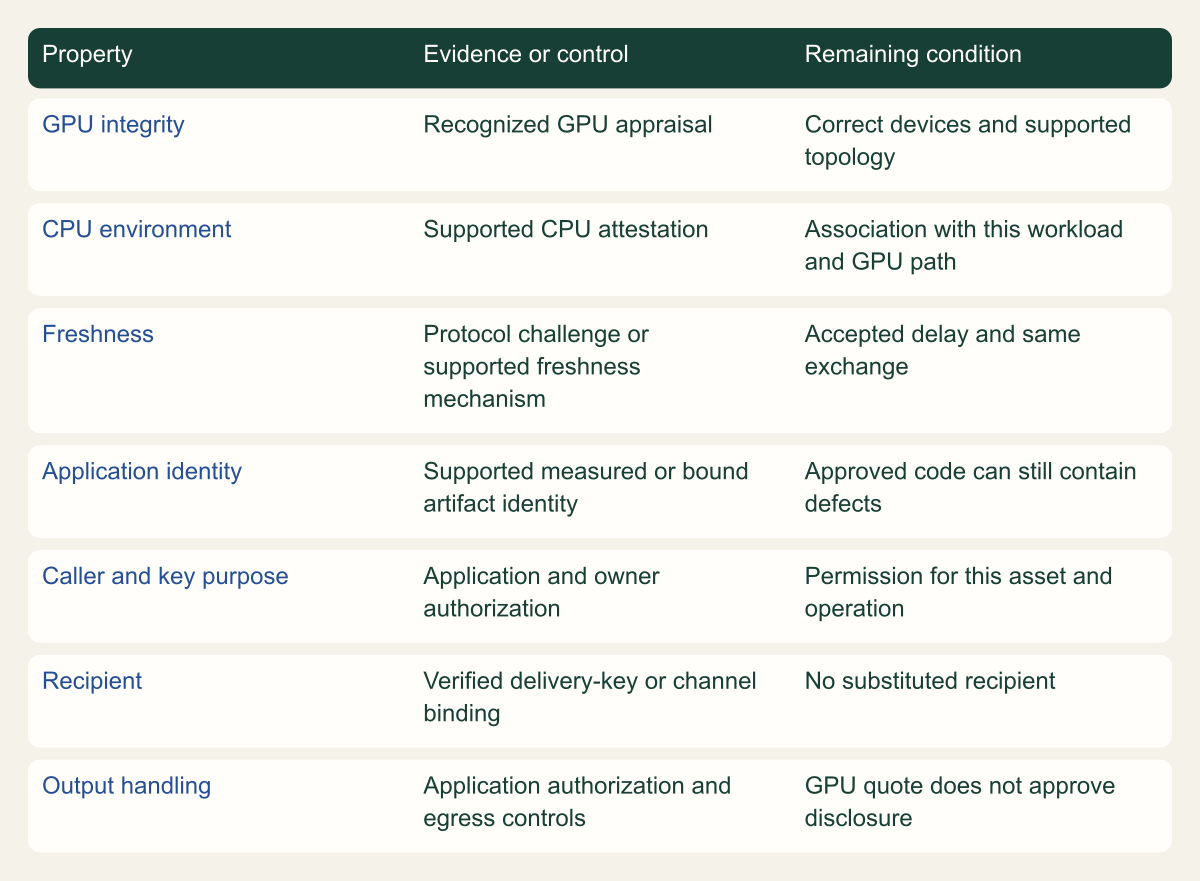
Keep the policy understandable to the owners of the protected material. A review should explain which platform and application may use the key, for which asset and operation, how the recipient is bound, and which post-release protections remain assumptions. The property matrix provides a compact way to expose gaps without inventing an overall trust score.
For a multi-owner workflow, require compatible authorizations from each owner rather than assuming that infrastructure approval substitutes for data approval. A data owner may permit one analysis while a model owner restricts use of its weights. Their policies can legitimately differ. The release service should enforce the intersection needed for the requested operation, or decline when it cannot establish that intersection.
Policy transitions should be evaluated as a pair of allowed sets rather than as an unexamined replacement file. During a staged rollout, identify which application builds may receive new keys, which existing sessions may continue, and when the old build loses eligibility. A rollback should return to a specifically approved build and policy combination. It should not expand acceptance to every historical measurement because the current deployment is unavailable.
Revocation information creates another explicit dependency. If a verifier needs current certificate or reference status, record how the selected implementation obtains it and what happens when that information cannot be refreshed. Do not invent an acceptable stale interval in the application merely to avoid an outage. The evidence owner and key owner should agree on the supported validity rules and the consequences of missing freshness information. This is a design review question, not a claim that every verifier uses the same cache or retrieval protocol.
Keep evidence privacy in the policy review. Device identifiers, workload measurements and request relationships can reveal operational information even when they contain no plaintext model data. Limit who can correlate them across tenants and retain only the detail needed for the release and its audit. A system should not remove one infrastructure disclosure path while publishing an unrestricted inventory through attestation logs.
What attestation establishes and what remains
Hardware evidence and business authorization belong to different checks and owners.

Source. Original property mapping informed by RFC 9334, NVIDIA version 3.0 claims and Microsoft's documented Secure Key Release integration. [1] [4] [7]
Method. Conceptual matrix. Rows are distinct requirements, not a score or a claim that one attestation product proves every property.
Accessible table and figure data
| Property | Evidence or control | Remaining condition |
|---|---|---|
| GPU integrity | Recognized GPU appraisal | Correct devices and supported topology |
| CPU environment | Supported CPU attestation | Association with this workload and GPU path |
| Freshness | Protocol challenge or supported freshness mechanism | Accepted delay and same exchange |
| Application identity | Supported measured or bound artifact identity | Approved code can still contain defects |
| Caller and key purpose | Application and owner authorization | Permission for this asset and operation |
| Recipient | Verified delivery-key or channel binding | No substituted recipient |
| Output handling | Application authorization and egress controls | GPU quote does not approve disclosure |
| Property | Evidence or control | Remaining condition |
|---|---|---|
| GPU integrity | Recognized GPU appraisal | Correct devices and supported topology |
| CPU environment | Supported CPU attestation | Association with this workload and GPU path |
| Freshness | Protocol challenge or supported freshness mechanism | Accepted delay and same exchange |
| Application identity | Supported measured or bound artifact identity | Approved code can still contain defects |
| Caller and key purpose | Application and owner authorization | Permission for this asset and operation |
| Recipient | Verified delivery-key or channel binding | No substituted recipient |
| Output handling | Application authorization and egress controls | GPU quote does not approve disclosure |
Plan for failed evidence
Every required check needs a failure outcome before the system receives production secrets. Distinguish unavailable evidence, invalid signatures, rejected measurements, stale challenges, unsupported schemas, missing topology participants, recipient mismatches and unauthorized purposes. They do not all mean the same thing, even when the immediate safe action is identical: do not release the key.
An unavailable verifier may justify a bounded retry or queueing the operation. A valid but rejected measurement may require a deployment or policy investigation. A recipient mismatch should not be repaired by accepting a new delivery key without repeating the binding process. Avoid a generic retry that changes evidence requirements until something passes. Retrying is operational recovery, not permission to weaken the policy.
Define a no-key state that the workload can handle. The service might return an explicit unavailable result, defer the job or use a preapproved workflow that does not require the protected material. It must not fall back to plaintext model weights, a long-lived emergency key or an unverified instance merely to preserve apparent availability. Any exceptional release authority needs its own explicit owner and policy.
Keep error reports useful but restrained. Include the failed check category, request reference and relevant policy version. Do not include model keys, decrypted prompts or arbitrary token contents in public errors. Some evidence fields can expose platform identifiers or operational detail, so decide which are appropriate for restricted diagnostic records rather than copying every claim into a customer-visible response.
Plan renewal and expiry as real state transitions. A workload that received a key earlier may continue using material already available to it even after the release service begins denying new requests. A policy change is not retroactive erasure. Use key and session lifetimes appropriate to the implementation, define teardown behavior, and document the limits of revocation instead of implying that a central switch can recall every secret already delivered.
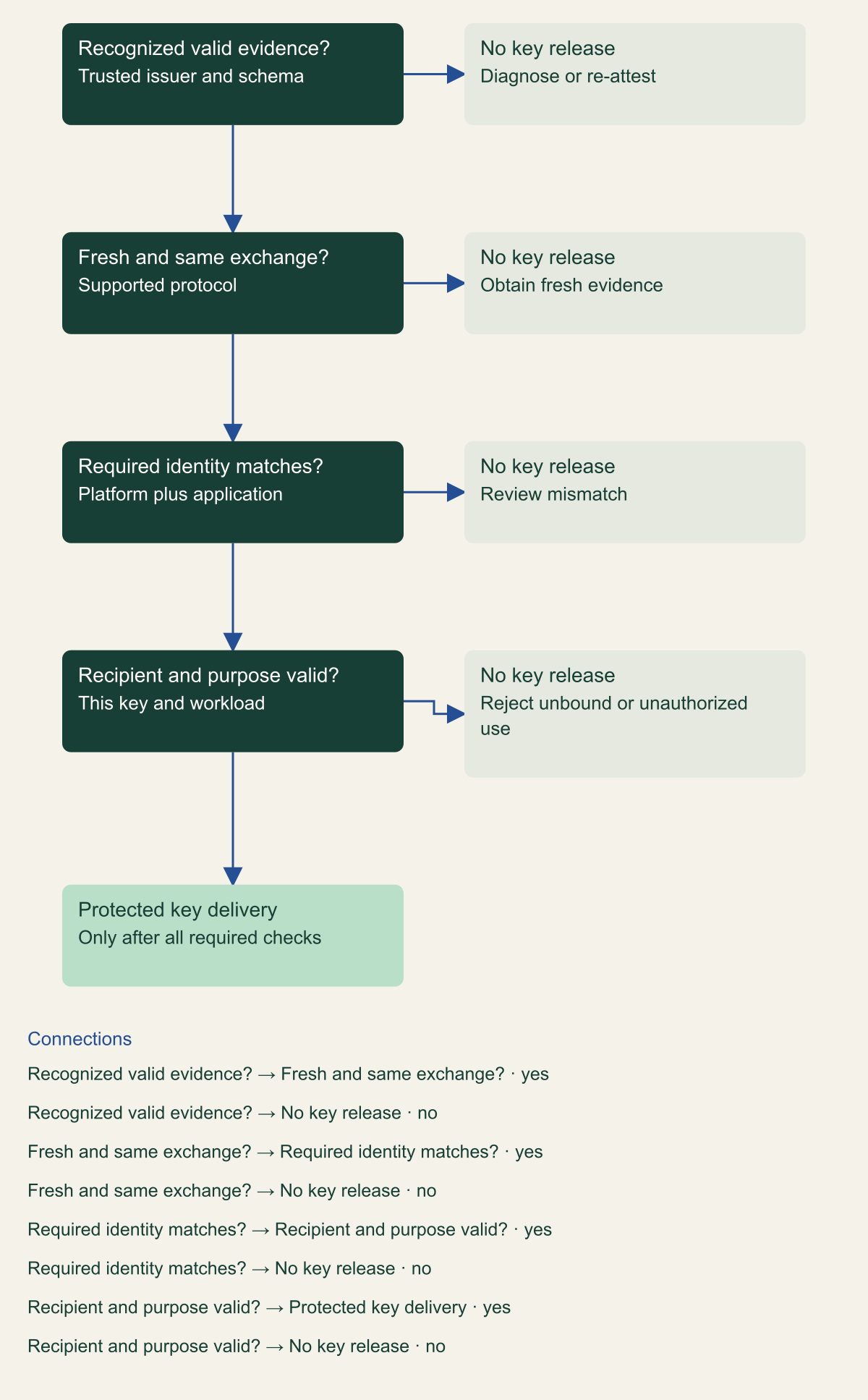
The decision tree intentionally sends every unmet required condition to refusal or bounded re-attestation. It does not treat a temporary infrastructure error as a security verdict about the hardware. That distinction matters for operations: engineers should be able to restore availability without suppressing a legitimate measurement mismatch, and security reviewers should be able to identify a denied release without mistaking a network timeout for proof of compromise.
Exercise these branches with approved synthetic assets and controlled failures in the selected implementation. No such tests were performed for this article. The acceptance evidence should show not only that a healthy path can release a test key, but that malformed, stale, mismatched and unauthorized requests do not. A screenshot of a passing attestation command covers only a small part of that claim.
Refuse release when a required condition is missing
An unavailable check is not an acceptable substitute for a verified condition.

Source. Original release-decision model informed by RFC 9334 and NVIDIA GPU-claims documentation. [1] [4]
Method. Conceptual flow. Retry is bounded and must not relax evidence or authorization requirements. It is not an executed key-release test.
Accessible table and figure data
| Question | If yes | If no |
|---|---|---|
| Is required evidence recognized and valid? | Check freshness | Do not release; diagnose or re-attest |
| Is it fresh and associated with this exchange? | Check composite environment | Do not release; obtain new evidence |
| Do required platform and application properties match? | Check recipient and purpose | Do not release; review mismatch |
| Are recipient binding and key purpose authorized? | Release through supported protected path | Do not release |
| Question | If yes | If no |
|---|---|---|
| Is required evidence recognized and valid? | Check freshness | Do not release; diagnose or re-attest |
| Is it fresh and associated with this exchange? | Check composite environment | Do not release; obtain new evidence |
| Do required platform and application properties match? | Check recipient and purpose | Do not release; review mismatch |
| Are recipient binding and key purpose authorized? | Release through supported protected path | Do not release |
Protect the post-release path
After release, plaintext exists where the approved application needs it. Trace what the application can do with that plaintext: generate output, write a log, create a checkpoint, call a tool, send a network request or persist a derived artifact. Confidential execution does not decide which of these business operations are authorized. The application and its surrounding controls still do.
Outputs are especially important because their release can be intentional. A model owner might protect weights from the infrastructure operator while allowing generated answers to leave the environment. A data owner might permit an aggregate answer but not a source document. The output boundary needs a policy matched to those permissions. GPU integrity evidence cannot establish that an answer contains no prohibited material.
Keep tool access independently constrained. An attested agent should not gain a broader destination list, filesystem scope or transaction authority solely because it runs in a protected environment. The hardware boundary can protect execution from some outside observation while the application voluntarily sends information through an allowed channel. Review the allowed channel rather than claiming the protected environment makes its contents safe.
Historical cross-component assessments reinforce the need to inspect the whole path. CENSUS's April 25, 2025 version 1.1 report examined an early-access GCP A3 configuration involving Intel TDX and H100. [8] Its scope should not be generalized into a current claim about every cloud or confidential GPU. It is useful here as evidence that composite systems require concrete evaluation, not as a substitute for current compatibility and security testing.
Operational diagnostics belong in the same review. A memory dump, debug endpoint or model checkpoint can create an exposure path outside the original release decision. Decide which modes are permitted with production secrets, where diagnostic artifacts are stored and who may retrieve them. A support workflow should not silently disable the protected mode or export sensitive state as a routine troubleshooting step.
Treat re-attestation as one part of lifecycle control. It can inform whether to issue new material or continue under a policy, but it cannot prove that previously released information was never copied through an authorized application path. Record what triggers renewed checks, what happens to active sessions and how the application handles withheld renewal. Avoid permanent-trust language.
The practical boundary is a chain of specific permissions: approved environment, bound key recipient, allowed application use and controlled output. A gap anywhere in that chain can defeat the key owner's intended restriction without falsifying a GPU claim. The design review should therefore end at the actual data destinations, not at the accelerator.
Assemble the evidence receipt
The release receipt should connect the approved design to the actual deployed configuration. Record hardware topology, supported mode, software versions, claims schema, protected evidence references, verifier configuration, release-policy version, requested asset, recipient binding and decision. The record should distinguish facts observed in an executed test from assumptions established through documentation or source inspection.
Use a positive test with a non-sensitive key, then negative cases for stale challenges, invalid evidence, missing devices, unexpected application identity, unauthorized key purpose and substituted recipient material. Exercise verifier unavailability and migration behavior as well. A complete set depends on the chosen protocol; this is a proposed checklist, not a claim of test coverage for a particular SDK.
Assign an owner to each unresolved property. If the key service cannot consume the required evidence, the design is not complete. If the evidence cannot be bound to the actual recipient, a passing hardware result is insufficient. If post-release outputs remain uncontrolled, state that residual trust explicitly rather than describing the entire workload as confidential.
Finally, record the next review date and the events that reopen approval. For this article, the NVIDIA Python SDK support deadline requires review before September 15, 2026. [3] For the implementation, changes to topology, application artifacts, claims schema, verifier or release service require a scoped reassessment. The desired outcome is a defensible key-release decision, not a permanent badge attached to a GPU.
Method and provenance
Cloud Security Desk architectural synthesis of RFC 9334, current NVIDIA attestation and migration documentation, Microsoft's documented key-release integration and a scoped historical assessment, reviewed September 2, 2026.
No confidential CPU or GPU environment, SDK, attestation exchange or key-release service was executed. Figures are conceptual. Product integration and claim schemas must be verified for the selected supported deployment; historical early-access findings are not generalized to current clouds.
AI assistance. Prepared with AI assistance for research synthesis, drafting and visual planning. No personal deployment experience, independent implementation testing or human expert review is claimed.
Published under the Cloud Security Desk organizational byline. Read the practitioner guide policy.
References
- Remote Attestation Procedures Architecture IETF. Accessed .
- GPU and switch attestation NVIDIA. Accessed .
- NVIDIA Attestation SDK Migration Guide NVIDIA. Accessed .
- GPU attestation claims NVIDIA. Accessed .
- Confidential Computing on H100 GPUs for Secure and Trustworthy AI NVIDIA. Accessed .
- Building a Zero Trust Architecture for Confidential AI Factories NVIDIA. Accessed .
- Secure Key Release with Azure Key Vault and Confidential Computing Microsoft. Accessed .
- Challenging the Boundaries of Confidential Computing for AI CENSUS. Accessed .