
An evidence-bounded guide to embedding confidentiality. Corrected GTR reconstruction results, surrogate-model research and storage-security guidance inform a practical review of vector exports and claimed privacy mitigations.
At a glance
Key findings
- Numeric vectors may retain disclosive information; their appearance is not evidence of anonymity.
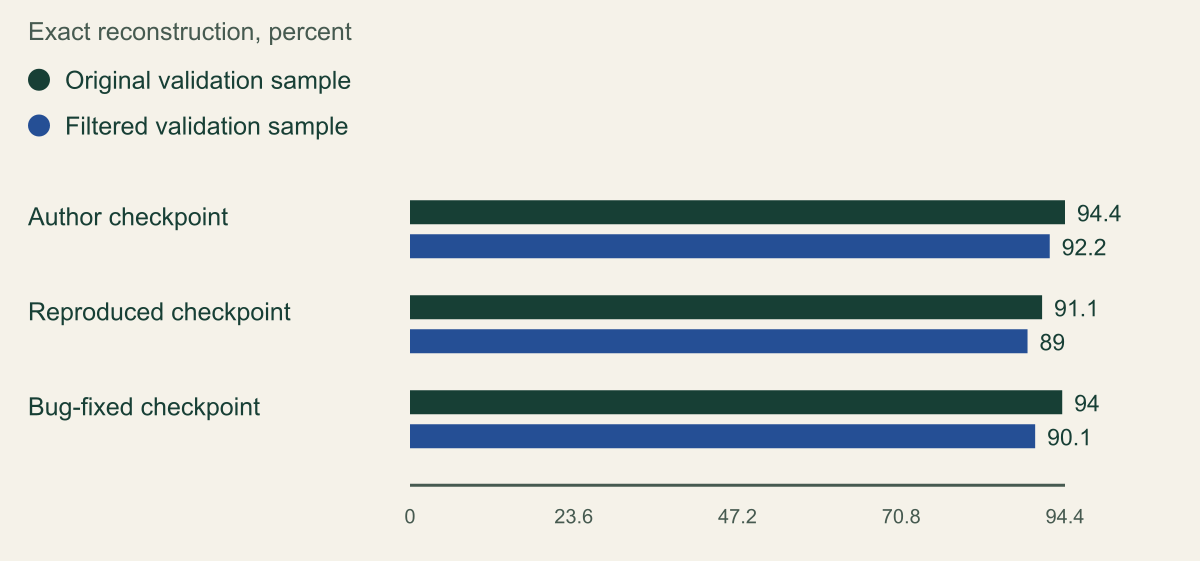
- The chart uses a corrected 2024 GTR-base reproduction, not an unqualified original headline.
- Bulk vector export, ordinary retrieval access and storage encryption address different decisions.
- Assess mitigations against explicit attacker knowledge, disclosure metrics and retrieval utility.
Classify the derived data
Replacing sensitive text with embeddings does not, by itself, justify broader access or unrestricted export. Treat the vectors as potentially disclosive derived data until a specific assessment supports a narrower classification. Decide separately who may query a retrieval service, inspect its metadata, download vectors and export the source corpus. A numerical representation is useful for computation; it is not evidence that the original information has become anonymous.
Embedding inversion research provides a concrete reason for that distinction. Vec2Text studied reconstruction of text from embeddings, and later work examined both implementation corrections and different attacker knowledge. [1] [3] The engineering conclusion is not that every modern vector can be perfectly inverted. It is that a vector's unfamiliar appearance is an inadequate basis for dropping the controls applied to the information from which it was derived.
Start with an inventory of objects, not a single row labeled vector database. A retrieval record can contain a vector, document identifier, chunk offset, source URL, access tags and a stored text fragment. A backup or diagnostic export may combine all of them. An identifier that looks harmless on its own can become revealing when joined to another system. Removing text from one export does not prove that its remaining representation and metadata reveal nothing useful.
Ordinary retrieval authorization is a different decision from bulk access. A user permitted to ask questions over a bounded corpus does not necessarily need every vector or the ability to enumerate all document identifiers. OWASP's RAG guidance treats access control and provenance as explicit requirements across the retrieval workflow. [7] Extend that reasoning to administrative and diagnostic routes instead of assuming that a secure query endpoint constrains every way data can leave the system.
A hypothetical support engineer wants a production vector dump to investigate poor search results. The relevant question is not whether the dump contains a column named text. Ask what problem must be reproduced, which source information the vectors represent, what metadata accompanies them, and what the recipient can combine with the dump. The same engineer might solve a ranking bug with synthetic documents, aggregate diagnostics or a narrowly scoped sample under existing production access.
This guide recommends a derived-data review record with source classification, intended use, recipient, available joins, model information, retention and permitted onward sharing. It does not make a legal determination that a particular embedding is personal data or anonymous. Those determinations require the applicable facts and rules. The technical contribution is to stop an unsupported representation change from silently becoming an authorization change.
Read the original result and its correction
The original EMNLP 2023 Vec2Text paper demonstrated text reconstruction under specified models, datasets and attack procedures. Its widely repeated headline should not be used as a universal recovery rate. The associated project provides an implementation and model-specific interfaces, not a promise that arbitrary embeddings from any current service invert in the same way. [1] [2]
A 2024 reproduction reported two important problems in the earlier setup: omission of GTR's final dense pooling layer and 50.7 percent overlap between the supplied Natural Questions validation and training sets. It evaluated a filtered split and a corrected implementation. The article's chart therefore uses that reproduction's Table 1, rather than repeating the original result without its subsequent qualification. [3]
For the bug-fixed GTR-base checkpoint, the table reports 94.0 percent exact reconstruction on the original validation sample and 90.1 percent on the filtered sample. Evaluation used 32-token inputs, 50 correction steps, sequence beam width eight and 1,000 sampled passages per split. The author checkpoint trained for 100 epochs, while the reproduced and bug-fixed checkpoints trained for 50. The other chart values are copied directly from the same table. [3]
Two conclusions can coexist. The original evaluation needed correction, and substantial reconstruction remained in the corrected setting. Reporting only the methodological problems would obscure the latter. Reporting only a dramatic original percentage would obscure the former. Neither approach helps a data owner decide whether a vector export should receive broader permissions than the source material.
Exact reconstruction is a stringent but incomplete confidentiality measure. It counts complete matching outputs in the specified evaluation. A reconstruction can fail that criterion while retaining a sensitive name, topic, relationship or meaningful phrase. Conversely, high exact recovery on short passages from one corpus does not predict recovery from a different embedder, longer documents, another language or transformed vectors. The assessment must identify the information whose disclosure would matter, not merely adopt a convenient benchmark metric.
The figure is a methods comparison, not a leaderboard. Compare original and filtered validation within each reported checkpoint and retain the unequal training-budget explanation. Do not interpret small differences across checkpoints as proof that one defense works better. There are no invented uncertainty bars, interpolated values or blended results from later papers. No inversion model or evaluation was executed for this article.
One further historical detail matters when discussing examples. The original clinical-name exercise used inserted fictitious names; it should not be retold as recovery of actual patient identities. [1] Careful scope makes the research more useful, not less serious. It separates what was demonstrated from the broader risk questions that an organization must assess for its own corpus.
Recovery persists after evaluation corrections
High exact reconstruction remained in the corrected GTR-base experiment, but the result is specific to its model, corpus and attack settings. [3]

Source. Table 1 of Understanding and Mitigating the Threat of Vec2Text to Dense Retrieval Systems, July 24, 2024 revision. [3]
Method. Reported GTR-base exact reconstruction on 1000-passage Natural Questions validation samples, using 32-token inputs, 50 correction steps and sequence beam width eight. The filtered split removes training overlap. The reproduced and bug-fixed checkpoints train for 50 epochs, versus 100 for the author checkpoint; the bug-fixed model also includes GTR's final dense pooling layer. These are scoped research results, not universal inversion rates. Percentages are copied without conversion or interpolation. No independent experiment was performed.
Accessible table and figure data
| Checkpoint | Original validation sample | Filtered validation sample |
|---|---|---|
| Author checkpoint | 94.4 | 92.2 |
| Reproduced checkpoint | 91.1 | 89 |
| Bug-fixed checkpoint | 94 | 90.1 |
| Checkpoint | Original validation sample | Filtered validation sample |
|---|---|---|
| Author checkpoint | 94.4 | 92.2 |
| Reproduced checkpoint | 91.1 | 89 |
| Bug-fixed checkpoint | 94 | 90.1 |
Update the attacker model
An exposure assessment should state what the recipient or attacker knows. Does it have direct access to the embedding model, a similar public model, paired examples of text and vectors, a description of the transformation, or only the exported numerical arrays? These are different experimental conditions. A control tested against one should not be presented as a general answer to all of them.
ACL 2024 research on transferable embedding inversion examined the use of surrogate models without direct queries to the victim model. [4] ALGEN, published at ACL 2025, investigated few-shot cross-model alignment and generation. [5] These papers are separate research settings, not extensions that can be combined numerically with the GTR chart. Their practical relevance is that hiding an exact model identifier is not a sufficient standalone confidentiality argument.
Imagine a recipient that initially receives vectors without text. It later gains access to a small public portion of the same corpus, a model card or paired diagnostic examples. The original export review may have assumed that such information was unavailable. This hypothetical change does not establish that an attack will succeed, but it changes the claim a mitigation must withstand. Review available auxiliary information, including what the organization itself publishes or sends in subsequent support tickets.
Separate an uninformed recipient from an adaptive one. A transformation might frustrate a fixed inversion model yet become easier to handle when the transformation is known or an attacker can obtain representative pairs. Ask whether the evaluation allowed that knowledge and whether the attack was retrained or adapted. Do not label the transformation ineffective without evidence either. The correct outcome may be that the tested protection is narrower than the proposed export policy requires.
Model secrecy can still have operational value, such as avoiding unnecessary disclosure of internal architecture. The mistake is elevating it into a proven privacy boundary. Keep model details restricted where appropriate, but decide access to production vectors on the data's sensitivity, the recipient's capabilities and the demonstrated limits of the chosen controls. This avoids making confidentiality depend on a name remaining obscure.
Revisit the threat model when the recipient, corpus or export format changes. A partner allowed to inspect a small diagnostic subset has a different opportunity from a service account with continuing bulk access. A one-time approval should not silently cover future paired samples or an expanded metadata join. The record should say what change requires another decision.
Map exposure beyond the vector query
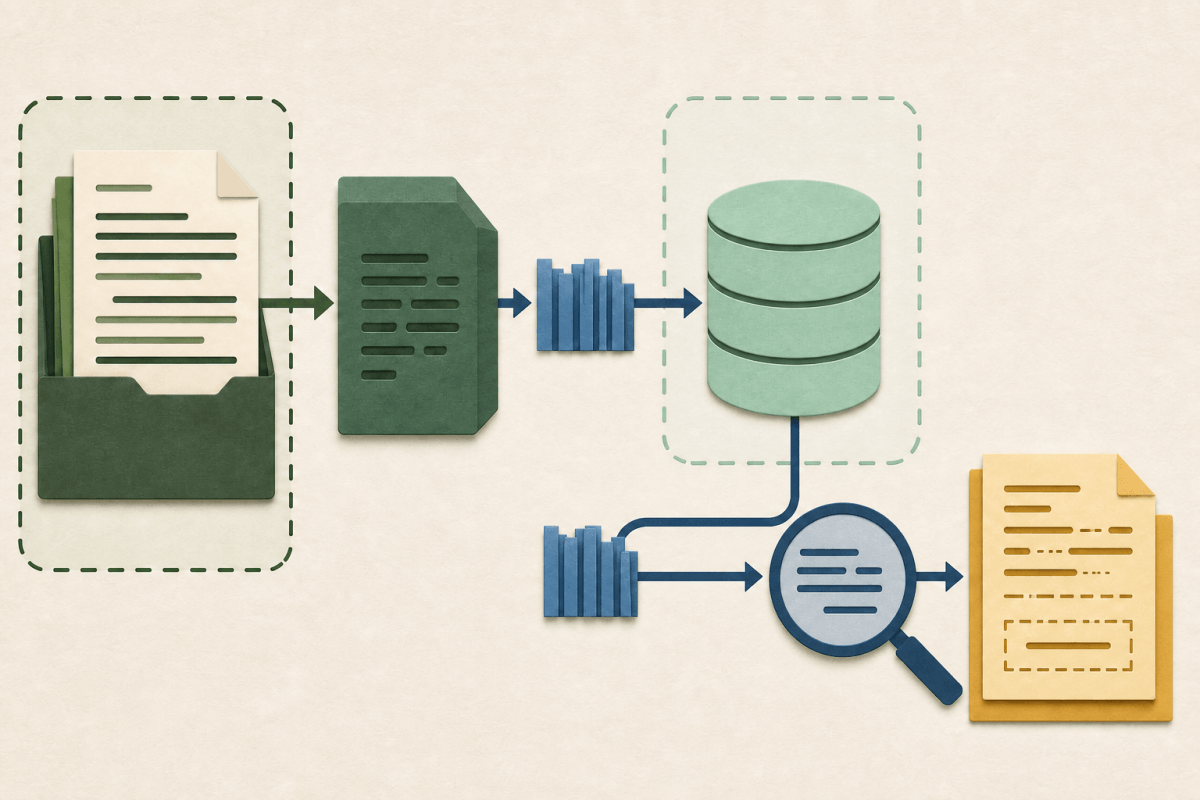
The conceptual illustration separates source storage, the encoder, vector storage and an authorized-looking export route. Its incomplete reconstructed page represents possible information recovery, not a guaranteed outcome or a measured percentage. The useful question is where access to the derived representation crosses an organizational boundary. That crossing can happen through an ordinary administrative feature without a storage vulnerability.
List bulk export endpoints, backup copies, notebook downloads, support bundles, local developer caches and observability pipelines. Also identify services that can read vectors while fulfilling their normal role. For each path, note whether the output includes metadata, raw text or references that enable joins. The exercise often reveals that a restrictive user-facing query route coexists with a much broader service identity used for maintenance.
Encryption at rest addresses threats at a particular storage layer. OWASP's cryptographic-storage guidance emphasizes selecting the encryption layer according to the threat model and minimizing retained sensitive information. [6] Applied to this case, an authorized process that decrypts and exports vectors has crossed the storage-encryption boundary by design. Strong storage encryption can remain necessary while being insufficient to govern what that process releases.
Use distinct permissions for interactive retrieval, corpus maintenance and bulk export where the platform permits it. Give a diagnostic workflow only the objects and operations needed for its task. This is a recommendation, not a claim that every vector product exposes identical roles. Where fine-grained permissions are absent, use a separate service path, bounded copy or controlled execution environment rather than disguising a broad credential as a narrow approval.
Observe the data path into an external embedding service as well as the path out of the vector store. If source text is sent for encoding, that transmission has its own recipient, retention and network questions. The fact that the returned object is a vector does not retroactively change what was transmitted. Conversely, locally produced embeddings can still leave later through a backup or support export. These are independent boundaries that deserve independent evidence.
Deletion also needs lineage. A source document can be removed while its vectors, metadata or exported copies remain. Record the mapping from source version to derived records and the handling of backups and recipient copies. Do not equate an empty search result with proof that all derived data has been erased. An export owner should know whether deletion reaches the destination or merely stops future access through the original service.
The smallest useful exposure map names the actor, operation, representation, destination and lifecycle. It should allow a reviewer to answer a concrete request without reading the entire retrieval architecture. If the map cannot explain a production dump's contents or recipient, the export is not ready for an evidence-backed approval.
Different representations cross a disclosure boundary
A vector export is a release of derived information, not proof that its source has become anonymous.

Source. Original conceptual illustration informed by Vec2Text research and OWASP cryptographic-storage guidance. [1] [6]
Method. Conceptual illustration, not a numeric chart, experiment, product screenshot or guarantee of exact recovery. The accessible table states its mechanism and limitations.
Accessible table and figure data
| Representation or boundary | Meaning | Limit |
|---|---|---|
| Source document | Sensitive input in source storage | Source authorization still applies |
| Encoder and vector bundle | A changed representation | Not a guarantee of anonymity |
| Vector repository | Stored derived information | Query access and bulk export are separate decisions |
| Export route | Vector access outside its storage boundary | Storage encryption does not govern an already authorized release |
| Incomplete reconstruction | Potential recovery of source information | No universal success rate is depicted |
| Representation or boundary | Meaning | Limit |
|---|---|---|
| Source document | Sensitive input in source storage | Source authorization still applies |
| Encoder and vector bundle | A changed representation | Not a guarantee of anonymity |
| Vector repository | Stored derived information | Query access and bulk export are separate decisions |
| Export route | Vector access outside its storage boundary | Storage encryption does not govern an already authorized release |
| Incomplete reconstruction | Potential recovery of source information | No universal success rate is depicted |
Evaluate mitigations against the stated threat
A proposal to add noise, reduce precision, shorten vectors or apply a transformation should state both its utility objective and its disclosure objective. The 2024 mitigation study examines defenses in defined retrieval and inversion settings; later alignment research asks different questions about what an attacker can adapt to. [3] [5] Avoid turning either a positive or negative research result into a universal statement about all transformations.
Require the evaluation to name the corpus, embedder, transformation, attacker knowledge and attack procedure. Then ask what was measured: full-string reconstruction, token overlap, recovery of selected sensitive attributes or another outcome. A report of zero exact matches is not enough if the release concern is the recovery of a confidential project name. A decrease in semantic similarity is not enough if a stable identifier remains recoverable through metadata.
Evaluate retrieval quality under the same conditions as the proposed deployment. A transformation that changes nearest-neighbor behavior can affect who receives which evidence and whether important documents are missed. An acceptable privacy result with unacceptable retrieval behavior is not a deployable solution. Conversely, a strong retrieval score does not demonstrate low leakage. Keep the two acceptance decisions visible rather than combining them into an invented overall safety score.
Ask whether the transformation is treated as secret and how that assumption is enforced. If a recipient receives transformed vectors plus a callable transformation service or known text-vector pairs, the assessment should consider those capabilities. If the defense relies on key material, its management and exposure need their own review. Do not call a custom numerical transformation encryption merely because it makes the output look different. OWASP recommends established cryptographic designs for the threats that encryption is intended to address. [6]
An evidence request can remain practical. Ask for a reproducible description of the evaluated configuration, a held-out corpus appropriate to the claim, disclosure metrics tied to the actual sensitive information, and utility results. Require the report to say which attacker capabilities were excluded. There is no need to promise that a single benchmark certifies irreversible embeddings; the goal is to decide whether a specific proposed release is justified.
Use a qualitative decision table to expose alternatives. A synthetic reproduction avoids production data but may miss corpus-specific behavior. Aggregated diagnostics preserve some operating evidence but may hide individual ranking errors. A bounded production sample can reproduce a real failure but needs recipient and retention controls. Full export provides the most debugging flexibility and also the broadest exposure. Those are tradeoffs to justify, not numeric risk scores to invent.
If evidence is absent, do not pretend a representation trick fills the gap. Retain the original access boundary, reduce the exported information or perform the analysis where the data is already authorized. This is a conservative engineering recommendation, not a finding that every untested technique fails. It makes the uncertainty explicit while still offering a useful path to solve the operational problem.
| Artifact | Useful for | Review concern |
|---|---|---|
| Synthetic corpus | Reproducing pipeline or ranking logic | May not reproduce source-specific behavior |
| Aggregate diagnostics | Finding broad operational patterns | May hide individual errors or reveal small groups |
| Bounded production sample | Investigating a specific failure | Source sensitivity, recipient and retained copies |
| Full vector export | Broad offline analysis | Bulk derived-data access and auxiliary joins |
Make the export decision explicit
Return to the support request. First ask the engineer to describe the failing behavior in terms that can be observed: a missing document, a ranking change, a dimension mismatch or an ingestion defect. Select the minimum artifact that can discriminate among the plausible causes. Do not begin with a full dump merely because the export command is convenient.
Suppose a synthetic corpus reproduces the same missing-result behavior after a configuration change. The production vectors are no longer necessary for that investigation. If the defect only appears on a particular document family, a controlled analysis in the existing authorized environment may be enough. If a bounded export is still required, choose the specific source versions and fields, and explain why each is needed. These are hypothetical branches, not results from an actual support case.
Name the recipient and destination before approval. State whether the recipient may create local copies, share with subcontractors, attach material to tickets or use it for model training. Establish the retention period and what evidence will show cleanup. A generic assurance that the data is 'only embeddings' answers none of these questions. An authorized release can be legitimate, but it should be authorized for the information and use involved.
Preserve a receipt with corpus scope, source sensitivity, export fields, model and transformation identifiers, approval basis and lifecycle owner. Avoid including the sensitive export itself in a broadly accessible audit record. The receipt should let an operator explain why the release occurred and find every copy under the agreed process. If a source is later withdrawn, lineage should make the affected exports discoverable.
Re-review when the model, corpus, dimensions, transformation, recipient or available auxiliary data changes. Those changes can invalidate either the utility rationale or the disclosure assumptions. A new model is not automatically more private, and a smaller vector is not automatically safer. The updated decision may retain the same permissions, narrow them or require new evidence; it should not happen by default.
The final authorization can be specific and useful: this recipient may use these derived records for this diagnostic purpose under these retention and sharing constraints. That is stronger than an unsupported anonymity claim because it remains meaningful even when reconstruction research advances. Embeddings can make retrieval efficient without making confidentiality disappear.
Method and provenance
Cloud Security Desk review of original embedding-inversion research, its documented reproduction corrections, implementation documentation and primary security guidance, accessed September 2, 2026. Export workflows and diagnostic alternatives are original engineering synthesis.
No model package was downloaded and no inversion, privacy or retrieval benchmark was run. Research outcomes are model- and dataset-specific. This article makes no legal determination of anonymity and does not certify a mitigation.
AI assistance. Prepared with AI assistance for source comparison, drafting and visual planning. It does not claim firsthand deployment experience, independent reproduction or human expert review.
Published under the Cloud Security Desk organizational byline. Read the practitioner guide policy.
References
- Text Embeddings Reveal Almost As Much As Text ACL and paper authors. Accessed .
- Vec2Text project documentation Vec2Text authors. Accessed .
- Understanding and Mitigating the Threat of Vec2Text to Dense Retrieval Systems Paper authors. Accessed .
- Transferable Embedding Inversion Attack ACL and paper authors. Accessed .
- ALGEN Few-shot Inversion Attacks on Textual Embeddings ACL and paper authors. Accessed .
- Cryptographic Storage Cheat Sheet OWASP. Accessed .
- RAG Security Cheat Sheet OWASP. Accessed .